Chương 17 CHƯƠNG 17: PHƯƠNG PHÁP LUẬN SÁNG TẠO VÀ ĐỔI MỚI: NHỮNG ĐIỀU MUỐN NÓI THÊM
17.1 DU NHẬP, PHỔ BIẾN VÀ PHÁT TRIỂN PHƯƠNG PHÁP LUẬN SÁNG TẠO VÀ ĐỔI MỚI (PPLSTVĐM) Ở VIỆT NAM
17.1.1 Mở đầu
Báo “Tuổi Trẻ Cuối Tuần” số ra ngày 8/5/2011, trang 9, có trích đăng lời của thủ tướng Trung Quốc Ôn Gia Bảo:
“Đất nước chúng ta sẽ trở nên vô địch nếu 1,3 tỷ dân có thể tư duy độc lập và sáng tạo”
Tuy không biết ngữ cảnh thực sự của câu nói, người chỉ đọc câu nói trên có thể hiểu nó như sau:
- “Vô địch” nói đến ở đây chắc là vô địch nhiều mặt (nếu không nói là vô địch về mọi mặt) chứ không phải chỉ vô địch về GDP hoặc vô địch về thám hiểm vũ trụ…
- “Vô địch” có lẽ là vô địch cỡ thế giới, chứ không phải vô địch cấp khu vực hoặc vô địch so với các nước đang phát triển…
- “Đất nước chúng ta”, “1,3 tỷ dân” có nghĩa là toàn bộ đất nước, người dân Trung Quốc chứ không phải chỉ có Bắc Kinh, Thượng Hải, chỉ có các cán bộ quản lý, lãnh đạo cấp cao hoặc tầng lớp tri thức, hoặc tầng lớp doanh nhân hoặc giai cấp công nhân…
- “Có thể tư duy độc lập và sáng tạo” là mong muốn, mục đích đề ra cần đạt.
Tuy nhiên, chúng ta chưa biết Trung Quốc sẽ làm những gì và làm như thế nào để đạt mục đích. Chẳng hạn, chỉ dừng ở mức hô hào: “Mỗi người Trung Quốc hãy đổi mới tư duy để trở thành một người tư duy độc lập và sáng tạo”; áp dụng các biện pháp khuyến khích, kích thích, tạo các điều kiện thuận lợi về môi trường để làm xuất hiện thêm những người tư duy độc lập và sáng tạo; dạy và học PPLSTVĐM đại trà để có được tất cả công dân tư duy độc lập và sáng tạo… Rõ ràng, cách làm dạy và học PPLSTVĐM một cách đại trà là cách làm bài bản, căn cơ và ích lợi lâu dài nhất.
- Câu nói trên không phải của người bình thường mà của người đứng đầu Chính phủ Trung Quốc cho thấy, những người lãnh đạo cấp cao nhất Trung Quốc đánh giá tuyệt đối cao vai trò của tư duy độc lập và sáng tạo của toàn bộ dân số quốc gia để phát triển đất nước trong thời đại kinh tế tri thức, xã hội tri thức có tính cạnh tranh và hợp tác cao.
- Câu nói trên chắc là không chỉ đúng với Trung Quốc, mà còn có thể suy rộng ra một cách tương tự, đúng với các nước khác.
Tuy nhiên, ở đây có chuyện thấy là như thế, biết là như thế nhưng không phải nước nào cũng có được những hành động, biện pháp, bước đi thích hợp để chắc chắn đạt mục đích. Nếu như cùng với câu nói của mình, thủ tướng Ôn Gia Bảo đã có sẵn kế hoạch quốc gia chi tiết và triển khai trên thực tế sao cho trong tương lai gần tất cả người Trung Quốc tư duy độc lập và sáng tạo thì chúng ta rất khâm phục và chân thành chúc Trung Quốc thành công.
- Riêng đối với người viết, qua các thông tin, tài liệu, các hội nghị khoa học quốc tế về PPLSTVĐM và những vấn đề liên quan, người viết cho rằng, Trung Quốc hiện nay, chủ yếu, mới đang ở giai đoạn du nhập PPLSTVĐM từ Mỹ, Tây Âu, Nga, Nhật vào Trung Quốc. Trong các danh sách thống kê các trung tâm, tổ chức hoạt động chuyên về sáng tạo, PPLSTVĐM trên thế giới cho đến nay, người viết không thấy có trung tâm, tổ chức nào của Trung Quốc. Điều này có nghĩa, để đạt được mục đích đề ra trong câu nói của thủ tướng Ôn Gia Bảo, Trung Quốc còn nhiều việc phải làm lắm, đặc biệt là công việc đào tạo thế hệ thứ nhất những nhà chuyên môn có thể giảng dạy, nghiên cứu PPLSTVĐM và có khả năng đào tạo các nhà chuyên môn kế thừa.
- Thủ tướng Trung Quốc Ôn Gia Bảo không phải là người đầu tiên nhận ra tầm quan trọng của việc tất cả mọi người trong một đất nước cần tư duy độc lập và sáng tạo.
Người viết nhớ lại, tại “Hội nghị quốc tế lần thứ bảy về tư duy” (The International Conference on Thinking) diễn ra trong tháng 6/1997 tại Singapore, Thủ tướng Singapore lúc đó Goh Chok Tong có đọc bài diễn văn dài 30 phút mở đầu Hội nghị. Trong bài diễn văn này, ông nhấn mạnh: “Chúng ta sẽ thực hiện sự thay đổi tư duy của người Singapore. Chúng ta cần từ bỏ ý tưởng cho rằng chỉ có những người lãnh đạo cấp cao nhất mới phải suy nghĩ, và công việc của tất cả những người khác là làm như được bảo. Thay vì thế, chúng ta muốn thực hiện tinh thần của đổi mới việc học bằng hành động, của tất cả mọi người ở mọi cấp bậc, luôn đặt câu hỏi làm thế nào anh hay chị có thể thực hiện công việc của mình tốt hơn” (We will bring about a mindset change among Singaporeans. We must get away from the idea that it is only the people at the top who should be thinking, and the job of everyone else is to do as told. Instead we want to bring about a spirit of innovation of learning by action, of everyone at all levels always asking how she or he can do her or his job better).
17.1.2 Du nhập phương pháp luận sáng tạo và đổi mới (PPLSTVĐM) vào Việt Nam
Có sáu người Việt Nam tốt nghiệp Học viện công cộng sáng tạo sáng chế Azerbaigian, thành phố Baku, Liên Xô.
Đấy là các anh Nguyễn Văn Chân, Nguyễn Văn Thông và tôi (khóa 1971 - 1973), Dương Xuân Bảo, Thái Bá Cần và Nguyễn Văn Thọ (khóa 1973 - 1975).
Nếu xét về nhiệm vụ chính trị được Đảng và Nhà nước giao cho: Anh Dương Xuân Bảo và tôi được phân công học vật lý, các anh Nguyễn Văn Chân, Nguyễn Văn Thông và Thái Bá Cần – học toán, anh Nguyễn Văn Thọ học địa chất tại Đại học tổng hợp quốc gia Azerbaigian chứ không phải học PPLSTVĐM. Việc học thêm Học viện công cộng sáng tạo sáng chế xuất phát từ ý thích, sự say mê cá nhân chứ không phải là nhiệm vụ bắt buộc. Do vậy, chúng tôi đã được nhắc nhở không xao nhãng nhiệm vụ chính trị. Rất may, chúng tôi đã hoàn thành tốt cả hai nhiệm vụ: Nhiệm vụ chính trị và nhiệm vụ tự đề ra.
Ở Học viện công cộng sáng tạo sáng chế, chúng tôi được học lý thuyết giải các bài toán sáng chế (TRIZ), algôrit giải các bài toán sáng chế (ARIZ), hầu hết các phương pháp sáng tạo của phương Tây và nhiều môn học liên quan khác như patent học, lý thuyết thông tin, lý thuyết hệ thống, điều khiển học, lý thuyết ra quyết định, tâm lý học sáng tạo, môn học phát triển trí tưởng tượng sáng tạo.
Học viện công cộng sáng tạo sáng chế không chỉ đào tạo các nhà sáng chế chuyên nghiệp sáng tạo có phương pháp, mà còn đào tạo các cán bộ giảng dạy, nghiên cứu PPLSTVĐM, các cán bộ tổ chức các hoạt động sáng tạo, sáng chế.
Học viện nhận vào học những người đã tốt nghiệp đại học (phần lớn là các kỹ sư), đã có những thành tích sáng tạo. Cùng học với chúng tôi có những người có trong tay cả chục patent. Chúng tôi lúc đó chỉ là những sinh viên, được nhận vào học như những trường hợp thử nghiệm, ngoại lệ. Còn khi vào học thì không có sự phân biệt đối xử nào.
Chúng tôi đã vô cùng may mắn được học trực tiếp thầy G.S. Altshuller. Sự may mắn thể hiện ở chỗ thầy G.S. Altshuller là tác giả TRIZ, có nghĩa, chúng tôi được học với người sáng lập ra một lý thuyết rất mạnh trong PPLSTVĐM. Nói cách khác, chúng tôi được học với sư tổ, học tận gốc. Dễ dầu gì có ai được học cơ học cổ điển với Newton, thuyết tương đối với Einstein, tin học với những người sáng lập ra ngành tin học… Một số trong chúng tôi sau khi học còn giữ liên lạc, được thầy Altshuller cung cấp các sách, tài liệu TRIZ mới nhất cho đến khi thầy Altshuller bị bệnh nặng, rồi qua đời năm 1998.
Một may mắn nữa cần nhấn mạnh là, khi chúng tôi đi học thêm ở Học viện công cộng sáng tạo sáng chế, Liên Xô là nước xã hội chủ nghĩa và học không phải đóng học phí. Nếu bây giờ tôi mới đi học PPLSTVĐM thì cũng phải bó tay vì giá trung bình trên thế giới là vài trăm USD cho một người, một ngày học.
Nếu xem du nhập một khoa học, một môn học vào một đất nước không đơn giản chỉ là nhập khẩu sách, tài liệu vào đất nước đó mà phải là du nhập kiến thức, kỹ năng của khoa học, môn học đó vào đầu và trở thành hành động của người bản xứ, thì thời điểm du nhập PPLSTVĐM vào Việt Nam được tính là năm 1973, khi nhóm ba người đầu tiên tốt nghiệp khóa một Học viện công cộng sáng tạo sáng chế.
17.1.3 Phổ biến và phát triển phương pháp luận sáng tạo và đổi mới (PPLSTVĐM) ở Việt Nam: Các kịch bản
Thông thường, sau giai đoạn du nhập một cái gì đó từ nước ngoài về, người ta thực hiện các giai đoạn tiếp theo là phổ biến và phát triển nó ở trong nước. Ví dụ, sau khi du nhập giống lúa mới, người ta tiến hành nhân giống, để khi có đủ số lượng thì phổ biến trồng đại trà, đồng thời, người ta cải tiến, hoàn thiện việc gieo trồng, chăm sóc, cao hơn nữa, cải tiến chính giống lúa nhập về. Không ai nhập thóc giống về để ăn.
Có thể có một số “kịch bản” liên quan đến việc phổ biến và phát triển PPLSTVĐM ở Việt Nam.
Kịch bản 1
PPLSTVĐM được du nhập thông qua sáu người Việt Nam đi học ở Liên Xô về. Cả sáu người đều không có ý định phổ biến PPLSTVĐM ở Việt Nam mà chỉ dùng riêng cho mình. Điều này có thể hiểu được vì động cơ ban đầu đến với PPLSTVĐM là do sự ham thích, say mê của từng cá nhân.
Thêm nữa, lúc này, không ai, kể cả các cán bộ quản lý, lãnh đạo khoa học, giáo dục Việt Nam đặt vấn đề và tạo điều kiện để sáu người phổ biến kiến thức, kỹ năng môn học PPLSTVĐM cho nhiều người biết.
Nếu kịch bản này xảy ra thì có chuyện du nhập PPLSTVĐM nhưng không có chuyện phổ biến, lại càng không có chuyện phát triển PPLSTVĐM ở Việt Nam.
Thực tế cho thấy, có anh Dương Xuân Bảo ở Hà Nội và tôi ở TP. Hồ Chí Minh có ý định phổ biến PPLSTVĐM và triển khai nó trong xã hội.
Kịch bản 2
Năm 1975, ba người tốt nghiệp khóa hai Học viện công cộng sáng tạo sáng chế về nước. Lúc này, tất cả sáu người đã học PPLSTVĐM đều có mặt ở Việt Nam.
Một hôm, những người quản lý chúng tôi mời chúng tôi lên và nói:
“Trong lý lịch các anh có viết, các anh học thêm Học viện công cộng sáng tạo sáng chế, ở đó dạy môn khoa học PPLSTVĐM. Vậy các anh có thể làm một hoặc vài seminar để chúng tôi biết nó (PPLSTVĐM) là cái gì không?”
Được lời như cởi tấm lòng vì cả sáu người chúng tôi đều có ý định phổ biến, phát triển PPLSTVĐM ở Việt Nam. Chúng tôi tích cực chuẩn bị và các buổi seminar đã diễn ra một cách tốt đẹp.
Sau các seminar một thời gian ngắn, chúng tôi được thông báo, các cơ quan có trách nhiệm thấy đây là khoa học cho tương lai nên quyết định đầu tư ở cấp nhà nước cho việc phổ biến và phát triển PPLSTVĐM ở nước ta.
Công việc được triển khai, trước hết là nhân giống: Từ chúng tôi, đào tạo ra những người có khả năng giảng dạy và nghiên cứu PPLSTVĐM. Những người này sẽ là các thầy, cô giáo dạy môn PPLSTVĐM khi PPLSTVĐM được đưa vào trường học các cấp.
Môn PPLSTVĐM đầu tiên sẽ đưa vào các trường đại học. Khi chuẩn bị đầy đủ người dạy, giáo trình phù hợp với kiến thức, độ tuổi, môn học PPLSTVĐM sẽ đưa xuống trung học phổ thông (cấp 3), trung học cơ sở (cấp 2), tiểu học (cấp 1), thậm chí đến mẫu giáo.
Một cách lý tưởng, môn học PPLSTVĐM sẽ được dạy liên tục từ mẫu giáo đến hai năm đầu của đại học, mỗi năm học vài chục tiết, với các trò chơi (đối với mẫu giáo), các giáo trình phù hợp với từng bậc học (đối với tiểu học trở lên). Các trường đại học và cao đẳng thành lập các trung tâm PPLSTVĐM để những người đang đi làm hoặc quan tâm có thể đến học.
Đến một lúc nào đó (tất nhiên phải rất lâu dài và cần hết sức kiên trì), PPLSTVĐM “phủ sóng” lên hết các người dân Việt Nam từ độ tuổi mẫu giáo trở lên. Đấy là những người biết tư duy sáng tạo có phương pháp khoa học, tư duy sáng tạo một cách có kỹ năng chứ không phải tư duy sáng tạo theo phương pháp tự nhiên thử và sai.
Bạn đọc thử tưởng tượng, nếu mọi cái đi theo kịch bản này, PPLSTVĐM được đầu tư ngay từ năm 1975 đến nay (2011) thì 36 năm vừa qua PPLSTVĐM đã được phổ biến và phát triển đến đâu?
Nhân đây, người viết nói về đầu tư cho PPLSTVĐM: Chi phí đầu tư cho PPLSTVĐM chỉ tương đương với đầu tư cho môn Ngữ văn – tiếng Việt trong trường học các cấp. Nói cách khác, chi phí đầu tư rất ít. Bởi vì, PPLSTVĐM không cần trang thiết bị, máy móc, hóa chất, nguyên vật liệu, năng lượng, thậm chí, không cần mỗi người học phải có một máy tính. Chưa kể, PPLSTVĐM không có chất thải gây ô nhiễm môi trường. Người đi học mang máy tính (bộ óc) của mình đến lớp học. Dạy và học PPLSTVĐM là nạp phần mềm tiên tiến nhất về tư duy sáng tạo vào máy tính (bộ óc) có sẵn, được cha mẹ cho không mất tiền mua.
Còn ích lợi thì sao? Ích lợi vô cùng lớn. Người học, về nguyên tắc, chỉ học đầy đủ chương trình PPLSTVĐM một lần và dùng nó suốt cuộc đời để giải quyết tốt các vấn đề của mình và góp phần giải quyết tốt các vấn đề của cộng đồng, xã hội.
Rất tiếc, kịch bản lý tưởng này đã không xảy ra.
Kịch bản 3
Một số trong chúng tôi có ý định phổ biến và phát triển PPLSTVĐM ở Việt Nam không chờ đợi hơn được nữa, quyết định tìm gặp các vị quản lý, lãnh đạo liên quan để chủ động trình bày PPLSTVĐM là gì và đề nghị được giúp đỡ.
Sau nhiều lần gặp, sau khi gặp được nhiều vị, cuối cùng, các vị quản lý, lãnh đạo có trách nhiệm bị thuyết phục và ra quyết định đầu tư phổ biến và phát triển PPLSTVĐM ở cấp độ nhà nước. Phần tiếp theo sẽ đi theo kịch bản 2, chỉ có khác, thời điểm ra quyết định ủng hộ không phải là năm 1975 mà có thể một số năm sau đó.
Rất tiếc kịch bản này đã không xảy ra, mặc dù tôi và anh Dương Xuân Bảo đã gặp nhiều vị quản lý, lãnh đạo chính quyền, khoa học-công nghệ, giáo dục-đào tạo ở địa phương cũng như ở trung ương.
Kịch bản 4
Nếu như chi phí đầu tư cho phổ biến, phát triển PPLSTVĐM ít thì tại sao chúng tôi không tự lực cánh sinh: Tự đầu tư, tự trang trải mà không được nhận kinh phí của nhà nước. Trong khi, là các viên chức nhà nước, lương chúng tôi chỉ thuộc loại ba cọc ba đồng. Nếu làm được như vậy thì bằng việc làm chứng minh được những điều sau:
- Quả thật chi phí đầu tư cho phổ biến, phát triển PPLSTVĐM rất ít.
- Nhiều người thuộc mọi thành phần kinh tế, xã hội đi học chứng tỏ môn học này cần cho xã hội, suy rộng ra, cho đất nước, cho dân tộc.
- PPLSTVĐM mang lại nhiều ích lợi cho người học thể hiện qua các thu hoạch mà các học viên phản ánh lại.
Tất cả những kết quả nói trên được chúng tôi gởi tới các vị quản lý, lãnh đạo liên quan, làm các vị “động lòng” và ra quyết định đầu tư ở cấp nhà nước cho PPLSTVĐM.
Kịch bản này đã và đang tiếp tục xảy ra phần đầu nhưng chưa đến được phần sau: Đến nay vẫn không có quan chức nào động lòng.
Kịch bản 5
Kịch bản 5 tương tự kịch bản 4 ở phần đầu và phần sau không bao giờ xảy ra.
Lúc này, những người thực hiện việc phổ biến, phát triển PPLSTVĐM đều đã già, rồi lần lượt ra đi theo quy luật tự nhiên. PPLSTVĐM dần quên lãng ở Việt Nam và tự khai tử.
Đây là kịch bản xấu nhất, nhưng tôi có cảm giác xác suất xảy ra kịch bản 5 này không nhỏ.
Ngoài ra còn có những kịch bản khác mà tôi không đưa vào đây.
Dưới đây là những gì đã xảy ra trong thực tế 34 năm qua liên quan đến phổ biến và phát triển PPLSTVĐM ở Việt Nam theo cách tự lực cánh sinh.
17.1.4 Phổ biến và phát triển PPLSTVĐM ở Việt Nam trước và từ khi thành lập Trung tâm Sáng tạo Khoa học - kỹ thuật (TSK)
Ngoài những gì viết ở đây, đề nghị bạn đọc xem lại các mục: 4.5 Mở rộng TRIZ và dạy TRIZ mở rộng cho đông đảo mọi người; 4.6 Một số kết quả mở rộng TRIZ và dạy TRIZ mở rộng, phần Thay cho kết luận và bốn Phụ lục của quyển một.
Trong thời gian học ở Học viện công cộng sáng tạo sáng chế, thấy được ích lợi to lớn của PPLSTVĐM đem đến cho những người học, tôi bắt đầu nung nấu ý định phổ biến những kiến thức học được cho càng nhiều người Việt Nam biết càng tốt. Bởi vì tôi nhận ra rằng, PPLSTVĐM thực sự cần cho sự phát triển của đất nước, của dân tộc. Trước khi về nước, tôi đem ý kiến này trao đổi với thầy G.S. Altshuller và được thầy ủng hộ, khuyến khích việc thực hiện phổ biến và phát triển PPLSTVĐM ở Việt Nam.
Phổ biến kiến thức một bộ môn khoa học nào đó thường được thể hiện dưới các hình thức:
- Đăng trên báo chí các bài viết dễ hiểu về môn khoa học đó để nhiều người đọc, từ đó họ sẽ tìm hiểu thêm, sâu hơn.
- Tổ chức các buổi nói chuyện, seminar, hội thảo.
- Viết và xuất bản các sách chuyên về bộ môn khoa học đó.
- Mở các lớp dạy bộ môn khoa học đó cho những người quan tâm theo học.
- Đưa bộ môn khoa học đó vào dạy trong các nhà trường.
Trong các hình thức nói trên, hai hình thức về “dạy và học”, đặc biệt, đưa vào dạy trong các nhà trường là cách làm bài bản, căn cơ và có hiệu quả thực sự to lớn, lâu dài nhất.
Do vậy, kể từ khi về nước năm 1973, tôi cố gắng để ý tìm điều kiện để mở lớp dạy PPLSTVĐM. Năm 1976 tôi chuyển công tác từ Viện khoa học - kỹ thuật miền Nam thuộc Viện khoa học Việt Nam sang Đại học tổng hợp TP. Hồ Chí Minh. Năm 1977, khi đang là cán bộ giảng dạy Khoa vật lý, tôi được bầu kiêm nhiệm làm ủy viên thường vụ Ban chấp hành Đoàn Trường đại học tổng hợp, phụ trách học tập trong Trường. Thời cơ thuận lợi cho việc mở lớp PPLSTVĐM đã đến, sau khi đạt được sự nhất trí về kế hoạch công tác với Ban giám hiệu và Thường vụ Đoàn Trường, tôi triển khai mở hai lớp học dành cho sinh viên quan tâm:
- Lớp PPLSTVĐM cho sinh viên các khoa khoa học tự nhiên.
- Lớp “đọc nhanh (speed reading)” cho sinh viên các khoa khoa học xã hội và nhân văn.
Tôi dạy lớp PPLSTVĐM, còn lớp “đọc nhanh” tôi mời thầy Đinh Quang Kim phụ trách.
Như vậy, khóa PPLSTVĐM đầu tiên ở Việt Nam được dạy vào năm 1977. Các khóa PPLSTVĐM tiếp theo tôi dạy theo các lời mời như của Câu lạc bộ thanh niên (nay là Nhà văn hóa thanh niên) thuộc Thành Đoàn, Câu lạc bộ lao động (nay là Nhà văn hóa lao động), Ủy ban khoa học và kỹ thuật TP. Hồ Chí Minh (nay là Sở khoa học và công nghệ TP. Hồ Chí Minh).
Tôi có hai lần sang lại Liên Xô để làm luận án tiến sỹ (PhD) và tiến sỹ khoa học (D.Sc) về vật lý thực nghiệm các chất bán dẫn. Cả hai lần này tôi đều tranh thủ sử dụng để cập nhật tất cả các kiến thức mới nhất về TRIZ, ARIZ, sưu tập được tất cả các sách và tài liệu cần thiết liên quan. Thầy G.S. Altshuller và các bạn xô-viết về TRIZ đã giúp tôi rất nhiều trong công việc này và tôi luôn nhớ đến với lòng biết ơn sâu sắc, tình cảm ấm áp.
Trở về nước vào mùa hè năm 1989, sau khi bảo vệ thành công luận án tiến sỹ khoa học, tôi dự định sẽ cùng một lúc làm hai việc: Vật lý và PPLSTVĐM. Thế nhưng năm học 1989 - 1990, rồi năm học 1990 - 1991 tôi không được phân công giờ dạy vật lý vì tất cả các môn của Khoa vật lý đều đã có người dạy từ trước. Máy móc, thiết bị nghiên cứu vật lý thì không có gì. Tôi quyết định, nếu như vật lý đã thế thì tôi tập trung vào một việc thôi: Phổ biến và phát triển PPLSTVĐM ở Việt Nam.
Tôi đem những kết quả đã dạy PPLSTVĐM ở nhiều nơi của mình, các tài liệu tiếng Nga, tiếng Anh về PPLSTVĐM đến gặp GS. TS. Nguyễn Ngọc Giao (hiệu trưởng lúc đó) và đặt vấn đề thành lập Trung tâm Sáng tạo Khoa học - kỹ thuật (TSK) như một bộ phận của Đại học tổng hợp TP. Hồ Chí Minh làm công việc giảng dạy, nghiên cứu PPLSTVĐM. GS. TS. Nguyễn Ngọc Giao đã nhanh chóng nhận ra sự cần thiết và sốt sắng ủng hộ. Tuy nhiên, GS. TS. Nguyễn Ngọc Giao dặn dò: “Trường nghèo lắm, nên các cậu phải tự thân vận động thôi”.
Ngày 23 tháng tư năm 1991, GS. TS. Nguyễn Ngọc Giao đã ký quyết định thành lập Trung tâm Sáng tạo Khoa học - kỹ thuật (TSK) hoạt động theo nguyên tắc tự trang trải.
Về mặt nhân sự, TSK lúc đó chỉ có hai người: Tôi và thầy Trần Thế Hưởng. Về sau có thêm hai thầy: Vương Huỳnh Minh Triết gia nhập TSK năm 1993, Lê Minh Sơn – 1998. Còn về các mặt khác như diện tích làm việc, tài chính, cơ sở vật chất… đều là những con số không.
Về diện tích làm việc, rất may, chúng tôi mượn được hai phòng nhỏ, một của Bộ môn vật lý chất rắn và một của Bộ môn vật lý điện tử. Chúng tôi luôn mãi biết ơn sự giúp đỡ nhiệt tình này của các đồng nghiệp. Một phòng chúng tôi dùng để làm nơi làm việc của các thầy, tiếp khách, ghi danh. Phòng kia dùng làm lớp học.
Về cơ sở vật chất, chúng tôi đi quanh trường tìm những đồ gỗ các bộ phận khác thải ra, tự sửa lại rồi dùng. Ngoài ra, vận động gia đình cho mang đồ gỗ của nhà đến Trung tâm làm việc.
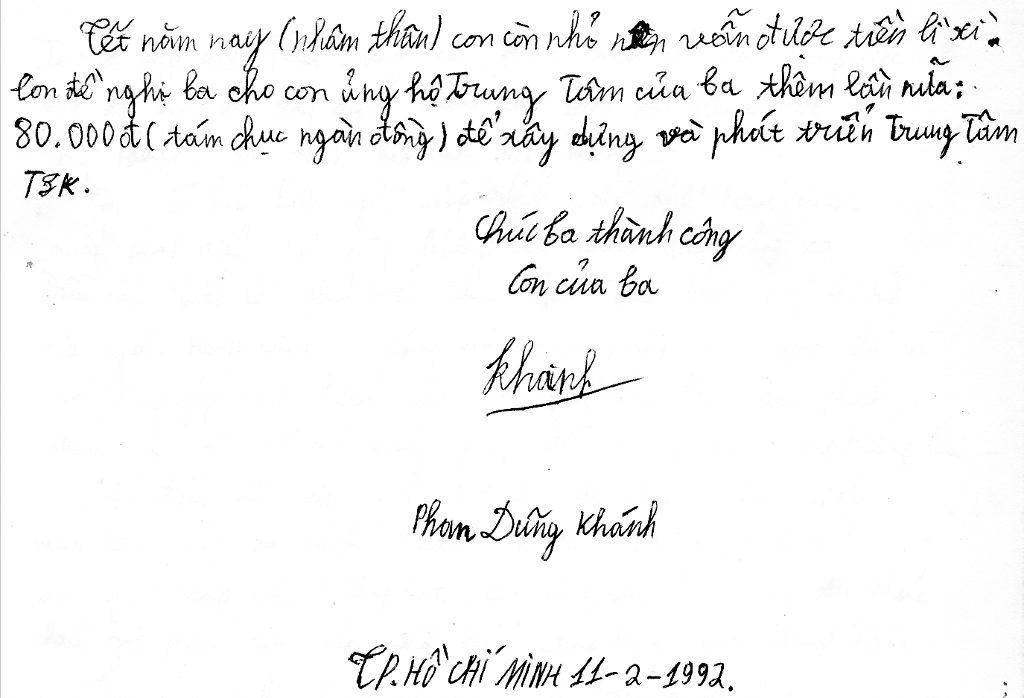
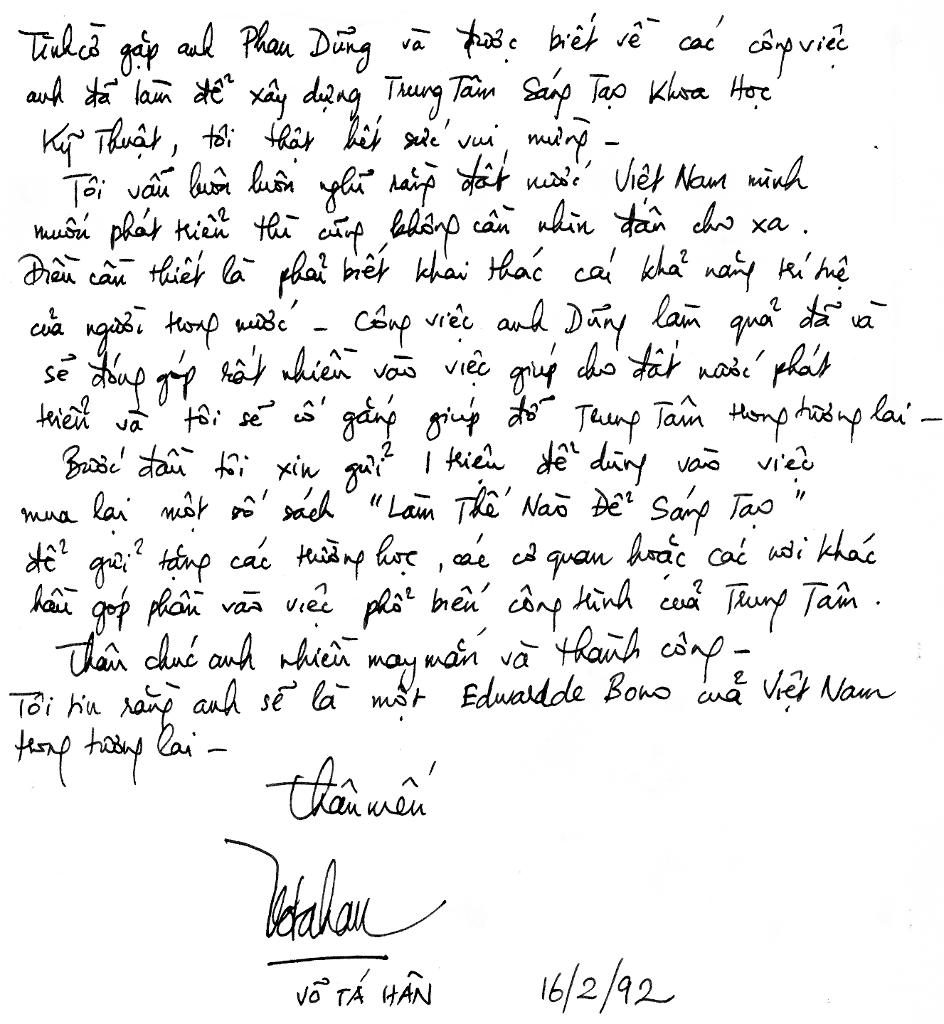
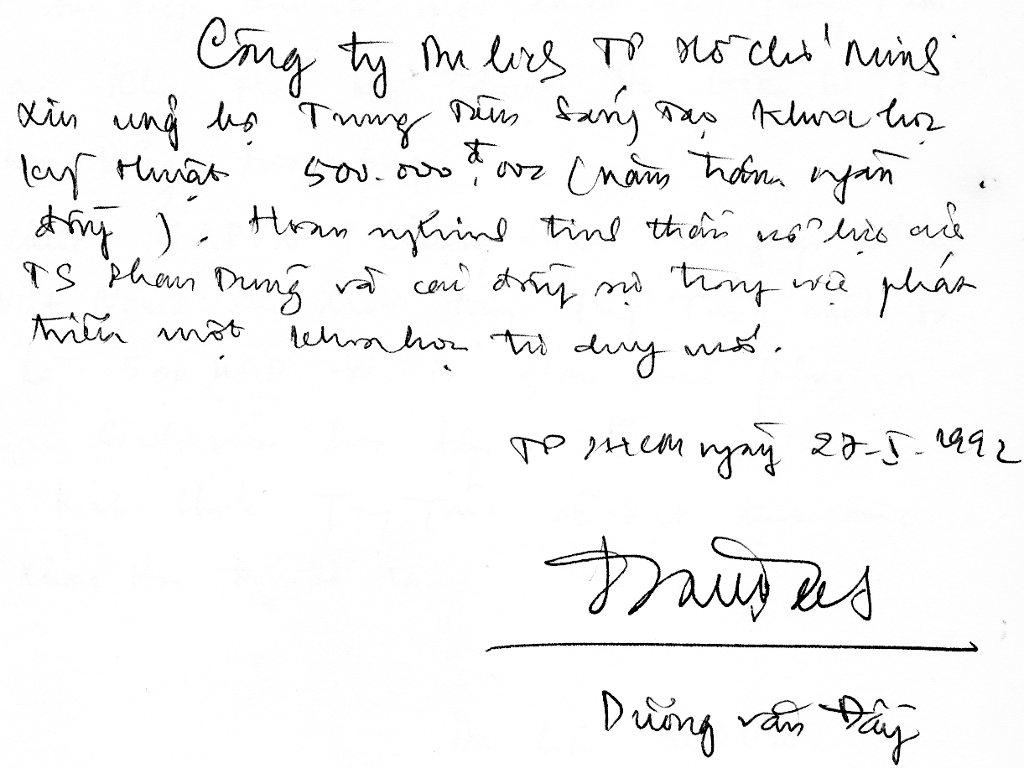
Chúng tôi có thành lập quyển “Sổ vàng TSK” nhằm mục đích ghi nhận sự ủng hộ đa dạng của các cá nhân, tập thể, tổ chức đối với giai đoạn đầu của việc thành lập và xây dựng TSK. Quyển “Sổ vàng TSK” được GS. TS., hiệu trưởng Đại học tổng hợp TP. Hồ Chí Minh Nguyễn Ngọc Giao khai bút.
Dưới đây là nội dung toàn bộ quyển “Sổ vàng TSK” với những dòng cuối cùng ghi ngày 25/11/1993:
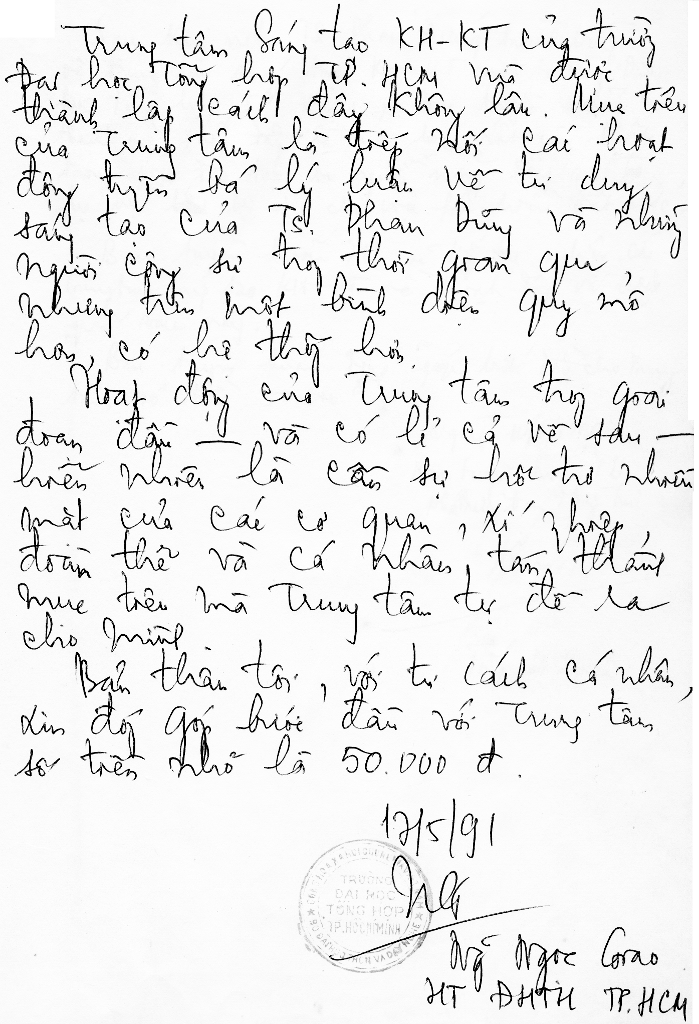
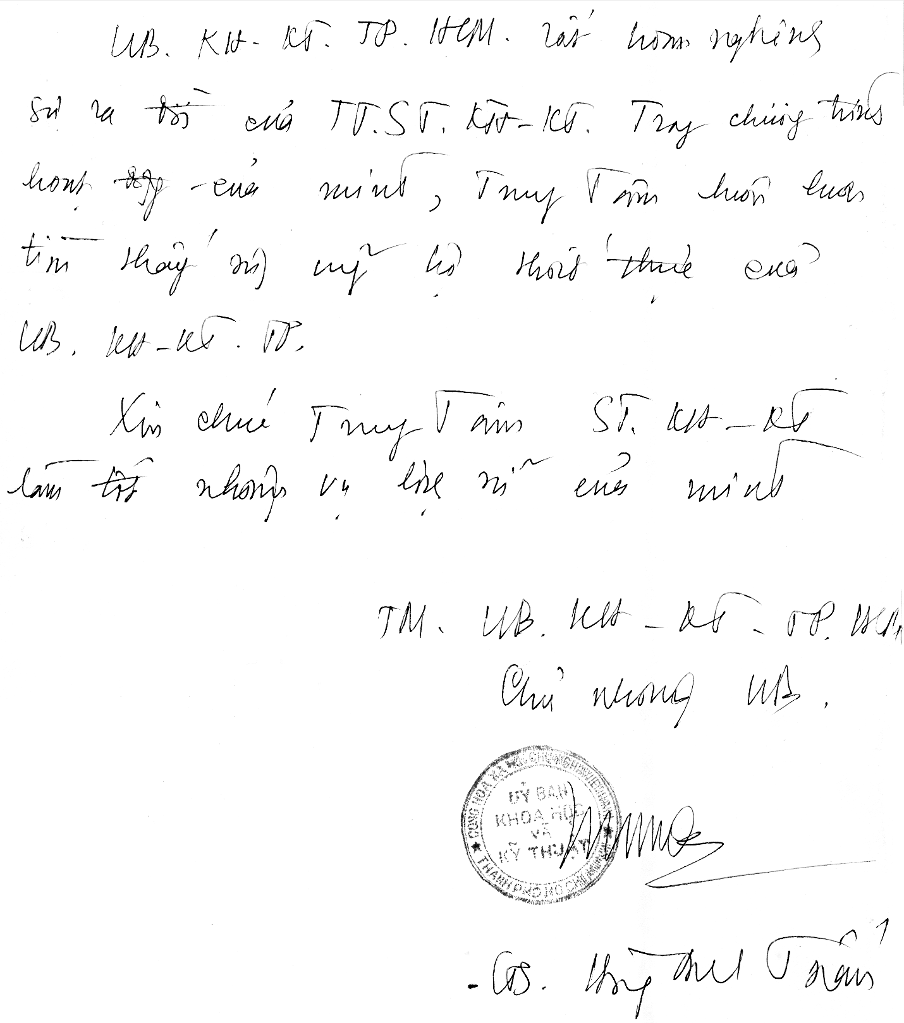
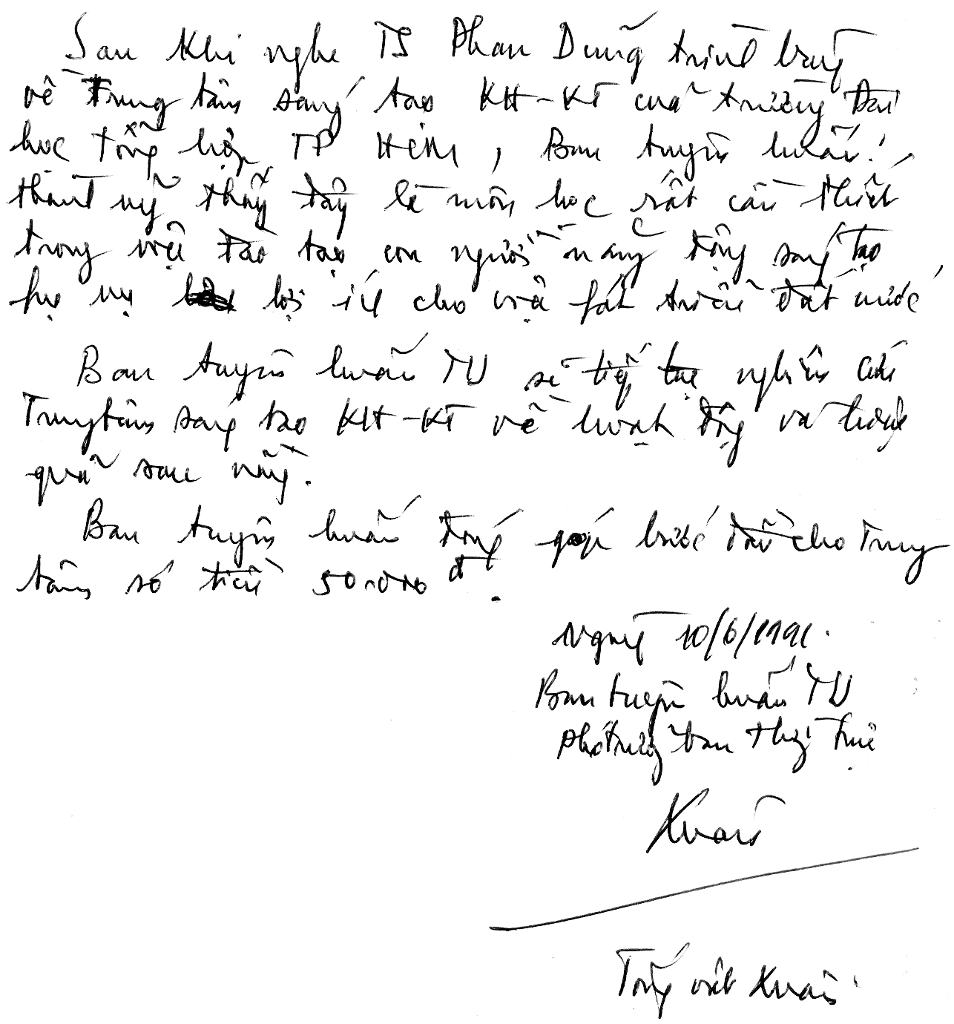
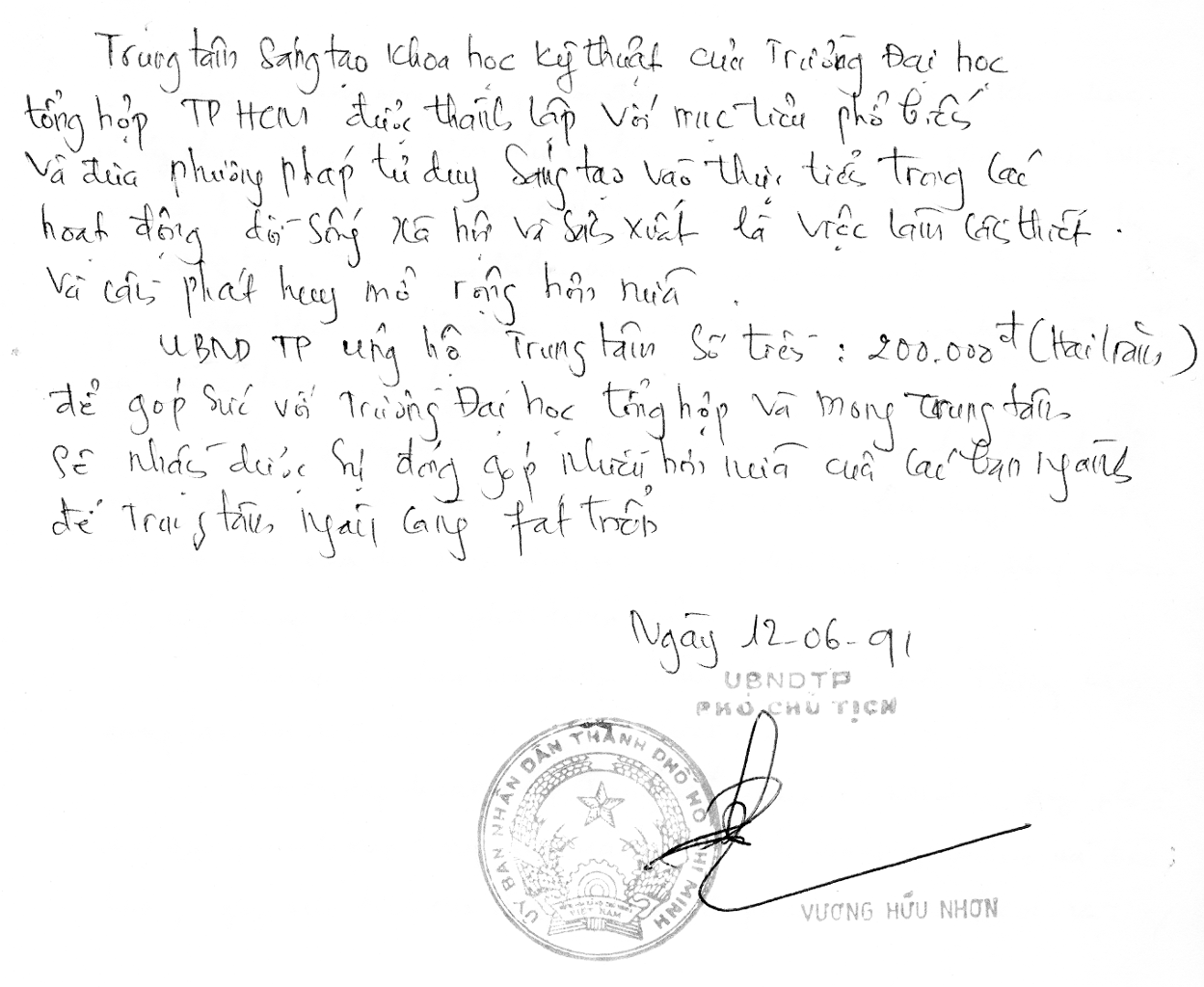
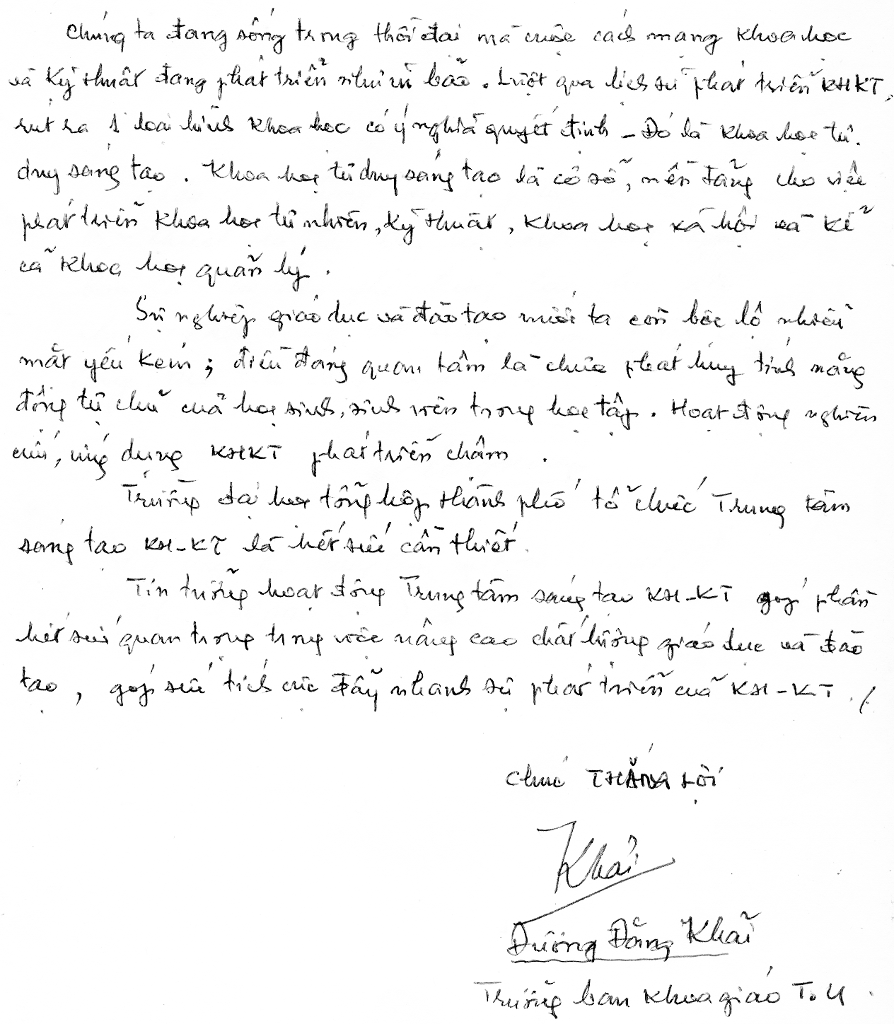
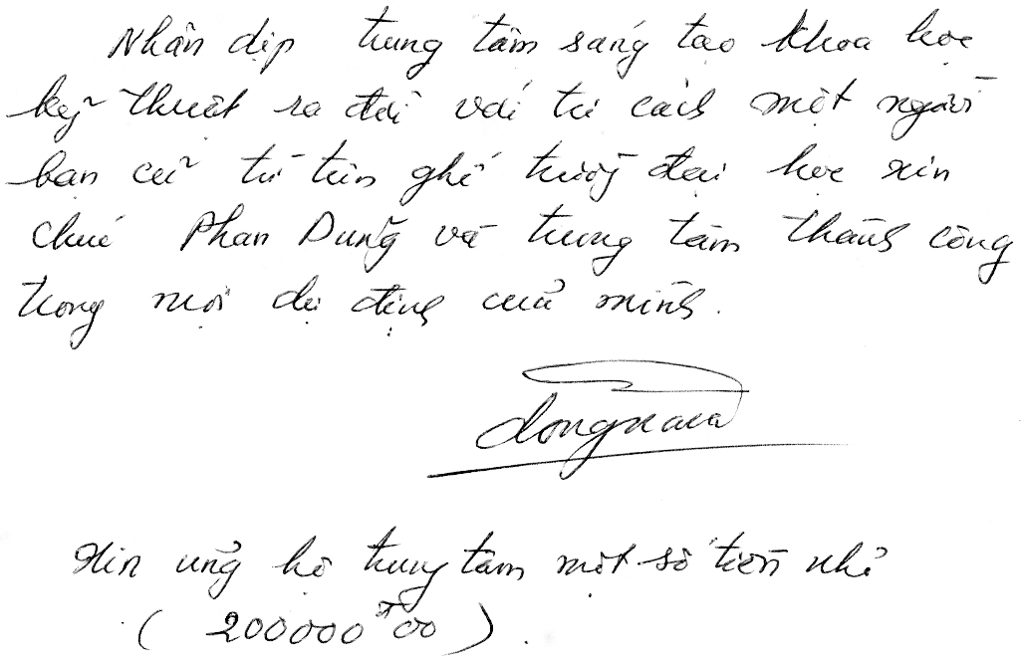
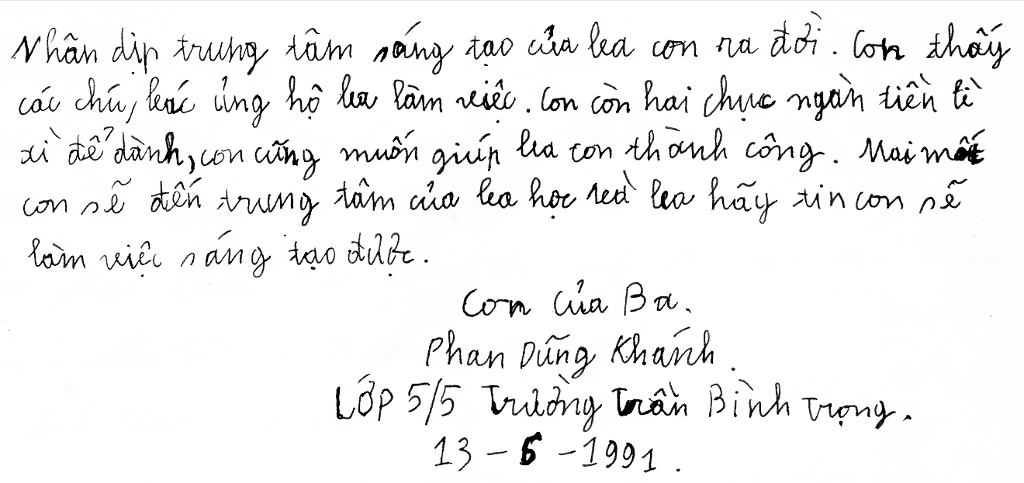
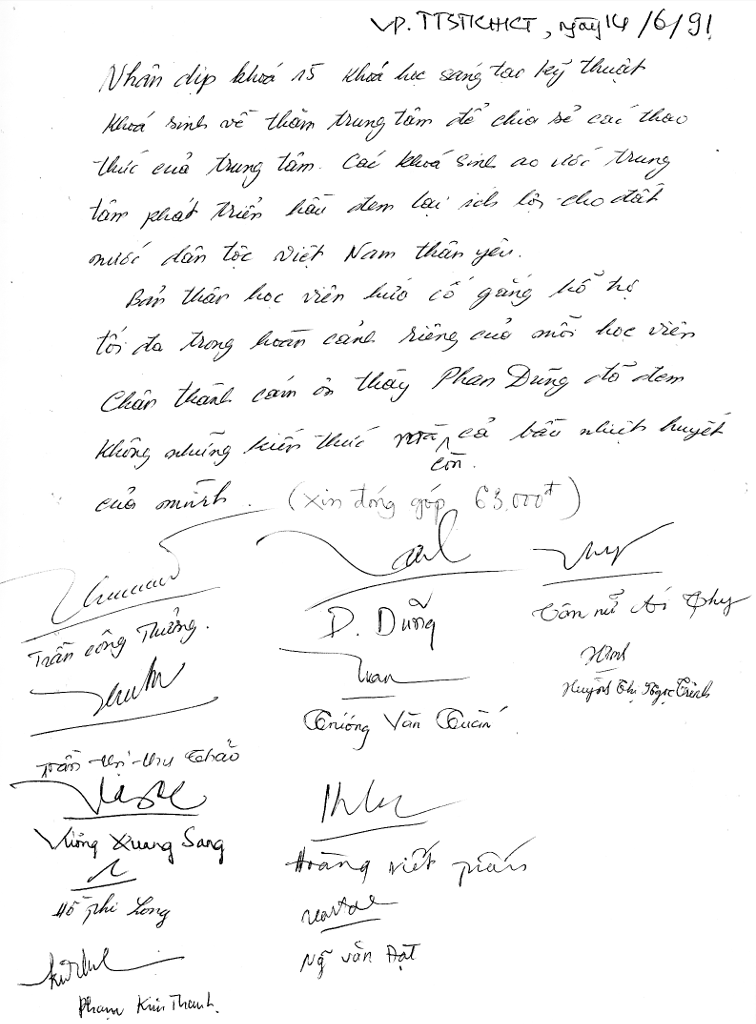
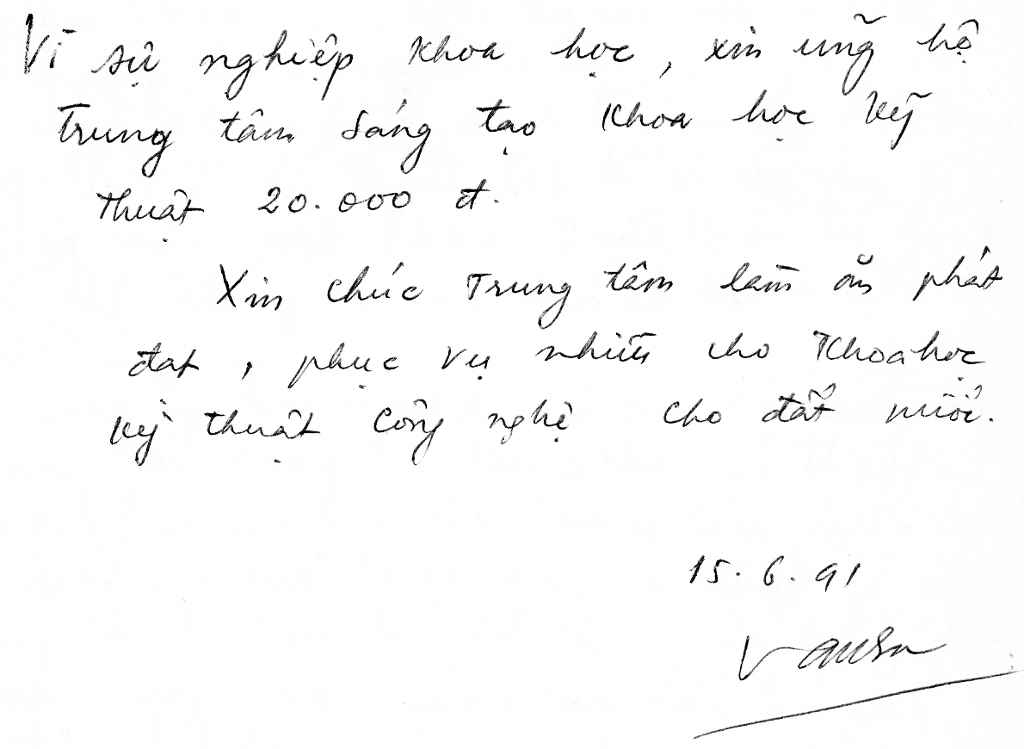
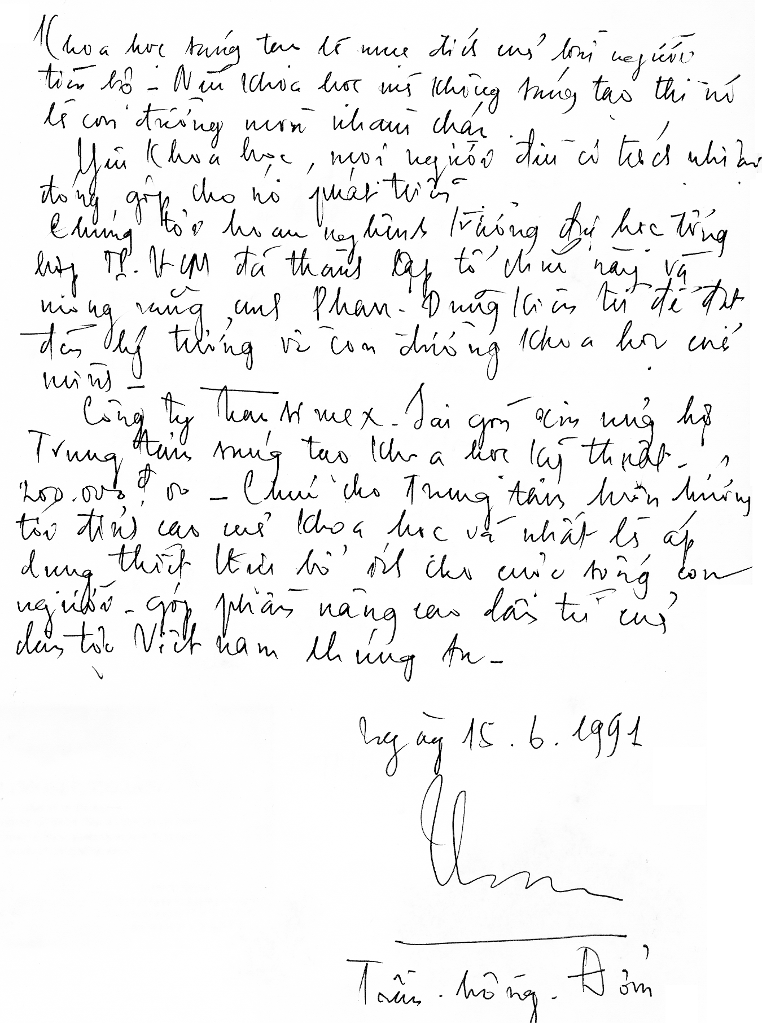
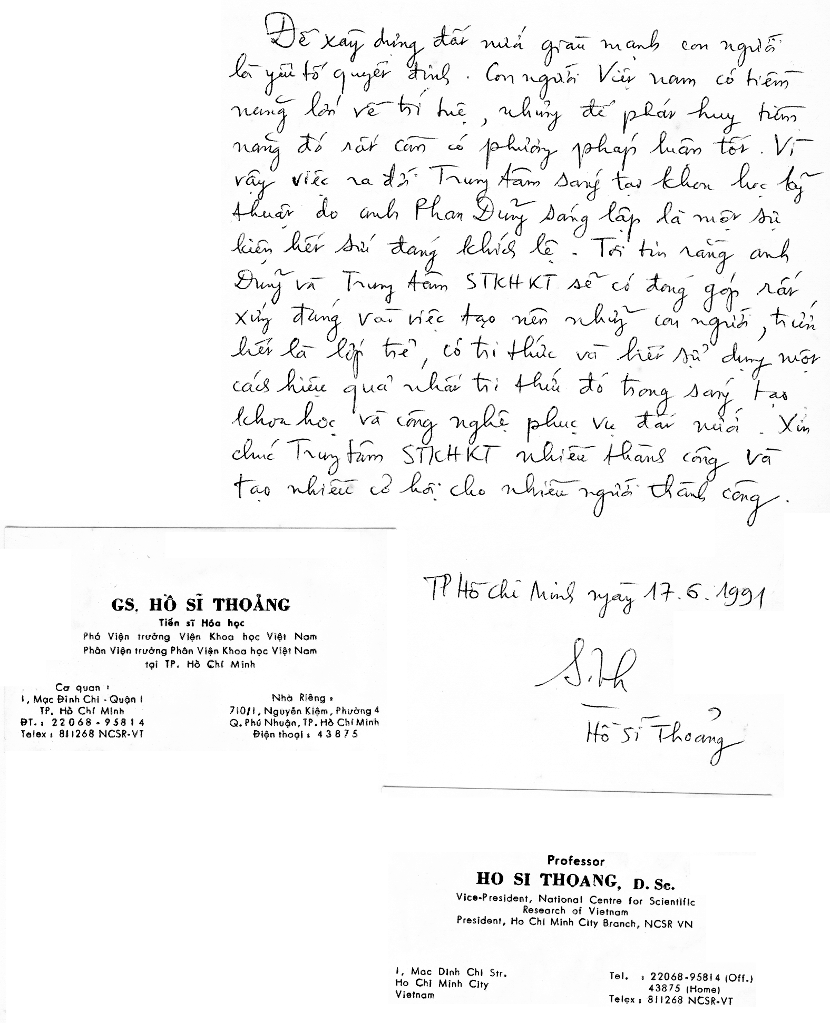
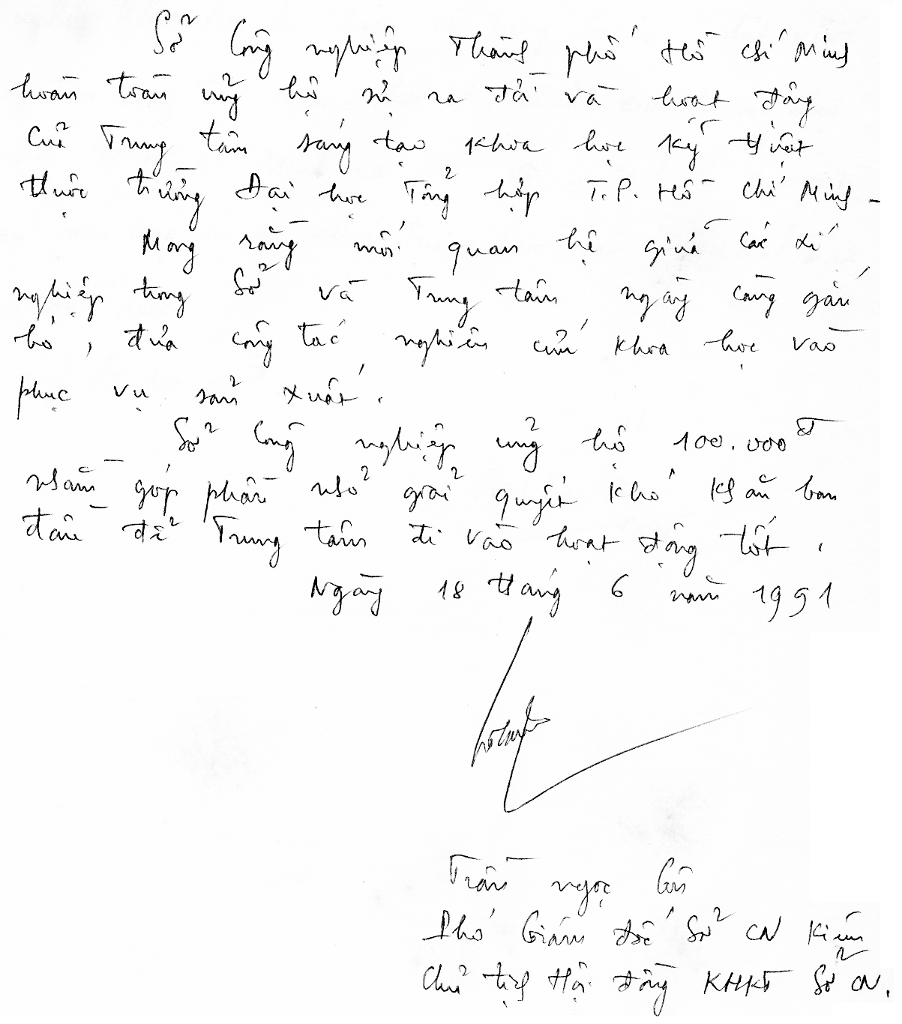
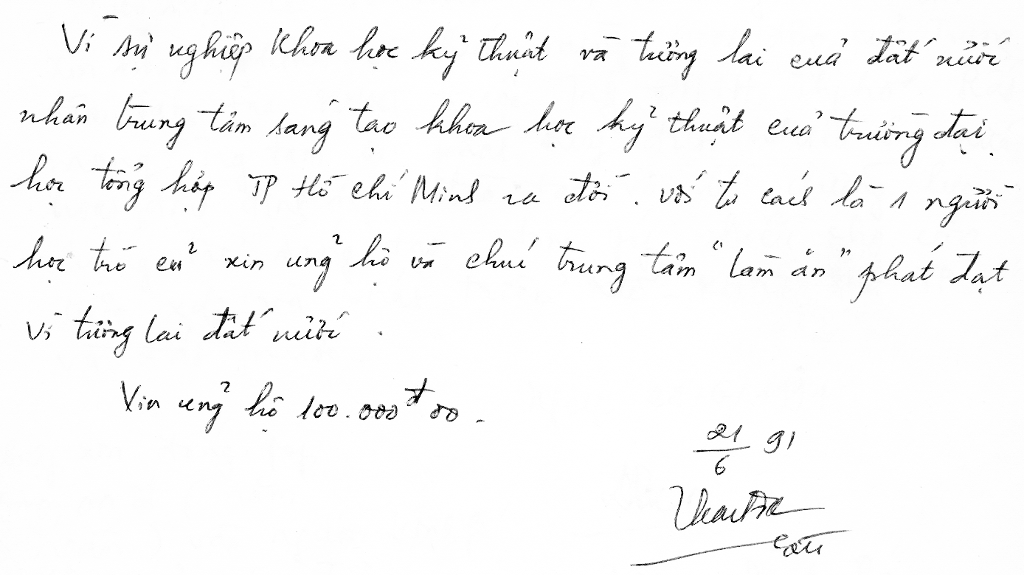
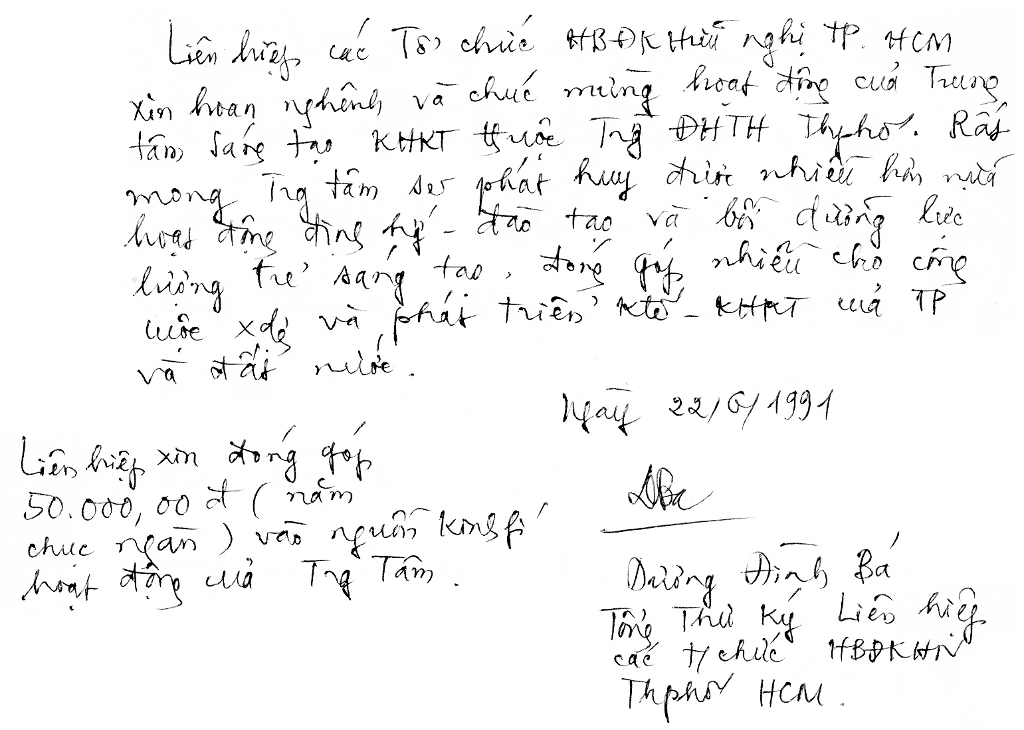
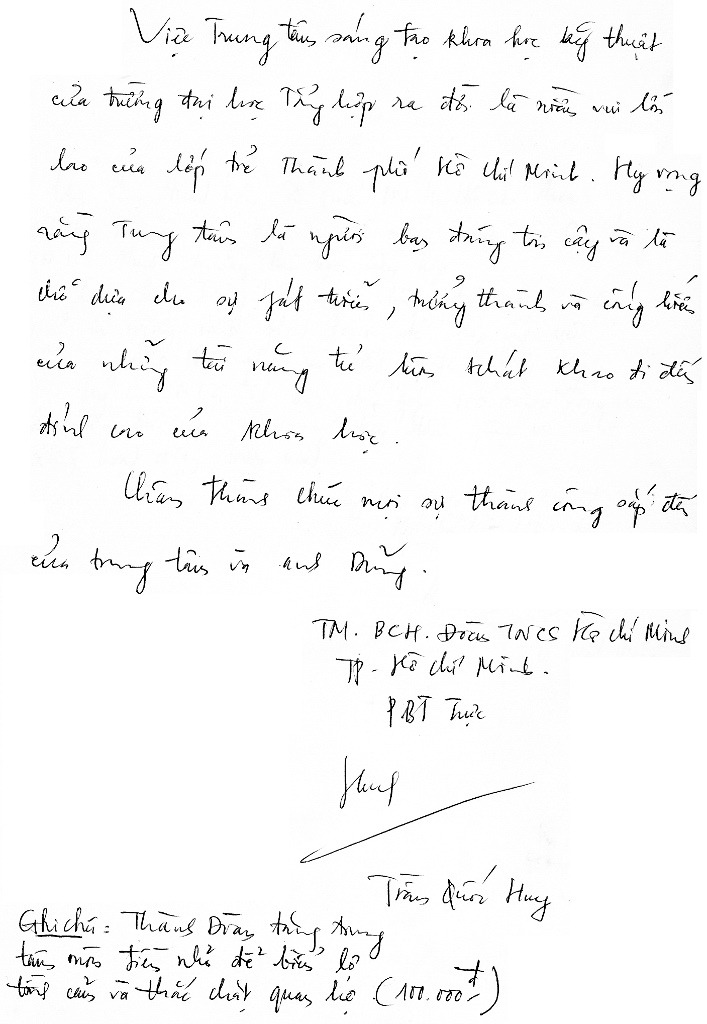
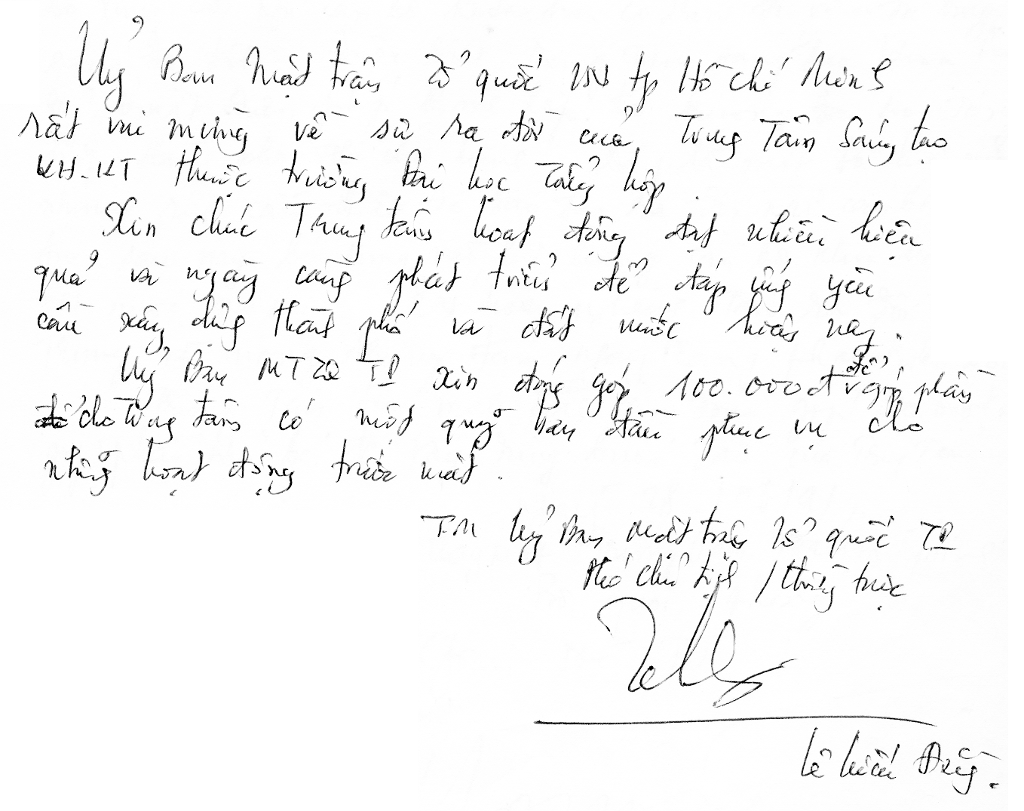
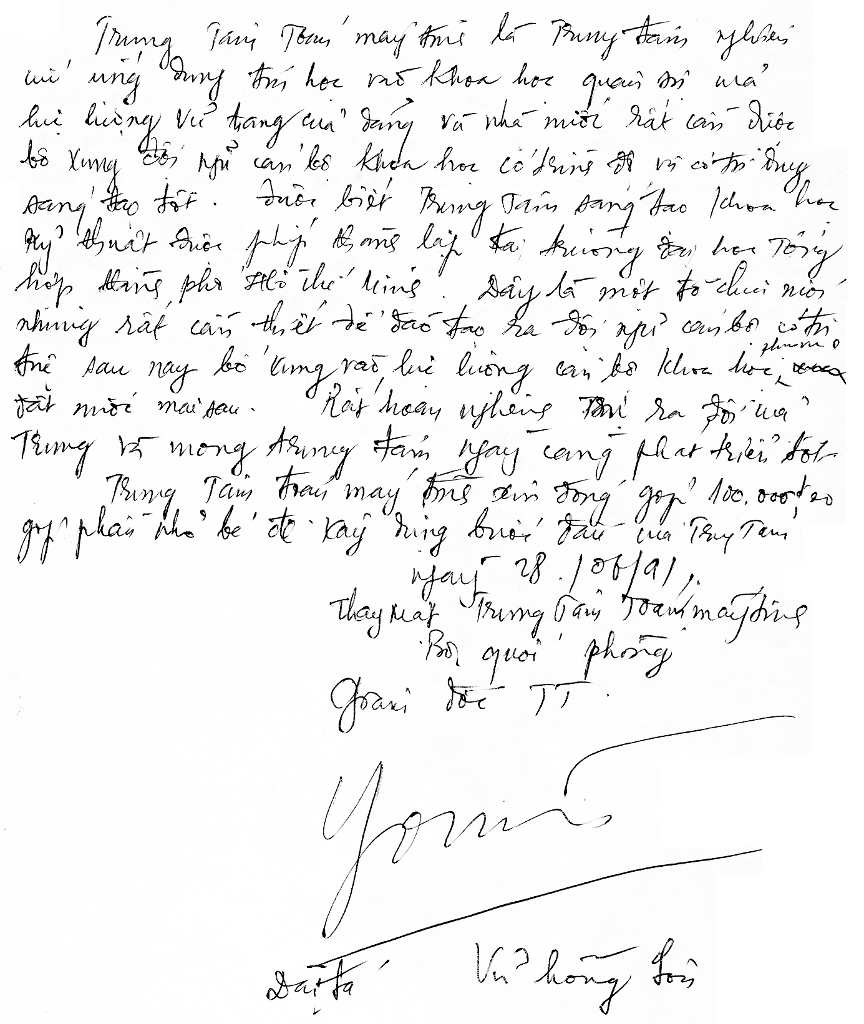
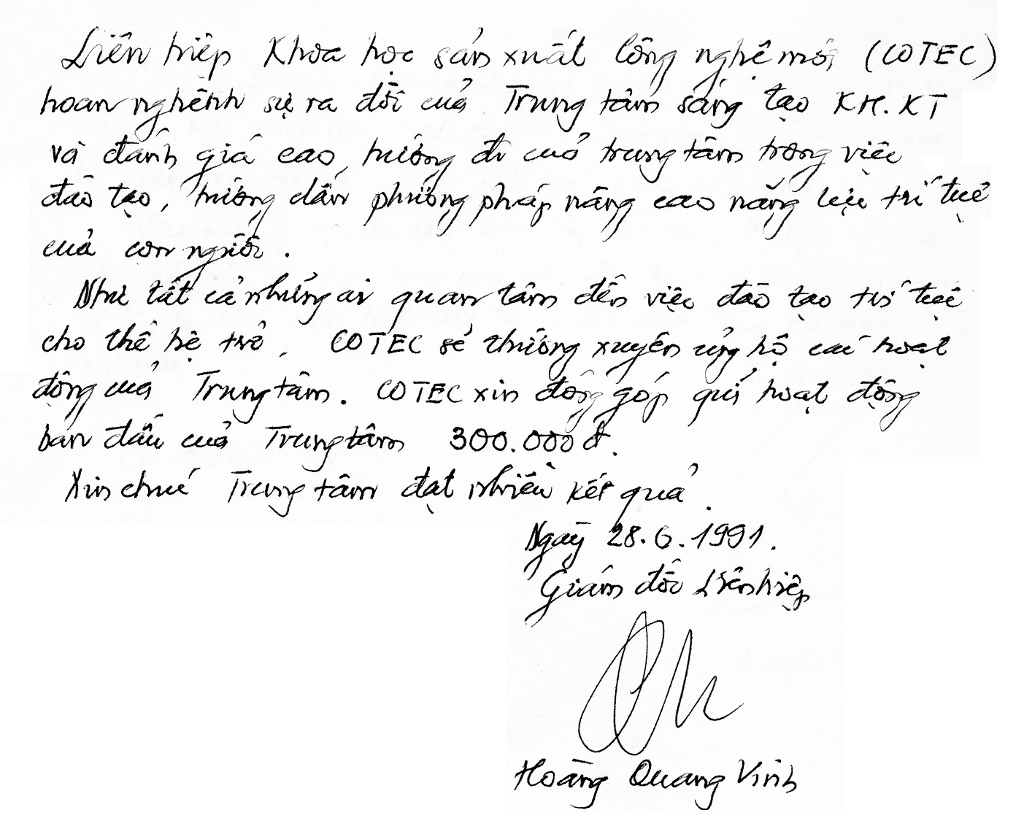
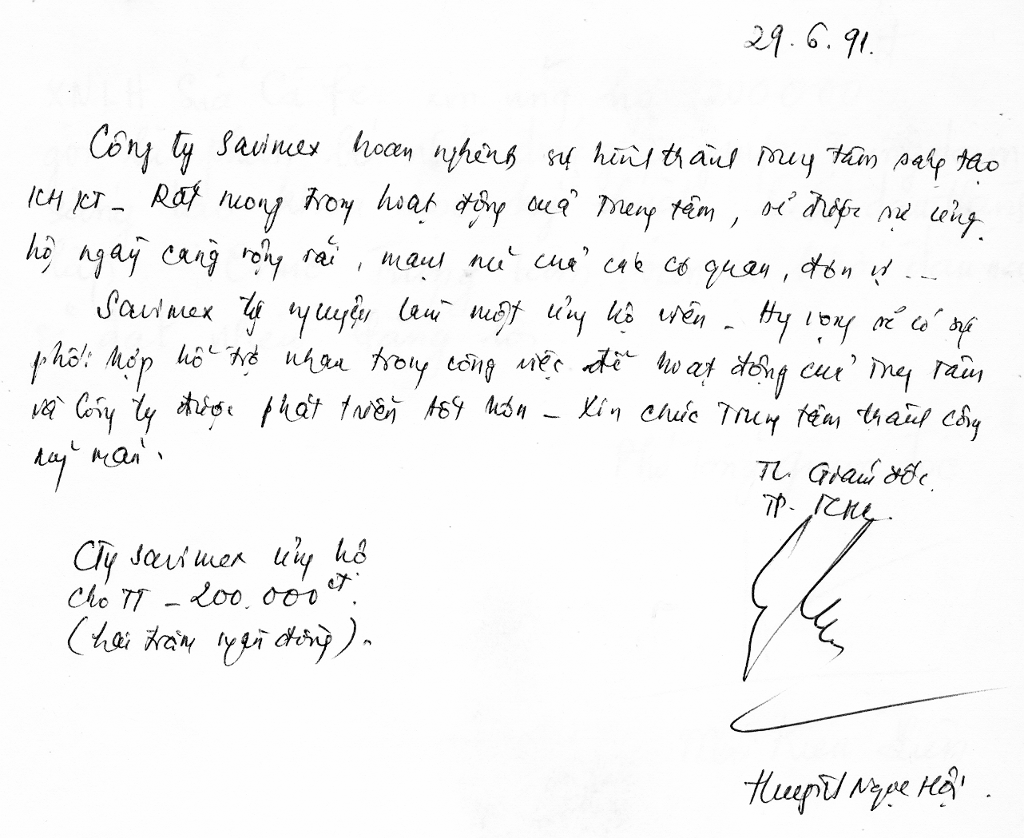

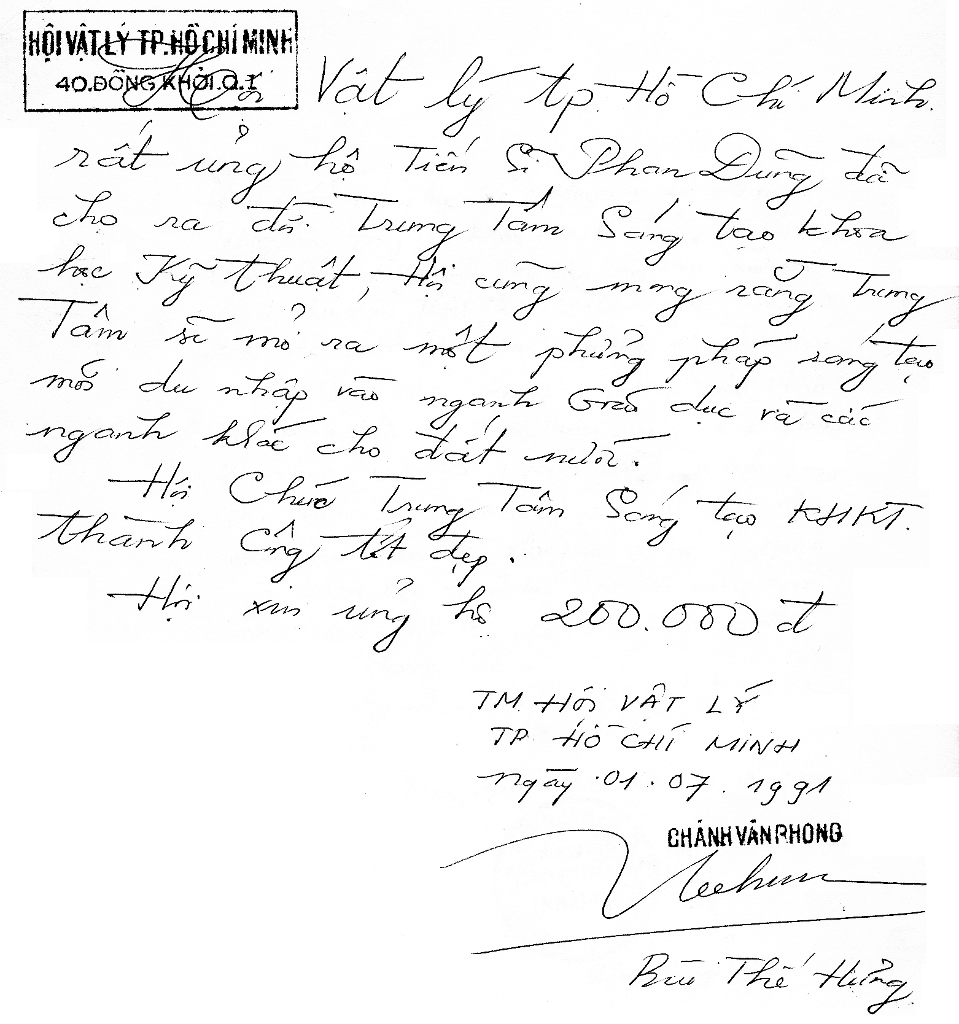



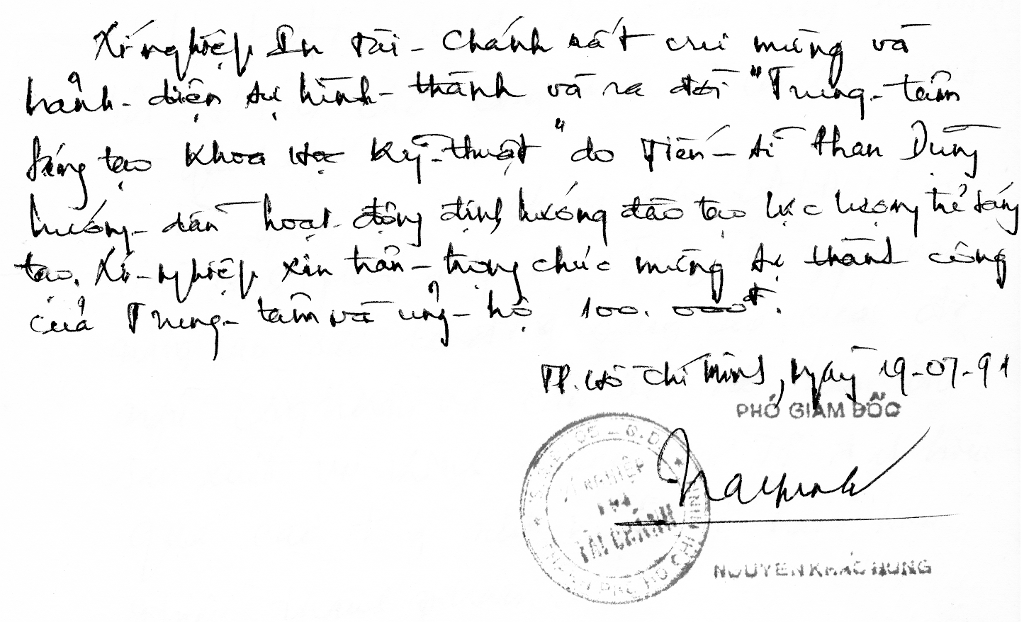
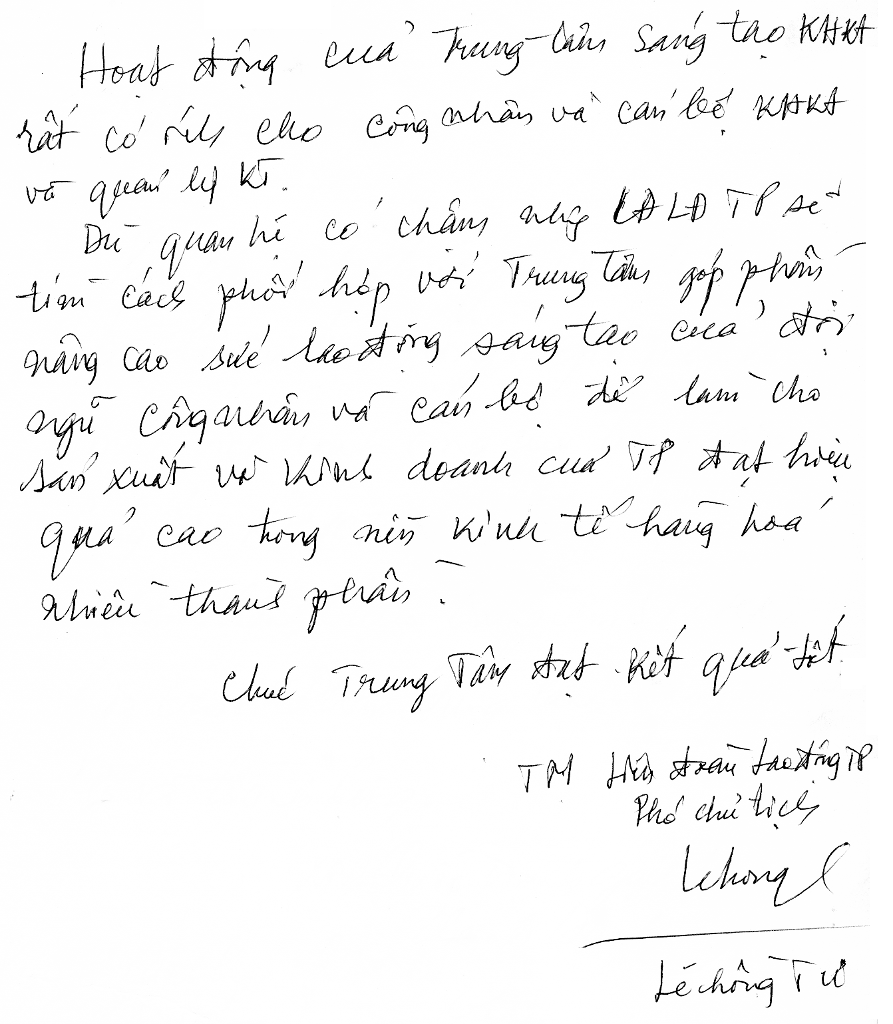
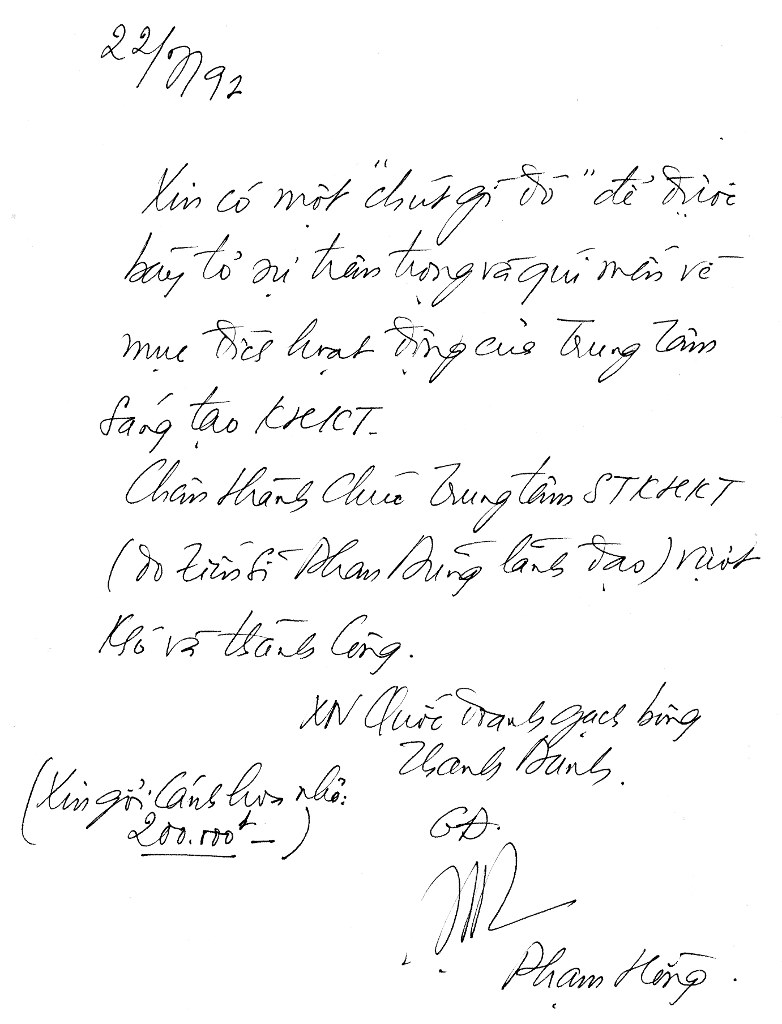
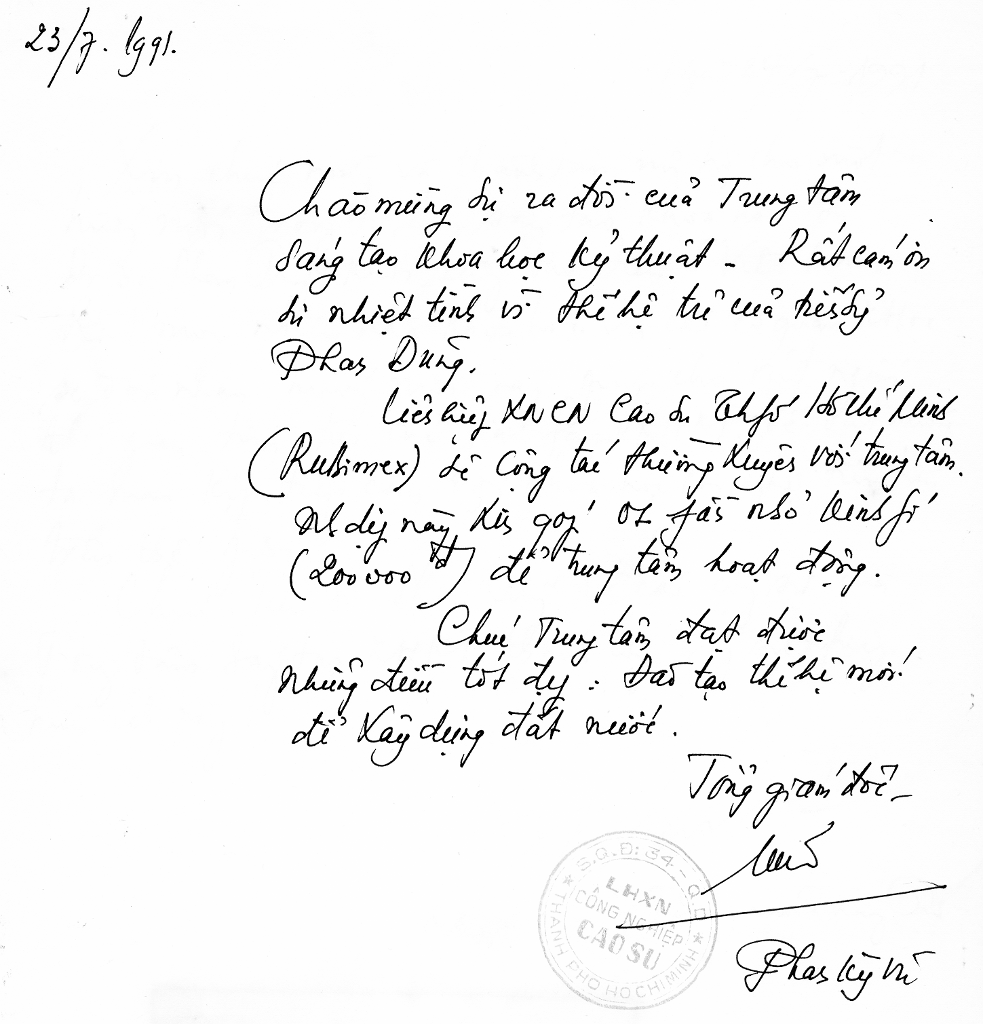
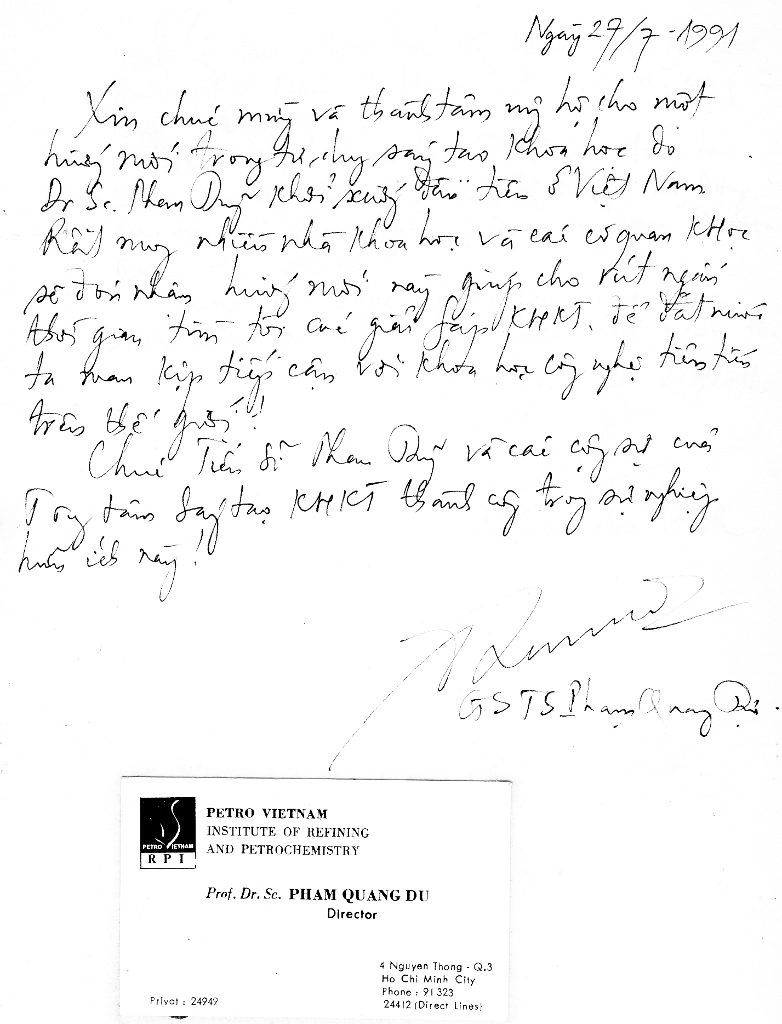

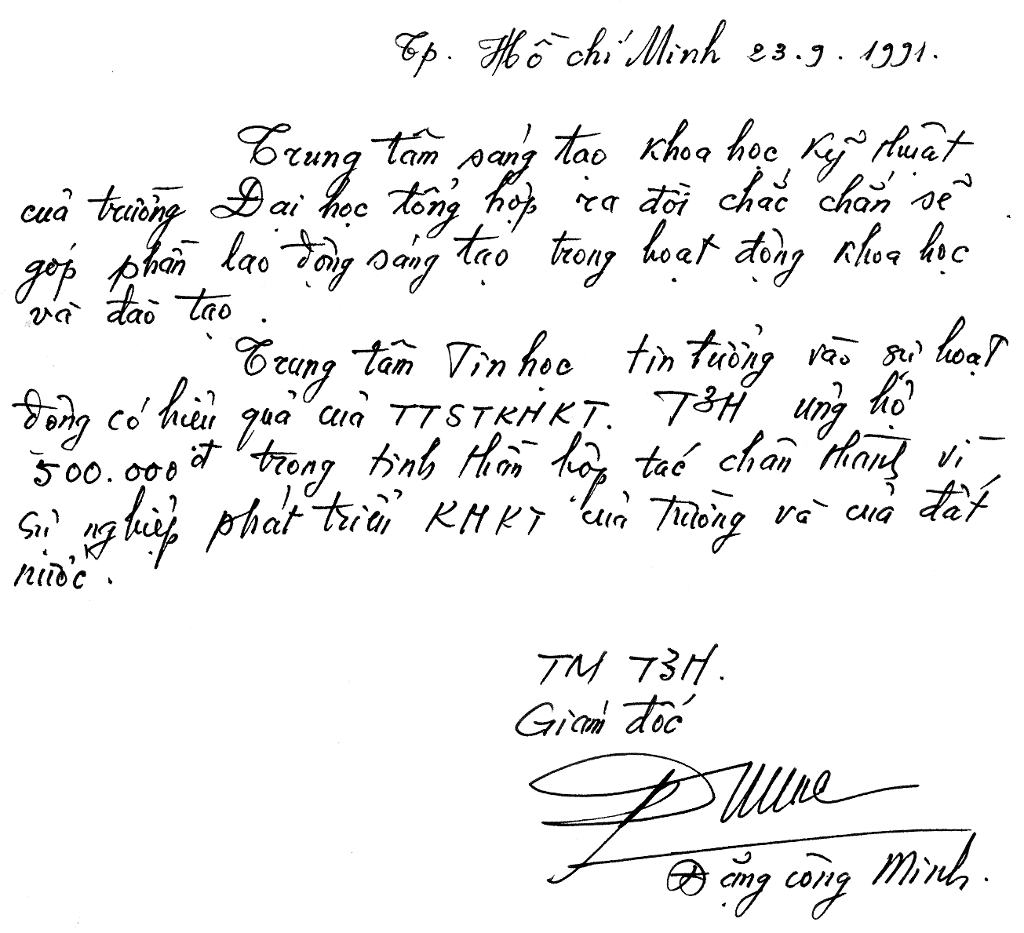
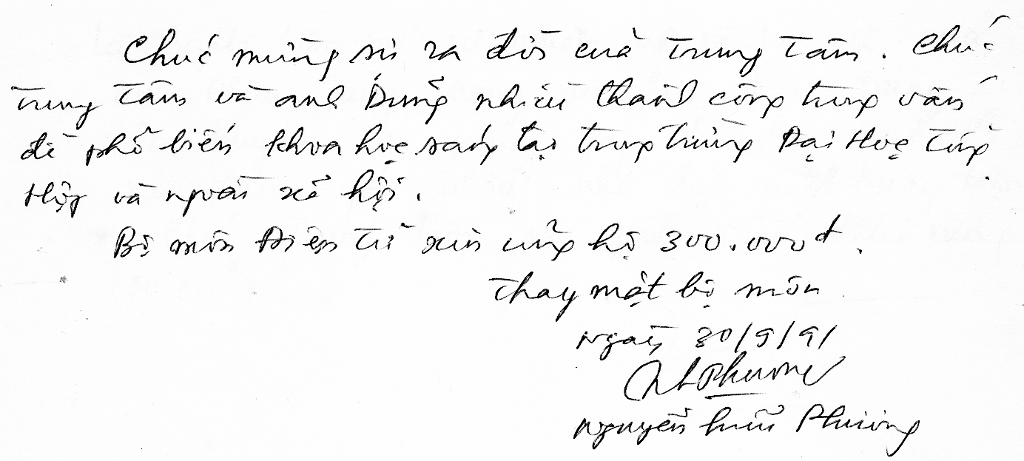
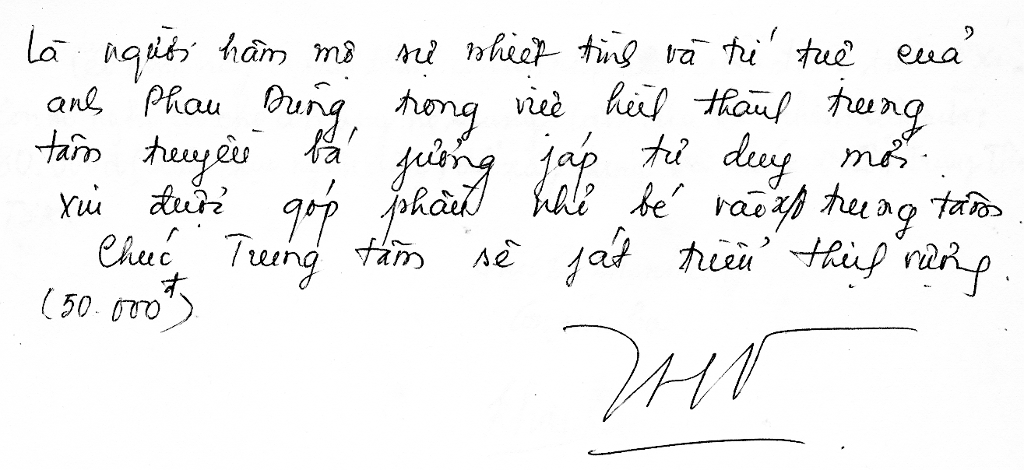
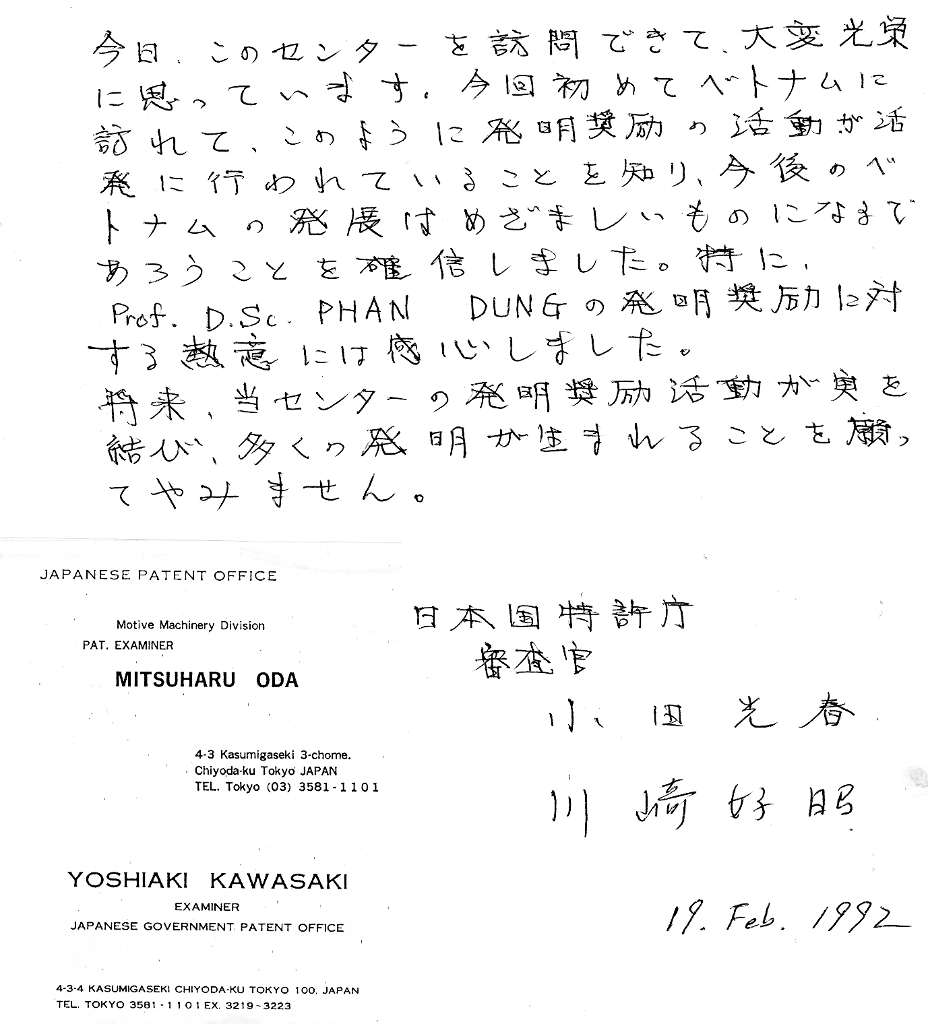
Hôm nay chúng tôi rất hân hạnh được đến thăm Trung tâm Sáng tạo Khoa học - kỹ thuật. Lần đầu tiên đến Việt Nam và được biết các hoạt động khuyến khích sáng tạo như vậy đang được tiến hành mạnh mẽ, chúng tôi tin rằng các hoạt động này chắc chắn sẽ đóng góp cho sự phát triển của đất nước Việt Nam trong tương lai. Đặc biệt, nhiệt huyết của GS.TSKH. Phan Dũng đối với sáng tạo khoa học kỹ thuật đã khiến chúng tôi ngưỡng mộ.
Xin chúc hoạt động của Trung tâm thu được nhiều kết quả, góp phần tạo được nhiều phát minh, sáng chế trong tương lai.
Mitsugaru Oda và Yoshiaki Kawasaki
Chuyên viên giám định patent thuộc Cục patent Nhật Bản
Ngày 19/2/1992


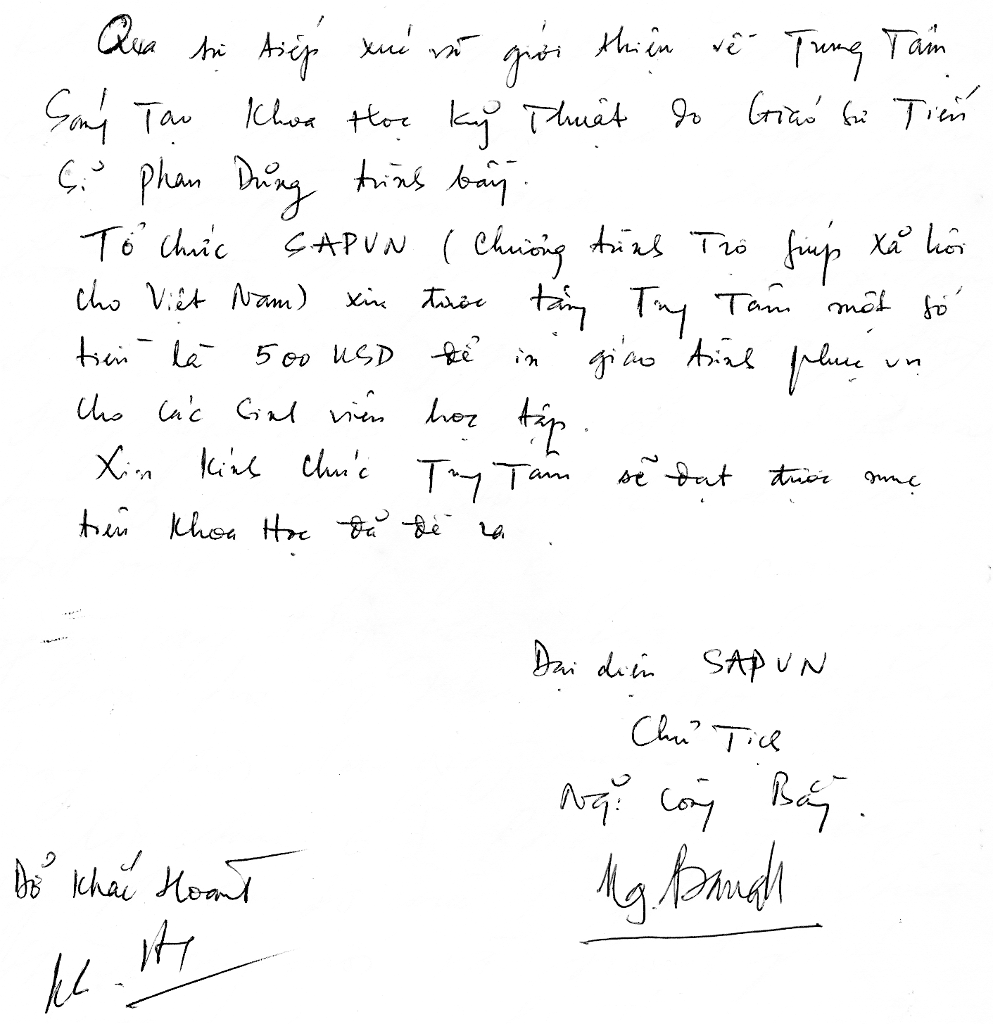

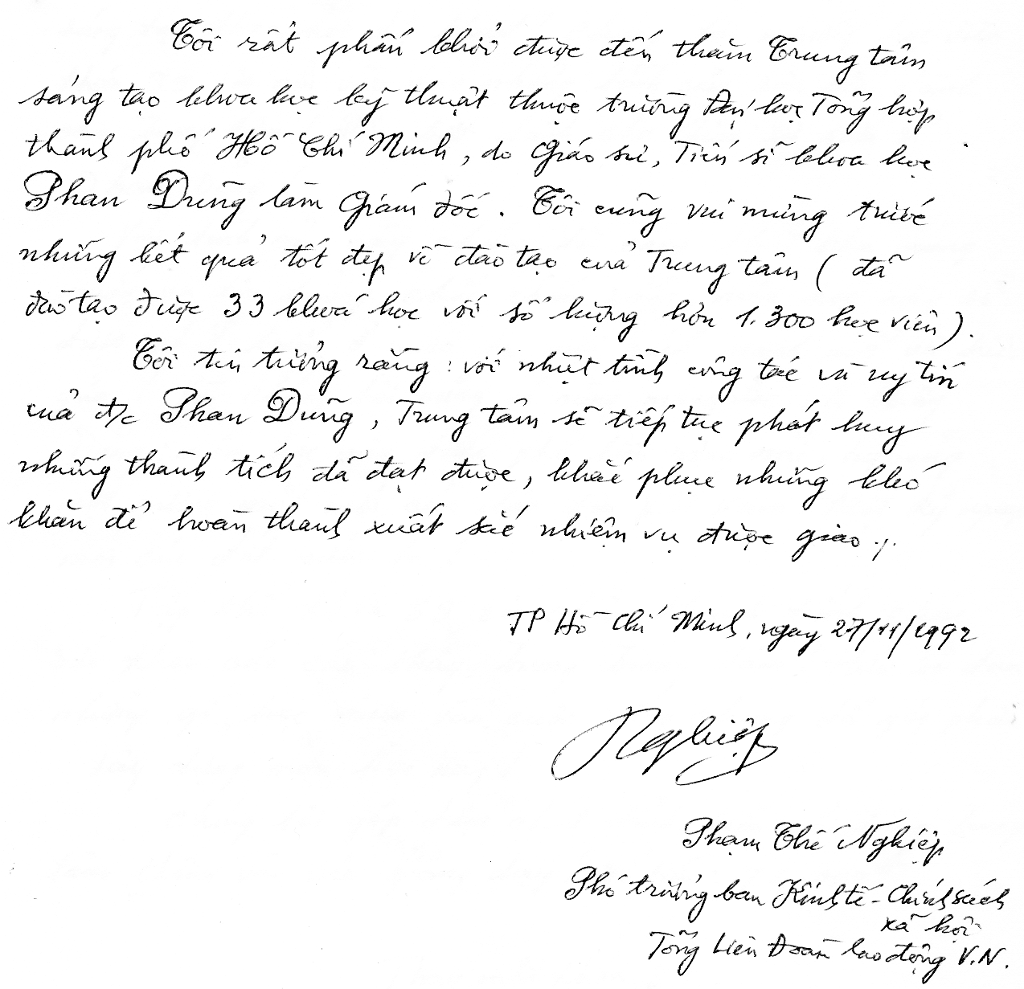
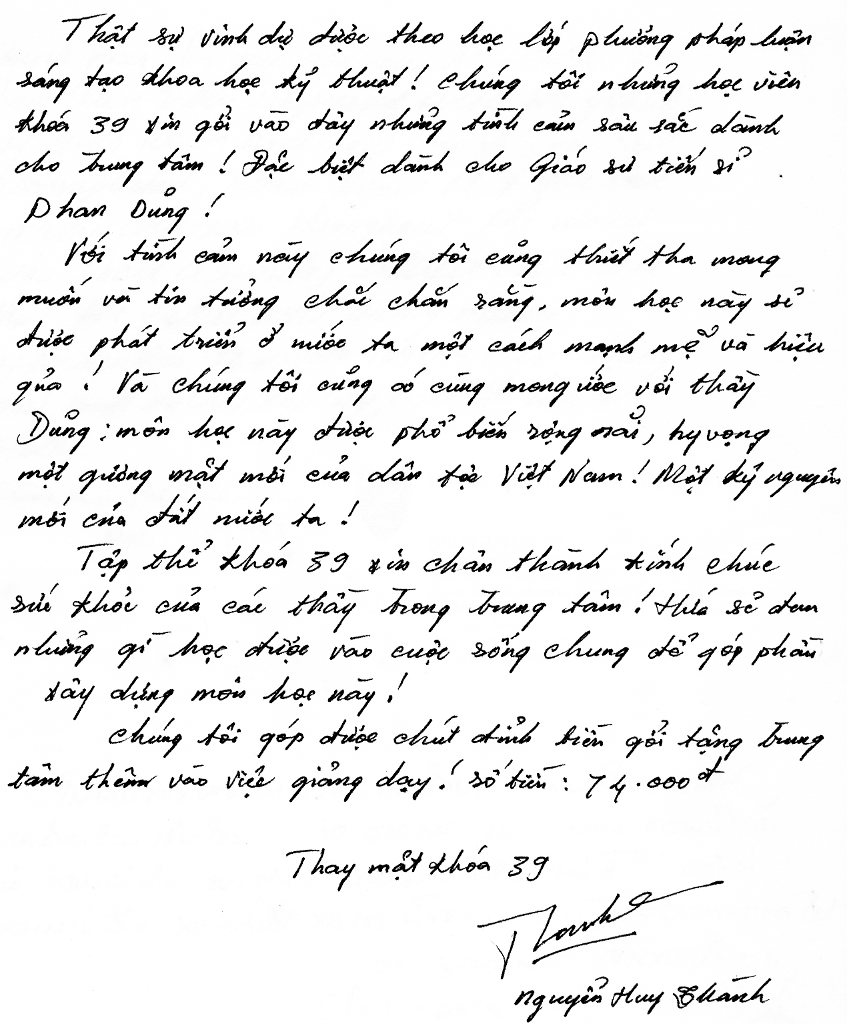
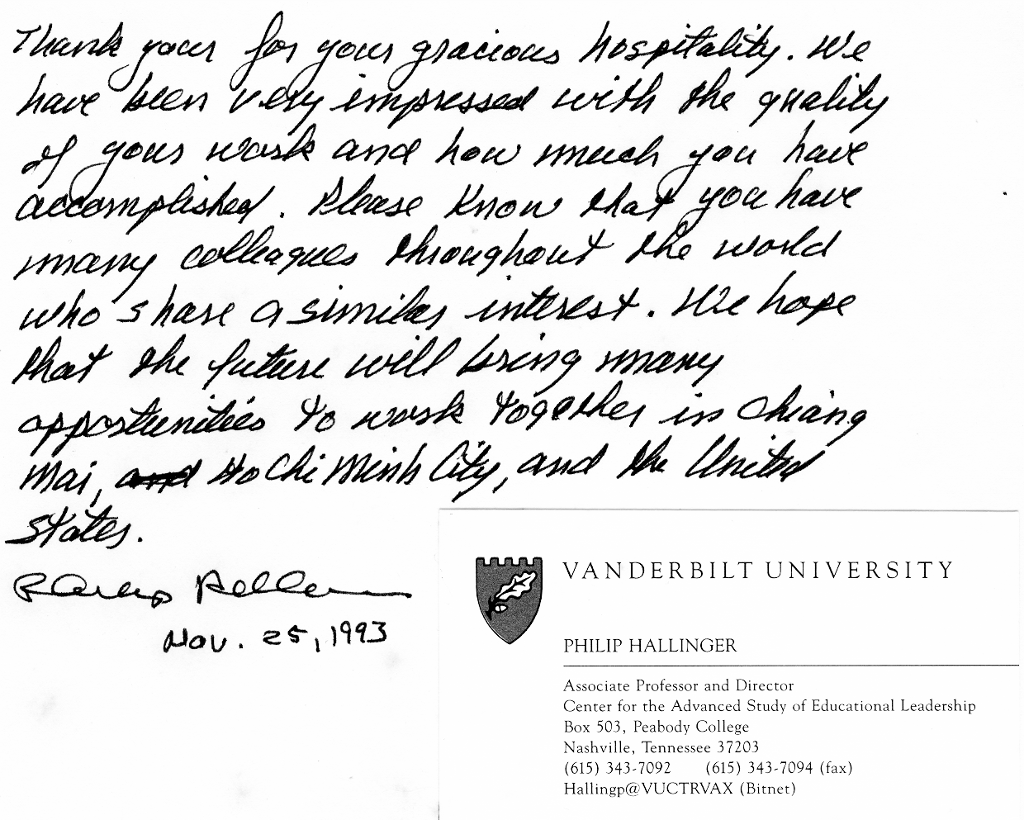
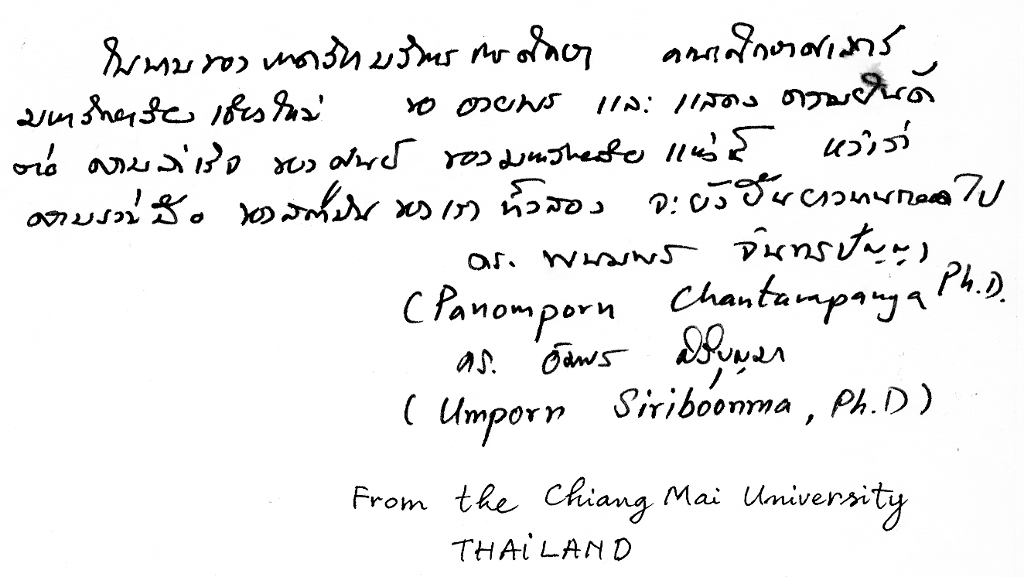
Thay mặt bộ môn nơi chúng tôi giảng dạy và đào tạo tại Đại học ChiangMai, chúng tôi kính chúc quí Trung tâm những điều tốt đẹp nhất và chúc mừng sự thành công của Trung tâm Sáng tạo Trường đại học khoa học tự nhiên. Tôi hy vọng mối quan hệ của chúng ta sẽ thành công và bền vững.
Ngày 25/11/1993
Thỉnh thoảng đọc lại “Sổ vàng TSK”, chúng tôi bồi hồi xúc động nhớ lại ba năm đầu tiên xây dựng TSK và tự hứa với mình phải cố gắng hơn nữa để xứng đáng với niềm tin, hy vọng của những người đã nhiệt tình ủng hộ chúng tôi ngay từ thủa ban sơ. Chúng tôi càng thấu hiểu câu nói: “Một miếng khi đói bằng một gói khi no”. Chúng tôi mãi mãi biết ơn họ. Những tình cảm ấm áp của mọi người đã động viên chúng tôi có đủ nghị lực lâu dài để vượt qua các khó khăn trên đường xây dựng và phát triển TSK, dù có những lúc chúng tôi cảm thấy cô độc, mất hứng và mệt mỏi.
Chúng tôi đã gặp rất nhiều vấn đề liên quan đến việc hình thành, xây dựng, quản lý và phát triển Trung tâm hoạt động trong cơ chế thị trường. Đây là các vấn đề nhân sự, tổ chức, tài chính, chiêu sinh, quảng cáo, marketing, chất lượng, quan hệ quốc tế… Tuy không được trang bị những kiến thức về các chuyên ngành nói trên, chúng tôi đã sử dụng chính PPLSTVĐM giải quyết khá thành công những vấn đề gặp phải, kể cả một số vấn đề thuộc loại tế nhị, tránh những phép thử sai.
Từ những số không ban đầu, bằng hoạt động tự trang trải, chúng tôi đã có tập thể nhỏ cán bộ giảng dạy vững tay nghề, làm việc với nhau khá ăn ý, tương đối đầy đủ cơ sở vật chất để làm việc, dạy và học, viết được các loại sách, giáo trình cần thiết phục vụ các học viên và những người quan tâm, hội nhập quốc tế ở mức độ cao (xem mục 17.3 Một số bài báo, báo cáo hội nghị của người viết về khoa học sáng tạo và phương pháp luận sáng tạo và đổi mới (PPLSTVĐM) công bố ở nước ngoài của quyển sách này).
Đến nay (cuối năm 2011) chúng tôi đã dạy được hơn 400 khóa học PPLSTVĐM theo chương trình 60 tiết học một khóa. Trong đó, có 13 khóa PPLSTVĐM nâng cao (trung cấp) và còn lại là các khóa PPLSTVĐM cơ bản (sơ cấp). Các khóa này gồm có những khóa dạy tại TSK và các khóa được các công ty, cơ quan, tổ chức… thỉnh giảng. Ngoài ra, TSK cũng thực hiện nhiều buổi nói chuyện chuyên đề, seminar về PPLSTVĐM theo yêu cầu.
Hơn 20.000 học viên đã theo học PPLSTVĐM gồm đủ mọi thành phần kinh tế, xã hội: Người đạp xích lô, tiểu thương, công nhân, học sinh, sinh viên, kỹ sư, bác sỹ, kiến trúc sư, nhà khoa học, cán bộ nhà nước, nhân viên, lãnh đạo công ty các loại, giới tu hành, giới nghệ sỹ, thể thao… Độ tuổi từ 13 đến 75. Trình độ học vấn từ lớp 7 đếùn giáo sư, tiến sỹ. Có những gia đình mà toàn bộ thành viên đều đã học PPLSTVĐM.
Các học viên, sau khi học, đều nhận thấy nhiều ích lợi của PPLSTVĐM đem lại cho họ, so với trước khi học (bạn đọc xem lại phần trích một số ý kiến của các học viên trong mục 4.6 Một số kết quả mở rộng TRIZ và dạy TRIZ mở rộng cho đông đảo mọi người của quyển một).
Để kết thúc mục nhỏ này, danh sách dưới đây liệt kê các mốc đánh dấu các hoạt động của TSK phổ biến và phát triển PPLSTVĐM theo thời gian:
Khóa cơ bản “Phương pháp luận sáng tạo và đổi mới” (PPLSTVĐM) đầu tiên dạy ngoại khóa cho gần một trăm sinh viên thuộc tất cả các khoa khối khoa học tự nhiên của Đại học tổng hợp TP.HCM (nay là Trường đại học khoa học tự nhiên, Đại học quốc gia TP.HCM) năm 1977.
Khóa PPLSTVĐM đầu tiên dạy tại chỗ là theo lời mời của Câu lạc bộ thanh niên (nay là Nhà văn hóa thanh niên), Thành Đoàn TP.HCM năm 1978. Đến nay, TSK đã thực hiện các bài giảng, khóa học rút gọn hoặc đầy đủ tại chỗ, theo lời mời cho hơn 100 đơn vị giáo dục, đào tạo, viện nghiên cứu, cơ quan đoàn thể, chính quyền, các công ty sản xuất và kinh doanh thuộc một số tỉnh và thành phố trong cả nước.
Bài phỏng vấn đầu tiên về lớp học PPLSTVĐM đăng trên Báo Tuổi Trẻ Xuân năm 1979. Đến nay đã có gần 100 bài báo trên các báo, tạp chí trung ương và địa phương phản ánh các hoạt động giảng dạy, nghiên cứu và ứng dụng PPLSTVĐM của TSK và các cựu học viên. Đặc biệt, trong đó có hai bài báo bằng tiếng Anh đăng trong “Vietnam News”.
Quyển sách đầu tiên về PPLSTVĐM có tên gọi “Algôrit sáng chế” của các tác giả Nguyễn Chân, Dương Xuân Bảo, và Phan Dũng được Nhà xuất bản khoa học và kỹ thuật, Hà Nội in và phát hành năm 1983.
PPLSTVĐM lần đầu tiên được giới thiệu trên làn sóng của Đài phát thanh và Đài truyền hình TP.HCM năm 1986.
Khóa cơ bản PPLSTVĐM đầu tiên dạy cho các học viên cao học theo chương trình chính khóa là khóa dành cho Viện quản lý khoa học (nay là Viện nghiên cứu chiến lược và chính sách khoa học công nghệ), Bộ khoa học, công nghệ và môi trường, Hà Nội, tháng 2 năm 1991. Đến nay, TSK đã dạy cho hơn 1500 học viên cao học và nghiên cứu sinh tiến sỹ các nơi sau: Trường đại học bách khoa, Đại học tài chính - kế toán (nay là Đại học kinh tế), khoa sau đại học thuộc Đại học mở bán công, Khoa Anh văn thuộc Đại học khoa học xã hội và nhân văn, Viện khoa học nông nghiệp miền Nam, Viện công nghệ hóa học, Viện cơ học ứng dụng thuộc Trung tâm khoa học tự nhiên và công nghệ quốc gia TP.HCM, Khoa môi trường và Khoa hóa, Trường đại học khoa học tự nhiên, Đại học quốc gia TP. Hồ Chí Minh.
Sau thành công của nhiều khóa dạy PPLSTVĐM ở trong và ngoài nhà trường, Hiệu trưởng Đại học tổng hợp TP.HCM chính thức ký quyết định số 50.91/QLKH ngày 23.4.1991 thành lập Trung tâm Sáng tạo Khoa học kỹ thuật (TSK) với giám đốc là tiến sỹ khoa học Phan Dũng. TSK hoạt động theo phương thức tự trang trải về mặt tài chính với các chức năng giảng dạy, nghiên cứu và ứng dụng PPLSTVĐM.
TSK trở thành hội viên thông tấn của Phòng thương mại công nghiệp Việt Nam năm 1991 và hội viên Trung tâm kinh tế châu Á - Thái Bình Dương của Việt Nam (VAPEC) năm 1994.
Các ông Mitsuharu Oda và Yoshiaki Kawasaki, chuyên viên giám định patent thuộc Cục patent Nhật Bản (Japanese Patent Office) là những vị khách nước ngoài đầu tiên đến thăm và làm việc với TSK ngày 19.02.1992. Tính đến nay đã có các đoàn khách, đồng nghiệp từ Anh, Bỉ, Canada, Mỹ, Nga, Thái Lan, Thụy Sỹ, Úc đến thăm và làm việc tại TSK.
Logo của TSK được thiết kế và sử dụng từ năm 1992. Với logo này TSK mong muốn các cựu học viên và học viên PPLSTVĐM luôn nhớ đến một số ý chính của PPLSTVĐM. Cùng với logo của TSK, logo TRIZ-ARIZ cũng thường được dùng trong các hoạt động của TSK.
Đề tài nghiên cứu cấp thành phố đầu tiên của TSK “Bước đầu nghiên cứu thực hiện giảng dạy và tổ chức áp dụng PPLSTVĐM vào hoạt động sở hữu công nghiệp” được Ủy ban khoa học và kỹ thuật (nay là Sở khoa học và công nghệ) TP.HCM nghiệm thu xuất sắc và được nhận tiền thưởng năm 1992. Ngoài ra, TSK cũng tham gia vào đề tài nghiên cứu số 14 của Bộ khoa học, công nghệ và môi trường với báo cáo “Hiệu quả kinh tế của đổi mới công nghệ: Nhìn từ những quy luật bên trong của chính quá trình đổi mới”, Hà Nội, 1993.
Khóa trung cấp PPLSTVĐM đầu tiên được thực hiện tại TSK từ ngày 23.4 đến ngày 21.6 năm 1993.
TSKH Phan Dũng trở thành hội viên Mạng lưới sáng tạo quốc tế (International Creativity Network – ICN) có trụ sở tại Buffalo, New York, từ tháng 3 năm 1994; Hiệp hội châu Âu về sáng tạo và đổi mới (European Association for Creativity and Innovation - EACI) có trụ sở tại Hà Lan từ tháng 8 năm 1994; Bản đồ lãnh đạo tri thức toàn cầu (Global Knowledge Leadership Map) có trụ sở tại Wilmington, Massachusetts, Mỹ năm 2000. Nhân dịp TSKH Phan Dũng được mời trình bày báo cáo chính (keynote address) tại Hội nghị TRIZCON2001, Viện Altshuller của Mỹ đã tặng ông danh hiệu hội viên suốt đời của Viện nói trên.
Bài báo đầu tiên của TSK đăng ở nước ngoài là ở Vương quốc Anh, nhà xuất bản Blackwell, viết theo lời mời của tạp chí quốc tế “Creativity and Innovation Management” với tựa đề “Introducing Creativity Methodologies into Vietnam”, số ra tháng 12 năm 1994.
Hội nghị quốc tế đầu tiên TSK tham dự và trình bày báo cáo dưới dạng bài giảng (lecture) là “The Fifth European Conference on Creativity and Innovation: Impact”, tổ chức tại Vaals, Hà Lan, 28.4 – 02.5.1996. Đến nay, TSK đã có nhiều công trình đăng hoặc báo cáo tại Anh, Hà Lan, Hàn Quốc, Malaysia, Mỹ, Nhật, Singapore và Thái Lan.
Lần đầu tiên TSK được hội nghị quốc tế mời với tư cách báo cáo viên chính (keynote speaker) là “The International Symposium and Seminar : Education – The Foundation for Human and Quality of Life Development”, tổ chức tại Chiang Mai, Thái Lan, 26 – 30.8.1996.
Khóa học PPLSTVĐM đầu tiên TSK thực hiện ở nước ngoài là dành cho các quan chức Bộ giáo dục Malaysia, theo lời mời của Viện quốc gia quản lý giáo dục (National Institute of Educational Management), Malaysia, tháng 12 năm 1996.
Hoạt động của TSK được GS công huân Morris I. Stein, Đại học tổng hợp New York giới thiệu tại Mỹ lần đầu tiên trong Hội nghị “The 8th Annual National Convention of the American Creativity Association”, được tổ chức tại Park Ridge Hotel, King of Prussia, bang Pennsylvania, 24.41997.
TSK được đích thân thầy G.S. Altshuller, tác giả của Lý thuyết giải các bài toán sáng chế – TRIZ giới thiệu tại Nga trong Đại hội lần thứ năm Hiệp hội TRIZ quốc tế, tổ chức tại thành phố Petrozavodsk, Liên bang Nga, tháng 7 năm 1997.
Bài báo đầu tiên của TSK được nhiều nơi như nhà xuất bản Winslow Press, Mỹ; tạp chí The Korean Journal of Thinking & Problem Solving, Hàn Quốc và TRIZ Home Page in Japan, Nhật Bản xin đăng lại là bản báo cáo có tựa đề “Dialectical Systems Thinking for Problem Solving and Decision Making” tại Hội nghị quốc tế “The 7th International Conference on Thinking”, tổ chức tại Singapore, 01 – 06.6.1997.
Lần đầu tiên TSK phát biểu và kiến nghị chính thức với Thủ tướng, các Phó thủ tướng, nhiều bộ trưởng, thứ trưởng các bộ về sự cần thiết đầu tư và phát triển khoa học sáng tạo, PPLSTVĐM ở mức vĩ mô là tại buổi “Thủ tướng Chính phủ Phan Văn Khải gặp mặt các doanh nghiệp các tỉnh phía Nam”, tổ chức tại hội trường Thống Nhất TP.HCM, 2 – 3.21998. (xem thêm báo Giáo dục và Thời đại số 18, ra ngày 03.3.1998).
Vị lãnh đạo cao nhất đến thăm và làm việc với TSK ngày 13.3.1998 là GS, Viện sỹ Đặng Hữu, Ủy viên Trung ương Đảng, Trưởng ban khoa giáo trung ương (xem thêm Tạp chí công tác khoa giáo số 5.1998).
Ban liên lạc cựu học viên, học viên PPLSTVĐM được thành lập tháng 10.1998 và hoạt động với sự cộng tác của TSK thường xuyên cho đến nay.
Ngày truyền thống hàng năm của các cựu học viên và học viên PPLSTVĐM được chọn là ngày chủ nhật đầu tiên sau ngày Nhà giáo Việt Nam (20.11). Đến nay, các cuộc họp mặt nhân “Ngày truyền thống” đã được tổ chức thường xuyên hàng năm, kể từ năm 1998.
Khóa học PPLSTVĐM đầu tiên dành cho các cán bộ lãnh đạo, chuyên viên chuyên trách cấp bộ ở Việt Nam là Bộ khoa học, công nghệ và môi trường, Hà Nội, 04 - 14.11999
Bản tin hàng quý với tên gọi “Báo tường TSK” (BTSK) với sự đóng góp tin, bài của các thầy và các cựu học viên, học viên của TSK, ra số đầu tiên ngày 31.3.1999. Các bạn có thể đọc tất cả các số BTSK trên website của TSK.
Sinh hoạt chuyên đề do TSK phối hợp với Ban liên lạc tổ chức buổi đầu tiên vào sáng chủ nhật 23.5.1999. Mọi người đã nghe và thảo luận báo cáo của anh Dương Ngọc Thạch, chủ tịch hội đồng quản trị Công ty đồ chơi “Ngọc Thạch”, cựu học viên PPLSTVĐM khóa 27 về “Ứng dụng PPLSTVĐM vào thực tiễn”.
Các thông tin của TSK lần đầu tiên đưa lên Internet vào cuối năm 1999. Dưới đây là địa chỉ các website của TSK: http://www.hcmuns.edu.vn/CSTC/home-v.htm (Tiếng Việt) http://www.hcmuns.edu.vn/CSTC/home-e.htm (Tiếng Anh)
Lần đầu tiên bài hát tập thể của các học viên PPLSTVĐM (“Sáng tạo ca”) được tất cả mọi người tham gia buổi Họp mặt truyền thống PPLSTVĐM lần thứ 3, tổ chức ngày 28.11.2000, nhiệt tình luyện tập để dùng trong các buổi sinh hoạt chung.
Lần đầu tiên tên và nội dung hoạt động của TSK được đưa vào danh sách “Các tổ chức sáng tạo” (Creativity Organzations) trên thế giới, đăng ở trang 219 của quyển sách “Facilitative Leadership – Making a Difference with Creative Problem Solving”, chủ biên là TS Scott G. Isaksen thuộc Creativity Research Unit, Creative Problem – Solving Group – Buffalo, Nhà xuất bản Kendall/Hunt Publishing Company in tại Mỹ, năm 2000.
Bài báo đầu tiên của TSK đã được dịch sang tiếng Nhật theo đề nghị của GS. Toru Nakagawa, Đại học Osaka Gakuin có tựa đề tiếng Anh là “My Experiences with my Teacher Genrikh Saulovich Altshuller” và đăng trên “TRIZ Home Page in Japan” ngày 08.5.2001: http://www.osaka-gu.ac.jp/php/nakagawa/TRIZ/eTRIZ/
Ngày 8/1/2004 TSK đã báo cáo trước Hội đồng tư vấn khoa học và công nghệ về vấn đề phương pháp luận sáng tạo KHKT, do bộ trưởng Bộ giáo dục và đào tạo ra quyết định thành lập, với GS. TSKH. VS. Phạm Minh Hạc làm chủ tịch Hội đồng. Tất cả các thành viên Hội đồng và đại biểu tham dự cùng nhất trí các đề nghị như: Xem xét áp dụng đưa vào đào tạo sau đại học, có thể mở mã ngành và tổ chức viết tài liệu đào tạo giảng viên; Có thể cho phép đào tạo như môn học tự chọn trong trường đại học; Có thể xem xét giảng dạy trong trường quản lý, bách khoa, sư phạm; Cần mở rộng phạm vi phổ biến, tạo điều kiện biên soạn tài liệu, sách chuyên đề, có thể phổ biến phương pháp luận sáng tạo theo phương thức đào tạo từ xa… Tất cả các đề nghị đã được bộ trưởng giao cho các đơn vị chức năng của Bộ nghiên cứu. Rất tiếc, cho đến nay, không một đề nghị nào được các đơn vị chức năng quan tâm thực hiện.
TSK là khách mời của chương trình “Người đương thời” với đề tài “Người gieo mầm sáng tạo”, phát trên VTV1 ngày 10/6/2007.
Bảy quyển sách đầu của bộ sách “Sáng tạo và đổi mới” (gồm mười quyển) được Công ty Hạnh Phúc và Nhà xuất bản Trẻ liên kết xuất bản lần đầu tiên năm 2010.
17.2 MỘT SỐ BÀI BÁO, BÀI TRẢ LỜI PHỎNG VẤN VỀ KHOA HỌC SÁNG TẠO, PHƯƠNG PHÁP LUẬN SÁNG TẠO VÀ ĐỔI MỚI (PPLSTVĐM), HOẠT ĐỘNG CỦA TRUNG TÂM SÁNG TẠO KHOA HỌC - KỸ THUẬT (TSK), ĐĂNG TRÊN CÁC BÁO CHÍ VIỆT NAM
ARIS? ARIS?7
Công nhân trẻ
Có một công nhân trẻ ở xưởng Ba Son lâu nay vẫn nghĩ với trình độ văn hóa lớp 3 - 4 của mình anh không thể có sáng kiến, cải tiến gì được. Sáng kiến, đó là việc của những kỹ sư. Nhưng sau khi học lớp ARIS do Phòng khoa học - kỹ thuật Câu lạc bộ thanh niên tổ chức, anh đã nghĩ khác và sau đó anh đã có 2 sáng kiến cải tiến.
ARIS là gì?
Chúng tôi tìm đến Câu lạc bộ Thanh niên vào một buổi sáng chủ nhật và câu chuyện giữa chúng tôi với anh Phan Dũng, người phụ trách lớp ARIS bắt đầu.
Xin anh cho biết ARIS là gì?
Khi chưa có compa và phương pháp vẽ đường tròn bằng compa, người ta buộc phải vẽ đường tròn bằng tay. Qua những đường tròn đó, người ta có thể đánh giá sự “khéo tay” của từng tác giả và rõ ràng là có sự chênh lệch về khả năng này đối với những người khác nhau. Sau khi có phương pháp vẽ đường tròn bằng compa, sự chênh lệch về “khả năng vẽ đường tròn” biến mất, mọi người đều vẽ “tròn” như nhau. Như vậy, phương pháp và công cụ đã làm bù trừ khả năng của từng người và làm cân bằng khả năng của mọi người. Tuy nhiên, khi đã có phương pháp và công cụ rồi thì khái niệm về khả năng cũng mang thêm nội dung mới: Khả năng sử dụng phương pháp và công cụ đã có với hiệu quả cao nhất.
Trong tư duy sáng tạo cũng có tình hình tương tự như vậy. Trước đây người ta cho rằng trong tư duy không có phương pháp và công cụ, sự sáng tạo phụ thuộc vào khả năng bẩm sinh của từng người. Gần đây người ta đưa ra một số phương pháp tích cực hóa tư duy, trong số đó, đáng kể nhất là ARIS. Từ ARIS là viết tắt của “Algorithm giải các bài toán sáng chế” theo tiếng Nga. ARIS là do nhà sáng chế - kỹ sư Liên Xô G.S. Altshuller đưa và hoàn thiện cho đến nay.
ARIS là một chương trình các hành động tư duy có định hướng, được kế hoạch hóa. Nó có mục đích tổ chức hợp lý và làm tích cực hóa tư duy sáng tạo, bước đầu tạo cơ sở cho lý thuyết chung về tư duy định hướng. ARIS có tính lôgích và linh động. Về mặt lôgích, ARIS có tác dụng phân nhỏ bài toán sáng chế thành từng phần, vừa sức với người giải bình thường. Về mặt linh động, nó khai thác tới mức lớn nhất mặt mạnh của từng người giải như kiến thức, kinh nghiệm, trí tưởng tượng, linh tính… và hạn chế mặt yếu như tính ì tâm lý, sự phân tán trong suy nghĩ… Có thể lấy hình ảnh tương tự sau đây để minh họa: Một hòn than đá không thể bị đốt cháy ngay bởi một que diêm được. Nhưng nếu ta biết cách đập nhỏ hòn than ra thì đến một mức nào đấy chỉ cần một tia lửa nhỏ cũng có thể làm bùng cháy.
Cần nhấn mạnh rằng ARIS không phải là “cái đũa thần sáng chế”, nó không thể thay thế kiến thức và kinh nghiệm nhưng nó giúp nâng cao hiệu suất của tư duy sáng tạo.
Xin anh cho biết lợi ích của ARIS nói chung.
Lợi ích của ARIS nói chung là nâng cao hiệu suất tư duy sáng tạo kỹ thuật. ARIS được bắt đầu nghiên cứu từ sau đại chiến thế giới thứ hai. Lúc đầu nó chưa gây được sự chú ý, từ những năm 60 do những kết quả cụ thể, nó bắt đầu được chú ý và sự chú ý đó ngày càng tăng. Năm 1968 ở trung ương Hội các nhà sáng chế và hợp lý hóa toàn Liên Xô thành lập Tiểu ban phương pháp sáng tạo kỹ thuật, sau đó 1 năm thành lập Phòng thí nghiệm công cộng phương pháp sáng chế. Từ năm 1971 ở thành phố Bacu lần đầu tiên mở Trường đại học và viện nghiên cứu công cộng sáng tạo sáng chế. Đến nay các trường sáng chế đã được mở ở 70 thành phố. Tài liệu ARIS được dịch ở Cộng hòa dân chủ Đức. Nhờ ARIS người ta đã nhận được giấy chứng nhận tác giả cho hơn 3000 sáng chế.
Hiện nay Câu lạc bộ Thanh niên có mở lớp nhằm giới thiệu để bước đầu các bạn trẻ yêu thích sáng tạo kỹ thuật áp dụng thử. Để đánh giá đúng lợi ích của nó trong thực tế, ở nước ta, tôi nghĩ cần có thời gian và biện pháp tổ chức hợp lý.
Nếu tôi là một công nhân bình thường, mới học qua lớp 4, 5, tôi có thể theo kịp lớp ARIS được không, có đủ khả năng tiếp thu và ứng dụng nó vào thực tế được không?
Việc giới thiệu ARIS còn mới ở bước đầu thành ra chưa có nhiều ví dụ sống để chứng minh, nhưng điều đó không có nghĩa là không thể có. Theo tôi nghĩ ở đây có rất nhiều yếu tố ảnh hưởng.
Hình thức giới thiệu ARIS như thế nào đối với các loại đối tượng nghe. Bản thân người nghe tự phấn đấu như thế nào…
Vì thế giới rất đa dạng, cho nên không loại trừ trường hợp với kiến thức lớp 4, 5, có thể có những sáng kiến, cải tiến. Nhưng như trên có nói, ARIS không thể thay thế cho kiến thức và kinh nghiệm, nó giúp ta khai thác tới mức tối đa kiến thức của người dùng nó. Không nên tạo cho mình tâm lý là kiến thức lớp 4, 5 cộng với phương pháp có thể làm được một cái gì đó, vậy thì không cần học thêm để bổ sung kiến thức nữa. Ngoài ra, khái niệm sáng kiến, sáng chế mới nói lên mặt định tính của vấn đề, thực tế nó còn có mặt định lượng nữa. Không phải mọi sáng chế đều có giá trị như nhau. Các bài toán sáng chế khác nhau ở mức độ phức tạp, người ta đưa ra thang 5 bậc để phân loại định lượng các sáng chế. Cho nên tôi nghĩ báo Đoàn nên khuyên bạn trẻ cần chú ý cả hai mặt: Kiến thức và phương pháp, ngoài ra cần rèn luyện nghị lực và khắc phục tính tự ti.
(Báo “Tuổi Trẻ” số Xuân năm 1979)
Một môn khoa học cần phổ biến
Kỹ sư sáng chế Dương Xuân Bảo
Chúng ta đang sống trong thời đại mà cuộc cách mạng khoa học - kỹ thuật đang tiến nhanh với một tốc độ chưa từng thấy. Người ta nói nhiều đến thời đại của chúng ta là kỷ nguyên của năng lượng nguyên tử, kỷ nguyên vũ trụ, kỷ nguyên hóa polyme, kỷ nguyên của máy tính điện tử… Tất cả cái đó đều đúng: Sự hiểu biết của con người đã vươn tới cấu trúc của các hạt nhân nguyên tử, tới cấu trúc gen và tới cả các thiên hà, tinh vân vũ trụ xa xôi. Song ít ai ngờ rằng một trong các đại dương bí hiểm đối với tri thức của loài người lại nằm ngay trong bộ não của chúng ta: Bộ não của chúng ta đã làm việc như thế nào để đưa ta đi tới các phát minh, sáng chế? Nếu như các môn khoa học tự nhiên truyền thống cộng với sự giúp đỡ của kỹ thuật đã tạo ra được hàng triệu máy móc, thiết bị giúp con người tăng năng suất lao động chân tay lên hàng nghìn, hàng vạn lần thì một câu hỏi rất tự nhiên nảy ra: Con người đã có “thiết bị” gì để giúp tăng năng suất của lao động trí óc, bắt bộ óc của con người cho ra nhiều phát minh và sáng chế hơn nữa. Chúng ta chắc cũng khó mà tưởng tượng nổi nền văn minh nhân loại sẽ tiến nhanh đến mức như thế nào nếu năng suất, chất lượng của lao động trí óc chỉ cần tăng lên gấp đôi, gấp ba chứ chưa cần tăng lên hàng nghìn, hàng vạn lần. Cái “thiết bị” đặc biệt đó đã được chế tạo, tuy còn chưa thật hoàn chỉnh song công dụng của nó rất lớn – đó là môn khoa học sáng tạo. Nếu như đối tượng nghiên cứu của các môn khoa học tự nhiên như hóa học, vật lý học, sinh vật học là bản thân vật chất và các mối tương tác giữa chúng thì đối tượng của môn khoa học sáng tạo lại là chính các sáng chế, phát minh mà loài người đã tích lũy được. Sau khi nghiên cứu hàng triệu phát minh và sáng chế ở tất cả mọi lĩnh vực, các nhà khoa học đã rút ra được nhiều quy luật khách quan rất có ích trong lao động trí óc, như quy luật phát triển của các hệ kỹ thuật, các phương pháp thắng sức ì trong tư duy để trong cùng một thời gian đưa ra được nhiều phương án lựa chọn, phương pháp nhìn tổng quát số phương án và cách chọn phương án tối ưu (gần kết quả lý tưởng cuối cùng).
Cũng như đối với mọi môn khoa học khác, môn khoa học sáng tạo cũng có lịch sử phát triển của mình. Để có được bảng tuần hoàn Men-đê-lê-ép diệu kỳ, môn hóa học hiện đại đã trải qua những thời kỳ sơ khởi: Phát hiện từng nguyên tố hóa học một, phân chia các nguyên tố hóa học theo trạng thái vật lý (rắn, lỏng, khí…), phân chia theo nhóm (có tính chất hóa học gần giống nhau). Môn khoa học sáng tạo cũng vậy, từ những thủ thuật đơn sơ ban đầu, thí dụ thuật đặt ngược vấn đề, thuật đi đường vòng… các phương pháp đơn giản đầu tiên như phương pháp tập kích não, phương pháp tiêu cự để đi đến với ARIZ (viết tắt theo các chữ cái tiếng Nga: Phương pháp giải các bài toán sáng tạo); phương pháp này do kỹ sư – nhà văn khoa học viễn tưởng G.S. An-su-le (Liên Xô) đề xướng vào những năm 50 và được chính ông cùng các nhà khoa học khác hoàn thiện dần. Phương pháp ARIZ – đó là một “kim chỉ nam” của môn khoa học sáng tạo ngày nay. Nắm được phương pháp ARIZ đó là việc các nhà khoa học, kỹ thuật nắm được các phương pháp tư duy tiên tiến trong lao động trí óc, nắm được các con đường để đi đến các thành công trong công tác nghiên cứu khoa học, trong vấn đề giải quyết các khó khăn kỹ thuật để sản xuất có năng suất cao hơn, chất lượng hơn, hiệu quả hơn. Phương pháp ARIZ còn cho phép thấy rõ được bản chất vật lý của các mâu thuẫn kỹ thuật và phương pháp loại trừ chúng. Ngoài ra ARIZ còn cho những cán bộ khoa học, kỹ thuật được biết thêm nhiều phương pháp tư duy sáng tạo: Thuật bộ ba, thuật RVX (thuật kích thước - giá cả - thời gian), cách nhìn các hệ kỹ thuật theo mức: Mức trên, mức dưới… và cho các nhà kỹ thuật cả một hòm dụng cụ đồ nghề trong tư duy sáng tạo: Hơn 40 thuật sáng chế cơ bản và hàng trăm các định luật, hiện tượng vật lý để giải quyết các mâu thuẫn kỹ thuật trong các bài toán sáng tạo thực tế. Điều đặc biệt hay là môn khoa học sáng tạo hoàn toàn có khả năng cho phép các nhà sáng chế dự đoán được sự ra đời của một sáng chế này hay một sáng chế khác. Hiện nay, môn khoa học sáng tạo được Nhà nước Liên Xô quan tâm và cho truyền bá ARIZ trong các trường đại học, các trung tâm nghiên cứu khoa học, mở các lớp đặc biệt ngoài giờ cho những người trực tiếp tham gia sản xuất và đang có kế hoạch dạy trong các trường phổ thông cơ sở (năm 1982 có khoảng 200 trường dạy ARIZ). Theo các thống kê chưa đầy đủ, từ năm 1972 đến 1981, các trường dạy ARIZ đã có khoảng 7000 người theo học, số học viên này đã cho ra 11000 bản đăng ký sáng chế, hiện đã được công nhận hơn 4000 sáng chế. Các sáng kiến cải tiến kỹ thuật và hợp lý hóa sản xuất do các học viên ARIZ đề xuất đã đem lại hiệu quả kinh tế hơn một triệu rúp. Một số nước trong khối SEV như Ba Lan, CHDC Đức… cũng đã có các chuyên gia về ARIZ. Nước ta đang xây dựng cơ sở vật chất kỹ thuật ban đầu của chủ nghĩa xã hội, một trong những hướng phát triển khoa học kỹ thuật ưu tiên đó là vấn đề hiệu quả kinh tế. Cách quản lý mới trong sản xuất phải có những phương pháp tổ chức khoa học sáng tạo, phương pháp hợp lý hóa trong khâu tìm bài toán – đề xuất ý kiến – tổ chức thử nghiệm – đưa vào sản xuất hỗ trợ thì mới đem lại hiệu quả lớn. Môn khoa học sáng tạo rất có ích cho cách quản lý mới trong sản xuất. Cách mạng là sự nghiệp của quần chúng, là ngày hội của quần chúng. Trong cuộc cách mạng thay da đổi thịt của đất nước ta phải có sự tham gia nồng nhiệt, hết lòng của hàng triệu quần chúng lao động và việc trang bị cho quần chúng lao động các kiến thức tư duy sáng tạo là rất cần thiết. Môn khoa học sáng tạo là rất thích hợp, kiến thức của nó phù hợp với trình độ của mọi người, đáng được quan tâm tổ chức để phổ biến.
(Báo “Nhân Dân”, ra ngày 27/10/1985)
Phương pháp sáng chế An-su-le – Khắc phục tình trạng tư duy xơ cứng, theo lối mòn
Trương Vân Tiên
Từ khi xuất hiện trên Trái Đất đến nay, loài người đã trải qua những biến đổi cực kỳ to lớn nhờ những hoạt động sáng chế của mình trong quá trình lao động sản xuất để sinh tồn. Từ việc tìm ra lửa, chế tạo công cụ bằng đá thô sơ… ở thời đại nguyên thủy đến việc sử dụng năng lượng nguyên tử, chinh phục vũ trụ… ở thời đại hiện nay, nền KHKT của loài người không ngừng được thúc đẩy phát triển bằng vô số các phát minh, sáng kiến, cải tiến kỹ thuật.
Hoạt động sáng chế cần có kim chỉ nam
Trước đây, trong một thời gian dài, con người tiến hành sáng chế kiểu mò mẫm: Thử hết cách này đến cách khác để cố tìm một kết quả tối ưu trong vô số các thí nghiệm khác nhau. Nhà vật lý Ê-đi-xơn đã phải thực hiện tới 5.000 phương án mới sáng chế ra được ắc-qui kiềm. Thật là quá tốn công sức và thời gian!
Có cách nào để giải bài toán sáng chế nhanh nhất? Từ đầu thế kỷ này, một số nhà khoa học ở các nước công nghiệp tiên tiến Tây Âu đã đề xuất nhiều phương pháp khác nhau để hướng dẫn cách tìm đến một sáng chế nào đó. Nhưng hầu hết các phương pháp này vẫn tương tự như cách làm của nhà vật lý Ê-đi-xơn là thực hiện vô số các thí nghiệm để tìm ra trường hợp tối ưu và tất nhiên con người vẫn phải bỏ ra quá nhiều công sức và thời gian, nhất là đối với các sáng chế chất lượng cao.
Sự ra đời của một phương pháp tiên tiến
Vào đầu thập kỷ 60 của thế kỷ này, nhà khoa học sáng chế Liên Xô An-su-le đã đề ra một phương pháp sáng chế giúp con người đường lối tư duy sáng tạo có định hướng trong lĩnh vực KHKT. Từ khi mới ra đời đến nay, phương pháp tiên tiến này đã nhanh chóng được đông đảo công nhân, kỹ sư các nhà máy, xí nghiệp tiếp nhận và ứng dụng. Nhận thấy kết quả tốt đẹp này, hiện nay nhiều nước trên thế giới đã bắt đầu giới thiệu và phổ biến phương pháp của An-su-le.
Đây chính là phương pháp giải các bài toán sáng chế, gồm các quy tắc phát hiện, xác định mâu thuẫn kỹ thuật và các “thủ thuật” nhằm khắc phục những mâu thuẫn đó để sau cùng tìm ra phương án tối ưu. Phương pháp này chú ý đến các yếu tố tâm lý của con người, khắc phục tình trạng tư duy xơ cứng – suy nghĩ theo lối mòn cũ – và phát huy trí tưởng tượng sáng tạo phong phú.
An-gô-rít: Hạt nhân của phương pháp An-su-le
Nhà khoa học An-su-le xác định phương pháp của mình là an-gô-rít sáng chế. Trong toán học, an-gô-rít có nghĩa là thuật toán, tức là trình tự chặt chẽ các bước đi để giải một bài toán từ các số liệu ban đầu. Ở đây, an-gô-rít sáng chế là chương trình gộp các bước tư duy có định hướng để giải bài toán sáng chế - tức tìm ra phát minh, sáng kiến, cải tiến.
Các bước gồm có: 1) Chọn bài toán sáng chế, 2) Xây dựng mô hình bài toán, 3) Phân tích mô hình bài toán, 4) Khử mâu thuẫn kỹ thuật, 5) Đánh giá sơ bộ lời giải nhận được, 6) Phát triển lời giải nhận được. Các bước đi trong an-gô-rít sáng chế khá linh hoạt, cơ động, không tuyệt đối chặt chẽ như trong an-gô-rít toán học.
Để tiến hành các bước này, An-su-le đã đề xuất 40 thủ thuật cơ bản, tức 40 thao tác tư duy riêng lẻ, khi tập hợp lại một số nào đó theo thứ tự dự định, chúng ta sẽ giải quyết được bài toán sáng chế.
Một ví dụ đơn giản áp dụng an-gô-rít sáng chế
Để bạn đọc có thể hình dung một phần nhỏ ứng dụng của phương pháp An-su-le, xin dẫn ra đây một ví dụ đơn giản:
Bài toán: Để đổ đất đá lấp sông xây dựng đập nước, người ta dùng loại sà-lan trọng tải hàng trăm tấn có thể tự động trút đất đá bằng cách lật nghiêng 90º trong phút chốc, rồi tự động quay về vị trí ban đầu. Do sông ít sâu, cần phải dùng sà-lan đáy bằng, thử nghiệm cho thấy nó không thể quay về vị trí cũ sau khi lật nghiêng vì đối trọng đặt ở đáy sà-lan không đủ nặng. Nhưng nếu tăng trọng lượng cho đối trọng thì phải giảm trọng tải của sà-lan.
Tìm sáng kiến khắc phục mâu thuẫn này.
Lời giải (tóm tắt): Chọn cặp thành phần xung đột: Trọng tải sà-lan – trọng lượng đối trọng.
Phân tích: Trọng tải sà-lan cần lớn (chở được nhiều đất đá), còn trọng lượng đối trọng phải nhẹ khi sà-lan ở vị trí ban đầu (nằm ngang), sau đó phải nặng khi sà-lan nằm nghiêng (để có thể quay về vị trí cũ).
Giải quyết: Đặt dưới sà-lan một khoang chứa (làm đối trọng) có lỗ cho nước vào. Ở vị trí ban đầu, trọng lượng đối trọng rất nhỏ (trọng lượng của khoang, không kể nước bên trong). Khi sà-lan lật nghiêng, khoang chứa đầy nước khi rời khỏi mặt sông trở thành khối nặng đưa sà-lan trở về vị trí cũ.
Chúng ta hy vọng ở các công trường, xí nghiệp, đơn vị quản lý kỹ thuật, trường kỹ thuật chuyên nghiệp… sớm tổ chức các lớp học lý thuyết an-gô-rít sáng chế theo phương pháp An-su-le và mạnh dạn áp dụng sáng tạo trong thực tế để đẩy mạnh phong trào phát huy sáng kiến, cải tiến kỹ thuật, chủ động trong sản xuất để nâng cao năng suất, chất lượng và hiệu quả.
(Báo “Sài Gòn Giải Phóng”, ra ngày 07/06/1986)
Khoa học và tư duy sáng tạo ở nước ta
Phan Dũng
Những hoạt động liên quan đến khoa học về tư duy sáng tạo ở nước ta mới thực sự bắt đầu vào cuối những năm 70. Những hoạt động này còn mang tính tự phát dựa trên nhiệt tình và sáng kiến của một số cá nhân, đoàn thể và cơ quan, chưa có tổ chức thống nhất, nói cách khác, chưa thành hệ thống như đối với những môn khoa học khác du nhập vào nước ta từ lâu.
Cho đến nay, những hoạt động liên quan đến khoa học tư duy sáng tạo mới thể hiện trên 3 hình thức:
- Giới thiệu bằng các bài báo ngắn trên các báo Trung ương như “Nhân Dân”, “Khoa Học và Đời sOáng”, trên các báo của thành phố ta như “Tuổi Trẻ”, “Sài Gòn Giải Phóng”, “Công Nhân Giải Phóng”, “Khoa Học Phổ Thông”, bằng các buổi nói chuyện tại cơ quan, xí nghiệp, trên “màn ảnh nhỏ”. Hình thức này mới mang tính chất “đánh động” đông đảo quần chúng về một môn khoa học còn ít người biết đến nhưng khá gần gũi, thiết thực với mọi người.
- Xuất bản những tài liệu chi tiết hơn về môn khoa học tư duy sáng tạo. Ví dụ cuốn sách “Algôrit sáng chế” (Nhà xuất bản khoa học kỹ thuật, Hà Nội, 1983) hoặc đăng thường kỳ trên tạp chí “Sáng tạo” (Thông báo sáng kiến và sở hữu công nghiệp) của Ủy ban khoa học và kỹ thuật TP. Hồ Chí Minh. Hình thức này đã có bề sâu và được đông đảo những người quan tâm hưởng ứng.
- Ngoài việc xuất bản một số sách và tài liệu, riêng ở thành phố ta đã mở được 4 khóa học vào những năm 1977, 1978, 1980, 1986. Qua kinh nghiệm của các nước tiên tiến và kinh nghiệm của thực tế ở nước ta thì hình thức này là hình thức tốt nhất để lĩnh hội và sử dụng những phương pháp tư duy tiên tiến vào cuộc sống, công tác. Đến nay đã có khoảng 200 người dự các lớp nói trên. Chương trình học của khóa 1986 gồm các phương pháp tích cực hóa tư duy, lý thuyết và Algôrit giải các bài toán sáng chế (TRIZ và ARIZ), giải gần 30 bài toán sáng chế. Để cho khách quan, dưới đây xin trích những ý kiến thu hoạch của các học viên 4 khóa, đánh giá về những điều học được và các dự định ứng dụng:
“… Tham dự lớp ARIZ, tôi luôn có cảm giác thích thú về những kiến thức tiếp thu được. Chính sự hiểu biết ban đầu ấy giúp tôi phát hiện được những hạn chế trong hoạt động của mình về mọi mặt, nhất là ở tư duy. Tôi thấy rõ “cái thói quen làm theo thói quen”, sự trì trệ của véc tơ quán tính khi suy nghĩ và giải quyết vấn đề. Điều đó giúp tôi từng bước khắc phục những hạn chế và cố tập cho mình phương pháp tư duy mới…” (Quan Thục Nhàn, sinh viên, Đại học Tổng hợp, 1977).
“… Trước đây tôi hầu như không có một chút định hướng cho những suy nghĩ của mình. Thường chỉ là những suy nghĩ theo quán tính, từ những cái quen thuộc nhất rồi thử dần tới cái chưa biết… Phải nói những buổi theo lớp là những lần tôi rất thích thú. Mỗi bài giảng như những chìa khóa mở những “hộc” mới trong óc tôi. Tôi đã bỏ cả những dự tính khác để dành buổi sáng chủ nhật đến lớp… Trong công tác sản xuất hàng ngày, nhờ áp dụng phương pháp “não công” và bảng “các nguyên tắc mẫu khắc phục các mâu thuẫn kỹ thuật”, tôi đã phát huy được một sáng kiến cải tiến: Cải tiến một máy nâng hàng nhỏ bơm tay, được xí nghiệp đánh giá tốt. Trong đời sống cũng thế. Với phương pháp “những câu hỏi kiểm tra”, tôi đã giải quyết dễ dàng các vấn đề tưởng rối ren, hóc búa… Ban sáng kiến ở xí nghiệp tôi chưa có, tôi đang nghĩ cách để lập ban này…” (Trần Bá Hùng, công nhân, 1978).
“… ARIZ đã gây cho tôi những ấn tượng sâu xa. Tôi có cảm tưởng như mình đang bước những bước đầu tiên vào một kho tàng rất phong phú… những đường lối, nguyên tắc chung do ARIZ đề ra, tôi nghĩ, có thể áp dụng vào nhiều lĩnh vực của đời sống… Tôi có thử áp dụng một vài thủ thuật nhỏ của ARIZ vào các bài toán: Vá ruột xe ở nơi thiếu phương tiện; bóc vỏ đậu; hàn dây xích và thấy có nhiều kết quả, ý tưởng mới và rất tốt…” (Lê Văn Khanh, kỹ sư chế tạo máy, 1980).
“… ARIZ đã cụ thể trong tôi một sức suy nghĩ, mang tính hệ thống hóa khi đặt vấn đề và giải quyết vấn đề, không mất thời gian suy nghĩ một cách mông lung như trước đây… nó lái tôi vào trong 40 nguyên tắc để tìm hiểu các sự kiện để vạch ra thủ đoạn, phương thức ứng dụng vào nghiệp vụ của mình… tôi đã dựa vào các nguyên tắc trên để tìm trong nghiệp vụ của mình những thủ đoạn tương tự, có một số thí dụ tôi tìm được thì nghiệp vụ hoàn toàn không dạy… tôi sẽ sử dụng nó vào nghiệp vụ để tìm kết quả, rút kinh nghiệm và phổ biến cho đồng đội những kết quả thực tiễn của ARIZ…” (Đoàn Thanh Phương, Sở công an, 1980).
“… Qua lớp học này, lần đầu tiên tôi mới biết, mới tiếp thu môn khoa học sáng tạo… Tôi được trang bị một cách có hệ thống, bước đầu những điều hết sức cần thiết để tư duy sáng tạo trong phát minh, sáng chế, sáng kiến, cải tiến. Đây là hành trang quý giá có thể giúp tôi đi sâu hơn, xa hơn trong lĩnh vực nghiên cứu, sáng tạo của mình…” (Trương Vĩnh Chấn, dược sĩ, phó khoa dược, Bệnh viện Phạm Ngọc Thạch, chiến sĩ thi đua cấp thành phố hai năm liền, 1986).
“… Với môn học này, tôi thấy rất cần thiết cho tất cả mọi người, từ cơ quan, xí nghiệp, nông trường đến trường học, khuyến khích làm sao mọi người có một số giờ dành riêng để học môn học tư duy sáng tạo này, với phương pháp này khiến con người ta sáng tạo, văn minh hơn, dân trí tiến bộ xa hơn, khoa học hơn, chắc chắn xã hội sẽ phồn vinh, thịnh vượng hơn…” (Lê Văn Sen, quản đốc, Xí nghiệp in số 4, chiến sĩ thi đua 5 năm liền, 1986).
Cuối cùng, người viết coi bài báo này là các ý kiến chân thành góp cho Đảng nhân Đại hội VI.
(Báo “Công Nhân Giải Phóng” (nay là báo Người Lao Động), ra ngày 9/10 ~ 15/10/1986)
Cần phổ cập phương pháp luận sáng tạo
Kỹ sư sáng chế Dương Xuân Bảo
Những người trực tiếp sản xuất, trực tiếp làm công tác nghiên cứu khoa học, thường gặp nhiều vấn đề, bài toán kỹ thuật mà việc tìm được giải pháp sáng tạo cho chúng sẽ đem lại hiệu quả rất lớn. Thí dụ, hệ sinh thái VAC là nguồn thu nhập lớn hiện nay của nhiều tập thể và cá nhân, song trồng cây ăn quả như thế nào để cây chóng lớn và cho nhiều quả? Vấn đề tăng năng suất cá nuôi trong ao, hồ như thế nào nếu việc nuôi dày quá lại dẫn đến cá bị sặc và chết hàng loạt khi thời tiết thay đổi? Nuôi gà công nghiệp như thế nào để cùng một điều kiện chuồng trại và thức ăn cho phép thu được nhiều thịt và trứng hơn, chất lượng thịt lại ngon hơn? Trong kỹ thuật, các vấn đề cần giải quyết ngay cũng nhiều vô kể: Các loại chất dẻo tổng hợp, vải màn tuyn dùng lâu thường bị ôxy hóa làm kém dần chất lượng, màu sắc sản phẩm bị xấu đi, vậy cần chống ôxy hóa cho loại vật liệu này như thế nào? Kỹ thuật hiện đại ngày càng thâm nhập sâu vào cuộc sống. Chất bán dẫn nhiệt điện là loại vật liệu có khả năng biến nhiệt năng thành điện năng và ngược lại. Chúng ta đã sản xuất được một số mẫu nguồn điện dùng cho sinh hoạt ở vùng nông thôn và miền núi từ ngọn đèn dầu hỏa nhờ chất bán dẫn nhiệt điện này. Song làm thế nào để tăng được hiệu suất có ích của nguồn điện, làm thế nào để ổn định được thế hiệu nguồn điện trong khi nguồn nhiệt bên ngoài thay đổi mà không cần dùng các thiết bị ổn định phức tạp?…
Thông thường, những vấn đề trên đã có nhiều giải pháp kỹ thuật, song liệu có những giải pháp khác hay hơn không và nếu có thì phương pháp tìm các giải pháp đó như thế nào? Hiện nay khoa học, kỹ thuật đang bước vào giai đoạn hai của cuộc cách mạng khoa học - kỹ thuật. Thông tin về khoa học, kỹ thuật chứa đựng trong nó các giải pháp mới, máy mới… đang trong giai đoạn “bùng nổ”. Các chuyên gia đã tính toán được rằng vào thập kỷ 50, việc đổi mới thiết bị được thực hiện sau 10 - 15 năm còn hiện nay sự đổi mới đó được thực hiện sau 5 - 6 năm, ở một số ngành thời gian đổi mới thiết bị chỉ còn 3 - 4 năm. Việc đi tìm các giải pháp kỹ thuật mới, việc đề xuất các ý tưởng mới có nhiều tính “hoang dã”, “độc đáo” là một yêu cầu cấp bách của chính bản thân nền khoa học - kỹ thuật và của chính bản thân cuộc sống. Các máy mới thường nhanh chóng thay thế các máy thế hệ cũ trong môi trường kinh doanh trên thế giới hiện nay, ý nghĩa của những ý tưởng mới lại càng quan trọng. Liệu có phương pháp luận nào để giúp những người làm công tác khoa học, kỹ thuật và sản xuất đi đến các ý tưởng mới hay không?
Thế giới vật chất quanh ta thật muôn hình muôn vẻ. Song điều kỳ diệu nhất có thể nói là tuy đa dạng như vậy song thế giới quanh ta đều tuân theo những quy luật biện chứng nhất định. Mọi vật chất đều hút lẫn nhau để tuân theo định luật vạn vật hấp dẫn mà nhà bác học thiên tài Niu-tơn đã khám phá ra. Bảng tuần hoàn Men-đê-lê-ép kỳ diệu đã buộc các nguyên tố hóa học biến đổi tính chất theo một trật tự nhất định. Nhờ bảng tuần hoàn của mình, nhà bác học Nga vĩ đại Men-đê-lê-ép đã tiên đoán được ba nguyên tố mới. Thế giới sống (thực, động vật) phát triển tuân theo học thuyết của Đác-uyn. Việc giải thích được vẻ đẹp muôn hình vạn dạng của thế giới sống, nguồn gốc muôn loài đã tạo nên một cuộc cách mạng vĩ đại nhất trong lịch sử nhân loại. Liệu thế giới kỹ thuật, sự phát triển của kỹ thuật có theo một quy luật nào không và việc khám phá ra các quy luật ấy có lẽ sẽ tạo ra một cuộc cách mạng lớn lao trong cuộc cách mạng khoa học - kỹ thuật ngày nay vì thông qua các quy luật ấy, chúng ta sẽ hoàn toàn có thể “tiên đoán” được hình dạng, bản chất của các thế hệ máy trong tương lai. Biết được xu hướng phát triển của hệ kỹ thuật sẽ giúp những người nghiên cứu biết được “đích” của mình, đỡ bị sai lầm trong khi chọn đối tượng nghiên cứu. Đứng trước sự “bùng nổ” thông tin ngày nay hơn lúc nào hết, cần có một phương pháp luận nào đó cho phép chúng ta biết cách quan sát, đánh giá và định hướng cho công việc hàng ngày của mình, biết cách tiếp cận từng đối tượng vì kết quả công việc của chúng ta hoàn toàn phụ thuộc vào cách tiếp cận vấn đề. Tất cả những vấn đề trên và nhiều vấn đề khác chung quanh công tác sáng tạo là đối tượng nghiên cứu của môn khoa học mới – sáng tạo học – hay gọi khác là phương pháp luận sáng tạo.
Ngay từ khi loài vượn người biết chế tạo ra dụng cụ lao động và trở thành con người thực sự cho đến mãi sau này, vấn đề sáng tạo luôn luôn gây xúc động loài người như vấn đề tình yêu vậy. Nhờ sáng tạo, loài người đã sáng chế ra được hàng chục triệu các máy móc lớn nhỏ và nhờ chúng, con người đã chế ngự được tất cả. Nhờ phương pháp thử và sai hay nói nôm na là phương pháp mò mẫm mà bản chất của phương pháp là thử cách này không được thì thử cách khác, con người đã tạo ra biết bao sáng chế kỳ diệu. Tuy vậy, phương pháp sáng tạo này rõ ràng đã lạc hậu vì tính kém hiệu quả của nó, mất nhiều thời gian để giải bài toán và trông đợi nhiều vào sự may rủi, linh tính của nhà sáng chế, dễ bị tính ì tâm lý trở nên không đáp ứng được sự phát triển như vũ bão của cuộc cách mạng khoa học - kỹ thuật ngày nay. Lao động sản xuất ra của cải của loài người hiện nay có cơ sở là các dây chuyền công nghệ lớn và chính vì vậy việc chậm cải tiến sản phẩm dù chỉ trong một thời gian ngắn cũng làm thiệt hại một số của cải vật chất, năng lượng khổng lồ. Thực tiễn sản xuất càng phát triển đòi hỏi phương pháp luận sáng tạo càng sâu sắc và phải nâng đến mức thành lý thuyết, thành một bộ môn khoa học để đủ sức soi rọi thực tiễn, hướng dẫn thực tiễn đi lên. “Phương pháp quan trọng hơn phát minh, vì phương pháp nghiên cứu đúng nhất định sẽ dẫn đến những phát minh còn có giá trị hơn nữa”. Đó là lời tâm sự của cố viện sĩ Viện hàn lâm khoa học Liên Xô – nhà vật lý Lan-đao – người đã được trao giải thưởng Nô-ben về vật lý.
Hiện nay phương pháp luận sáng tạo đã và đang được các nước công nghiệp phát triển sử dụng một cách rộng rãi với vai trò chỉ đạo nền sản xuất. Việc sử dụng phương pháp luận sáng tạo đã cho những hiệu quả kinh tế vô cùng to lớn. Để có thể thúc đẩy sản xuất đi lên, một việc làm không thể thiếu được là phải phát huy tính chủ động sáng tạo của tất cả mọi người trong mọi lĩnh vực hoạt động của xã hội, đặc biệt là trong sản xuất. Trang bị kiến thức về phương pháp luận sáng tạo cho quần chúng lao động, cho các cán bộ làm công tác khoa học kỹ thuật là một việc làm cần thiết và cần làm ngay.
(Báo “Nhân Dân”, ra ngày 27/08/1987)
Đổi mới tư duy trong sáng tạo khoa học kỹ thuật
Kỹ sư sáng chế Dương Xuân Bảo
Sáng tạo kỹ thuật là hoạt động của con người liên quan đến sáng kiến, cải tiến kỹ thuật, hợp lý hóa và cao hơn nữa là liên quan đến sáng chế, kiểu dáng công nghiệp, mẫu hữu ích – các đối tượng thường được pháp luật Nhà nước bảo hộ. Nhờ sáng tạo kỹ thuật mà nhiều người đã đi vào lịch sử của nhân loại như Tô-mát E-đi-xơn với các sáng chế bóng đèn điện, máy quay đĩa, tàu điện. Gút-đi-a với sáng chế lưu hóa cao su. Ru-bích với sáng chế khối vuông kỳ diệu. Tôn Thất Tùng với phương pháp mổ gan độc đáo. Sáng tạo kỹ thuật chính là chiếc cầu nối cực kỳ quan trọng để biến các tri thức khoa học, kỹ năng kỹ thuật thành các sản phẩm, giải pháp cụ thể có thể tính được bằng tiền (là hàng hóa trao đổi). Vì vậy, hoạt động sáng tạo kỹ thuật có thể nói là một trong những hoạt động quan trọng nhất của xã hội.
Hiện nay, chúng ta đang nói nhiều đến việc đổi mới tư duy, trong đó phải nói tới đổi mới tư duy trong sáng tạo kỹ thuật. Vậy đổi mới tư duy trong sáng tạo kỹ thuật là gì? Làm cách nào để tăng hiệu quả trong hoạt động này làm cho các sản phẩm mới xuất hiện ngày càng nhiều, các bài toán kỹ thuật thực tế ngày càng được giải quyết một cách nhanh chóng và kịp thời, mang lại hiệu quả kinh tế lớn cho xã hội? Đổi mới tư duy sáng tạo kỹ thuật nhằm đáp ứng được các yêu cầu đó. Để đổi mới tư duy trong sáng tạo kỹ thuật, chúng ta phải làm được hai yêu cầu chính sau đây:
- Hiểu được tư duy cũ trong sáng tạo kỹ thuật là gì, có những khuyết điểm gì?
- Đưa ra được tư duy mới trong sáng tạo kỹ thuật, điều đó có nghĩa là phải đưa ra được một chương trình cụ thể mới cho phép giải quyết các vấn đề trong hoạt động sáng tạo kỹ thuật với một hiệu quả cao hơn, tránh được các khuyết điểm của phương pháp tư duy cũ.
Từ xưa đến nay, thông thường khi nhận được một bài toán kỹ thuật thực tế không có phương pháp giải sẵn, thí dụ hãy tìm một mẫu ấm pha chè mới có khả năng tiêu thụ cao; tìm phương pháp lọc nước biển thành nước ngọt với khối lượng lớn, hiệu suất cao cho các đảo xa; nước ta là nước có nhiều bão, hãy tìm phương pháp chống bão cho các cổ thụ có hiệu quả và ít tốn kém. Nhiều người thường chỉ dùng phương pháp mò mẫm, thử cách này không được thì thử cách khác. Thí dụ thời trước, để tìm vật liệu cho sợi tóc bóng đèn điện, nhà sáng chế E-đi-xơn đã dùng cả sợi bông, đay, tre, tóc, để thử nghiệm. Phương pháp làm việc kiểu này được các nhà khoa học gọi là phương pháp “thử, sai”. Rõ ràng bằng phương pháp này muốn đi tới các sáng chế, các nhà khoa học phải mất nhiều thời gian, sức lực, năng lượng và vật liệu để thử nghiệm và khả năng thành công rất nhỏ.
Tư duy cũ trong sáng tạo kỹ thuật chính là tư duy theo phương pháp “thử, sai”. Phương pháp tư duy này còn kém hiệu quả vì tính bảo thủ, trì trệ của bộ óc mà trong khoa học gọi là sức ì trong tư duy, là bức tường tâm lý. Sức ì trong tư duy mà ở bất cứ ai cũng có liên quan chặt chẽ với những kinh nghiệm sống, kiến thức thu được. Trong nhiều trường hợp, sức ì tâm lý cản trở những người làm công tác khoa học đi đến các giải pháp sáng tạo. Để thay thế được phương pháp “thử, sai” và tránh được sức ì tâm lý hiện nay, người ta sử dụng phương pháp luận sáng tạo.
Phương pháp luận sáng tạo nghiên cứu nhiều vấn đề liên quan đến sáng tạo kỹ thuật như các thuật sáng chế, thí dụ thuật đặt ngược lại vấn đề, thuật kết hợp và chia nhỏ, thuật năng động hóa. Các phương pháp khử sức ì trong tư duy như phương pháp “kích thước, giá cả, thời gian”, phương pháp tập kích não, phương pháp đối tượng tiêu điểm, phát hiện các quy luật phát triển của hệ kỹ thuật, thí dụ quy luật phối hợp nhịp điệu, quy luật chuyển từ mức vĩ mô sang mức vi mô, phân loại các bài toán sáng chế thành các bài toán chuẩn và dùng lời giải chuẩn để giải quyết.
Để chinh phục được các đỉnh núi cao, các vận động viên leo núi không thể không được học và rèn luyện các bài tập leo núi, sử dụng các dụng cụ đặc hiệu như dây leo, búa chim, bình dưỡng khí. Cũng như vậy, để chinh phục các đỉnh cao trong khoa học – kỹ thuật, các nhà khoa học cũng cần được nghiên cứu phương pháp luận sáng tạo, sử dụng tốt các kỹ thuật sáng chế, các phương pháp kích thích nảy sinh ý tưởng mới, đặc biệt là tập rèn luyện óc sáng tạo của mình qua các bài toán kỹ thuật thực hành trước khi đi đến các sáng chế, phát minh thật sự. Thực tiễn dạy và học phương pháp luận ở Liên Xô đã cho thấy hiệu quả rất cao, thí dụ từ năm 1972 đến 1981, riêng Trường phương pháp luận sáng tạo ở thành phố Đơ-nhe-prô-pê-trốp-xcơ với chín khóa học, đào tạo được 500 học viên, đã có 350 bằng tác giả sáng chế; số tiền làm lợi cho Nhà nước nhờ áp dụng các sáng chế đó lên tới hàng chục triệu rúp. Ở nước ta hiện nay, phương pháp luận sáng tạo đang được nghiên cứu và dạy thử (ở Hà Nội và thành phố Hồ Chí Minh). Chúng ta hy vọng rằng phương pháp luận sáng tạo sẽ trở thành chiếc “chìa khóa vạn năng” giúp các nhà khoa học và sản xuất đi tới các sản phẩm hàng hóa cụ thể để làm giàu cho đất nước.
(Báo “Nhân Dân”, ra ngày 24/11/1988)
Có một khoa học như thế
Phan Dũng
LTS: Khoa học tư duy sáng tạo trên thế giới đã hình thành từ lâu. Sau một thời gian dài bị lãng quên, gần đây, do yêu cầu của thực tiễn nó được nhìn nhận lại, phát triển và đem lại hiệu quả đáng kể.
Ở nước ta lĩnh vực khoa học này mới trong giai đoạn gây dựng. Để phát triển nó, cần có sự quan tâm của Nhà nước mà trước hết là Bộ giáo dục và đào tạo và Ủy ban khoa học nhà nước.
Ba lĩnh vực loài người cần nhận thức và tiến tới làm chủ là tự nhiên, xã hội và tư duy. Tư duy – sản phẩm bộ não, chỉ riêng con người mới có. Con người không ngừng sáng tạo ra những giá trị vật chất, tinh thần nhằm thỏa mãn nhu cầu ngày càng tăng theo nguyên tắc: Đạt hiệu quả cao nhất với những chi phí ít nhất. Có thể nói, những thành tựu vĩ đại đạt được trong hai lĩnh vực tự nhiên và xã hội là kết quả “vật chất hóa” quá trình tư duy sáng tạo. Từ đây dễ dàng nhận thấy: Tư duy sáng tạo là công nghệ của mọi công nghệ và nếu nâng cao được hiệu quả tư duy sáng tạo thì những thành tựu của hai lĩnh vực kia chắc chắn sẽ nhân lên gấp bội.
Ý định “khoa học hóa tư duy sáng tạo” có từ lâu. Nhà toán học Hy Lạp Papp ở Alexanđri, sống vào thế kỷ thứ ba, gọi khoa học này là Ơrixtic (Heuristics) có gốc là từ Ơrica (Eureka). Theo quan niệm lúc bấy giờ, Ơrixtic là khoa học về các phương pháp và quy tắc làm sáng chế, phát minh trong mọi lĩnh vực khoa học, kỹ thuật, văn học, nghệ thuật, chính trị, triết học, toán học, quân sự… Do cách tiếp cận quá chung và chủ yếu do không có nhu cầu xã hội, Ơrixtic bị quên lãng cho đến thời gian gần đây. Cùng với cuộc cách mạng khoa học – kỹ thuật, số lượng bài toán phức tạp mà loài người cần giải quyết tăng nhanh, đồng thời yêu cầu thời gian giải chúng phải rút ngắn lại. Trong khi đó không thể tăng mãi phương tiện và số lượng người làm công tác khoa học và kỹ thuật. Thêm nữa, cho đến nay và tương lai khá xa sẽ không có công cụ nào thay thế được bộ óc tư duy sáng tạo. Người ta đã nhớ lại Ơrixtic và đặt vào nó nhiều hy vọng tìm ra cách tổ chức hợp lý, nâng cao hiệu quả quá trình tư duy sáng tạo – công nghệ làm sáng chế, phát minh.
Các nhà tâm lý, qua các nghiên cứu của mình cho thấy: Người ta thường giải bài toán (hiểu theo nghĩa rộng) bằng cách lựa chọn phương án – phương pháp thử và sai. Mỗi một phương án giúp người giải hiểu bài toán đúng hơn để cuối cùng đưa ra phương án may mắn là lời giải chính xác bài toán. Các nhà tâm lý cũng phát hiện ra vai trò quan trọng của liên tưởng, hình tượng, linh tính, ngữ nghĩa, ngữ cảnh, các gợi ý trong các tình huống có vấn đề… Quá trình giải bài toán phụ thuộc rất nhiều vào kinh nghiệm có trước đó của người giải. Cho nên tính ì tâm lý cản trở sự sáng tạo trong phần lớn các trường hợp. Phương pháp thử và sai có nhược điểm chính là tốn thời gian, sức lực và phương tiện vật chất do phải làm rất nhiều phép thử.
Để cải tiến phương pháp thử và sai, người ta đưa ra các thủ thuật, gần 30 phương pháp tích cực hóa tư duy như: Não công (brainstorming), phương pháp đối tượng tiêu điểm (method of focal objects), phương pháp các câu hỏi kiểm tra, phương pháp phân tích hình thái (morphological method), Synectics… Các phương pháp này có tác dụng nhất định khi giải các bài toán sáng tạo. Tuy nhiên, chúng bộc lộ nhiều hạn chế, đặc biệt đối với những bài toán có số các phép thử lớn.
Một hướng khác trong Ơrixtic nghiên cứu các quy luật phát triển, tiến hóa của các hệ thống kỹ thuật nhằm đưa ra phương pháp luận mới, thay thế phương pháp thử và sai. Đó là lý thuyết giải các bài toán sáng chế (viết tắt và đọc theo tiếng Nga là TRIZ) với hạt nhân của nó là Algôrit giải các bài toán sáng chế (ARIZ). Tác giả của TRIZ là Genrikh Saulovich Altshuller (có thể đọc tiểu sử của ông trong tạp chí Liên Xô “Nhà sáng chế và hợp lý hóa”, trang 9, số 2/1990). Ông bắt đầu nghiên cứu, xây dựng lý thuyết này từ năm 1946. Tiền đề cơ bản của TRIZ là: Các hệ kỹ thuật phát triển tuân theo các quy luật khách quan, nhận thức được. Chúng cần được phát hiện và sử dụng để giải một cách có ý thức những bài toán sáng chế. TRIZ được xây dựng như một khoa học chính xác, có lĩnh vực nghiên cứu riêng, ngôn ngữ riêng, các công cụ riêng. Ý nghĩa của TRIZ là ở chỗ xây dựng tư duy định hướng nhằm đi đến lời giải bằng con đường ngắn nhất dựa trên các quy luật phát triển các hệ kỹ thuật và sử dụng chương trình tuần tự các bước, có kết hợp một cách hợp lý bốn yếu tố: Tâm lý, lôgích, kiến thức và trí tưởng tượng. Ở Liên Xô có khoảng 300 trường dạy TRIZ. Mới đây Hội TRIZ được thành lập và dự định sẽ ra tờ tạp chí riêng về hướng khoa học này. Theo thống kê chưa đầy đủ, trong vòng mười năm (1972 - 1981) đã có 7000 người tốt nghiệp các trường sáng tạo sáng chế. Họ đã gửi được 11000 đơn xin công nhận sáng chế và đã nhận được hơn 4000 bằng tác giả. Thành phần tham dự các trường, lớp này gồm từ sinh viên đến tiến sĩ khoa học, đôi khi cả học sinh trung học. Người ta cũng bắt đầu dạy thử cho các cháu mẫu giáo dưới hình thức các trò chơi, các bài toán đố. Thực tế cho thấy một rúp đầu tư vào các lớp học thu được 16,1 rúp tiền lãi do các sáng chế được áp dụng mang lại. Ở Ba Lan, Bungari… cũng mở các lớp tương tự. Tài liệu về TRIZ được dịch ở các nước tư bản như: Nhật, Mỹ, Phần Lan, Tây Đức… Ngoài ra TRIZ còn được dùng kết hợp với các phương pháp kinh tế – tổ chức (như phương pháp phân tích giá thành – chức năng, gọi tắt là FSA) tạo nên công cụ tổng hợp và có hiệu quả mạnh mẽ, tác động tốt đến sự phát triển công nghệ.
Ở nước ta, những hoạt động liên quan đến khoa học về tư duy sáng tạo mới thực sự bắt đầu vào cuối những năm 70 và thể hiện trên ba hình thức:
- Giới thiệu bằng các bài báo ngắn trên các báo Trung ương như “Nhân Dân”, “Khoa học và đời sống”, trên các báo của thành phố Hồ Chí Minh, bằng các buổi nói chuyện tại cơ quan, xí nghiệp, trường học, trên “màn ảnh nhỏ”. Hình thức này mới mang tính chất “đánh động” đông đảo quần chúng về môn khoa học còn ít người biết đến nhưng khá gần gũi, thiết thực với mọi người.
- Xuất bản những tài liệu chi tiết hơn về môn khoa học tư duy sáng tạo. Ví dụ cuốn sách “Algôrit sáng chế” (Nhà xuất bản khoa học và kỹ thuật, Hà Nội, 1983) hoặc đăng thường kỳ trong tạp chí “Sáng Tạo” của Ủy ban khoa học và kỹ thuật thành phố Hồ Chí Minh. Hình thức này đã có bề sâu hơn và được những người quan tâm hưởng ứng.
- Dạy và học những phương pháp tư duy sáng tạo. Cho đến nay đã mở được một số lớp tại thành phố Hồ Chí Minh và Hà Nội. Qua kinh nghiệm của các nước tiên tiến và kinh nghiệm thực tế ở nước ta thì hình thức này là hình thức tốt nhất để lĩnh hội và áp dụng vào cuộc sống, công tác.
Khoa học về tư duy sáng tạo mới du nhập vào nước ta, mới làm được một số việc như vừa nêu, còn trong giai đoạn gây dựng. Để khoa học này thực sự phát huy tác dụng (mà tác dụng chắc chắn là to lớn) cần phát triển nó thành hệ thống với ba chức năng: Đào tạo, áp dụng và nghiên cứu. Ở đây, Nhà nước, trước hết là Bộ giáo dục và đào tạo, Ủy ban khoa học Nhà nước cần có sự đầu tư cần thiết, nhất là giai đoạn đầu. Về lâu dài, ngành này có thể tiến tới chỗ tự trang trải và tự phát triển nhờ hiệu quả kinh tế do các ý tưởng mới, các sáng kiến cải tiến, các sáng chế, các hàng hóa mới mang lại. Khoa học về tư duy sáng tạo sẽ giúp ích thiết thực việc phát huy tiềm năng sáng tạo của mỗi người, do đó, của toàn dân tộc.
(Tạp chí “Hoạt động khoa học” số 10/1990, Ủy ban khoa học Nhà nước)
Nếu vẫn hờ hững với khoa học sáng tạo…
LTD
Ơristic (Heuristics): Khoa học về sáng tạo
Từ ngữ Ơristic lần đầu tiên xuất hiện trong những công trình của nhà toán học Hy Lạp Papp Alexandriski (nửa cuối thế kỷ thứ III sau Công Nguyên). Sau đó các nhà toán học và triết gia nổi tiếng như Descartes, Leibnitz… đã cố gắng xây dựng Ơristic một cách hệ thống.
Ơristic cung cấp một số phương pháp và rèn luyện một số khả năng cần thiết giúp con người đề ra những ý tưởng mới, có ích, điều khiển quá trình tư duy sáng tạo. Nói cách khác, đây là môn khoa học hướng dẫn cách xử lý thông tin, công cụ cần thiết giúp cho việc hình thành óc phán đoán, phân tích, xác định triển vọng tối ưu của các giải pháp. Hiểu như vậy, nếu không chú ý đúng mức việc truyền bá môn khoa học này trong quá trình giáo dục đào tạo, các sáng kiến, cải tiến, sáng chế sẽ mang nặng tính tự phát, mò mẫm, thử đi thử lại rất lãng phí vật chất và thời gian.
Hiện nay, khoa học này được phát triển rộng rãi ở nhiều nước công nghiệp. Liên Xô bắt đầu tiếp cận với Ơristic năm 1971 với hai trung tâm giảng dạy khoa học sáng tạo đầu tiên ở Baku và Ukraina. Đến nay, con số các nhà trường chuyên giảng luyện và nghiên cứu lĩnh vực này đã lên đến hơn 300.
Ở nước ta, công việc này đến giờ vẫn còn nằm bên ngoài các hoạch định cho tương lai.
Trung tâm Sáng tạo KHKT và 14 năm vật vã
Cuối tháng 4 vừa qua, trung tâm đầu tiên (và có lẽ cũng là duy nhất) trên cả nước mới được chính thức thành lập nhờ sự đỡ đầu tinh thần của Trường đại học Tổng hợp TPHCM. “Biên chế” gồm 3 người: Một giám đốc, một phó và một thư ký.
Trường đại học Tổng hợp, trong điều kiện kinh phí rất hạn hẹp hiện nay, cũng đã cố gắng chia sẻ trách nhiệm và nhiệt tình bằng cách cho vay 2 triệu đồng để tạo vốn ban đầu cho Trung tâm. Số tiền này phải được hoàn lại cho Nhà trường sau 6 tháng.
Tiến sĩ Phan Dũng, giám đốc TSK, cho biết: Việc cho ra đời một trung tâm chính thức, có tư cách pháp nhân như hiện nay là một bước tiến bộ lớn. “Giá mà các anh biết chúng tôi đã vật lộn với nó 14 năm trời trong hoàn cảnh cơ cực như thế nào!”
Lớp học đầu tiên khai giảng vào năm 1977, theo đề xuất của cá nhân anh. Lớp quy tụ được 74 học viên. Có thể xem đó là những người mở đường đi khai hoang. Không kinh phí, không tài liệu, giáo trình, cả thầy lẫn trò đã vượt qua thử thách và cương quyết duy trì lớp học. 14 năm, 661 học viên đã “ra trường”. Trong số họ, có cả các tiến sĩ, phó tiến sĩ các ngành chuyên môn, kỹ sư, bác sĩ, cao học, nhiều người đã từng được giải thưởng sáng chế, phát minh, đến với khoa học này vì một lý do giản đơn: Phương pháp sáng tạo sẽ giúp họ hạn chế các thao tác thừa và lãng phí trong khi làm việc.
Hiệu quả của môn học vượt xa dự kiến, ngay trong điều kiện như vậy. Trong thu hoạch cuối khóa học, nhiều học viên bộc bạch: “Tôi đã bỏ dần cách tư duy theo con đường cũ (thử và sai). Tư duy cũ chỉ đưa tôi xa dần mục tiêu”; “Trước khi học lớp này tôi đã có nhiều sáng kiến và cải tiến… Tôi may mắn được học lớp này… với nội dung của lớp học, tôi đã có một phương pháp tư duy ổn định và chắc chắn, giải quyết được một số trở ngại trong thiết kế trước đây”…
Tương lai còn bỏ ngõ
Sẽ là một lầm lỗi khó biện hộ đối với tương lai của đất nước nếu tình trạng này kéo dài và những chương trình vì ngày mai như TSK bị xếp xó. Bởi vì ai cũng biết ngành khoa học đặc biệt này được trân trọng như thế nào ở các nước văn minh. Ở Liên Xô, học viên phải bỏ ra 1.700 rúp/tháng để theo học Ơristic. Còn ở Phần Lan, người ta phải trả 3.000 đôla cho một buổi giảng của chuyên gia nghiên cứu phương pháp sáng tạo KHKT.
Còn ở nước ta chương trình phát triển môn khoa học này cho đến nay vẫn chỉ là những phác thảo dở dang, mặc dù lãnh đạo các cấp đều thừa nhận (!) tầm quan trọng và hiệu quả thực tế của nó.
Thử thách gay go nhất vẫn là vấn đề kinh phí hoạt động. Với số vốn ban đầu quá ít ỏi, Trung tâm chưa biết phải định hướng ra sao để tự nuôi sống mình, trước khi nghĩ đến hướng phát triển. Trong tình hình khó khăn ngân sách hiện nay, việc đầu tư cho các lĩnh vực sản xuất thuộc diện “mì ăn liền” đã là cả vấn đề, huống chi đầu tư cho một hoạt động chỉ đem lại lợi ích sau một vài thế hệ!
(Báo “Phụ Nữ Thứ Tư” TPHCM, ra ngày 07/08/1991)
Một ngành khoa học mới mẻ
Tấn Phong
Làm việc cho một cơ sở sản xuất của tư nhân ở quận 5, kỹ sư Lê Văn K. là người có nhiều sáng kiến, cải tiến kỹ thuật, làm lợi cho cơ sở hàng triệu đồng. Có lần, anh được giao đúc một chi tiết cao su rỗng, bên trong có áp suất và mặt ngoài phải bóng láng. Anh hiểu trong kỹ thuật đúc cao su, muốn chi tiết đúc sao chép chính xác bề mặt khuôn, người ta phải khoan thủng nhiều lỗ nhỏ xuyên qua vỏ khuôn để “đuổi” lớp không khí giữa chi tiết đúc và bề mặt khuôn ra ngoài. Những lỗ thủng này chắc chắn sẽ để lại trên bề mặt chi tiết những sợi “râu” cao su. Làm thế nào để khuôn đúc của anh vừa có lỗ cho không khí thoát ra, vừa không có lỗ để chi tiết khỏi “mọc râu” khi định hình? Suy nghĩ kỹ, anh thấy cách tốt nhất là phải tạo ra vô số những lỗ nhỏ li ti trên bề mặt khuôn. Điều này có thể thực hiện dễ dàng bằng cách dùng vật liệu xốp làm vỏ khuôn, nhưng ở xưởng không có loại vật liệu này. Cái khó ló cái khôn, anh đã nghĩ ra cách quét một lớp mỏng bột lưu huỳnh lên bề mặt khuôn đúc bằng thép. Quả thật, không khí dễ dàng thoát ra ngoài qua lớp bột này. Và, khi chi tiết sắp định hình, bột lưu huỳnh tác dụng với cao su, biến bề mặt chi tiết thành một lớp bóng láng.
Đó chỉ là một việc nhỏ trong rất nhiều việc kỹ sư Lê Văn K. đã làm được trong quá trình sản xuất. Anh tiết lộ: “Nhờ nắm vững Algôrit giải các bài toán sáng chế (ARIZ) nên khi gặp bài toán kỹ thuật, tôi đã nhanh chóng xác định được mâu thuẫn kỹ thuật, mâu thuẫn lý học, cương quyết đẩy các mâu thuẫn đó đến tột cùng để có được lời giải gần với kết quả lý tưởng cuối cùng (KLC)”.
ARIZ là một nội dung quan trọng của môn phương pháp luận sáng tạo KHKT mà mấy năm trước, anh Lê Văn K. được học tại Trung tâm Sáng tạo KHKT (Trường đại học Tổng hợp). Ghé Trung tâm vào một buổi sáng đầu Xuân, chúng tôi gặp anh Hà Văn Luân, giáo viên của một trường cấp 2 ở Thủ Đức, đến ghi danh theo học lớp đêm. Anh thành thật kể: “Khi tôi giảng bài, học sinh thường kêu khó hiểu. Nghe đồn ở trung tâm này có lớp dạy cách suy nghĩ để đạt hiệu quả cao trong công việc nên tôi theo học. Chưa biết hiệu quả ra sao nhưng cái tên môn học nghe dội quá”. Khoa học về tư duy sáng tạo đúng là ngành khoa học còn quá mới mẻ ở nước ta. Tiến sĩ Phan Dũng, giám đốc Trung tâm, là một trong số rất ít nhà khoa học Việt Nam được tiếp cận với khoa học này ở một trường đại học của Liên Xô (cũ). Trung tâm Sáng tạo KHKT chỉ mới có tên gọi chính thức từ cuối tháng 4/1991, nhưng môn khoa học về tư duy sáng tạo được tiến sĩ Phan Dũng tổ chức giảng dạy ở thành phố suốt từ năm 1977 đến nay. Gần 900 học viên của 22 khóa học bước đầu được trang bị hệ thống những thủ thuật và phương pháp tích cực hóa tư duy. Nghề nghiệp và trình độ khác nhau, nhưng mỗi người học đều tìm thấy từ môn học này những cách thức tốt nhất để khắc phục tính ì tâm lý, đánh thức tiềm năng sáng tạo của mình trong từng công việc cụ thể. Phương pháp phân tích hình thái đã giúp anh Đặng Quốc Trí, huấn luyện viên võ thuật, thành lập được nhiều đòn thế tấn công có thể có trong môn Việt Võ Đạo; chị thợ may Nguyễn Thị Mai Diễm thiết kế được nhiều kiểu áo mới lạ, ưng ý. Phương pháp đối tượng tiêu điểm được anh Phạm Văn Thu, cán bộ giảng dạy Đại học Y - Dược, vận dụng vào việc liên kết những kiến thức rời rạc, hình thành nên một hệ thống kiến thức hoàn chỉnh trong bài giảng, giúp sinh viên dễ hiểu bài hơn. Anh Hồng Tuấn Minh, sinh viên Đại học Tổng hợp, thấy rõ việc học tập môn tiếng Anh của mình có kết quả hơn khi học theo phương pháp các câu hỏi kiểm tra. Tư duy sáng tạo, nếu được hiểu như là những suy tưởng khoa học nhằm đạt tới cái mới, cái có ích cho cuộc sống thì không chỉ nhờ những tư chất trời phú, mà mọi người đều có khả năng sáng tạo. Nhưng việc biến những khả năng ấy thành hiện thực lại phụ thuộc nhiều vào phương pháp tư duy của mỗi người. Kiên trì “thử và sai” đến một lúc nào đó, có thể đạt được kết quả gần với KLC, song phải tốn rất nhiều thời gian, công sức, vật tư… Khoa học về tư duy sáng tạo chỉ ra cho người học con đường ngắn nhất đi đến kết quả công việc.
Cuối năm 1990, một nhóm học viên dưới sự hướng dẫn của tiến sĩ Phan Dũng, đã nghiên cứu thành công giải pháp “Cơ cấu kẹp các tờ giấy rời”, được Cục sáng chế cấp bằng độc quyền giải pháp hữu ích số HI - 0049. Anh Phùng Hữu Hạt, người đại diện nhóm đứng tên chủ bằng, cho biết toàn bộ chi phí cho việc nghiên cứu thành công giải pháp này chưa đến 2 triệu đồng. Không thể đòi hỏi kết quả nhiều hơn ở một lớp sơ cấp với 60 tiết học. Thu hoạch lớn nhất, phổ biến nhất của những người theo học lớp này là thái độ tự tin, chủ động và cách giải quyết khá hợp lý những bài toán trong cuộc sống. Tiến sĩ Phan Dũng cho biết: “Từ những kết quả ban đầu, tôi dự định sẽ phổ biến môn học này cho nhiều người hơn, ở trình độ cao hơn, để từng bước đưa môn học này vào nhà trường”. Thiết nghĩ, Nhà nước cần tạo điều kiện cho ý tưởng khoa học và tâm huyết này sớm biến thành hiện thực.
(Báo “Sài Gòn Giải Phóng”, ra ngày 21/02/1992)
Một khoa học dành cho sự cất cánh
Lê Vinh Quốc
“Thật là một điều kỳ diệu!” – anh Quách Thụy Môn, cử nhân hóa học 42 tuổi thốt lên – “Chỉ sáu chục giờ học mà tôi thấy quý vô cùng, vì từ nay cách nhìn của tôi, suy nghĩ của tôi, tư duy của tôi mới thật sự trả về đúng tên gọi của nó… Tôi có thể chắc chắn nói rằng: Tôi sẽ sáng tạo được!”. Đó là cảm tưởng của anh sau khi học hết chương trình sơ cấp của bộ môn “Phương pháp luận sáng tạo khoa học kỹ thuật”.
Ở Việt Nam, môn khoa học mới mẻ này lần đầu tiên xuất hiện tại thành phố Hồ Chí Minh chỉ 2 năm sau đại thắng mùa xuân 1975. Nhờ miền Nam được giải phóng, nhà vật lý trẻ tuổi Phan Dũng tốt nghiệp ở Liên Xô được điều động vào công tác tại thành phố Hồ Chí Minh. Trong khi còn theo học ngành vật lý, chàng sinh viên Phan Dũng đã không bỏ lỡ cơ hội theo học khóa đầu tiên của trường đại học đầu tiên ở Liên Xô giảng dạy bộ môn “Phương pháp luận sáng tạo” vào năm 1971, do chính người đề xướng khoa học đó ở Liên Xô là Genrikh Saulovich Altshuller hướng dẫn. Hiểu rõ tầm quan trọng của khoa học này đối với tương lai phát triển của đất nước, anh luôn mơ ước đến ngày đem các hạt giống của nó gieo trồng trên đất nước quê hương. Chính tiềm năng, phong cách và điều kiện của thành phố mang tên Bác đã giúp anh biến ước mơ thành hiện thực.
Kể từ khi lớp học đầu tiên về “Phương pháp luận sáng tạo” được mở vào năm 1977 cho đến nay, 26 khóa với gần 1.000 học viên đã được học khoa học này (đến năm 1987, ở Hà Nội mới khai giảng khóa đầu tiên của khoa học về sáng tạo). Nhưng mãi đến tháng 4/1991, Trung tâm Sáng tạo Khoa học - kỹ thuật do giáo sư tiến sĩ Phan Dũng làm giám đốc mới chính thức được thành lập tại Trường đại học tổng hợp thành phố Hồ Chí Minh để nghiên cứu, giảng dạy và phổ biến sâu rộng khoa học này.
Khoa học về tư duy sáng tạo đã được đề cập đến từ đầu Công nguyên, và người Hy Lạp cổ gọi nó là Ơ-ri-xtic (Heuristics) có gốc là từ Ơ-ri-ca (Eureka). Nhưng do cách tiếp cận quá chung và chủ yếu do không có nhu cầu xã hội nên Ơ-ri-xtic bị nhân loại lãng quên. Mãi đến gần đây, nhất là từ sau Chiến tranh thế giới thứ hai, do nhu cầu bức bách của cuộc cách mạng khoa học – kỹ thuật đặt ra, người ta phải nhớ lại Ơ-ri-xtic và đặt vào nó những hy vọng tìm ra cách tổ chức hợp lý, nâng cao hiệu quả quá trình tư duy sáng tạo – công nghệ làm sáng chế, phát minh. Nhằm mục đích đó, khoa học về tư duy sáng tạo được nghiên cứu ở cả Liên Xô (trước đây) và phương Tây theo những phương hướng không hoàn toàn giống nhau. Ở Liên Xô (trước đây), khoa học này được coi là “Lý thuyết giải các bài toán sáng chế” (viết tắt theo tiếng Nga là TRIZ) với hạt nhân của nó là “Algorit giải các bài toán sáng chế” (ARIZ).
Phần lớn học viên các lớp Phương pháp luận sáng tạo ở thành phố Hồ Chí Minh đã chọn môn học này chỉ vì tò mò trước tên gọi của một khoa học mới lạ. Họ đã không thất vọng khi bước vào học tập, vì bị cuốn hút mạnh mẽ bởi những tri thức hết sức mới mẻ có tính thực tiễn rất cao, và bởi năng lực cũng như phương pháp truyền thụ của người thầy. Bởi thế, đã có những học viên sống và công tác ở Thủ Đức vẫn đều đặn đạp xe về thành phố theo học lớp này trong những buổi tối khuya. Đã có những trường hợp hai cha con học cùng khóa, hoặc kẻ trước người sau. Nhiều học viên từ các tỉnh Sông Bé, Hậu Giang, Đắc Lắc… về thành phố học nghiệp vụ, đã tranh thủ học thêm môn khoa học sáng tạo. Trong lớp học, có thể thấy các thanh niên nam nữ vừa tốt nghiệp lớp 12 ngồi bên các bậc cha chú họ. Có những người thợ may, thợ cơ khí cùng các kỹ sư, bác sĩ, dược sĩ, nhà giáo các cấp; các nhà khoa học và giảng viên đại học; có cán bộ tuyên huấn, đoàn thể, có sĩ quan quân đội… cùng học với nhau. Đã có người trước ngày lên máy bay xuất cảnh còn ráng theo học buổi cuối cùng, và khi đến nước Mỹ đã viết thư về xin tài liệu để tiếp tục học thêm.
Ở nước ngoài cũng có dạy môn này nhưng học phí quá cao ít ai theo nổi. Ở Mỹ, khoa học này gọi là Synectics. Mỗi nhóm theo học môn này tại Cambridge (Massachusetts) phải trả hàng trăm ngàn đô-la. Tại một trung tâm giảng dạy Phương pháp luận sáng tạo ở Singapore do người Mỹ tổ chức, học viên phải trả 2.000 đô-la Mỹ cho 3 ngày học. Tại Trung tâm Sáng tạo ở thành phố Hồ Chí Minh, học phí cho một khóa 60 tiết kéo dài trong 2 tháng là một số tiền Việt Nam nhỉnh hơn… 5 đô-la một chút!
Kết thúc mỗi khóa học, hầu hết học viên đều thu hoạch được nhiều điều như một nhà hóa học đã phát biểu ở đầu bài viết này. Học viên Ngô Thị Thu Tâm, 23 tuổi với trình độ văn hóa lớp 12, đã bộc bạch: “Trước kia tôi thiếu tự tin, lười suy nghĩ. Giờ đây tôi lạc quan hơn và thích quan sát, ham tìm tòi, suy nghĩ, đầu óc trở nên sắc sảo, nhạy bén hơn, giải quyết vấn đề nhanh hơn, hiệu quả hơn và ít tốn kém hơn”. Các học viên thường lấy làm tiếc rằng họ được học môn này quá muộn; nếu sớm hơn thì sự nghiệp mà họ đang phục vụ sẽ có thể thành đạt sớm hơn và to lớn hơn nhiều. Dĩ nhiên ý kiến của các học viên vẫn chỉ là cảm tưởng. Nhưng cảm tưởng của những người trong cuộc ấy chứa đựng hạt nhân chân lý.
Ngày nay ai cũng biết rằng, mặc dù tài nguyên và nguồn vốn đầu tư là rất quan trọng, yếu tố quyết định sự phát triển của đất nước vẫn là khả năng sáng tạo của con người. Lịch sử đã khẳng định rằng tầm cao của tiến bộ và thành đạt của một dân tộc bao giờ cũng quan hệ mật thiết với sức sáng tạo và sức sản xuất của dân tộc đó. Chính vì vậy mà khoa học về sáng tạo ngày càng trở nên đắt giá trên thế giới. Cũng như đa số các dân tộc châu Á, người Việt Nam không thua sút ai về sự cần cù, thông minh, nhưng lại yếu kém hơn về khả năng sáng tạo. Bởi thế, phương pháp luận sáng tạo lại càng quan trọng đối với nước ta trên con đường cất cánh. Lẽ dĩ nhiên, như tiến sĩ Phan Dũng thường nói, chỉ một ngành khoa học không thôi, không làm gì được. Vấn đề là ở sự đồng bộ và tính hệ thống của mọi lĩnh vực. Tuy vậy, vai trò thúc đẩy và tác dụng thiết thực của phương pháp luận sáng tạo là hết sức rõ ràng. Giúp con người khắc phục “sức ì tâm lý”, gạt bỏ những nhầm lẫn quanh co của “phương pháp thử và sai”, nó góp phần làm cho tốc độ phát triển trong sự nghiệp của mỗi người và của toàn dân tộc tăng lên.
Trong chuyến đến thăm Trung tâm Sáng tạo Khoa học – kỹ thuật của Trường đại học Tổng hợp thành phố Hồ Chí Minh ngày 19/12/1992, các chuyên viên giám định sáng chế thuộc Cục sáng chế Nhật Bản là các ông Mitsuharu Oda và Yoshiaki Kawasaki đã phát biểu: “Chúng tôi tin tưởng rằng sự phát triển sau này của Việt Nam rất nhanh, nhờ vào Trung tâm đáng chú ý như thế này”.
Nảy mầm và phát triển tại thành phố Hồ Chí Minh, trung tâm “đáng chú ý” này đã được Ủy ban khoa học kỹ thuật thành phố, Trường đại học Tổng hợp, Nhà văn hóa thanh niên, các cơ quan truyền thông báo chí cùng một số cơ quan khác giúp đỡ và ủng hộ.
Tuy vậy, phương thức hoạt động chủ yếu của trung tâm vẫn là tự trang trải kinh phí theo cơ chế thị trường. Với phương thức này, trung tâm đã và sẽ có khả năng phát triển. Nhưng nếu không được Nhà nước đầu tư một cách thích đáng, thì dù là một Trung tâm sáng tạo khoa học - kỹ thuật đi nữa, cũng khó làm nên những điều kỳ diệu.
(Báo “Sài Gòn Giải Phóng”, ra ngày 06/05/1992)
Một loại máy tính đang bị phí phạm
Phan Dũng
Có một loại máy tính với rất nhiều ưu điểm nổi bật: Ai cũng có, luôn mang theo người, không sợ để quên đâu đó, được sử dụng thường xuyên để giải các bài toán khác nhau hơn bất kỳ loại máy tính nào, chủ động về năng lượng để làm việc vì không dùng các loại nguồn điện, thời gian hoạt động trung bình 60 - 70 năm mà không phải sửa chữa hoặc thay thế, có những tính năng mà không một máy tính hiện đại nào so sánh nổi, máy được cha mẹ tặng, không mất tiền mua…
Chắc bạn đọc đã đoán ra: “máy tính” vừa nói đến chính là bộ não của mỗi con người. Chúng ta dùng bộ não để suy nghĩ (tư duy) ở mọi nơi, mọi lúc, quen thuộc và tự nhiên như đi lại, nói năng và hít thở khí trời, đến nỗi ít ai tự đặt câu hỏi: “Suy nghĩ như vậy đã tốt chưa?”, “Làm sao suy nghĩ nhanh hơn nữa, tốt hơn nữa?”…
Khi nào người ta thực sự suy nghĩ? Các nghiên cứu cho thấy, đấy là khi gặp tình huống có vấn đề (bài toán – hiểu theo nghĩa rộng), ở đó người ta biết mục đích cần đạt nhưng không biết cách đạt đến mục đích hoặc không biết cách tối ưu đạt đến mục đích trong các cách đã có. Nói chung, kết quả cần đạt được trong quá trình suy nghĩ là các ý tưởng sáng tạo (ý tưởng mới, bổ ích), giúp giải quyết vấn đề. Với việc sử dụng bộ não một cách “tự nhiên chủ nghĩa”, hiệu quả của quá trình tư duy sáng tạo rất thấp so với nhiều lĩnh vực khác.
Trong lĩnh vực sáng tạo, lối suy nghĩ mò mẫm dẫn đến những cách thực hiện mò mẫm (đạt được cái đúng sau nhiều lần sai – phương pháp thử và sai) phải trả giá đắt đến nỗi, có những nhà nghiên cứu đưa ra so sánh: “Thiệt hại do phương pháp thử và sai mang lại còn lớn hơn nhiều tổng số các thiệt hại do bão, lụt, hạn hán, núi lửa phun và động đất gây ra!”
Xung quanh lĩnh vực tư duy sáng tạo tồn tại nhiều nghịch lý, ở đây chỉ xin dẫn ra một trong số đó. Lịch sử tiến hóa của loài người chứng minh rằng, các bước ngoặt phát triển xảy ra không phải do sự thay đổi bên trong con người về các mặt như cơ thể, sinh lý, cấu trúc bộ não, mà do con người tìm ra và trang bị cho mình những phương tiện (gọi chung là các công cụ) mới về mặt nguyên tắc. Từ các công cụ bằng đá đến máy hơi nước rồi máy tính điện tử…, xã hội loài người đã tiến những bước dài. Trong khi đó, phần lớn mọi người hiện nay vẫn suy nghĩ theo phương pháp thử và sai, giống như tổ tiên xưa kia. Cho đến gần đây, con người hình như đã thỏa mãn với những kết quả tư duy sáng tạo của mình: Bài toán, nảy sinh từ thực tế, đòi hỏi sự sáng tạo, không người này thì người khác giải, hoặc nhiều người cùng giải, hoặc nhiều thế hệ nối tiếp nhau giải, theo kiểu chạy tiếp sức, cuối cùng bài toán vẫn giải được mà không ảnh hưởng gì lớn tới sự sống còn hoặc nhịp độ tiến hóa của xã hội. Nói cách khác, lúc này đã không còn nhu cầu xã hội phải nghiên cứu và cải tiến cách suy nghĩ.
Cùng với cuộc cách mạng khoa học kỹ thuật, nảy sinh từ giữa thế kỷ 20, tình hình đã thay đổi hẳn: Số lượng và mức độ phức tạp của các bài toán tăng nhanh và thời gian phải giải được chúng càng ngày càng rút ngắn lại. Cơ chế phát triển cũ, theo kiểu dùng số lượng lớn người giải, huy động phương tiện vật chất (kiểu xây thêm các trường đào tạo, các phòng thí nghiệm, viện nghiên cứu, tăng đầu tư cho khoa học kỹ thuật) và thời gian giải để bù cho chất lượng giải bài toán, đang tiến dần đến những giới hạn không vượt qua được. Ví dụ, người ta tính rằng nếu tăng số lượng các nhà khoa học lên như thời gian trước đây, thì đến năm 2050, toàn bộ dân số trên Trái Đất sẽ biến thành các nhà bác học, mà điều này là hết sức vô lý. Trong khi đó, cho đến nay và cả tương lai khá xa nữa, sẽ không có cái gì thay thế được bộ óc tư duy sáng tạo.
Cách giải quyết đi theo con đường khác, đó là cần phải tạo ra các phương pháp suy nghĩ sáng tạo mới, có năng suất và hiệu quả cao hơn nhiều so với phương pháp “tự nhiên chủ nghĩa”: Thử và sai. Đây chính là những công cụ có vai trò, ý nghĩa như máy xúc so với cái xẻng cầm tay vậy. Bạn đọc có thể tưởng tượng, nếu làm được điều đó, thì những thành tựu mà loài người có thể đạt được sẽ tăng lên rất nhiều lần và sự lãng phí sẽ giảm đáng kể.
Nói một cách gần đúng, hiện nay có ba cách tiếp cận giải quyết vấn đề cải tiến cách suy nghĩ:
- Cách thứ nhất nghiêng về khía cạnh tâm lý, nhằm phát huy những mặt mạnh như liên tưởng, sự tập trung chú ý, linh tính… và hạn chế các mặt yếu như sự phê phán thái quá, suy nghĩ lộn xộn, tính ì tâm lý…
- Cách thứ hai đi theo hướng tăng năng suất phát ý tưởng. Các nhà nghiên cứu cho rằng, càng có nhiều ý tưởng thì xác suất có được ý tưởng đúng, dẫn đến lời giải, càng lớn. Bạn đọc có thể tin được rằng trong vài chục phút, nhờ các phương pháp tích cực hóa tư duy mà người giải có thể phát tới hàng tỷ ý tưởng được không?
- Cách thứ ba nhắm tới việc nâng cao hiệu quả của ý tưởng phát ra, nói cách khác, xây dựng tư duy định hướng mang tính điều khiển: Người giải được trang bị các phương pháp suy nghĩ để phát các ý tưởng đúng về phía lời giải chứ không đơn thuần phát ra ý tưởng chỉ vì để có ý tưởng. Cách tiếp cận thứ ba này dựa trên quan niệm cho rằng “gốc” của tư duy nằm trong các quy luật phát triển của hiện thực khách quan, không phụ thuộc vào việc suy nghĩ “duy ý chí” của người giải bài toán. Do vậy, để nâng cao hiệu quả, người giải phải suy nghĩ theo các quy luật bên ngoài. Dạy và học suy nghĩ sáng tạo chính là dạy và học các quy luật đó, thiết lập các kỹ năng suy nghĩ phù hợp với các quy luật đó.
Ở các nước tiên tiến, các phương pháp suy nghĩ được đưa vào dạy trong các trường học. Trong xã hội, có những công ty chuyên giúp các công ty khác giải quyết các vấn đề và đào tạo những nhà sáng tạo chuyên nghiệp. “Lớp học sáng tạo” do ông Edward de Bono và công ty The Whole Brain Corporation (TWBC) thực hiện tại Singapore là một ví dụ. Tuy thời gian học khá ngắn (hai-ba ngày) nhưng học phí lên tới vài ngàn đôla Singapore (1,6 đôla Singapore bằng 1 đôla Mỹ). Điều này có thể giải thích, do cạnh tranh trên thế giới càng ngày, càng sẽ phải là “cạnh tranh chất xám sáng tạo” chứ không phải theo lối chụp giật, trả lương rẻ mạt hay do có được nguồn tài nguyên thiên nhiên trời cho, có được vị trí địa lý thuận tiện… Chúng ta nghe nói nhiều đến các nhóm chất lượng Nhật Bản, nhưng ít biết rằng các nhóm đó cũng được trang bị phương pháp tư duy sáng tạo nên mới đạt được những kết quả to lớn. Riêng hãng Toyota hằng năm nhận được khoảng hai triệu đề nghị cải tiến, sáng kiến từ 50 ngàn thành viên các nhóm chất lượng của hãng và 95% số đề nghị đó được đưa vào áp dụng. Còn tính chung trên toàn nước Nhật, mỗi người trong nhóm chất lượng hằng năm đưa ra tới 60 đề nghị cải tiến, sáng kiến với lợi nhuận trung bình thu được từ một đề nghị là 5.000 đôla/năm.
Phải chăng nhờ chú ý vào giáo dục-đào tạo, bồi dưỡng khai thác và phát huy năng lực sáng tạo trí tuệ mà Nhật Bản là nước duy nhất trên thế giới được gia nhập “Câu lạc bộ các nước giàu” trong hơn một thế kỷ qua?
(Tạp chí “Thế Giới Mới” số 37, ra tháng 9/1992)
Trung tâm Sáng tạo Khoa học - kỹ thuật
Ghi chép của Lê Khắc Hân
Mười bốn năm thai nghén
Leo lên lầu cuối của dãy nhà bốn tầng trong khuôn viên Trường đại học tổng hợp TP Hồ Chí Minh nằm trên đường Nguyễn Văn Cừ, ta sẽ bắt gặp “Trung tâm Sáng tạo Khoa học - kỹ thuật”. Gọi là Trung tâm chắc những người “mang nặng đẻ đau” ra nó cũng “ráng” chen chân với đủ loại trung tâm mọc lên như nấm gặp mưa ở thành phố này. Thật thế, nó quá nhỏ nhoi khiêm tốn giữa một ngôi trường vốn khang trang, bề thế với nhiều cơ sở. Này nhé, một phòng vừa là lớp học vừa là chỗ ghi danh và nửa phòng có đặt bàn làm việc của giám đốc được chất quanh bởi “trăm thứ bà dằn” dùng để dạy và học. Nhân sự ư, tất cả có 3 người: 1 giám đốc và 2 cán bộ (một do Trung tâm tự ký hợp đồng trả lương).
Tò mò về những ý tưởng ban đầu của việc hình thành trung tâm này, tôi được giáo sư tiến sĩ Phan Dũng tâm sự: “Hồi học phổ thông, giải xong một bài toán, tôi luôn tự hỏi: Mình đã suy nghĩ thế nào để giải được bài này? Có bài lý giải được nhưng cũng nhiều bài đành chịu phải cho là do một ý tưởng ngẫu nhiên. Và rồi câu hỏi này luôn lẩn quất trong đầu tôi. Năm 1967, sang Liên Xô học Khoa vật lý Trường đại học tổng hợp, nhân một buổi giáo sư đến muộn, tôi đem chuyện trên kể lại với các bạn Nga liền được biết: Trường đại học “sáng tạo sáng chế” ở đây sắp khai giảng. Mừng quá, tôi tìm ngay đến trường đăng ký xin học bộ môn khoa học mới mẻ và hấp dẫn: Tư duy sáng tạo. Thế là từ 1971 đến 1973, ban ngày học Đại học tổng hợp, buổi tối và chủ nhật học “sáng tạo sáng chế”, tôi đã hoàn thành tốt luận án tốt nghiệp ở hai trường đại học chỉ cách nhau một thời gian ngắn…”
Bắt đầu từ 1977, Phan Dũng đã đem những hiểu biết của mình soạn thảo một chương trình sơ cấp có tên là “Phương pháp luận sáng tạo khoa học kỹ thuật” dạy ngoại khóa cho sinh viên Trường đại học tổng hợp – nơi anh công tác – và Nhà văn hóa thanh niên TP Hồ Chí Minh. Từ kết quả của những lớp này, anh mở liên tiếp 4 khóa dạy miễn phí cho những ai thích môn học trên. Tiếng lành đồn xa, học viên xin học ngày càng đông, cơ sở vật chất tối thiểu cần cho việc dạy và học bộ môn không thể không có, mà anh chỉ có tri thức và nhiệt tình, vậy là phải thu học phí với một giá biểu mà cho đến hôm nay mọi người theo học đều cho là quá rẻ. Sớm thấy được việc làm ích lợi của Phan Dũng, Ủy ban khoa học kỹ thuật TP Hồ Chí Minh đã tích cực ủng hộ bằng cách duyệt cấp vốn làm đề tài “Bước đầu nghiên cứu thực hiện việc giảng dạy và tổ chức áp dụng phương pháp luận sáng tạo khoa học kỹ thuật vào hoạt động sở hữu công nghiệp” do anh làm chủ nhiệm, và đề tài này đã được nghiệm thu loại xuất sắc tháng 4/1992. Học phí, tiền nghiên cứu khoa học và tiền… nhà đã giúp Phan Dũng cùng đồng sự của anh duy trì được các lớp “Phương pháp luận sáng tạo khoa học kỹ thuật” có đủ cơ sở vật chất để dạy và học tốt: Tài liệu, phương tiện nghe nhìn (TV, camera…). Thật cảm động khi tò mò lần giở cuốn sổ vàng để trên bàn giám đốc, ngoài sự tưởng thưởng và ghi nhận của nhiều nhà khoa học, nhà hoạt động xã hội, kinh tế, thương mại và Việt kiều, ta bắt gặp đến hai lần nét chữ non nớt của con trai anh: “… tặng Trung tâm của ba tất cả tiền lì xì Tết của con…” Phan Dũng mới chỉ có một cậu con trai.
Sau 14 năm hoạt động tự khẳng định mình, ngày 23/4/1991 “Trung tâm Sáng tạo Khoa học - kỹ thuật” được hiệu trưởng trường đại học Tổng hợp TP Hồ Chí Minh ký quyết định thành lập và cử giáo sư tiến sĩ Phan Dũng làm giám đốc.
… Và đứa trẻ vừa đầy tuổi tôi
Thế là Trung tâm được chính thức khai sinh hơn một năm nay. Tính từ 1977 – những ngày đầu thai nghén – ngoài thời gian hai lần sang Liên Xô (cũ) làm luận án Phó tiến sĩ rồi Tiến sĩ vật lý thực nghiệm (1982 - 1989), giáo sư Phan Dũng đã trực tiếp giảng dạy 29 khóa “Phương pháp luận sáng tạo khoa học kỹ thuật” (khóa 29 khai giảng ngày 10/7/1992) cho hơn 1000 học viên có độ tuổi từ 15 đến gần 60 và đủ mọi trình độ học vấn từ lớp 10 trở lên ở TP Hồ Chí Minh, Hà Nội, Cần Thơ. Nhìn vào bảng theo dõi thành phần học viên theo học ta rút ra được nhiều thông tin bổ ích: Hơn 50% là học sinh, sinh viên đang học ở các trường, 26% có trình độ từ tốt nghiệp đại học trở lên đang công tác ở các ngành nghề khác nhau, gần 13% làm nghề tự do… Trung tâm đã có một giáo trình hoàn chỉnh gồm các bài giảng cho chương trình sơ cấp gồm 60 tiết; đã xuất bản ba cuốn sách: “Làm thế nào để sáng tạo” (60 trang), “Phương pháp luận sáng tạo khoa học kỹ thuật” (124 trang) và “Các thủ thuật (nguyên tắc) sáng tạo cơ bản (216 trang); xây dựng hoàn chỉnh một bộ hình vẽ và mua sắm đầy đủ phương tiện nghe nhìn giúp học viên học tốt giáo trình đã soạn.
Học xong 60 tiết của giáo trình sơ cấp “Phương pháp luận sáng tạo khoa học kỹ thuật” ra trường, học viên đều có giấy chứng nhận, và mỗi người tùy theo công việc, không ít thì nhiều đều có những sáng kiến cải tiến. Xin được đơn cử một vài trường hợp. Một số học viên học xong các khóa khác nhau đã tổ chức thành nhóm thử nghiệm có tên là nhóm “Chủ nhật”, sinh hoạt trên cơ sở tự giác mỗi chủ nhật khoảng hơn 1 giờ, để áp dụng các phương pháp học được vào hoạt động sở hữu công nghiệp. Một kết quả là nhóm đã nhận được bằng “độc quyền giải pháp hữu ích” số HI - 0049, cấp ngày 13/6/1991 về “cơ cấu kẹp các tờ giấy rời”. Kỹ sư Lê Văn K. (quận 5, TP Hồ Chí Minh) nghiên cứu đúc thành công một chi tiết cao su rỗng bên trong có áp suất mà mặt ngoài láng bóng đã tâm sự: “Nhờ nắm vững ARIZ (phương pháp giải các bài toán sáng tạo) nên khi gặp bài toán này tôi đã nhanh chóng xác định được mâu thuẫn kỹ thuật, mâu thuẫn lý học, đẩy các mâu thuẫn đó đến tột cùng để có được lời giải gần với kết quả lý tưởng”. Phương pháp phân tích hình thái giúp huấn luyện viên võ thuật Đặng Quốc Trí thành lập được nhiều đòn thức tấn công có thể có trong Việt Võ Đạo, và giúp chị thợ may Nguyễn Thị Mai Diễm thiết kế được nhiều kiểu áo mới lạ. Anh cán bộ giảng dạy trường đại học Y - Dược TP Hồ Chí Minh Phạm Văn Thu đã vận dụng phương pháp đối tượng tiêu điểm vào việc liên kết những kiến thức vốn rời rạc thành hệ thống hoàn chỉnh trong bài giảng khó giúp sinh viên dễ hiểu bài hơn.
Hiện nay Trung tâm mới thành lập, thiếu thốn mọi bề, đặc biệt là nhân sự nên chưa thể làm được công việc mà Phan Dũng hằng ao ước: Theo dõi kết quả hoạt động thực tiễn của những học viên đã học xong một khóa sơ cấp, chắc chắn còn những thành quả lý thú khác mà ta chưa biết đến.
Dự báo và điều kiện
Có 6 chàng sinh viên Việt Nam được đi học đại học tại Liên Xô (cũ) ở những thời điểm, môn học khác nhau, cả 6 đã hoàn thành nhiệm vụ và ngẫu nhiên cùng chung một đam mê: Dành các buổi tối và ngày chủ nhật trong hai năm rưỡi theo học một môn khoa học mới mẻ và hấp dẫn tại “Trường đại học sáng tạo sáng chế”. Có hai người tiếp tục thủy chung với nó: Giáo sư tiến sĩ Phan Dũng và kỹ sư sáng chế Dương Xuân Bảo, người đã tổ chức được hai khóa giảng dạy về tư duy sáng tạo tại Hà Nội vào các năm 1986 và 1991, hiện anh công tác tại Tổ chức hỗ trợ sáng tạo khoa học và công nghệ thuộc Viện khoa học Việt Nam. Một trong ba người còn lại, chúng tôi được biết vừa chuyển công tác từ Quảng Nam, Đà Nẵng vào Trường đại học sư phạm kỹ thuật Thủ Đức. Một vốn liếng quá khiêm tốn, ít ỏi, lại rất phân tán.
Quay lại với Trung tâm của giáo sư Phan Dũng, trước mắt tôi là hơn 500 bản thu hoạch của học viên. Cái chung nhất mà họ cùng nói lên là các vấn đề được học đều mới và ích lợi, cùng bày tỏ sự thích thú và thấy môn học rất gần gũi, thiết thực, nhiều người cho là nó làm tăng nơi họ tính tự tin, khơi dậy những ham thích sáng tạo, có người mạnh hơn: Thấy mình lạc quan, yêu đời hơn… Tất cả cùng dự báo: Sẽ có hiệu quả thiết thực, muốn được tiếp tục học những chương trình cao hơn. Anh Quang Dương, cán bộ nghiên cứu cao tuổi của Viện khoa học giáo dục phía Nam cho biết: “Tôi đang học, tuy rất bận nhưng quyết dành thì giờ học cho hết khóa vì càng học càng thấy thích thú và ích lợi”. Anh khuyến cáo: “Giáo viên ngành ta nên dành thời gian theo học môn này vì nó rất có lợi cho công tác giảng dạy”.
Với thế giới, “khoa học sáng tạo” còn rất trẻ nhưng nó đã phát huy tác dụng rất lớn (chúng tôi sẽ có bài giới thiệu kỹ vấn đề này). Với Việt Nam một dự báo chắc chắn là: “Khoa học sáng tạo” sẽ được đặt vào vị trí xứng đáng, nó là một tồn tại khách quan. Trước mắt việc tập hợp và đào tạo một cách bài bản các cán bộ chuyên môn cho khoa học này cũng như sự đầu tư thực chất và có chiều sâu cho những trung tâm như trung tâm được nói đến ở bài viết này là những việc cấp bách.
Khi được hỏi về những đề nghị của mình trong việc phát triển của Trung tâm, giám đốc Phan Dũng cười nhẹ: “… mong được tạo điều kiện để tiếp tục cống hiến”. Tôi rất hiểu câu trả lời ngắn gọn tế nhị mà hàm súc của anh từ thực tế tồn tại của Trung tâm Sáng tạo Khoa học - kỹ thuật của Trường đại học tổng hợp TP Hồ Chí Minh.
(Báo “Giáo dục và thời đại” số 33 (1087), ra ngày 17/8/1992)
Có gì thú vị như phương pháp luận sáng tạo?
Hữu Thiện
Tiếng sét ái tình với anh giáo viên trẻ
Từ Tân Phú (An Giang), anh giáo viên trẻ Trịnh Xuân Khanh quyết định kết thúc chặng đường tám năm làm thầy giáo của mình để về Sài Gòn học đại học và luyện thi lấy bằng C Anh ngữ. Một trong những địa chỉ đầu tiên anh tìm tới để ghi danh: Trung tâm Sáng tạo Khoa học - kỹ thuật (viết tắt là TSK) thuộc Đại học tổng hợp TPHCM. Môn học: Phương pháp luận sáng tạo (PPLST).
Buổi học đầu tiên, Khanh gặp một cú sét ái tình! Qua phần giới thiệu và phân tích của tiến sĩ Phan Dũng – giám đốc kiêm giảng viên… duy nhất của TSK, anh chợt phát hiện được sự tồn tại của tính ì tâm lý trong con người và ngay trong chính mình, lực cản trong mọi hoạt động sáng tạo. Sự cuốn hút của môn PPLST từ đó cứ tăng dần lên. Khanh về nhà nhất định kéo chị, em và các cháu phải đi học môn này bằng được. Hiện, nhà anh đã có tới sáu người gồm ba sinh viên, hai bác sĩ và một kỹ sư địa chất đang học các lớp về tư duy sáng tạo. Học về các thủ thuật (nguyên tắc sáng tạo), về các phương pháp tích cực hóa tư duy… Không chỉ theo học, họ còn tham dự thường xuyên vào nhóm Chủ nhật, một loại Câu lạc bộ tự nguyện gồm hơn 30 cựu học viên về PPLST. Nhóm tự thành lập từ tháng 10/1992, sinh hoạt thường kỳ vào mỗi chiều chủ nhật để giúp nhau tìm hiểu thêm về lịch sử môn học. Để làm giàu quỹ bài tập của nhóm bằng cách hàng tuần, mỗi người nộp một bài tập chọn từ cuộc sống, từ những tình huống có vấn đề trong học tập, trong lao động sản xuất, kinh doanh… và cả trong… chuyện tình yêu của mình (!) để cùng nhau phân tích, rèn luyện các thao tác sáng tạo. Hướng xa hơn: Nhóm sẽ tìm nhận hợp đồng sáng tạo các mẫu mã mới, đưa ra các giải pháp mới, ý tưởng mới… theo đơn đặt hàng của các công ty, xí nghiệp. Tất cả đều mong ước tự hình thành nên một nhóm Synectics chuyên nghiệp, đầu tiên của thành phố – bao gồm những nhà sáng tạo thuộc những ngành nghề khác nhau, tập hợp lại để cố gắng giải một cách sáng tạo các bài toán thiết kế kỹ thuật và quản lý hành chính, xã hội…
Ở đâu lại chẳng cần sáng tạo
Trong 1.294 học viên của 31 khóa PPLST tại TSK, Dương Ngọc Thạch là một học viên khá… đặc biệt: Anh đã vận dụng thành công môn học này từ trước khi là học viên của TSK.
Năm 1987, tình cờ Thạch mua được cuốn sách Algôrit sáng chế. Lúc đó, anh vẫn còn là một thanh niên đang vất vả kiếm sống bằng đủ thứ việc linh tinh: Sửa ống nước, sửa điện nhà, vẽ chân dung, vẽ trang trí bảng hiệu… Quan sát cuộc sống của trẻ trong các trường mẫu giáo, anh phát hiện một điều: Các cháu quá thiếu đồ chơi, trong khi những mẫu mã do Bộ giáo dục-đào tạo hướng dẫn thực hiện lại quá đơn điệu và thô sơ. Thiên hướng yêu trẻ kết hợp với việc ngẫm nghĩ và vận dụng triệt để các thủ thuật sáng tạo cơ bản từ cuốn sách gối đầu giường vừa nêu đã đưa anh vào một bước ngoặt mới trong cuộc đời: Trở thành nhà thiết kế mẫu đồ chơi trẻ em.
Vận dụng nguyên tắc đổi chiều, Thạch đã sáng tạo từ chiếc xích đu bình thường theo kiểu ngang thành xích đu chiều dọc, từ đó cải tiến thành xích đu xe buýt với nhiều chỗ ngồi hơn, thú vị hơn với trẻ. Cuộc sáng tạo vẫn chưa chịu ngừng lại: Vận dụng thêm nguyên tắc cầu hóa (làm tròn), Thạch làm tiếp kiểu xích đu tự xoay theo đủ mọi chiều. Rồi lại cải tiến loại đu quay bình thường thành đu quay xe đạp (lắp bánh xe) nhờ áp dụng nguyên tắc chuyển sang chiều khác và nguyên tắc kết hợp…
Từ năm 1987 tới năm 1992, Thạch đã có hơn 40 mẫu đồ chơi sáng tạo như thế, giúp các cô mẫu giáo - nhà trẻ thực hiện được rất nhiều yêu cầu giáo dục, rèn luyện trẻ em theo yêu cầu của Bộ. Từ một thanh niên nghèo và nặng nợ vợ con, nay Thạch đã là ông chủ trẻ mới 30 tuổi của một cơ sở sản xuất đồ chơi nổi tiếng khắp từ Bắc vào Nam.
Nhớ lại những buổi đầu theo học TSK, Thạch cảm thấy như tìm được một kho báu quý giá hơn mọi của cải vật chất, cảm thấy từ nay mình có thể bay bổng với nhiều suy nghĩ mới lạ trên một hướng đi mới mà biết chắc sẽ thành công lớn hơn. Được thầy giúp đỡ, Thạch phát hiện được ngay tính ì tâm lý của chính mình ngay trong những hoạt động sáng tạo đúng bài bản sách vở! Từ nay, anh đã biết nhìn nhiều chiều hơn, nhìn rộng hơn và rộng lượng hơn, biết biến hại thành lợi ngay cả trong hoạt động quản lý sản xuất, kinh doanh…
Phương pháp luận sáng tạo cho trẻ em – sao lại không?
Trong 1.294 học viên của TSK, hơn 40% là học sinh, sinh viên đã đến với PPLST ở các lớp đêm. Số học viên còn lại thì đa dạng hơn: Giáo viên, giáo sư đại học, bác sĩ, dược sĩ, tiến sĩ, kỹ sư… bên cạnh những cán bộ Đảng, công nhân, thợ may, huấn luyện viên thể thao, tiểu thương… Có dịp đọc gần 1.000 bài thu hoạch cuối khóa của 32 khóa PPLST, phóng viên ghi nhận: Tất cả học viên đều khẳng định họ đã biết lắng nghe và tôn trọng ý kiến người khác để chắt lọc những yếu tố có giá trị, biết nhìn một vấn đề theo nhiều chiều và lại quen tìm ra cái mới trong mỗi chiều nhìn, biết tự tin hơn… để vươn tới một nhân cách sáng tạo! Đúng như cô bạn Diễm Linh – giáo viên Trường thực nghiệm quận 1, học viên khóa 28 PPLST – nói: “Khát vọng sáng tạo là nhân bản!”. Trong khi đó, cô thợ may Mai Diễm – một cựu học viên đã biết vận dụng các thủ thuật sáng tạo để thiết kế nhiều kiểu áo mới lạ – thì tâm sự: “Giá như tôi biết tới môn PPLST từ khi mới thôi học phổ thông thì có lẽ nghề nghiệp của mình đã khác nhiều! Vì vậy, tôi quyết định khi con mình đủ tuổi sẽ cho tới học môn PPLST…”
Tại sao lại không? Tại sao lại không nghĩ tới chuyện dạy trẻ em VN về tư duy sáng tạo, theo những hình thức phù hợp với tâm sinh lý của các em? Liệu có thể đưa môn PPLST vào các trường phổ thông, xem như một môn học chính khóa? Tại sao trong lĩnh vực mới mẻ và rất quan trọng này, dường như chỉ mới có bàn tay của tiến sĩ Phan Dũng?
(Báo “Tuổi Trẻ”, ra ngày 3/12/1992)
“Phương pháp luận sáng tạo” là gì?
Phan Dũng
LTS: Ở thành phố ta, từ năm 1977 đã có những khóa học dạy về “phương pháp luận sáng tạo”. Để giúp hiểu rõ hơn đối tượng và mục đích của môn học mới mẻ này, chúng tôi giới thiệu cùng bạn đọc bài viết sau đây của GS, tiến sĩ khoa học PHAN DŨNG, Giám đốc Trung tâm Sáng tạo Khoa học - kỹ thuật (TSK) thuộc Đại học Tổng hợp TP.HCM.
Nói một cách ngắn gọn, “Phương pháp luận sáng tạo” là bộ môn khoa học có mục đích trang bị cho người học hệ thống các phương pháp, các kỹ năng thực hành về suy nghĩ để giải quyết các vấn đề và ra quyết định một cách sáng tạo, về lâu dài, tiến tới điều khiển được tư duy.
Có người đưa ra định nghĩa về đời người như sau: Cuộc đời là chuỗi các vấn đề cần phải giải quyết và chuỗi các quyết định cần phải ra. Quả thật, mỗi người chúng ta trong cuộc đời của mình gặp biết bao vấn đề, từ chuyện mua sắm, học hành, quan hệ giao tiếp đến chọn ngành nghề, nơi ở, thu nhập, xã hội… phải suy nghĩ để giải quyết và ra quyết định xem phải làm gì và làm như thế nào. Nói như vậy để thấy tuy cái tên “Phương pháp luận sáng tạo” còn “dội” đối với nhiều người nhưng đối tượng và mục đích của bộ môn khoa học này lại hết sức gần gũi với mỗi người.
Nếu như trước đây, ngay cả đối với các nhà nghiên cứu, sáng tạo được coi là huyền bí, mang tính thiên phú, may mắn, ngẫu hứng… thì ngày nay với những phát hiện mới, người ta cho rằng có thể khoa học hóa được lĩnh vực sáng tạo và sáng tạo có thể dạy và học được. Không những thế, còn cần phải quản lý sự sáng tạo như là lâu nay người ta vẫn quản lý một cách có kết quả nhiều lĩnh vực khác. Ví dụ, hiện nay, một tạp chí khoa học quốc tế, trụ sở đặt tại Manchester, nước Anh, có tên gọi rất rõ ràng về mục đích ấy “Quản lý sự sáng tạo và đổi mới” (Creativity and Innovation Management) mà số đầu tiên của nó mới ra đời năm 1992.
Trên thế giới, các trung tâm, trường học, công ty chuyên về sáng tạo được thành lập cách đây chưa lâu. Ở Mỹ, lâu đời nhất là Trung tâm nghiên cứu sáng tạo (Center for Studies in Creativity) thuộc đại học Buffalo, New York ra đời năm 1967. Đại học sáng tạo sáng chế đầu tiên của Liên Xô cũ hoạt động từ năm 1971. Ở Anh, khi người ta bắt đầu chương trình dạy sáng tạo tại Trường kinh doanh Manchester năm 1972 thì chưa một trường đại học Tây Âu nào làm việc này. Ngày nay, ít nhất đã có 12 nước Tây Âu triển khai các chương trình tương tự. Các hiệp hội, mạng lưới về sáng tạo được thành lập ở nhiều nước và nhiều khu vực trên thế giới. Chỉ riêng Mạng lưới sáng tạo quốc tế (International Creativity Network), trụ sở liên lạc ở Mỹ, tuy mới thành lập ba năm nay, đã có hơn 300 hội viên ở hơn 25 nước. Các hội nghị khoa học về sáng tạo cũng được tổ chức thường xuyên. Riêng năm 1990 đã có 7 hội nghị như vậy. Năm 1994 từ ngày 10 đến 13 tháng 8 đã có một hội nghị quốc tế tại Québec, Canađa, sắp tới đây có một hội nghị về sáng tạo tại London (Anh Quốc).
Ở nước ta, lớp học đầu tiên về tư duy sáng tạo được tổ chức vào năm 1977. Hiện nay, Trung tâm Sáng tạo KHKT (TSK) thuộc Đại học Tổng hợp TPHCM thường xuyên mở các lớp, chiêu sinh theo cách ghi danh tự do cho những người nào quan tâm đến việc nâng cao chất lượng suy nghĩ. Gần 60 khóa học đã mở với hơn 2.300 người tham dự. Qua các ý kiến của các học viên có thể thấy được những ích lợi cụ thể do môn học mang lại. Một số học viên đã có những thành công đáng kể trong công việc và trong cuộc sống của chính mình mà báo chí thành phố ta đã có dịp nói tới.
Thế kỷ 21, theo các dự báo là thế kỷ trí tuệ. Sự cạnh tranh trên thế giới, càng ngày càng sẽ là cạnh tranh chất xám sáng tạo chứ không phải theo lối chụp giựt, trả lương rẻ hay do có được nhiều tài nguyên thiên nhiên, có được vị trí địa lý thuận tiện… Dưới cách nhìn hiện đại, sáng tạo là nguồn tài nguyên cơ bản của con người (a fundamental human resource), nguồn tài nguyên đặc biệt mà theo như nhà khoa học Mỹ George Koznetsky: bạn càng sử dụng nó nhiều thì bạn càng có nó nhiều hơn. Từ đây, chúng ta thấy, giáo dục và rèn luyện tính sáng tạo sẽ càng ngày càng đóng vai trò quan trọng như John Dewey nhận xét: “Mục đích giáo dục trẻ em không phải là thông tin về những giá trị của quá khứ, mà là sáng tạo những giá trị mới của tương lai” (chắc là, không chỉ đối với trẻ em).
Người viết tin rằng, trên con đường phát triển, đất nước chúng ta sẽ không tránh khỏi bộ môn khoa học mới mẻ này. Do vậy, chúng ta cần có những nỗ lực cần thiết để đưa nó vào cuộc sống xã hội, giúp nâng cao khả năng sáng tạo của mỗi người, của toàn dân tộc.
(Báo “Sài Gòn Giải Phóng”, ra ngày 28/1/1995)
Exporting VN creative thought
Minh Huy
While the world at large, and especially Việt Nam’s neighbours, concentrate on promoting creative thinking, Việt Nam lacks substantial investment in an area which researchers believe could change the future of science.
HCM city – Professor Phan Dũng just received a request from the Malaysian Ministry of Education, asking him to give a lecture to a visiting Malaysian delegation on the subject of creative thinking.
Phan Dũng, who manages the Centre for Scientific and Technical Creativity (CSTC) at HCM City University, met Dr. Ibrahim Ahmad Bajunid last August at an international conference on education and human resources in Chiang Mai, Thailand.
At the conference, Dũng’s enthusiasm, together with his sound research, captured Bajunid’s attention, who then invited him to conduct courses of creativity and the Theory of Inventive Problem Solving (the Russian acronym is TRIZ) methods for Malaysia’s educational administrators.
As the director of Malaysia’s National Institute of Educational Management, Bajunid wants to introduce more sophisticated teaching tools to his country’s educators, as Malaysia is poised to become ASEAN’s next tiger.
Creative thinking appears to be the key to problem solving, particularly in scientific and technical fields.
According to Phan Dũng, Malaysia has creative thinking, and has already been studying many different aspects of this science. While visiting this Islamic country, Dũng noticed a range of literature that deals with this topic. However, most of that literature represented “Western thinking” schools. Dũng guesses that Malaysia wants to make a comparative study of the former USSR’s creative sciences.
Following Dũng’s course, one Malaysian educational manager wrote, “Before I attended your lectures, my approach towards creativity was simply trial and error. Your lectures on the topic of creativity and methods of problem solving have opened my eyes…”
The science of creativity
Genrikh Saulovich Altshuller created TRIZ in the former Soviet Union, in 1946. TRIZ differs from Western methodologies in its approach to finding guiding mechanisms for problem solving.
In 1971, Altshuller co-operated with his colleagues to form the Institute of Inventive Creativity. Fortunately, Phan Dũng was one of its first students.
Whilst a student at a Hải Phòng’s junior secondary school, Dũng used to wonder why thinking had no rules, while all scientific disciplines were subjected to many principles. The question of thought processes continued to haunt young Dũng, until he got a scholarship to study in the USSR in 1967.
By chance, Dũng learned about the creation of a special institute that studied “the ways of thinking”. The institute admitted only engineers and professionals from creative fields. However, Dũng’s enthusiasm helped him to gain admission and, in 1973, he graduated from the Institute of Inventive Creativity. Later, he earned his Ph.D. and Doctor of Science in Experimental Physics, being the first Vietnamese to attain such a high degree in this field, particularly before reaching 40 years of age.
Back in Việt Nam, although receiving no substantial aid, Dũng began to lecture on the new field of “Methodologies for Scientific and Technical Creativity”. His first official course opened in 1977. Since then, Dũng has taught more than 90 three-month courses, gathering some 3,600 participants. In 1991, with the permission of the University of HCM City, Dũng established his Centre for Scientific and Technical Creativity.
There, a self-effacing Dũng works 12 to 14 hours per day. Like many others who have something to say, Dũng worries that he will pass away before he is able to transfer his knowledge to future generations.
“My real hope is to turn out a workforce, sufficient in number and quality to persevere and expand the methodologies (of creative thinking). I’m afraid that I cannot live out my dreams, that one cannot hold out all one’s life, that the tenacity cannot prolong from one generation of scientists to another,” he told Việt Nam News.
According to Dũng, Việt Nam is still failing to invest substantially in the field of scientific and technical creativity. Although the question of creative thinking is raised daily in newspapers, little is being done to bring about a more practical and scientific approach to the creative methodologies.
Dũng is not only trying to spread TRIZ and other creativity methodologies that he learned in the former USSR. “In fact, we try to ‘Vietnamise’ what I’ve learned from Altshuller, I mean that we add lessons from actual experiences in learning and teaching, we better the courses and make them more accessible and effective,” he explains.
When he says “we”, Dũng is referring to his one young assistant. “In the USSR, only six Vietnamese students graduated from the Institute of Inventive Creativity”, he recalls. “Most of us did not diffuse the creativity methodologies by teaching. In fact, many preferred just to apply those methodologies to their field of study and work,” laments Dũng.
“Researchers say that the development of human society went through four waves. The first wave was an agricultural one, when men made rapid progress in farming; the second wave was industrial and the third, IT. Now we’re preparing to initiate the fourth, so-called “post-IT era”, where there’s a tremendous boom in mankind’s creative activities.”
Việt Nam should export its creative “softwares”
Việt Nam’s neighbours are becoming aware of the upcoming “fourth wave”. According to Asiaweek magazine, Singapore has invested \$1 billion to consolidate a number of special programmes aimed at intensifying creative thinking in its schools.
Malaysia has also set aside some \$4 billion to ameliorate its scope of education and training, including creative thinking, from now to the year 2000. The Malaysian Minister of Education, Dato Sri Mohd Najib, asked Dũng for the loan of documents on Vietnamese’ methods of creative thought.
Dũng’s lectures at the special seminar on “The Renewal in Creative Thinking Processes for Problem Solving and Decision Making” in Malaysia’s Genting Highlands have left their seeds, as the relevant ministry has asked him to form a special complementary course in Việt Nam for a Malaysian team.
Dũng has somewhat delayed the course as he wanted to rearrange the two unique small rooms at his CSTC. Nonetheless, he sees a bright future for his favourite discipline.
Last April at the fifth European Conference on Creativity and Innovation organised in the Netherlands, the international audience appreciated Vietnamese papers presented by Dũng.
And last August at the conference on Education and Human Resources organised in Thailand, where presenters from 12 countries lectured on creativity, Dũng also captured special attention when he spoke about his works.
If things go according to plan, the Seventh International Conference on Thinking in Singapore will also learn about Việt Nam’s creative methods.
In the meantime, Dũng continues to teach creativity to everyone, from a Vietnamese school-boy to a Western expat.
When asked whether his obsessive need to teach was an occupational hazard, Dũng explains, “If we do not invest in human resources in time, catching up will be very hard.”
“Every one of us was born with a free wonderful thinking device: our brain, which can be compared to a computer’s hardware. And every one of us differs from each other in our way of thinking. Now the science of creative thinking is like our brain’s software, and I think we can sell, and export this marvelous software,” he suggests.
(Báo “Việt Nam News”, ra ngày 20/1/1997)
Người say mê khoa học sáng tạo
Nguyễn Thị Minh Thái thực hiện
Trước mắt tôi là một chồng giấy thật dày – được xếp thành từng tập nhỏ theo số thứ tự, lưu lại những cảm tưởng của học viên sau hơn 90 khóa đào tạo tại “Trung tâm Sáng tạo Khoa học - kỹ thuật” (viết tắt là TSK) của Trường đại học khoa học tự nhiên thuộc Đại học quốc gia TP. Hồ Chí Minh. GS-TS Phan Dũng – giám đốc TSK – đề nghị tôi rút bất kỳ một tờ ghi cảm tưởng nào đó. Tôi rút và đọc: “Môn học đã mở ra cho em một thế giới mới – một thế giới đầy những điều thú vị, chưa được khám phá và khai thác hợp lý: Đó là thế giới của tư duy sáng tạo. Những điều trước đây tưởng chừng như mơ hồ, vượt quá tầm tay và khả năng của bản thân nay trở nên hoàn toàn có thể thực hiện được với những phương pháp và kỹ năng thích hợp…” (Đặng Thạch Quân, học viên khóa 90).
Vốn là người vui tính, yêu mê văn học Nga cổ điển và hiện đại, song tiến sĩ Phan Dũng lại rất nghiêm trang khẳng định với tôi: Môn học của tôi mang một cái tên mới lạ: Phương pháp luận sáng tạo khoa học - kỹ thuật. Nhưng thực ra, môn học này được giảng dạy ở TPHCM và duy nhất chỉ có ở thành phố này, đã 20 năm, và ở các nước phát triển trên thế giới còn lâu hơn. Ở Mỹ, Trung tâm nghiên cứu sáng tạo thuộc Đại học Buffalo bang New York bắt đầu đào tạo cử nhân chuyên ngành sáng tạo vào năm 1974, cao học vào năm 1975. Riêng thư viện chuyên ngành về sáng tạo của Đại học Buffalo đã tập hợp được hơn 5.600 thư mục. Cuối những năm 80, đầu những năm 90 có thêm ba tạp chí quốc tế chuyên ngành về sáng tạo ra đời, nâng tổng số lên thành 4 tạp chí. Mỗi năm có vài hội nghị quốc tế về sáng tạo. Nhiều đại học đã đưa môn học này vào chương trình giảng dạy chính thức, một số nước bắt đầu dạy thử ở phổ thông, ngoài ra còn có các lớp thí điểm dạy từ mẫu giáo.
Còn ở Việt Nam thì sao?
Khóa “Phương pháp luận sáng tạo” tôi giảng dạy lần đầu vào năm 1977. Đến nay, TSK đã thực hiện được 93 khóa sơ cấp và khóa trung cấp, với khoảng 4.000 người tham dự. Mấy năm sau này, với một số trường đại học, viện nghiên cứu có chức năng đào tạo, môn học mới này đã được đưa vào giảng dạy chính khóa cho sinh viên cao học hoặc tiền cao học của nhiều ngành. Gần đây nhất, tôi lọt vào “tầm ngắm” của tiến sĩ người Malaysia, ông Ibrahim Ahmad Bajunid – giám đốc Trường quản lý giáo dục quốc gia (National Institute of Educational Management) nhân ông nghe bản báo cáo về khoa học sáng tạo của tôi trong “Hội nghị quốc tế về giáo dục và nguồn nhân lực” tổ chức ở Thái Lan cuối tháng 8/1996. Ông đã mời tôi qua Malaysia dạy 30 giờ môn “Phương pháp luận sáng tạo” ở lớp học gồm 33 học viên là các quan chức thuộc Bộ giáo dục của các bang, các tỉnh, và hiệu trưởng một số trường trung học Malaysia, trong 5 ngày liên tục.
Như thế cả ở VN, Malaysia và một số nước phát triển trong khu vực Đông Nam Á đã rất chú ý đến môn học này. Vậy ông đã làm quen với nó như thế nào?
Từ khi còn là một cậu học sinh phổ thông, tôi đã luôn băn khoăn về cách giải các bài tập toán, lý, hóa: “Làm sao suy nghĩ nhanh và đạt hiệu quả nhất? Các môn học đều có quy luật thì tại sao không có quy luật trong suy nghĩ sáng tạo?”.
Cho đến khi tôi trở thành sinh viên vật lý ở Liên Xô (cũ) tình cờ biết được Hội các nhà sáng chế Liên Xô thành lập Đại học Sáng tạo sáng chế, tôi liền vội vã tìm đến “tầm sư học đạo”. Có lẽ gặp may nên tôi được học trực tiếp G.S. Altshuller – người Nga gốc Do Thái, ông tổ của trường phái sáng tạo Liên Xô. Tôi theo học trong các năm từ 1971 đến 1973 thì bảo vệ luận án tốt nghiệp ngành khoa học sáng tạo (Creatology). Vậy là tôi đã được đào luyện từ Liên Xô (cũ) theo hai ngành: Vật lý và sáng tạo.
Chắc chắn ngành khoa học sáng tạo đã đem lại cho ông những lợi ích, dù nó là ngành học thứ hai?
Đúng, khoa học sáng tạo đã giúp trước hết cho tôi giải quyết tốt nhất, những vấn đề đặt ra liên tục trong quá trình học tập nhiều năm ở Liên Xô, với việc bảo vệ 2 luận án tốt nghiệp 2 đại học, bảo vệ luận án phó tiến sĩ khoa học, đặc biệt là luận án tiến sĩ khoa học về vật lý thực nghiệm ở Liên Xô (cũ). Không những thế, khoa học sáng tạo còn giúp tôi giải quyết các bài toán liên quan đến quản lý, lãnh đạo, phát triển TSK và cả các bài toán đặt ra trong cuộc sống đời thường riêng tư của mình nữa. Tóm lại, vẫn là vấn đề phương pháp luận – cơ sở của mọi vấn đề. Hiện nay các nhà nghiên cứu đã cố gắng từ bỏ cách suy nghĩ giải quyết vấn đề theo phương pháp thử và sai – chỉ dựa trên kinh nghiệm từng trải qua để tìm ra những phương pháp mới – giúp cho việc suy nghĩ giải quyết vấn đề nhanh hơn, tốt hơn. Hệ thống các phương pháp này cùng các kỹ năng tư duy tương ứng được gọi là “phương pháp luận sáng tạo” (creativity methodologies). Thực ra, nó chỉ là phần ứng dụng của một môn khoa học rộng lớn hơn, mới hình thành và phát triển trong thời gian gần đây, như tôi vừa nói, đó là khoa học sáng tạo (Creatology). Theo các nhà nghiên cứu thì bộ môn khoa học này ứng với “làn sóng thứ tư” trong quá trình phát triển của loài người, sau nông nghiệp, công nghiệp và tin học. Làn sóng thứ tư ứng với Creatology (hay còn gọi là thời đại hậu tin học, chính là sự nhấn mạnh vai trò chủ thể tư duy của loài người trong thế kỷ XXI).
Nghe ông thuyết giảng, có lẽ tôi cũng muốn “cắp cặp” theo học ở TSK. Ở TSK có dạy những phương pháp sáng tạo trong lĩnh vực văn chương nghệ thuật không nhỉ?
TSK không hạn chế tuổi và nghề nghiệp (chỉ cần có trình độ văn hóa từ lớp 12 trở lên). Chương trình học gồm 6 phần trong 60 tiết giảng): 1/ Phần mở đầu; 2/ Phương pháp thử và sai (Trial and error method) cùng các nhược điểm; 3/ Các thủ thuật (nguyên tắc) sáng tạo cơ bản; 4/ Các phương pháp tích cực hóa tư duy; 5/ Lý thuyết và Algôrit giải các bài toán sáng chế; 6/ Mỗi phần đều có thực hành giải các bài tập rèn luyện tư duy sáng tạo, giúp hình thành các kỹ năng cần thiết cho mỗi học viên.
Và xin hỏi câu cuối cùng: Học phí cho một người học theo một khóa học cơ bản là bao nhiêu?
Hiện nay là 135.000 đ. Tôi cho rằng đây là giá phù hợp với túi tiền của người Việt Nam.
Xin cảm ơn ông.
(Báo “Lao Động Chủ Nhật”, ra ngày 13/4/1997)
Một tiến sĩ Việt Nam dạy “Phương pháp luận sáng tạo” ở Malaysia
Lê Khắc Hân thực hiện
Tiến sĩ khoa học Phan Dũng, giám đốc Trung tâm Sáng tạo Khoa học – kỹ thuật thuộc Trường đại học khoa học tự nhiên, Đại học quốc gia Tp. HCM được mời dạy một khóa 30 giờ về “Phương pháp luận sáng tạo” cho các quan chức giáo dục thuộc Bộ Giáo dục Malaysia. Dưới đây là các ý kiến trao đổi của chúng tôi với tiến sĩ khoa học Phan Dũng
Xin tiến sĩ cho biết “Phương pháp luận sáng tạo” là gì?
TS. Phan Dũng (TS. PD): Bộ óc của chúng ta chỉ làm việc một cách thực sự tích cực khi cần giải quyết một vấn đề nào đó mà chưa biết lời giải. Cách suy nghĩ giải quyết vấn đề thường là theo phương pháp thử và sai, dựa trên các kinh nghiệm đã trải qua, cách suy nghĩ như vậy có rất nhiều nhược điểm. Hiện nay, các nhà nghiên cứu đã tìm ra những phương pháp mới, giúp suy nghĩ giải quyết vấn đề nhanh hơn, tốt hơn. Hệ thống các phương pháp này cùng các kỹ năng tư duy tương ứng được gọi là “Phương pháp luận sáng tạo”. Thực ra, “Phương pháp luận sáng tạo” chỉ là phần ứng dụng của một bộ môn khoa học rộng hơn, mới hình thành và phát triển trong thời gian gần dây. Đó là “Khoa học sáng tạo” (Creatology)
Xuất xứ chuyến đi Malaysia của tiến sĩ
TS.PD: “Hội nghị quốc tế về giáo dục và nguồn nhân lực” tổ chức ở Thái Lan có mời tôi tham dự và trình bày báo cáo đề dẫn (keynote paper) về khoa học sáng tạo. Sau báo cáo, tiến sĩ Ibrahim Ahmad Bajunid, giám đốc Trường quản lý giáo dục quốc gia (National Institute of Educational Management) của Malaysia có gặp tôi và mời qua bên đó, trước mắt dạy 30 giờ và về lâu dài giúp huấn luyện cán bộ giảng dạy môn học sáng tạo cho Malaysia.
Cái gì trong bản báo cáo của tiến sĩ đã gây sự chú ý để các bạn Malaysia mời?
TS. PD: Tôi không nghĩ các bạn Malaysia mời vì sự hấp dẫn của báo cáo trình bày ở Thái Lan. Họ cập nhật thông tin về sự phát triển các bộ môn khoa học mới diễn ra trên thế giới. Do vậy, theo tôi, các bạn Malaysia đã có sẵn trong đầu dự định xây dựng và phát triển bộ môn khoa học sáng tạo. Việc gặp tôi ở Thái Lan chỉ là một cơ hội và họ đã sử dụng cơ hội đó.
Xin tiến sĩ cho biết vài nét về lớp học được tổ chức ở Malaysia?
TS. PD: Lớp học được tổ chức tại Genting Highlands (một khu nghỉ mát nổi tiếng, tương tự như Đà Lạt của ta). Học viên gồm 33 người là các quan chức thuộc Bộ giáo dục các bang, các tỉnh và hiệu trưởng một số trường trung học. Tôi dạy liên tục trong năm ngày từ ngày 2 đến hết ngày 6/12, mỗi ngày sáu giờ.
Các học viên quan tâm điều gì nhất từ các bài giảng?
TS. PD: Như tôi đã nói, các bạn Malaysia được cập nhật các thông tin mới, thêm nữa, một số học viên đã từng nghe các bài giảng của các giáo sư Anh, Mỹ về môn học này cho nên họ quan tâm đến những phương pháp chưa biết và tôi cũng chỉ trình bày những gì họ chưa biết
Tiến sĩ đánh giá chuyến đi giảng dạy vừa rồi như thế nào?
TS. PD: Tôi có mang về bản nhận xét chính thức kết quả khóa học của Trường quản lý giáo dục quốc gia Malaysia và các bản viết tay của các học viên về cảm tưởng sau khi học. Để cho khách quan, xin mời xem.
Trích tờ Bản đánh giá chính thức: “Khóa học đã thực hiện thành công… Phần lớn các học viên bày tỏ sự mong muốn học thêm… 50% học viên cho điểm xuất sắc (excellent) và 50% kia cho điểm tốt (good) đối với nội dung của giáo trình… Các học viên rất hài lòng với các câu trả lời của giảng viên giải đáp thắc mắc… Trường chúng tôi lấy làm vinh dự mời tiến sĩ Phan Dũng đến chia sẻ với các quan chức giáo dục của chúng tôi phương pháp luận giải quyết vấn đề độc đáo…”.
Trích từ các bản ghi cảm tưởng của các học viên: “Tôi đã nhận được kiến thức quý giá. Bắt đầu từ ngày thứ ba, tôi đã có thể áp dụng một ít những gì thu nhận được vào giải quyết các tình huống có vấn đề… Tôi lấy làm vinh dự được tham dự khóa học này”. “Giáo trình của ông đã cho tôi nhận thức mới về tư duy sáng tạo. Bây giờ tôi có thể nhìn mọi vật thông qua 40 nguyên tắc của TRIZ và giúp tôi rất nhiều trong việc giải quyết vấn đề một cách hệ thống, từ bỏ phương pháp thử và sai, sử dụng chương trình rút gọn giải quyết vấn đề gồm 6 bước”. “Sau khi tham dự khóa học, tôi thấy mình tự tin hơn khi phải đối mặt với các vấn đề tương lai. Tôi thấy mình “mắc nợ” đối với giảng viên, tiến sĩ Phan Dũng, vì những bài giảng thú vị và hấp dẫn”…
Ngoài thực hiện khóa học nói trên, tiến sĩ còn tham gia hoạt động nào nữa không trong thời gian ở Malaysia?
TS. PD: “Hội thảo quốc gia Malaysia về đổi mới sáng tạo và quản lý giáo dục” với gần 500 người tham dự có mời tôi báo cáo hai giờ về đổi mới tư duy sáng tạo. Trong hội thảo này, tôi có được giới thiệu gặp và nói chuyện với ông Dato’Sri Mohd Najib Razak8, Bộ trưởng Bộ Giáo dục liên bang Malaysia.
(Báo “Giáo dục và thời đại”, ra ngày 18/7/1997)
Suy nghĩ về hội nghị tư duy
Nguyễn Thị Minh Thái thực hiện
Tiến sĩ khoa học Phan Dũng, Giám đốc Trung tâm Sáng tạo Khoa học - kỹ thuật thuộc Trường đại học khoa học tự nhiên, Đại học quốc gia TPHCM, sau khi tham dự và báo cáo tại “Hội nghị quốc tế lần thứ bảy về tư duy”, tổ chức tại Singapore trong tháng 6/1997 đã dành thời gian trao đổi với phóng viên về hội nghị nói trên.
Xin tiến sĩ cho biết những nét chung về hội nghị?
Đây là “Hội nghị quốc tế lần thứ bảy về tư duy” (The International Conference on Thinking), lần đầu tiên tổ chức ở châu Á, do Tổng thống Singapore Ong Cheng Tong, đứng ra bảo trợ danh dự. Hội nghị lần thứ nhất tổ chức năm 1982, Hội nghị lần thứ sáu tổ chức năm 1994 ở Boston (Mỹ) và sắp tới Hội nghị lần thứ tám sẽ tổ chức ở Canada năm 1999.
Tham dự hội nghị lần này có 2.000 người từ khoảng 50 nước, có đại diện Liên hiệp quốc, Nghị viện châu Âu.
Hội nghị có 20 bản báo cáo chung tại hội trường lớn và khoảng 350 báo cáo tại gần 20 tiểu ban.
Mục đích của hội nghị là xác lập các phương thức, phương tiện phát triển tư duy và nghiên cứu làm thế nào để phổ biến kiến thức, kỹ năng dạy tư duy trong các trường học, cơ quan, tổ chức, công ty; tăng cường các nỗ lực hợp tác nghiên cứu và phát triển trong lĩnh vực tư duy; thúc đẩy sự tham gia đa lĩnh vực vào việc phát triển các phương pháp và kỹ năng tư duy.
Tiến sĩ đã báo cáo gì ở hội nghị?
Bản báo cáo có nhan đề “Tư duy hệ thống biện chứng để giải quyết vấn đề và ra quyết định” (Dialectical Systems Thinking for Problem Solving and Decision Making). Tôi trình bày những suy nghĩ về sự cần thiết xây dựng và sử dụng tư duy hệ thống biện chứng ở mức cụ thể; tổng quan về “lý thuyết giải các bài toán sáng chế” (TRIZ); một số kết quả hoạt động giảng dạy và nghiên cứu của chúng tôi trong lĩnh vực này ở Việt Nam trong 20 năm qua; phác thảo bức tranh tương lai liên quan đến khuynh hướng này.
Những cảm tưởng của tiến sĩ trong khi tham dự hội nghị này?
Thứ nhất, hội nghị có quy mô rất lớn, quy tụ nhiều chuyên gia và nhà hoạt động nổi tiếng trong lĩnh vực này, ví dụ các giáo sư từ Đại học Harvard, Viện công nghệ Massachusetts (MIT) của Mỹ, Đại học Oxford, Cambridge của Anh, có cả cựu bộ trưởng Bộ phát triển trí tuệ Venezuela – ông Luis Alberto Machado.
Thứ hai, hội nghị rất đa dạng. Đa dạng về đề tài báo cáo. Các phương pháp, kỹ năng tư duy đưa ra cũng rất đa dạng, và đa dạng về cả thành phần tham dự hội nghị: Có những người là lãnh đạo, quản lý, cũng có các nhân viên bình thường từ đủ mọi lĩnh vực như giáo dục, đào tạo, y tế, văn hóa, kinh doanh, công nghệ, môi trường…
Thứ ba, qua hội nghị này tôi cảm nhận rất rõ sự chú ý ngày càng tăng không chỉ của cá nhân hoặc tập thể các nhà nghiên cứu đến lĩnh vực tư duy mà còn cả quần chúng nữa. Đặc biệt ở một số nước (gần chúng ta là Singapore và Malaysia) sự chú ý đã được nâng đến tầm quốc gia với những chính sách và việc làm cụ thể, thiết thực.
Thứ tư, với tư cách là người giảng dạy và nghiên cứu, tôi bắt đầu cảm thấy “ngợp” trước sự tăng vọt lượng thông tin (sách, tạp chí, băng video, audio, CD, phần mềm…) liên quan đến tư duy sáng tạo và phương pháp luận sáng tạo có trên thế giới, được quảng cáo, bày bán tại khu vực triển lãm của hội nghị và trong các hiệu sách ở Singapore. “Ngợp” vì nhiều quá, không thể có đủ tiền để mua và vì nếu mua đủ cũng không có thời gian đọc, theo dõi được hết.
Những suy nghĩ của tiến sĩ sau hội nghị về tư duy này?
Hội nghị một lần nữa giúp chúng tôi khẳng định hướng hoạt động mà Trung tâm Sáng tạo KHKT lựa chọn là đúng. Hiện nay và trong một số năm nữa, nếu không có trục trặc gì lớn, chúng tôi vẫn còn tiếp tục đi cùng với họ và có những cái có thể trao đổi, hợp tác cả hai bên cùng có lợi, chưa đến nỗi bị bỏ lại đằng sau. Nhưng xét trên bình diện rộng hơn thì lo, vì một khi họ đã chú ý phát triển thì họ có đủ điều kiện để phát triển rất nhanh. Tháng 12 năm ngoái, sau khi đi dạy “Phương pháp luận sáng tạo” cho lớp các quan chức Bộ giáo dục Malaysia về, tôi đã nghĩ thầm trong đầu là bây giờ mình dạy họ, nếu không có những nỗ lực cần thiết thì trong tương lai rất có thể chúng ta phải học lại họ.
Ai đài thọ kinh phí chuyến đi dự hội nghị vừa rồi của tiến sĩ?
Vì kinh phí Nhà nước eo hẹp nên tôi phải tự bỏ tiền túi để đi.
(Báo “Sài Gòn Giải Phóng”, ra ngày 26/7/1997)
“Khoa học sáng tạo” cần cho mọi người, nhưng…
Lê Nguyên
Khóa học đầu tiên về “Phương pháp luận sáng tạo khoa học - kỹ thuật” được tổ chức cách đây 20 năm tại thành phố. Chúng tôi có cuộc trao đổi với tiến sĩ khoa học Phan Dũng, Giám đốc Trung tâm Sáng tạo Khoa học - Kỹ thuật (TSK) thuộc Trường Đại học Khoa học Tự Nhiên (Đại học Quốc gia thành phố Hồ Chí Minh), về các hoạt động trong lĩnh vực khoa học mới từng được nhiều nước trên thế giới quan tâm này.
Phóng viên: Xin tiến sĩ cho biết hoạt động của Trung tâm Sáng tạo Khoa học - Kỹ thuật (TSK) thuộc lĩnh vực khoa học nào?
TS Phan Dũng: Chúng ta thường phải suy nghĩ khi cần giải quyết vấn đề hoặc cần ra quyết định mà lời giải không có sẵn trong óc. Một loạt ví dụ: Làm sao giải được bài tập thầy cho? Giữa hai món hàng nên mua món nào? Học ngành gì cho thích hợp? Xin việc làm ở đâu?… Cho đến những vấn đề lớn hơn như buôn lậu, tham nhũng, bệnh AIDS… Sẽ không quá đáng nếu nói rằng cuộc sống và công việc của mỗi người là chuỗi các vấn đề cần giải quyết, chuỗi các quyết định cần phải ra. Song, lâu nay, chúng ta suy nghĩ giải quyết vấn đề và ra quyết định thường theo kinh nghiệm mà ít khi đặt câu hỏi: Mình đang suy nghĩ như thế nào? Cách suy nghĩ đó đã tốt chưa? Có cách suy nghĩ nào nhanh hơn và hiệu quả hơn không? Trong suy nghĩ có các quy luật, phương pháp cụ thể không? Có thể dạy và học suy nghĩ như dạy và học các môn khoa học truyền thống được không?…
Có một khoa học mới hình thành và phát triển mạnh trên thế giới trong thời gian gần đây mà mục đích của nó là trả lời các câu hỏi trên. Khoa học đó có tên gọi Creatology (Khoa học sáng tạo).
Có thể phác thảo vài nét chính về sự hình thành và phát triển khoa học sáng tạo trên thế giới?
Cũng giống như sự phát triển của các khoa học khác, khoa học sáng tạo được khởi đầu bằng một số cá nhân, đột phá lĩnh vực mới như A.Osborn (Mỹ), E.De Bono (Anh), G.S.Altshuller (Liên Xô). Sau đó là sự hình thành các tập thể, các trường phái và cộng đồng các nhà khoa học. Hiện nay trên thế giới có bốn trường phái khoa học lớn và nhiều hiệp hội quy mô quốc gia và quốc tế. Có gần mười tạp chí quốc tế chuyên về sáng tạo và các vấn đề liên quan, còn các bản tin (newsletter) thì nhiều hơn. Các trung tâm, viện, trường liên quan đến khoa học sáng tạo ra đời ngày càng nhiều. Môn học về sáng tạo được đưa vào dạy ở nhiều trường đại học, tổ chức, công ty. Một phần ba số công ty Mỹ thực hiện việc này nhằm làm tăng sức cạnh tranh trong nền kinh tế toàn cầu. Một số nước đã tiến hành đào tạo cử nhân, thạc sĩ chuyên ngành sáng tạo và đổi mới. Các hội nghị quy mô quốc gia, quốc tế về tư duy, tư duy sáng tạo, sáng tạo và đổi mới cũng được tổ chức thường xuyên
Còn TSK ở nước ta đã làm được gì?
Trung tâm chúng tôi hoạt động theo hai hướng lớn: Giảng dạy và nghiên cứu. Về giảng dạy, từ năm 1977 đến nay, TSK đã thực hiện được hơn 100 khóa học “Phương pháp luận sáng tạo” trình độ cơ bản và nâng cao với hơn 5000 người từ mọi thành phần kinh tế, xã hội, trong độ tuổi từ 13 đến 73, trình độ văn hóa từ phổ thông trung học đến giáo sư, tiến sĩ tham dự. Đặc biệt phải kể đến khóa học cho các quan chức Bộ Giáo dục Ma-lai-xi-a vào tháng 12 - 1996 mà sau đó họ có đề nghị cử một đoàn cán bộ sang học tiếp tại Trung tâm TSK.
Về nghiên cứu, chúng tôi đã công bố một số công trình ở Anh, Hà Lan, Thái Lan, Ma-lai-xi-a, Xinh-ga-po trên các tạp chí khoa học hoặc các hội nghị chuyên ngành. Các hoạt động của Trung tâm cũng được giới thiệu trong các bản báo cáo của các hiệp hội sáng tạo ở Nga, Mỹ, châu Âu. Trung tâm có quan hệ trao đổi khoa học với các đồng nghiệp ở khoảng 20 nước trên thế giới
Khoa học sáng tạo rất quan trọng?
Khoa học sáng tạo giúp con người từ chỗ có khả năng suy nghĩ đến chỗ biết cách suy nghĩ giải quyết vấn đề và ra quyết định. Tôi cho rằng đây là khoa học dành cho mọi người. Nhiều nhà nghiên cứu dự báo về thời đại hậu tin học hay làn sóng văn minh thứ tư, đó là thời đại sáng tạo, thời đại của các ý tưởng mới mang tính quần chúng rộng rãi, thúc đẩy sự phát triển của từng cá nhân và toàn thể nhân loại.
Như vậy, khoa học sáng tạo rất cần cho công cuộc công nghiệp hóa, hiện đại hóa ở Việt Nam?
Chúng ta rất cần đông đảo nhưng người có năng lực cao trong việc suy nghĩ giải quyết vấn đề và ra quyết định một cách sáng tạo. Với ý nghĩa như vậy, tôi tin rằng khoa học sáng tạo sẽ góp phần thiết thực vào việc chuẩn bị những con người thực hiện thành công sự nghiệp công nghiệp hóa, hiện đại hóa đất nước
Theo tiến sĩ, phải làm gì để phát triển mạnh khoa học sáng tạo này ở nước ta?
Đây là vấn đề lớn. Cần có sự tập hợp của nhiều tổ chức, nhiều cấp bàn bạc để trả lời câu hỏi này và quyết định nhưng việc cần làm. Tôi có cung cấp thông tin về khoa học sáng tạo cho một số người có trách nhiệm nhưng xin thông cảm giùm, vì tôi không có quyền quyết định trên mức trung tâm. Trung tâm TSK hoạt động tự trang trải ngay từ ngày đầu thành lập cho đến nay, và cũng không tránh khỏi nhiều lúc cảm thấy… đơn độc và mệt mỏi. Chúng tôi mong rằng, những người, ngành có chức năng và trách nhiệm quan tâm, tạo điều kiện phát triển khoa học sáng tạo còn non trẻ ở nước ta trong khi các nước trên thế giới đã tiến rất xa.
(Báo “Sài Gòn Giải Phóng” số ra ngày 21/10/1997)
Teaching people to become creative thinkers
VNS
More than 2,000 people attended a conference on creative thinking in Singapore, with guests including renowed international intellectuals such as Howard Gardner and Dr. Edward de Bono. Việt Nam had only one participant – the director of the Centre for Scientific and Technical Creativity in HCM City – Professor Doctor Phan Dũng.
Việt Nam News’s reporter Minh Huy interviewed Professor Phan Dũng about the conference and its applicability for Asian education.
Q: Last year, you lectured at international seminars and symposiums on education and creative thinking in the Netherlands, Thailand and Malaysia. How did the 7th International Conference on Creative Thinking in Singapore compare?
A: While the European Conference was more professional, the Singaporean conference was on a larger scale and it was the first time that a conference solely on creative thinking was held in Asia. It was given official patronage by Singaporean President Ong Cheng Tong and by Premier Goh Chok Tong who delivered a 30-minute speech. Our ambassador Nguyễn Đức Hùng was also present at the conference.
Secondly, the Singaporean conference explored many themes in creative thinking, from the abstract to practical and covered topics like mathematics, the study of foreign languages and straight physics.
There was also much diversity in the methods and schools of creative thinking introduced at the conference.
Thirdly I can sense an overall increasing interest in creative thinking.
This interest comes not only from academics but the general public as well. In some countries, especially our neighbors Malaysia and Singapore, this interest is brought to a national level, materialised by concrete relevant policies and works.
Finally, as a teacher and researcher, I begin to feel “dizzy” before the rocketing amount of information related to creative thinking and heuristics (the system of learning where the student is trained to find out things for her or himself) displayed at the latest conference.
Q: What was your report at the conference?
A: My report was called “Dialectical System Thinking for Problem Solving and Decision Making.” I introduced the outline of the “Theory of Inventive Problem Solving” – which has a Russian acronym of TRIZ. The report also included the results of our research and teaching over the past 20 years in Việt Nam and what prospects it has in the future.
Q: What are those prospects?
A: The future of creatology in Việt Nam depends on how and how far the science attracts interest. Already there’s a greater awareness here in information technology, and maybe that interest can spread to the study of creative thinking processes.
Our 20 years of training and research has had to survive on self-sufficiency, receiving no material support. It therefore remains on a small scale.
Q: You said that PM Goh Chok Tong delivered an important 30-minute speech at the conference. Would you please sum it up?
A: Prime Minister Goh Chok Tong outlined Singapore’s vision for meeting the challenge of the future, to enable the country to compete and stay ahead. He encapsulated this vision in four words: “Thinking Schools, Learning Nation.”
He emphasised: “We will bring about a mindset change among Singaporeans. We must get away from the idea that it is only the people at the top who should be thinking, and the job of everyone else is to do as told. Instead we want to bring about a spirit of innovation of learning by action, of everyone at all levels always asking how she or he can do her or his job better.”
Premier Goh and several other scholars and experts stressed the need for a creative thinking society.
Q: Does Singapore have an appropriate approach for creating the “Thinking Schools, Learning Nation” formula?
A: I think the Singaporean approach is very positive. Premier Goh has suggested concrete guidance.
For instance, he said: “The task of education will be to instill in students the habit of life-long learning”; “Schools must produce students who have a passion for learning, instead of just studying for the sake of scoring A’s”; “To see how creative thinking can be taught better in schools, the Education Ministry is reviewing its curriculum and assessment system”; “Teachers and principals too, need to learn and to look constantly for new ideas. They will be given more autonomy so that they can think of their own solutions to problems”; “Schools will also give feedback on policies and this process of sharing knowledge will define education for the future.”
Q: I’ve heard that copies of your report were sold out at a recent American Creativity Association meeting.
A: No, it was not copies of my report that were sold. Rather people have purchased Professor Morris Stein’s report on my work on Creatology in Việt Nam. Stein is a Professor Emeritus at New York University.
(Báo “Việt Nam News”, ra ngày 4/8/1997)
Không thể cứ “thua keo này bày keo khác”
Lưu Trọng Văn
Xanh Pê-téc-bua, nước Nga một tối mùa đông cuối năm 1988, ngoài cửa sổ tuyết rơi trắng xóa. Phan Dũng chẳng đoái hoài gì tới luận án tiến sĩ khoa học vật lý thực nghiệm đầu tiên và đang là duy nhất của các nhà khoa học Việt Nam bảo vệ tại Nga, mà đã say sưa đến nồng nhiệt cùng tôi buồn vui về thực trạng của nước Việt. Tôi ngạc nhiên vì ở cái xứ sở quê hương của Puskin, Sotstacôvích với dòng Nêva băng giá xa lắc này, Phan Dũng lại có thể phân tích rành rẽ và khoa học đến thế những gì đang diễn ra ở Việt Nam. Cho đến lúc bình minh rạng trên ống khói chiến hạm Rạng Đông, Phan Dũng đã nói tới “Tư duy sáng tạo” (TDST) mà theo anh đó chính là vũ khí sắc bén giúp một dân tộc thoát khỏi lạc hậu, đói nghèo. Lúc ấy tôi không hề biết rằng ngay từ năm 1977, ở tuổi 27 chàng trai gốc Huế sinh ra ở Thanh Hóa, đã tự mình mở ra lớp giảng dạy đầu tiên ở Việt Nam (và ở cả Đông Nam Á) về Tư duy sáng tạo.
Thế rồi, cho đến tận hôm nay, một chiều cuối năm 1997, chúng tôi mới lại có thể cà kê tiếp về cái gọi là TDST ấy.
Phan Dũng: Ông hút thuốc đi!
Tôi không hút.
Phan Dũng: Ông vẫn không hút à?
Liệu ông có TDST nào để có thể cho tôi khoái hút thuốc được không? Thôi, vào cuộc nhé! TDST bắt đầu trong ông từ lúc nào?
Phan Dũng: Hồi nhỏ làm sai bị mắng “mày làm, sao không nghĩ!”. Tôi thắc mắc tại sao không ai dạy mình như thế nào mới là biết nghĩ. Học vật lý thấy có quy luật, vậy trong suy nghĩ có quy luật không? Khi biết được quy luật, ngành vật lý đã phát triển rất nhanh. Vậy khi biết được quy luật, suy nghĩ sẽ ra sao? Khi tôi qua Liên Xô (cũ) học đại học, tình cờ hôm ấy thầy giáo đến muộn, ngồi tán phét với sinh viên Nga tôi mới lòi ra cái thắc mắc hồi thơ ấu của mình ra, sinh viên Nga mới mách với tôi rằng ở thành phố Bacu này người ta vừa mở một khóa dạy phương pháp luận sáng tạo. Thế là tôi xin học khóa đầu tiên ấy từ năm 1971 - 1973. Chính phương pháp suy nghĩ sáng tạo tôi được học đã giúp tôi sau này bảo vệ thành công luận án tiến sĩ khoa học vật lý thực nghiệm trong thời gian ngắn.
Vậy “Tư duy sáng tạo” là gì?
Phan Dũng: Nôm na là chúng ta có bộ óc nhưng chúng ta quen dùng nó một cách tự nhiên như đi lại, hít thở và ít khi hỏi, mình đi lại, hít thở như thế đã đúng chưa? Có cách đi lại, hít thở nào khác có lợi hơn không? Nhà viết kịch Bernard Shaw từng nói “Ít người suy nghĩ hơn hai hoặc ba lần trong một năm. Tôi tạo được sự nổi tiếng quốc tế là do tôi luôn suy nghĩ một hoặc hai lần trong một… tuần”. Người nông dân ở ta tới vụ gieo trồng nhưng ít khi suy nghĩ vì sao lại gieo trồng giống ấy và gieo trồng theo cách ấy mà không đặt câu hỏi: Có giống gì khác, có cách gì khác sẽ đem lại lợi nhuận hơn không? Hoặc một cậu học trò ra hiệu sách thấy hai cuốn sách rất cần mua nhưng chỉ đủ tiền mua một cuốn, vậy cậu sẽ phải mua cuốn nào?. Ngành khoa học chuyên nghiên cứu cách suy nghĩ giải quyết vấn đề nảy sinh và ra quyết định, từ đó tìm ra phương pháp có hiệu quả nhất, gọi là khoa học sáng tạo.
Để dễ hiểu hơn, xin anh cho một ví dụ!
Phan Dũng: Cần nối dây từ máy điện thoại tới ống nghe điện thoại như thế nào tốt nhất? Lúc đầu, người ta nối dây ngắn, được cái tiện lợi là dây gọn, không lùng nhùng, nhưng khi nói điện thoại, cứ phải ghé sát bên không kéo ra xa được đến chỗ ngồi thuận lợi. Người ta nối dây dài, nghe được ở xa máy nhưng khi không nghe, dây lại lùng nhùng. Cuối cùng, người ta phải suy nghĩ tìm ra loại dây nối nào vừa không lùng nhùng, vừa có thể kéo ra nghe ở xa. Thế là sinh ra loại dây xoắn. Rõ ràng ở đây yêu cầu thiết kế dây nói điện thoại phải là ngắn lúc không gọi và dài lúc gọi. Nhưng ngắn và dài là hai phạm trù đối lập loại trừ nhau. Chính TDST sẽ giúp người ta thống nhất được hai phạm trù đối lập ấy bằng dây xoắn.
Đại văn hào Pháp Victor Hugo vào thế kỷ trước đã tiên đoán: “Có một thứ mạnh hơn tất cả các đạo quân trên thế giới đó là ý tưởng, mà thời đại của ý tưởng đã đến!” Phải chăng “ý tưởng ấy chính là TDST”?
Phan Dũng: Loài người đã trải qua ba làn sóng văn minh là nông nghiệp, công nghiệp, thông tin, và đang xuất hiện làn sóng văn minh thứ tư: Đó chính là văn minh sáng tạo gồm công nghệ tạo ra ý tưởng (Ideas Engineering) và công cụ đưa khái niệm mới (Conceptor).
Muốn TDST, trước hết phải biết thắc mắc, biết không bằng lòng với cái đã có và muốn thành công phải biết xử lý thông tin. Theo anh có cách nào giúp người ta nhận biết thông tin nhanh và xử lý thông tin nhanh?
Phan Dũng: Thông tin là một nguồn dự trữ có sẵn, phải biết sử dụng tối đa nguồn dự trữ ấy. Muốn vậy, phải tự rèn luyện thành kỹ năng, thành tác phong, thói quen cho đến mức nhuần nhuyễn thành bản năng. Louis Pasteur nói rằng: “Dịp may chỉ đem lại ích lợi cho bộ óc đã được chuẩn bị”.
Phương pháp nào rèn luyện tư duy?
Phan Dũng: Cái gì cũng phải học, nhưng người ta có cái dở là ưa học lỏm, học lóm, học lỏi mà không chịu học cơ bản.
Có nghĩa là ưa làm theo mẹo vặt?
Phan Dũng: Mẹo vặt giúp giải quyết cái cụ thể nhưng nếu gặp sự cố ngoài cái cụ thể ấy thì không biết xử lý ra sao. Cuộc đời là một chuỗi các vấn đề cần giải quyết chứ không chỉ một vấn đề riêng lẻ, vì vậy con người cần phải có tư duy sáng tạo chứ không chỉ cần có vài ba mẹo vặt.
Anh là người đầu tiên truyền bá “Lý thuyết giải các bài toán sáng chế – nền tảng của TDST, của nhà khoa học Nga Antơsule vào Việt Nam. Nhưng anh nghĩ sao khi nhà bác học Einstein nói: “Tôi chỉ vén bức màn cái đã có”?
Phan Dũng: Trong sáng tạo có hai khái niệm: Phát minh và sáng chế. Phát minh là vén cái vốn đã có cho mọi người thấy như hyđro (H2) vốn đã có trong thiên nhiên các nhà bác học phát hiện ra. Hoặc từ hiện tượng vốn có hai vật hút nhau, Newton phát minh ra định luật vạn vật hấp dẫn. Còn sáng chế là đưa ra cái không có sẵn trong thiên nhiên như cái bóng điện, điện thoại, quạt máy. Hiện nay nhiều người nhầm lẫn tùm lum giữa phát minh và sáng chế. Tuy vậy, chúng có liên quan mật thiết với nhau. Ví dụ: Nhờ có phát minh về quy luật quang học mới có sáng chế kính viễn vọng.
Từ tay không anh đã tạo dựng nên cả một trung tâm TDST đầu tiên và duy nhất ở Việt Nam và Đông Nam Á, qua hơn 100 khóa giảng dạy anh đã “truyền đạo” sáng tạo cho hàng ngàn môn sinh giúp họ trở thành những người thành đạt. Vậy còn sự hòa nhập vào khu vực và thế giới thì sao?
Phan Dũng: Các tạp chí khoa học nổi tiếng ở một số nước có nhắc đến hoạt động của Trung tâm TDST Việt Nam. Mới đây, Bộ giáo dục Malaysia đã mời tôi tới giảng về TDST và lý thuyết giải các bài toán sáng chế (TRIZ) cho các cán bộ đầu ngành giáo dục của họ. Học xong, họ rất thích. Một cán bộ quản lý giáo dục Malaysia phát biểu: “Bài giảng của ông đã giúp tôi có thể nhìn mọi vật và giải quyết vấn đề có hệ thống, đã giúp tôi từ bỏ phương pháp thử và sai mà tôi vẫn sử dụng bấy lâu nay”. Còn chính ông Bộ trưởng Bộ giáo dục Malaysia cũng đề nghị tôi hướng dẫn cho ông để ông hiểu biết thêm về TDST và TRIZ. Tháng 2 - 1998, Malaysia sẽ cử một đoàn các nhà quản lý giáo dục đến trung tâm của chúng tôi học thêm 60 tiết nữa về TDST và TRIZ.
Thật buồn cười và trớ trêu thay, trong khi đó tại Việt Nam chưa có nhà quản lý giáo dục nào quan tâm tới lĩnh vực này… Vừa rồi anh có nhắc tới phương pháp “thử và sai”, một phương pháp đã và đang ăn sâu ở nước ta trong mọi hành xử. Theo tôi hiểu đó chính là phương pháp “mò mẫm”… phải chăng chính TDST sẽ thủ tiêu “mò mẫm”? Sẽ thủ tiêu cái việc đem con người ra làm vật thí nghiệm cho sự ít hiểu biết của mình?
Phan Dũng: Chúng ta đang thực hiện một phương ngôn rất tai hại, đó là “Thua keo này bày keo khác”. Nếu cứ bày keo khác rồi keo khác nữa vẫn sai thì sao? Hậu quả tất nhiên sẽ không lường được. Vì vậy H.G. Wells có nói: “Lịch sử loài người càng ngày càng trở thành cuộc chạy đua giữa giáo dục và thảm họa”. Chính giáo dục sẽ giúp chúng ta có một TDST để không cho phép mình làm sai.
Ở nông thôn, phương ngôn “thua keo này bày keo khác” cũng đã giúp tạo nên kinh nghiệm nhà nông và tạo nên những lão nông tri điền.
Phan Dũng: Phải mất nhiều đời, nhiều năm, phải trải qua bao thất bại mới tạo ra được các kinh nghiệm nhà nông, nhưng các lão nông tri điền ấy lại không thể giải thích được vì sao mình lại gieo, lại bón phân, lại tỉa lá như vậy? Trong khi đó, với TDST và khoa học của mình, một anh kỹ sư nông nghiệp mới ra trường có thể làm được tất cả những điều ấy đạt hiệu quả cao, với những phân tích về đất đai, gien giống, thuốc hóa học, thời tiết một cách rạch ròi.
Nhà bác học Einstein nói rằng “Trí tưởng tượng quan trọng hơn kiến thức”. Để đúc kết câu chuyện này, xin anh tưởng tượng cho một phương ngôn của riêng mình?
Phan Dũng: Tôi chỉ nhắc lại lời của các nhà khoa học: “Trong sáng tạo không có thiểu số phục tùng đa số”. Và xin nhắc một câu nói của W. Drummond: “Ai không muốn suy nghĩ là người cuồng tín, ai không thể suy nghĩ là gã đần, ai không dám suy nghĩ là kẻ nô lệ”.
(Tạp chí “Kiến thức gia đình” số 63, ra ngày 18/11/1997)
PHƯƠNG PHÁP LUẬN SÁNG TẠO 21 & MỘT
Bùi Thị Song Hà, sinh viên Đại học Ngoại Thương TPHCM, học viên khóa 118
Từ những học viên đặc biệt
Dù đã được ban tổ chức giới thiệu trước rằng một cựu học viên đặc biệt sắp xuất hiện, nhiều người không khỏi ngạc nhiên khi thấy ông T, chủ một cơ sở sản xuất nhỏ có uy tín. Ông say sưa kể lại quá trình tìm đến và theo học lớp Phương pháp luận sáng tạo (PPLST) tại Trung tâm Sáng tạo Khoa học - kỹ thuật (TSK) – Đại học khoa học tự nhiên TP. HCM. Tuần hai buổi tối, ông kiên nhẫn bám bài với tinh thần “Việc người khác làm một lần mình có thể phải làm tới mười lần”. Cứ thế trong suốt gần 2 tháng, ông đến lớp mà không hề biết mặt thầy, những học viên khác và khung cảnh lớp học ra sao. Vâng, ông T là một người khiếm thị. Ông nói: “Môn PPLST đã giúp tôi suy nghĩ một cách có hệ thống và định hướng hơn hẳn trước kia, đem lại hiệu quả tốt hơn”. Ông đang cố gắng thu xếp đi học tiếp lớp trung cấp. Ông thổ lộ nỗi ước ao có băng nghe các sách thầy biên soạn. và, như… cô Tấm trong quả thị bước ra, T – sinh viên Đại học bách khoa – đã trao tặng ông cuốn băng cassette đầu tiên mà cô liên tục đọc để ghi âm từ lúc biết tin đó vào buổi sáng.
Một người khác đặc biệt nữa tuy không có mặt nhưng được nhiều người nhắc tới, đó là ông P. T. C, nguyên bộ trưởng Bộ giáo dục chế độ cũ, tiến sĩ kinh tế ở Paris từ năm 1955, thầy dạy của nhiều trí thức nổi tiếng hiện giờ. Ông đến với TSK khi… 72 tuổi. Sau khi học xong, trong các bài giảng của mình cho sinh viên, ông thường khuyên họ đi học PPLST và nhiều người đã nghe lời ông theo học tại TSK.
Đến những lá thư từ xa nửa vòng trái đất
Ở nước Mỹ xa xôi, tuy bận rộn với việc mưu sinh, có người học trò cũ bỏ công viết những lá thư dài mấy trang giấy khổ A4 cho thầy với tình cảm nồng ấm “hôm nay có thì giờ ngồi tâm sự với thầy em tưởng tượng mình như đứa con ở xa về nhà trong chiều 30 Tết”. Anh L.V.K, định cư ở Mỹ từ 1995, sống bằng nghề lập trình viên tại một nhà máy, vẫn tiếp tục ứng dụng PPLST, đặc biệt là TRIZ (Lý thuyết giải các bài toán sáng chế, viết tắt theo tiếng Nga) mà anh học từ năm 1980 vào công việc của mình, như trước đây anh đã nhiều lần ứng dụng thành công khi còn ở Việt Nam.
Anh báo động “người Mỹ mới du nhập TRIZ từ đầu những năm 1990, đến nay họ đã có những phần mềm ứng dụng TRIZ. Về phần mềm mình hầu như không bằng họ, nhưng về sách, em nhận ra là mình đang hơn họ. Hy vọng các giới chức có thẩm quyền ở Việt Nam, những người thực sự day dứt vì sự phát triển và sống còn của đất nước, nếu họ nhận được những thông tin này sẽ ý thức được tầm quan trọng của TRIZ, sẽ lập một trường đại học để giảng dạy TRIZ, và sẽ lập một công ty chuyên làm về TRIZ”. Anh còn nung nấu ý định trở về Việt Nam sau khi có đủ vốn để thành lập một công ty chuyên làm về TRIZ. “Đây là một ước mơ xa xôi, nhưng những người tư duy theo kiểu TRIZ biết rằng sẽ có một cách nào đó để biến những ước mơ xa xôi thành hiện thực”.
Người thầy trên bục giảng, người anh đời thường
Không khí lắng đọng và những bức thư đem đến tưởng chừng như tan biến đi khi thầy Phan Dũng – giám đốc, đồng thời là người sáng lập ra TSK – nã phát pháo đầu cho chương trình giao lưu văn nghệ bằng những ba bài hát, trong đó có ca khúc Yesterday được ca sĩ tự nguyện này trình bày bằng tiếng Anh và tiếng Nga. Không khí ngày 20/11 còn âm vang đâu đây, và đó cũng chính là một trong những lý do ra đời buổi “HỌP MẶT TRUYỀN THỐNG CÁC HỌC VIÊN PPLST” này. Bị bao vây bởi các học viên có mặt mang tính “đại biểu” dưới ánh đèn sáng choang của khách sạn Bến Nghé đêm 21/11, lúc nhận khánh vàng các học viên trao tặng, chắc thầy Dũng không còn thấy cô độc như lúc thầy dạy PPLST lần đầu tiên ở Việt Nam cách đây 21 năm (năm 1977) vì nay thầy đã có gần 7000 người theo học. Vâng, TSK hạch toán độc lập ngay từ ngày đầu cho đến nay mà không hề nhận được sự đầu tư cần thiết từ những cấp cao hơn. Tôi tự hỏi phải chăng người ta đang áp dụng cơ chế thị trường với một tổ chức giáo dục hoạt động chỉ với mục đích là làm sao phổ biến được môn học đang được phát triển rộng rãi trên thế giới bởi những kết quả to lớn mà nó đem lại, đặc biệt là tại những nước như Mỹ, Anh, Nga…
Nghĩ những chuyện như vậy chắc cả ngày không hết, tôi chợt bị cuốn đi bởi những câu chuyện rôm rả của những người xung quanh. Không khí buổi họp mặt tự nhiên đến nổi trẻ như thầy Triết đã đành, đến thầy Hưởng trọng tuổi hơn và ngay cả thầy Phan Dũng cũng được vài học viên lớn tuổi vô tư gọi bằng… anh. Không phải chờ đến lúc này mọi người mới giao lưu, tất cả dường như đã hòa chung nhịp “Tôi trung cấp 6, còn anh?”, “Tôi sơ cấp 29”, “Tôi sơ cấp 122”. Họ nói với nhau bằng “ngôn ngữ PPLST” mà nếu không phải là người từng “kinh qua” thì ú ớ ngay. Trò chơi “đi tìm một nửa của mình” bắt đầu và duyên tiền định hay sao, “nửa của tôi” ngồi ngay sát bên tôi!
Một anh không phải là cựu học viên mà đi theo bạn đến buổi họp mặt vì… tò mò, “cắc cớ” hỏi thầy rằng liệu PPLST có thể áp dụng trong nghề luật không? Thì đây, luật sư T (một cựu học viên) kể cho mọi người nghe câu chuyện bằng thủ thuật “chuyển sang chiều khác” đã giúp anh bảo vệ một thân chủ của mình khỏi mất 5000 USD như thế nào. PPLST có phạm vi áp dụng rộng rãi trong mọi lĩnh vực, nên từ những người đạp xích lô, anh công nhân, cô thợ may, bà nội trợ, chị tiểu thương… đến các bác sĩ, chủ doanh nghiệp, nghệ sĩ… và những người có trình độ tiến sĩ đã từng đến TSK theo học. Một cô bé lớp 8 gây ấn tượng cho tôi với tư cách là người “vượt rào”, vì yêu cầu tối thiểu đối với học viên PPLST là “từ lớp 12 trở lên”.
PPLST: To be or not to be (tồn tại hay không tồn tại)?
Đây là cuộc gặp mặt tự phát mà thời gian chuẩn bị rất ngắn, BTC đã “vượt nhanh” đáng kể. Đây chỉ là một bài toán trong chuỗi bài toán cuộc đời mà mọi người phải giải. Tuy có nhiều bài toán nhưng điều quan trọng nhất là biết chọn đúng các bài toán tất yếu cần giải cho một giai đoạn nào đó. Việc phổ biến và phát triển PPLST cũng là một bài toán. Vậy đã đến lúc phải tập trung giải nó hay chưa, khi mà Nghị quyết Hội nghị BCHTƯ Đảng lần 4 khoá VII năm 1993 đã yêu cầu “Áp dụng những phương pháp giáo dục hiện đại để bồi dưỡng cho học sinh năng lực tư duy sáng tạo, năng lực giải quyết vấn đề” và được nhắc lại trong các nghị quyết khác cho đến nay. Tôi chợt liên tưởng đến việc học sinh phổ thông bị “nhồi nhét” kiến thức đang được xem là “chuyện thường ngày ở huyện”. Và phần đông những sinh viên như tôi đang học đại học với phương pháp của “học sinh cấp 4”, chủ yếu nghe giảng, ghi chép bài, học thuộc (hoặc cầu cứu “phao”) rồi… đi thi và xong.
Chúng tôi sẽ làm gì trong thế kỷ 21 đây khi mà “làn sóng phát triển thứ tư” đang đến. Thời đại “hậu tin học” – làn sóng thứ tư – là “thời đại sáng tạo mang tính quần chúng rộng rãi nhờ việc sử dụng các phương pháp tư duy sáng tạo một cách có khoa học, được dạy và học đại trà”. Hiện nay Singapore đang cắt giảm chương trình học để học sinh có thời gian làm những bài tập rèn luyện tư duy sáng tạo. Trong khi đó ở Việt Nam chúng ta, đổi mới phương pháp dạy và học, phát huy tinh thần sáng tạo học sinh là một trong những vấn đề bức xúc của giáo dục Việt Nam, đã được đề cập từ hội nghị này sang hội nghị khác nhưng vẫn chưa có sự thay đổi thật sự nào. Thủ tướng Chính phủ Phan Văn Khải, tại Hội nghị mở rộng lần VI Hội đồng trung ương Liên hiệp các hội khoa học và kỹ thuật Việt Nam (diễn ra đầu năm 1998), phát biểu: “… nguồn vốn lớn nhất có thể nói vô tận, phải là tài trí kinh doanh của đội ngũ doanh nghiệp cộng với năng lực sáng tạo của đội ngũ cán bộ khoa học - công nghệ nước nhà”. Tại cuộc gặp gỡ của Chính phủ, các nhà doanh nghiệp và các nhà khoa học tổ chức tại Dinh Thống Nhất từ 2 - 3/2/1998, giáo sư tiến sĩ Phan Dũng đã có bài phát biểu đề nghị Chính phủ chú ý đến khoa học sáng tạo (Creatology) ở mức vĩ mô và nhấn mạnh sự cần thiết phải phổ biến áp dụng rộng rãi và phát triển môn học PPLST tại Việt Nam như là một trong những cách thiết thực “phát huy nội lực để tạo ra sự phát triển bền vững”. Thầy cũng đã trao tận tay cho Thủ tướng… 5 kg tài liệu tiếng Việt, Anh, Nga… về PPLST và các kết quả nó đem lại ở Việt Nam và trên thế giới. Có lẽ hiện giờ 5kg tài liệu đó đang… được nghiên cứu. Gần đây nhất, một công ty nước ngoài ở Việt Nam đã bắt đầu dạy tư duy sáng tạo cho các nhà quản lý, lãnh đạo doanh nghiệp, khóa học 2 ngày với giá 250 USD/người.
Thay cho kết luận
Cuộc họp mặt kết thúc trong sự nuối tiếc của phần đông vì những câu chuyện đang dang dở mà trời ngày càng khuya. Tôi biết chắc rằng đêm nay nhiều người trăn trở với những ý tưởng giúp PPLST ngày càng đi sâu vào đời sống và mang lại các kết quả cụ thể góp phần thiết thực vào sự nghiệp hiện đại hóa, công nghiệp hóa của đất nước. Còn các thầy, đang nghĩ gì sau 21 năm các thầy tự trang trải, chèo chống để truyền bá nó ở nước ta? Phải chăng là làm sao phát triển tiếp TSK – Trung tâm đầu tiên và đang là duy nhất của Đông Nam Á chuyên giảng dạy và nghiên cứu PPLST, để vị trí môn PPLST này của Việt Nam không bị tụt hạng so với thế giới trong thế kỷ 21. Sau cuộc họp mặt lần Một này, hy vọng sẽ có nhiều tin vui hơn ở những cuộc họp mặt lần sau…
(Báo tường TSK số 1, ra tháng 3/1999)
Trong mỗi con người có một Mozart: Phan Dũng – nhà “truyền bá” tư duy sáng tạo
Phạm Minh
“Phan Dũng là chủ của một doanh nghiệp mà sản phẩm rất đặc biệt: Hao tốn ít nguyên liệu, không hề gây ô nhiễm, sản phẩm xuất khẩu lại đạt giá trị cao”. Chắc hẳn với lời giới thiệu này nhiều người sẽ ngạc nhiên khi tận mắt thấy cơ ngơi của anh: Vẻn vẹn hai căn phòng nhỏ ẩn mãi trên lầu 3, khu B của Trường đại học khoa học tự nhiên TPHCM.
Một phòng chỉ rộng 10 m² đa chức năng, vừa nghiên cứu, lưu trữ, vừa là nơi giám đốc tiếp khách giao dịch với một chiếc bàn tròn to như bàn ăn của mỗi gia đình. Phòng còn lại là “cơ sở sản xuất” chính giỏi lắm chỉ chứa được khoảng 50 người.
Khởi nghiệp từ khi chưa thành danh
Trung tâm Sáng tạo Khoa học - kỹ thuật (TSK) của giám đốc Phan Dũng đã tồn tại và phát triển gần 8 năm qua. Để trở thành một giáo sư – tiến sĩ vật lý, hay như anh tự nhận “mình vừa là nhà khoa học, nhà giáo, vừa là nhà doanh nghiệp”, Dũng đã khởi nghiệp cách đây 22 năm. Cuối năm 1977, Dũng mới 27 tuổi, anh quyết định phổ biến “Phương pháp luận tư duy sáng tạo, đặc biệt là lý thuyết giải bài toán sáng chế” (TRIZ) cho các bạn trẻ. Điểm hẹn là Nhà văn hóa thanh niên, hoặc Ủy ban khoa học - kỹ thuật. Ban đầu chỉ thu hút được một số người hiếu kỳ. Chưa mấy ai tin rằng sáng tạo lại có thể đem dạy và học như các môn khác. Bản thân Dũng trở thành sinh viên của Trường đại học sáng tạo sáng chế ở Bacu (Liên Xô cũ) một cách rất tình cờ. Anh sang đây để học vật lý, đang học thì biết có khóa dạy sáng tạo mà tò mò tìm đến. G.S. Altshuller, một nhà khoa học và nhà văn viễn tưởng, người sáng lập Trường đã chấp nhận anh và hai người Việt Nam khác như một ngoại lệ, vì đối tượng chiêu sinh chỉ dành cho những ai đã từng công tác và có những công trình sáng tạo. Dũng vừa học vật lý vừa học khoa học sáng tạo. Anh kể: “Năm 71 - 73, thầy Altshuller đã trực tiếp truyền cho tôi những gì ông có. Ông là người thầy cực kỳ tốt bụng. Ngay trước khi mất, ông vẫn giúp đỡ tôi, thậm chí còn gửi cho tôi cả những tài liệu chưa hề được công bố”. Altshuller chính là tác giả lý thuyết và Algorit được coi là cha đẻ của trường phái khoa học sáng tạo của Nga.
Đã 22 năm qua, TSK mà chủ yếu là Phan Dũng và một hai cộng sự đã mở được 125 khóa sơ cấp, 6 khóa trung cấp về phương pháp luận tư duy sáng tạo, với hơn 10.000 lượt học viên đủ mọi thành phần. Có người là tiến sĩ kinh tế ở Paris từ 1955, có người là nữ nghệ sĩ nổi tiếng, rất nhiều người là giám đốc các doanh nghiệp, hoặc các chuyên viên ngành kỹ thuật, quản lý… đã từng tốt nghiệp đại học và có người còn học phổ thông. Đặc biệt có cả những quan chức của Bộ giáo dục Malaysia… Ai nấy đều khẳng định đã học được cách làm thế nào để sáng tạo. Thực tế họ đã giành được nhiều kết quả tốt đẹp trong công tác và cuộc sống.
Con đường sáng tạo chưa phải đã thoáng đãng
Phan Dũng không giấu niềm tự hào khi khẳng định TRIZ đã được đưa vào truyền bá giảng dạy ở Việt Nam từ 1977. Tuy vậy, anh vẫn tỏ ra băn khoăn trước những thông tin dồn dập. Tuy chỉ mới được đưa vào Mỹ như một ngành công nghệ từ năm 1991, đến nay Mỹ lập được hai viện chuyên nghiên cứu về TRIZ. Một là The Altshuller Institute for TRIZ Studies tại Massachusetts và một viện là TRIZ Institute tại California. Những công ty lớn của Mỹ sử dụng TRIZ mỗi ngày mỗi dài, bao gồm: MW, Kodak, MC Donnel Douglas, Motorola, P&G, US Air Force, Siemens, Intel, 3M, Mobil-Oil, Ford… Phan Dũng cho biết: “Ở Việt Nam, gần đây có số học viên của TSK do các công ty, đơn vị liên doanh nước ngoài cử đến. Vì sáng tạo là yêu cầu kỹ năng cơ bản nhất để đáp ứng yêu cầu công việc trong tương lai. Chỉ cần đọc các thông báo tuyển dụng của các công ty này đăng trên báo dù quản lý hay cho bất kỳ một công việc nào cũng yêu cầu sáng tạo”. Giá đào tạo của TSK lại quá rẻ so với các lớp tổ chức ở nước ngoài (chỉ khoảng trên dưới 20 USD/khóa 60 tiết). Gần đây, một công ty TNHH có vốn đầu tư nước ngoài ở TPHCM cũng mở các lớp tương tự trong 2 ngày với giá 250 USD/học viên…
Nhưng điều mà Phan Dũng tỏ ra quan tâm và lo lắng nhất là, đến nay, trước ngưỡng cửa thế kỷ 21 với dự báo làn sóng văn minh thứ tư sau nông nghiệp, công nghiệp và thông tin đang ập đến. Đó là nền văn minh sáng tạo gồm công nghệ tạo ra ý tưởng (Ideas Engineering) và công cụ đưa ra khái niệm mới (Conceptor), chúng ta thực sự chưa có một bước chuẩn bị. Trong lúc ở Venezuela đã có Bộ phát triển trí tuệ với hơn 100.000 giáo viên dạy tư duy đã được đào tạo. Họ đã quy định thành luật: Mỗi học sinh phải học mỗi tuần 2 giờ về kỹ năng tư duy. Singapore cũng đã có chương trình dạy tư duy sáng tạo cho học sinh. Phan Dũng thích nhắc lại một câu nói của Thomas Edison, “ông tổ” của hơn ngàn sáng chế cho nhân loại: “Nhiệm vụ quan trọng nhất của nền văn minh là dạy con người biết suy nghĩ”.
(“Thời báo Kinh tế Sài Gòn”, xuân Kỷ Mão, ra ngày 24/2/1999)
Xuất khẩu tri thức
PV thực hiện
Gần như trùng với các trận bóng đá giải Tiger Cup, có một người Việt Nam lặng lẽ lấy taxi ra sân bay để đi Singapore dạy phương pháp luận sáng tạo và đổi mới (Creativity and Innovation Methodologies). Người đó là tiến sĩ khoa học Phan Dũng, giám đốc Trung tâm Sáng tạo Khoa học - kỹ thuật, Trường đại học khoa học tự nhiên, Đại học quốc gia TpHCM. Dưới đây là cuộc trò chuyện giữa TTCN và TSKH Phan Dũng.
* Thưa giáo sư, thanh niên thì đi xuất khẩu lao động, còn ông đi Singapore xuất khẩu tri thức. Vậy là ông tự đi hay người ta mời? Và ai theo học ông?
- Cuối tháng 3/2002, ông T.H. San, giám đốc Học viện công nghệ thiết kế (Design Technology Institute – DTI) có gởi cho tôi một lá thư làm quen. Ông cho biết trước đây có đọc một số bài báo khoa học của tôi đăng ở nước ngoài, khi ông còn làm việc tại Công ty Philips, ở thành phố Eindhoven, Hà Lan. Nay, ông được cử làm giám đốc DTI – Học viện do Đại học tổng hợp quốc gia Singapore (National University of Singapore – NUS) và Đại học tổng hợp kỹ thuật Eindhoven (TU/e), Hà Lan liên kết thành lập và đặt tại NUS. Ông muốn đưa môn học phương pháp luận sáng tạo và đổi mới (PPLSTĐM) vào học viện của ông, sau đó mở rộng hơn, đưa vào xã hội Singapore, kể cả các công ty, tổ chức, các trường phổ thông từ cấp tiểu học. Ông chính thức mời tôi sang Singapore giảng dạy và làm tư vấn dài hạn về PPLSTĐM. Trước mắt, tôi nhận lời sang Singapore hai tuần trong tháng 12/2002 để dạy chương trình sơ cấp PPLSTĐM, người học là các cán bộ giảng dạy và nghiên cứu của DTI. Trong số 23 học viên chính thức có 6 tiến sĩ (hai trong số họ là phó giáo sư), 12 thạc sĩ và 5 kỹ sư hoặc cử nhân. Về chức vụ, có hai người là phó giám đốc học viện, sáu kỹ sư trưởng, một người là hiệu phó một trường phổ thông. Về quốc tịch, có 11 người Singapore, 6 người Trung Quốc, 4 người Malaysia, 1 người Ấn Độ và 1 người Hà Lan.
* Qua những lần giảng dạy PPLST ở nước ngoài, ông thấy các học viên của ông lần này ra sao?
- Các học viên tôi dạy ở nước ngoài cho đến nay đều là những người đang làm việc. Tôi rất khâm phục tinh thần, thái độ và hành động của họ. Lần này cũng vậy, việc học tập diễn ra rất tập trung và liên tục (họ hầu như ngày nào cũng học 6 giờ). Đã thế còn đủ các loại bài tập trên lớp, trình bày trước lớp, bài tập về nhà và viết báo cáo. Tóm lại, tôi thấy các học viên rất có tinh thần trách nhiệm và khát khao kiến thức.
* Cũng là đi xuất khẩu, vậy khi về ông có suy nghĩ gì?
- Xuất phát điểm của Singapore rất thấp về nhiều mặt, một hòn đảo nhỏ bé, nơi dài nhất khoảng vài chục cây số, không có các tài nguyên thiên nhiên gì, đến nước sinh hoạt cũng phải nhập khẩu, dân số ít lại nhiều vấn đề về sắc tộc, tôn giáo. Vậy mà trong thời gian ngắn họ làm được cú nhảy kỳ diệu như lời của cựu Thủ tướng Lý Quang Diệu “Từ thế giới thứ ba sang thế giới thứ nhất”. Tôi cho rằng họ đã rất thành công trong việc luôn suy nghĩ và hành động hướng tới những gì hiện đại nhất trên thế giới một cách có chọn lọc.
* Vậy Singapore hiện đang hướng tới cái gì?
- Kinh tế tri thức mà sáng tạo và đổi mới (creativity and innovation) là động lực. Thủ tướng Goh Chok Tong đã tuyên bố ý định biến Singapore thành một đất nước đổi mới (innovation nation). Khi sang Singapore, trao đổi với các đồng nghiệp và qua một số bài báo, tôi cảm nhận được quyết tâm cùng những hành động chuẩn bị rất khẩn trương và bài bản của các bạn Singapore. Trong lúc đi đường, đôi lần tôi có bắt gặp xe buýt thay vì sơn trên thành xe quảng cáo đủ loại, lại sơn khẩu hiệu “Keeping The Knowledge-Based Economy Moving” (tạm dịch: Giữ cho kinh tế dựa trên tri thức vận động). Ngay sau ngày dạy đầu tiên của tôi, ông phó giám đốc học viện có đề nghị tôi nói nhanh hơn và hỏi tôi có cách gì giảm bớt số giờ học mà vẫn đạt yêu cầu, tôi trả lời nửa đùa nửa thật: “Tôi có phải người Anh, Mỹ hay Úc đâu mà có thể nói nhanh hơn được. Các ông cứ thử học PPLSTĐM bằng tiếng Việt đi, đố có theo kịp được tôi”. Ông ấy vẫn nhìn tôi vẻ nghi ngờ. Đến khi tôi nói chân tình: “Dục tốc thì bất đạt”, bấy giờ mới thôi. Nói chung họ rất sốt ruột với những mục tiêu mà họ đề ra để vươn tới những gì hiện đại nhất.
* Chúng ta cũng đã nói về kinh tế tri thức mà sáng tạo và đổi mới là động lực…
- Tôi nghĩ chúng ta định hướng cũng tốt, chỉ có cái thực hiện là chưa như và bằng họ.
Suốt 8 năm qua, Ban liên lạc là cầu nối của hơn 10.000 học viên đam mê sáng tạo và sở hữu rất nhiều bằng chứng nhận sáng tạo và giải pháp hữu ích. Đầu năm 2006 này, một kế hoạch lớn đã được thông qua: “Mỗi tuần một ý tưởng sáng tạo!”
Nhân đây tôi xin kể một câu chuyện. Năm ngày đầu ở Singapore, tôi tình cờ ở chung khách sạn York với thạc sĩ Nguyễn Minh Hiệp, giám đốc thư viện cao học của trường tôi, sang dự Hội nghị quốc tế về áp dụng công nghệ cao vào các hoạt động của thư viện. Lúc rảnh, hai anh em rủ nhau đi chơi và tất nhiên phải vào hiệu sách. Hiệu sách chúng tôi vào có tên là Kinokuniya, được giới thiệu là hiệu sách lớn nhất Đông Nam Á. Đúng là một “rừng sách”. Từ “rừng sách”, chúng tôi đến “vườn sách” với dòng chữ ghi trên các kệ “Sáng tạo và đổi mới”, ở đó có cơ man nào là sách có tựa chứa cụm từ trên. Giá sách toàn cỡ 20 đô la Singapore trở lên (1 đô la Singapore khoảng 9.000 đồng Việt Nam). Tôi hỏi anh Hiệp trong thư viện của anh có quyển sách nào tương tự về lĩnh vực này không, anh trả lời là không. Tôi nghĩ chắc không cần nói gì thêm.
* Ông đã nhiều lần đề nghị với cấp trên về việc cần đầu tư phát triển môn khoa học mới về sáng tạo và đổi mới. Gần đây có tín hiệu lạc quan gì không?
- Không.
* Sắp tới Trung tâm của ông có những kế hoạch hợp tác quốc tế gì?
- Cơ hội xuất khẩu PPLSTĐM không phải là ít. Hiện nay chúng tôi phải cân đối nhiều mặt vì Việt Nam vẫn phải là nơi hoạt động chính của chúng tôi và tôi mong mãi vẫn là như thế.
(Báo “Tuổi Trẻ Chủ Nhật”, ra ngày 12/1/2003)
Ban liên lạc Phương pháp luận sáng tạo khoa học kỹ thuật: Mỗi tuần một ý tưởng
Phương Nguyên
Trưa thứ bảy hằng tuần, tại một nhà hàng trên đường Điện Biên Phủ, TP.HCM, hơn chục người từ sinh viên tới những mái đầu điểm bạc, có người là kỹ sư, luật sư, giám đốc… cùng chụm lại bàn chuyện sáng tạo! Ở góc nhỏ quen thuộc này, nhiều bài toán hóc búa được đưa ra giải quyết và đã trở thành giải pháp, sản phẩm hữu ích. Họ là những thành viên Ban liên lạc Phương pháp luận sáng tạo khoa học kỹ thuật - Trường ĐH Khoa học tự nhiên TP.HCM. Đầu năm 2006, nhóm đã rất “sung” với 3 giải pháp được cấp bằng độc quyền sáng tạo: Áo mưa tam thân, Hộp đựng có cửa quay, Đế giữ nhiệt. PV Thanh Niên đã trao đổi với anh Cao Việt Hưng, Trưởng ban liên lạc về kế hoạch táo bạo này.
* Áo mưa tam thân - cái tên nghe lạ quá!
- Đó là giải pháp của hai anh Cao Trí và Thạch Lam. Chúng ta hay sử dụng áo mưa 2 vạt, nhưng nước dễ đọng thành vũng ở vạt trước và bị hắt ở hai bên, khi gió mạnh vạt trước dễ bị hất tung che mặt người lái xe rất dễ gây tai nạn. Từng là nạn nhân của một vụ ngã xe như thế, hai anh nảy ra ý tưởng chia vạt trước áo mưa từ thắt lưng trở xuống thành hai nửa vạt. Tại hai mép của hai nửa vạt này được gắn các bộ phận liên kết có thể gắn lại và tháo ra được nhiều lần. Giải pháp này khắc phục được cả 3 nhược điểm của áo mưa 2 vạt.
* Kế hoạch “mỗi tuần một ý tưởng” của các anh nghe hơi “nặng”?
- Những ý tưởng của chúng tôi sẽ được nghiên cứu phát triển, đủ tiêu chuẩn để đăng ký bằng độc quyền sáng chế, thương mại hóa và đi vào cuộc sống. Chúng tôi sẽ đi theo con đường không xa lạ gì với thế giới nhưng khá mới mẻ ở Việt Nam, đó là: Kinh doanh ý tưởng giải pháp và sáng chế! Trong ban liên lạc có đủ cả người sáng chế, luật sư, người phát triển thị trường… Vấn đề là ý tưởng đó đáp ứng nhu cầu thị trường, có nâng cao chất lượng cuộc sống hay không. Đó là mục tiêu mà nhóm cần đạt.
* Làm thế nào mà nhóm giữ được “lửa sáng tạo” trong suốt thời gian dài như vậy?
- Đó chính là nhờ “văn hóa”. Trong sáng tạo không có khái niệm sai, nó đúng trong quá khứ, sẽ đúng trong tương lai hoặc đúng nhưng chưa đủ để đi vào cuộc sống. Vì vậy, mọi ý tưởng đều được khuyến khích để mọi người mạnh dạn đưa ra, dù ý tưởng đó có đơn giản hay phức tạp, dù dễ hiểu hay kỳ quặc đều được ghi nhận, trân trọng và khích lệ. Khi đưa ra rồi được cả nhóm cùng suy nghĩ để hoàn thiện. Sáng tạo thì không có “chiêu” gì cả, tất cả dựa vào tính định hướng và các “thao tác” thủ thuật tư duy! Nhưng có lẽ, “chất” cần có của người sáng tạo là trái tim nóng để có cảm xúc đi tìm ý tưởng và cái đầu đủ lạnh để rẽ “trái” khi mọi người đi thẳng…!
(Báo “Thanh Niên”, ra ngày 6/2/2006)
PGS-TSKH PHAN DŨNG: Thà rằng đừng làm gì còn hơn làm mà không có phương pháp
HG thực hiện
Lịch sử phát triển của thế giới cho thấy, bất kỳ đất nước nào muốn phát triển một cách liên tục và ổn định, đều phải chú ý tạo điều kiện bồi dưỡng, sử dụng và phát huy khả năng sáng tạo của dân tộc mình. Ngoài việc chăm lo nâng cao dân trí, ban hành các bộ luật cần thiết để bảo vệ quyền lợi của những người sáng tạo, thi hành các chính sách, biện pháp khuyến khích sáng tạo…, còn cần phải trang bị những công cụ cần thiết, giúp cho việc nâng cao hiệu quả sáng tạo của mỗi cá nhân. Phương pháp luận sáng tạo (PPLST) là một trong những công cụ như vậy.
Tạp chí Hoạt động Khoa học đã có dịp trao đổi với PGS-TSKH Phan Dũng - Giám đốc Trung tâm Sáng tạo khoa học - kỹ thuật (TSK) về vấn đề này. ông là một trong số rất ít người Việt Nam đầu tiên được học một cách hệ thống và bài bản về PPLST tại Liên Xô (trước đây) và đang nỗ lực phổ biến các kiến thức này cho cộng đồng thông qua các khoá đào tạo về PPLST.
Xin ông cho biết đôi nét về lịch sử phát triển của khoa học về tư duy sáng tạo trên thế giới và ở nước ta?
Khoa học sáng tạo (tên cổ điển là Heuristics, tên hiện đại là Creatology) ra đời từ thế kỷ thứ III, tuy nhiên sau đó nó bị quên lãng, rồi được nhớ lại và phát triển, trước hết ở những nước tiên tiến cùng với cuộc Cách mạng khoa học - kỹ thuật sau Chiến tranh thế giới lần thứ 2.
Đại học Buffalo, bang New York, Mỹ bắt đầu đào tạo cử nhân khoa học (từ năm 1974), thạc sỹ khoa học (từ năm 1975) về sáng tạo và đổi mới (Creativity and Innovation).
Ở Liên Xô (trước đây), Hiệp hội toàn liên bang các nhà sáng chế và hợp lý hóa đã thành lập Học viện công cộng sáng tạo sáng chế vào năm 1971. Do sở thích cá nhân, ngoài ngành học được Đảng và Nhà nước phân công (tôi được phân công học chuyên ngành vật lý thực nghiệm các chất bán dẫn), tôi cùng với 5 sinh viên Việt Nam khác đang học tại Liên Xô đã theo học thêm Học viện nói trên: 3 người tốt nghiệp khóa một, 3 người tốt nghiệp khóa hai.
Trở về Việt Nam năm 1973, tôi nuôi ý định phổ biến hệ thống các phương pháp dùng để suy nghĩ sáng tạo (gọi tắt là PPLST) của khoa học sáng tạo cho nhiều người cùng biết. Khóa PPLST đầu tiên với hạt nhân là “Lý thuyết giải các bài toán sáng chế” (viết tắt là TRIZ) của G.S. Altshuller (thầy giáo của chúng tôi) đã được thực hiện năm 1977, dưới dạng ngoại khóa cho sinh viên các khoa tự nhiên của Trường đại học tổng hợp Tp Hồ Chí Minh (nay là Trường đại học khoa học tự nhiên, Đại học quốc gia Tp Hồ Chí Minh).
Trải qua 30 năm, trên cơ sở tự trang trải, chúng tôi đã thực hiện được hơn 300 khóa học PPLST cơ bản và nâng cao cho hơn 15.000 người, tuổi từ 14 đến 75, thuộc đủ mọi thành phần kinh tế, xã hội, lĩnh vực chuyên môn.
Ngoài Trung tâm Sáng tạo Khoa học - kỹ thuật ở Tp Hồ Chí Minh, anh Dương Xuân Bảo cũng rất tích cực phổ biến PPLST ở Hà Nội, thông qua Công ty TrizViet (do anh là giám đốc).
Việc học và áp dụng PPLST mang lại những lợi ích nào cho người sử dụng, thưa ông?
Các ích lợi của PPLST đem lại cho người học và sử dụng PPLST rất đa dạng, vì phạm vi áp dụng của nó rất rộng. Nói một cách tóm tắt, PPLST giúp những người được trang bị suy nghĩ giải quyết các vấn đề gặp phải hoặc tự đề ra (các vấn đề đó không nhất thiết chỉ thuộc chuyên môn, nghiệp vụ) trong suốt cuộc đời của mình nhanh hơn, hiệu quả hơn, trả giá ít hơn so với khi chưa được trang bị PPLST. Điều này cũng giúp họ tự tin, yêu đời và hạnh phúc hơn.
Trải nghiệm của chính chúng tôi, những người dạy PPLST và của các học viên thông qua các bản thu hoạch, các câu chuyện kể, các kết quả đạt được đã xác nhận điều đó một cách thuyết phục. Chưa kể, các nghiên cứu tổng kết của nhiều nước như Nga, Mỹ, Anh, Nhật, Pháp, Hàn Quốc… cũng đều cho thấy rõ điều đó.
René Descartes, nhà toán học, triết học nổi tiếng (người Pháp), người dành khá nhiều thời gian nghiên cứu phương pháp từng nhấn mạnh: “Thà rằng đừng nghĩ đến chuyện tìm kiếm chân lý gì cả, còn hơn làm điều đó mà không có phương pháp”. Từ đây, chúng ta có thể suy rộng ra: “Thà rằng đừng làm gì còn hơn làm mà không có phương pháp”.
Nếu như trước đây, sáng tạo được cho là huyền bí, mang tính thiên phú, hay nhờ may mắn, ngẫu hứng xuất thần, hay nhờ cần cù thử và sai…, nghĩa là không phải ai cũng có thể sáng tạo được, thì ngày nay trên thế giới đã có sẵn PPLST có thể dạy và học được như các môn học truyền thống. Như vậy, tại sao những người làm trong các lĩnh vực khoa học, kỹ thuật, sản xuất, thị trường và các lĩnh vực khác không trang bị PPLST cho mình để sử dụng, nhằm thu được nhiều ích lợi lớn hơn trước.
Như đã nói ở trên, PPLST có phạm vi áp dụng rất rộng. Do vậy, nó có thể trở thành ngôn ngữ trao đổi, các công cụ dùng chung về suy nghĩ cho những nhà chuyên môn thuộc các lĩnh vực rất khác nhau, tạo nên sự kết nối thông suốt, hiệu quả mang tính hệ thống, thay đổi về chất, chứ không phải là sự gán ghép khiên cưỡng, rời rạc, duy ý chí.
Những người chưa tìm hiểu kỹ PPLST thì cho rằng, nó chỉ dừng ở chỗ cung cấp một số phương pháp làm sáng kiến, cải tiến, sáng chế. Thật ra, PPLST nhắm tới mục đích cao hơn, xa hơn – góp phần đào tạo các nhân cách sáng tạo. Trên thực tế, PPLST cùng lúc dạy chữ (kiến thức, quy luật về sáng tạo), dạy nghề (nghề suy nghĩ giải quyết vấn đề và ra quyết định) và dạy người (trở thành những nhân cách sáng tạo).
Ông có dự định gì cho việc phát triển môn học về tư duy sáng tạo ở Việt Nam?
Thời thanh niên, tôi có rất nhiều ý định về phát triển PPLST nói riêng, khoa học sáng tạo nói chung ở Việt Nam và góp phần phát triển khoa học sáng tạo, PPLST cùng với các đồng nghiệp trên thế giới. Một số ít trong số các ý định đó đã thành hiện thực, một số đang dở dang,… Không ai có thể trẻ mãi, khỏe mãi, nhiều dự định tất yếu phải chuyển giao cho thế hệ sau.
Bây giờ, ngoài những việc phải làm để trang trải cho cuộc sống của mình và những người thân yêu, tôi dự định sẽ biên soạn cho xong bộ sách “Sáng tạo và đổi mới” (Creativity and Innovation) gồm 10 quyển, với tốc độ mỗi năm một quyển.
Xin cảm ơn và chúc ông sớm hoàn thành dự định của mình.
(Tạp chí “Hoạt động khoa học”, số tháng 7/2007)
Suy nghĩ tốt: Ít trả giá và hạnh phúc hơn
Kim Yến thực hiện
SGTT - Hơn 30 năm theo đuổi nghiên cứu và giảng dạy phương pháp luận sáng tạo và đổi mới (PPLST&ĐM), TS khoa học Phan Dũng9 xuất hiện đều đặn trên các tạp chí chuyên ngành của thế giới như một nhà khoa học hàng đầu, được mời giảng dạy tại các nước và tham dự nhiều hội thảo quốc tế… nhưng ông lại khá đơn độc ngay trên đất nước mình.
Trong một thế giới tràn ngập thông tin nhưng lại thiếu hụt nghiêm trọng về tri thức, về tư duy sáng tạo, nỗi lo lớn nhất của ông là thái độ dửng dưng của những người có trách nhiệm, khiến cho lĩnh vực khoa học quan trọng này đã và đang bị bỏ lỡ. Theo ông, PPLST&ĐM là một nhân tố quan trọng góp phần chuẩn bị nguồn nhân lực cho nền kinh tế tri thức. Giản dị nhưng thật nghiêm cẩn trong từng lời, ông thổ lộ về những tâm nguyện của mình…
Là người bức xúc với những vấn đề xã hội, anh nghĩ gì về những vấn nạn đang xảy ra hàng ngày?
Chúng ta đang phát động “lắng nghe ý kiến của dân” trên nhiều lĩnh vực. Đúng là có những khía cạnh cần hỏi ý kiến nhân dân. Ngoài ra, còn những khía cạnh khác thuộc về quản lý và chuyên môn. Ví dụ, bệnh viện tim có thể lắng nghe ý kiến nhân dân về cách phục vụ của mình, chứ không thể hỏi ý kiến nhân dân về cách mổ tim thế nào cho tốt. Do vậy, người dân đâu có chịu trách nhiệm về những khía cạnh quản lý, chuyên môn. Người dân không có lỗi, lỗi là ở những người quản lý và các nhà chuyên môn. Ở nhiều nước, khi một cây cầu bị sập, họ không hỏi ý kiến dân, mà cách chức ngay những vị nào chịu trách nhiệm về công việc đó. Hay là do số lượng các nhà chuyên môn, quản lý của Việt Nam ít quá, không kiếm được người thay?
Nguyên nhân của tất cả các vấn nạn trong xã hội, suy cho cùng, nằm trong giáo dục, hiểu theo nghĩa rộng, tức là giáo dục từ gia đình, nhà trường, đến xã hội. H.G. Well nhận xét: “Lịch sử của loài người là cuộc chạy đua giữa giáo dục và thảm họa”. Nếu giáo dục thắng thì thảm họa thua, và ngược lại. Tôi nhớ năm 1975, khi đất nước mới giải phóng, nhiều buổi tối sát giờ giới nghiêm tôi đi xe gắn máy về nhà, khi gặp đèn đỏ, mọi người đều dừng lại dù đường cắt ngang rất vắng. Quan sát người dân khi va quệt xe, tôi thấy nhiều người tự giải quyết, trao đổi với nhau để đền bù mà không cần công an. Vậy tại sao 35 năm sau ngày đất nước giải phóng, chuyện chấp hành luật giao thông càng ngày càng đi xuống? Phải chăng những người thuộc thế hệ trước được giáo dục về chấp hành luật giao thông hiệu quả hơn hiện nay?
Anh vừa nói nguyên nhân gốc của các vấn nạn trong xã hội là giáo dục, vậy còn những nguyên nhân gần hơn, trực tiếp hơn?
Chị có thể thấy những nguyên nhân gần hơn, trực tiếp hơn trong các bài báo, các lời phát biểu trên các diễn đàn, kể cả diễn đàn của Quốc hội. Ví dụ, vấn đề trả lương, tham nhũng, cải cách hành chính…
Tôi nghĩ nguyên nhân chính của tham nhũng là lương. Tôi còn nhớ, chỉ cần mấy năm sau khi hòa bình lập lại ở miền Bắc (1954) thì có chính sách về lương. Người vừa tốt nghiệp đại học được nhận lương 60 đồng. Năm xu xôi là ăn sáng được rồi. Một tô phở bò thị trường là 25 xu. Tiền ăn một tháng là 20 đồng (chỉ chiếm một phần ba lương). Nếu lấy giá tô phở làm đơn vị để tính giá trị lương thì để bằng những năm cuối 1950, người vừa tốt nghiệp đại học hiện nay phải được trả gần năm triệu đồng. Các phó giáo sư, giáo sư hiện nay, trước khi về hưu cũng chỉ nhận đồng lương tương đương với người vừa tốt nghiệp đại học cách đây nửa thế kỷ! Đây là một trong nhiều điều tôi không hiểu.
Điều không hiểu nữa là hiện tượng lưu manh hóa tràn lan ở mọi tầng lớp trong xã hội. Trong giáo dục thì nạn bạo lực học đường, các khoản thu ngoài quy định, chạy trường bằng tiền đút lót. Bác sĩ thì kê khống toa thuốc, thông đồng với người bán thuốc để làm giá với người bệnh. Quan tòa, quan chức lưu manh. Người ta đánh nhau, giết nhau vì những nguyên nhân rất vớ vẩn… Tôi không phải là người nghiên cứu lịch sử tội phạm, nhưng tôi có cảm giác, chưa bao giờ tội ác nhiều và mức độ độc ác cao như hiện nay. Văn minh mà chúng ta đang có là… văn minh giật lùi!
Ngoài ra tôi còn thấy, hình như loại người “ăn như rồng cuốn, nói như rồng leo, làm như mèo mửa” ngày càng nhiều.
Chúng ta đang rơi vào “mê hồn trận” cải cách giáo dục, với nhiều lúng túng, mơ hồ, sai rồi sửa, sửa rồi lại sai… Theo anh, muốn cải cách phải bắt đầu từ đâu?
Kiến trúc sư Lê Hoài Việt, trưởng phòng quy hoạch kiến trúc công ty CPĐT Sài Gòn:
“Tôi đặc biệt ấn tượng cách truyền đạt nghiêm túc, chăm chút từng câu chữ với phương pháp sư phạm cao của thầy Dũng. Nhìn bề ngoài thầy có vẻ đạo mạo tưởng chừng khó gần, nhưng thầy luôn sẵn sàng lắng nghe học trò và đưa ra những câu trả lời cặn kẽ, chân tình. Tôi rất buồn khi thấy sự nghiệp thầy bỏ công nghiên cứu và giảng dạy suốt mấy chục năm qua không biết sẽ đi về đâu. Mong ước của tôi là phổ biến cho càng nhiều người biết càng tốt về phương pháp này”
Tôi nghĩ rằng chúng ta phải quay trở lại với khoa học giáo dục, kế thừa những thành tựu của nhân loại. Đọc sách về khoa học giáo dục, tôi tâm đắc với cách hiểu sau về giáo dục: Bằng các biện pháp thích hợp, tác động lên ý thức người học nhằm làm thay đổi hành vi của người học, từ đó củng cố những hành vi đó thành thói quen mới. Ví dụ, thầy cô giáo nói với các em: “Ra đường nhìn thấy người già, các em phải giúp đỡ”. Nếu một hôm gặp cụ già đang lúng túng tìm cách qua đường, em học sinh chợt nhớ đến lời thầy cô, quyết định dẫn cụ qua đường là em đã thay đổi hành động và mọi việc nằm trong vùng ý thức. Điều cao hơn nữa cần đạt được đấy là việc giúp đỡ người già của các em trở thành thói quen tự động mới, không còn phải đấu tranh tư tưởng, làm một cách tự giác, thậm chí không để ý, không nhớ việc mình đã làm. Giáo dục phải đạt đến mức hình thành những giá trị đạo đức nền tảng có trong tiềm thức, như thế thì khi người ta đưa hối lộ, người được giáo dục mới có thể gạt đi một cách cương quyết, hoặc tự động thấy chuyện bất bình không tha, chứ không phải đứng đó mà suy nghĩ xem có nên hay không. Rất tiếc giáo dục hiện nay chỉ là thầy cô nói, học sinh học thuộc lòng, rồi trả lại thầy cô, chứ không hề làm thay đổi hành vi của người học. Hơn nữa, thầy cô muốn dạy học sinh trước hết phải là những người đã được giáo dục, để những giá trị nền tảng trở thành tiềm thức, có như thế họ mới là những tấm gương cho học trò. Điều này cũng đúng đối với các quan hệ giáo dục khác như bố mẹ giáo dục con cái, nhà quản lý giáo dục người bị quản lý, người đi trước giáo dục người đi sau, người lớn tuổi giáo dục người nhỏ tuổi. Tóm lại, những người làm công tác giáo dục (hiểu theo nghĩa rộng) phải là những người được giáo dục. Nếu không, thượng bất chính, hạ tắc loạn.
Anh từng viết rằng PPLST&ĐM sẽ giúp con người biến “đời là bể khổ” dần trở thành “bể sướng”, điều đó… có thật không?
Cuộc đời mỗi người là chuỗi các vấn đề cần giải quyết. Các vấn đề này có thể nảy sinh trong mua sắm, học tập, chọn ngành nghề đào tạo, xin việc làm, thu nhập, hôn nhân, giáo dục con cái, quan hệ với những người khác, sản xuất, kinh doanh… Hạnh phúc của mỗi người tùy thuộc vào việc người đó giải quyết các vấn đề gặp trong suốt cuộc đời của mình như thế nào. Cách suy nghĩ hiện nay của phần lớn mọi người kém hiệu quả, phải trả giá nhiều, nên thấy đời khổ.
PPLST&ĐM là môn học trang bị hệ thống các phương pháp, các kỹ năng suy nghĩ tiên tiến, về lâu dài, tiến tới điều khiển được quá trình suy nghĩ, giải quyết vấn đề. Nhờ thế, suy nghĩ tốt hơn, ít trả giá hơn, giúp hạnh phúc hơn trước. Đây là các kiến thức khoa học, lấy từ tâm lý học, khoa học về hệ thống, lý thuyết thông tin, điều khiển học… dành cho mọi người, giúp mỗi người hiểu mình và hiểu người khác hơn, cao hơn nữa, làm chủ thế giới bên trong của chính mình. Nhiều người quan niệm, sáng tạo là cái gì đó cao siêu. Trong khi đó, công việc giải quyết vấn đề chính là công việc sáng tạo và mỗi người cần sáng tạo suốt cuộc đời.

Nguyễn Trần Thành, trưởng phòng kỹ thuật công ty dịch vụ hỗ trợ thanh toán thương mại điện tử Việt Phú:
“Thầy là một nhân cách lớn, người có kiến thức và sự hiểu biết sâu sắc không chỉ trong học thuật mà cả trong cuộc sống. Học thầy là học cách sống, cách nghiên cứu khoa học và tấm lòng sẵn sàng chia sẻ với mọi người. Con đường vất vả gian nan của thầy để biến lý tưởng thành hiện thực khiến tôi không khỏi suy nghĩ tại sao môn học này lại được chấp nhận rất dè dặt ở Việt Nam, trong khi ở nước ngoài nhiều chuyên gia theo đuổi ngành này rất thành công?”
Tuy cần thiết như vậy, nhưng từ hơn ba chục năm nay (khóa PPLST&ĐM đầu tiên chúng tôi dạy là vào năm 1977), việc mở rộng dạy môn này trong xã hội gặp rất nhiều khó khăn. Tôi cho rằng trên con đường phát triển, Việt Nam ta không thể tránh khỏi môn học này cũng như đã không tránh khỏi các môn khoa học như toán, lý, hóa, tin học… Theo một số dự báo khoa học mà chúng tôi được biết, người ta tin rằng, sau thời đại tin học (hay còn gọi là làn sóng văn minh thứ tư sau nông nghiệp, công nghiệp và tin học) là thời đại sáng tạo (tri thức) mang tính quần chúng rộng rãi nhờ việc sử dụng các phương pháp tư duy sáng tạo một cách khoa học, được dạy và học một cách đại trà.
Xuất thân là nhà vật lý, vì sao anh chuyển hướng sang học PPLST&ĐM?
Phải nói ngược lại mới đúng, bởi vì tôi quan tâm tư duy sáng tạo từ khi còn học phổ thông trung học và rất mong được theo học và nghiên cứu lĩnh vực này. Hồi nhỏ tôi hay tự ái lắm, mỗi khi làm điều gì sai thường bị người lớn mắng: “Sao dại thế, làm gì cũng phải nghĩ trước chứ”. Tại sao không ai dạy mình cách suy nghĩ, cách tư duy? Khi học các quy luật trong các môn lý, hóa, sinh, tôi luôn tự hỏi: Vậy trong suy nghĩ có quy luật không? Những câu hỏi đến ngày một nhiều. Sau khi tốt nghiệp phổ thông, tôi được Nhà nước phân công học ngành vật lý. Tình cờ biết về sự thành lập Học viện sáng tạo sáng chế đáp ứng mong ước của mình, tôi xin theo học ngay và mừng như người khát gặp nước uống.
Anh học được điều gì lớn nhất từ người thầy mà mình ngưỡng mộ, G.S. Altshuller? Số phận thăng trầm của người thầy có khiến anh suy nghĩ nhiều không về nhân tình thế thái, về lý tưởng của đời mình?
Thầy Altshuller là tác giả của lý thuyết giải các bài toán sáng chế (viết tắt là TRIZ). Trong lĩnh vực PPLST&ĐM, TRIZ được coi là mạnh nhất và chúng tôi dùng nó như là hạt nhân của giáo trình PPLST&ĐM. Cuộc đời thầy trải qua rất nhiều thăng trầm, kể cả bị kết án oan. Có bài viết về thầy mang tựa Cuộc đời cay đắng và nhân cách độc đáo của một nhà văn, nhà khoa học. Thầy không chỉ là nhà sáng chế xuất sắc, nhà nghiên cứu mang tính cách mạng, đột phá một lĩnh vực lâu nay được coi là bí ẩn (lĩnh vực sáng tạo), là nhà văn viết truyện khoa học viễn tưởng với phong cách độc đáo, mà còn là người sống giản dị, chu đáo, hào hiệp với người khác, suốt đời theo đuổi mục đích giúp mỗi người trong nhân loại có những công cụ cần thiết để thực hiện một cách tốt nhất quyền mà tự nhiên đã trao cho con người: Quyền được sáng tạo. Tôi coi thầy là tấm gương để noi theo.
Dạy về sáng tạo, anh có liên tục tự thay đổi mình? Kỷ niệm nào mà anh nhớ nhất trong đời làm khoa học của mình?
Rất nhiều ích lợi tôi đã nhận được nhờ áp dụng PPLST, năng suất và hiệu quả công việc tăng lên, sai lầm và trả giá giảm đi. Có hai việc làm tôi tự hào, đó là rút ngắn được thời gian làm luận án tiến sĩ khoa học và phổ biến PPLST ở Việt Nam. Ở đại học tổng hợp Leningrad, nơi tôi làm việc trong lĩnh vực vật lý thực nghiệm, thời gian trung bình từ bậc tiến sĩ vật lý thực nghiệm lên tiến sĩ khoa học phải mất khá nhiều năm, nhờ PPLST, tôi đã rút ngắn xuống còn hai năm.
Triết lý sống nào ảnh hưởng đến mọi quyết định của anh? Phương châm sống nào anh cho là quý giá nhất?
Tạo được những thế hệ tư duy sáng tạo có phương pháp khoa học chính là sự thay đổi về chất lớn lao cho cả dân tộc, đó là điều tôi theo đuổi. Khó khăn thì lúc nào chẳng có, nhưng với tôi, sống và làm việc theo lương tâm là giá trị lâu bền nhất chứ không phải là những giá trị cơ hội.
Một người thẳng thắn, quyết liệt như anh có khó sống không?
Nếu sống với lương tâm mình thì không đến nỗi khó sống. Bởi vì tòa án lương tâm là tòa án đeo đuổi mình, lên án mình, dày vò mình… mọi nơi mọi lúc. Đấy là lúc khó sống nhất.
Anh nghĩ gì về các giá trị gia đình? Kinh nghiệm nào giúp anh giữ được một mái ấm bình yên và thanh thản?
Tôi quan niệm gia đình là thiêng liêng và phải gìn giữ nó như gìn giữ con ngươi của mắt mình. Khi có những vấn đề về gia đình, cũng như các vấn đề khác, cần phải áp dụng PPLST&ĐM.
Anh mong muốn điều gì ở con cái?
Tôi mong phần “con” của chúng càng ngày càng thu nhỏ lại, và phần “người’ ngày càng phát triển to, đẹp hơn.
(Báo “Sài Gòn Tiếp Thị”, ra ngày 4/6/2010)
“Nghề suy nghĩ” cần cho mọi người
Lam Điền thực hiện
“Chúng ta tuy được đào tạo và làm những nghề khác nhau nhưng có lẽ có một nghề chung, giữ nguyên suốt cuộc đời, cần cho tất cả mọi người. Đó là nghề suy nghĩ…”
Dưới góc nhìn đó, phó giáo sư - tiến sĩ khoa học Phan Dũng đã viết nên bộ sách Sáng tạo và đổi mới sau hơn 30 năm tích cực du nhập, phổ biến và phát triển bộ môn phương pháp luận sáng tạo và đổi mới tại VN. Ông dành cho Tuổi Trẻ một cuộc trao đổi nhân bộ sách “Sáng tạo và đổi mới” (Công ty sách Hạnh Phúc và NXB Trẻ) vừa ra mắt công chúng.
Năm 1971, ông Phan Dũng được nhận vào học tại Học viện sáng tạo sáng chế ở Liên Xô và được học “Lý thuyết giải các bài toán sáng chế (TRIZ)” từ cha đẻ của lý thuyết này – G.S. Altshuller. Năm 1977 khi có điều kiện thuận lợi, ông đã mở khóa giảng dạy đầu tiên.
Năm 1991, ông sáng lập Trung tâm Sáng tạo Khoa học - kỹ thuật (TSK) – thuộc Trường đại học khoa học tự nhiên TP.HCM và điều hành Trung tâm đến nay. Ông cho biết qua gần 380 khóa giảng dạy cơ bản và nâng cao, những học viên đã có những phản hồi rất tích cực.
∗ Thưa ông, phương pháp luận sáng tạo và đổi mới (cũng là tên tập 1 của bộ sách) nghe giống một môn học cao siêu?
Phương pháp này có thể bắt đầu từ những chuyện rất nhỏ. Tôi lấy ví dụ từ cái nắp vung nồi làm bằng kim loại. Có bà nội trợ nhận thấy: Đậy vung thì không bị mất nhiệt nhưng không biết thức ăn được nấu ra sao. Ngược lại, mở vung thì biết được tình trạng thức ăn nhưng bị mất nhiệt. Bà nội trợ đề ra mục đích làm sao có được nắp vung vừa giữ nhiệt, vừa giúp biết được tình trạng thức ăn. Bà nội trợ ở đây đã phát hiện vấn đề có trong công việc thường xuyên của bà, nằm ở chỗ cần phải giải quyết mâu thuẫn giữa đóng và mở – mà logic thông thường là loại trừ nhau. Giải pháp giải quyết vấn đề (cũng chính là giải pháp sáng tạo) là làm nắp vung trong suốt. Tính quy luật cần thấy ở đây là: Làm đối tượng chưa trong suốt trở nên trong suốt.
Quả thật, không phân biệt ngành nghề, lĩnh vực, dần dần chúng ta có vỏ bật lửa, cánh cửa tủ lạnh, thùng phiếu bầu cử, khiên (mộc) của cảnh sát chống biểu tình, tôn lợp mái nhà, đáy thuyền du lịch biển… được làm trong suốt. Nếu hiểu theo nghĩa bóng còn có thể lấy thêm nhiều ví dụ nữa như quốc hội được truyền hình trực tiếp – quốc hội trở nên trong suốt, rồi chính phủ trong suốt… Từ “minh bạch” hiện nay thường được dùng trên báo chí, về mặt nghĩa cũng là “trong suốt”.
Chúng ta cũng có thể dự báo về những thứ “trong suốt” khác. Thùng thư để ở cổng nhà bạn chưa trong suốt, hãy làm cho nó trong suốt. Bình đựng gas chưa trong suốt, hãy làm cho nó trong suốt. Còn nếu có bêtông trong suốt thì người ta không dám rút ruột công trình… Lưu ý những gì liên quan đến “trong suốt” vừa trình bày chỉ là một ý rất, rất nhỏ của phương pháp luận sáng tạo và đổi mới.
∗ Ông vừa cho xuất bản bộ sách Sáng tạo và đổi mới với từng nội dung cụ thể, chi tiết và cũng rất chuyên biệt. Ông kỳ vọng điều gì sau khi bộ sách này phát hành trên cả nước?
Bộ sách này tôi thai nghén từ hơn 40 năm trước, là kết quả tích lũy của tôi qua quá trình được đào tạo, tự đào tạo và qua thực tế giảng dạy, nghiên cứu. Bộ sách này gồm mười quyển, hiện nay mới xuất bản được bảy quyển. Với bộ sách này tôi không kỳ vọng lớn lao, mà chỉ mong muốn phổ biến cho nhiều người biết đến bộ môn phương pháp luận sáng tạo và đổi mới. Đó là bộ môn khoa học trang bị cho mỗi người học các phương pháp với phạm vi áp dụng rất rộng, giúp người đó nâng cao năng suất và hiệu quả quá trình suy nghĩ, giải quyết vấn đề và ra quyết định trong suốt cuộc đời.
∗ Có vẻ như ông tìm mọi cách để hướng mọi người đến một niềm tin rằng: Sự sáng tạo cũng được khoa học hóa, tức có quy luật, có phương pháp?
Thầy tôi, G.S. Altshuller, có một quyển sách tên Sáng tạo như một khoa học chính xác, tức là khi môn sáng tạo được khoa học hóa nó có thể được giảng dạy cho những người bình thường, kể cả các bà nội trợ. Môn học này hấp dẫn mọi người bởi cung cấp các công cụ cho tư duy trong mọi lĩnh vực công việc, đời sống, để mọi người có thể lựa chọn cách thức tối ưu suy nghĩ, giải quyết vấn đề và ra quyết định.
Phương pháp luận sáng tạo và đổi mới chính là môn học được dùng thường xuyên hơn bất cứ môn học nào khác. Có lẽ mọi người cần học môn này trước khi học các chuyên môn riêng. Bởi như G.S. Altshuller từng nói: “Mọi người có quyền bình đẳng về hạnh phúc, và quyền này trước tiên bao gồm quyền có cơ hội sáng tạo”. Bộ môn này sẽ giúp mọi người được bình đẳng hơn trong lĩnh vực đó.
(Báo “Tuổi Trẻ”, ra ngày 25/6/2010)
17.3 MỘT SỐ BÀI BÁO, BÁO CÁO HỘI NGHỊ CỦA NGƯỜI VIẾT VỀ KHOA HỌC SÁNG TẠO VÀ PHƯƠNG PHÁP LUẬN SÁNG TẠO VÀ ĐỔI MỚI (PPLSTVĐM) CÔNG BỐ Ở NƯỚC NGOÀI
17.3.1 Introducing Creativity Methodologies into Vietnam10
Phan Dung
Editorial: “… Professor Phan Dung provides one of the first accounts in English of work on creativity in Vietnam. One fascinating influence comes from his earlier experiences in the former USSR, which have been combined with systems more familiar to many readers (brainstorming, etc). Such truly multi-cultural work will repay close study.”
Making acquaintance with the CF methodologies of creativity
In the early 1960s, when I was a junior high school student, I often had questions associated with creative thinking such as: How do eminent scientists and inventors think up the ideas which make discoveries and inventions? Are there any laws of creative thinking? Why do they not teach thinking anywhere, while a great utility from effective thinking is evident? What should I do to improve my own thinking?
The first books which had a strong impact on me are Polya’s books: How to solve it, Mathematics and Plausible Reasoning and Mathematical Discovery. After that I had myself validate my thinking and give feedback on my problem solutions and decisions everywhere I could in my life. I saw noticeable progress in my thinking but at the same time I found many issues regarding creative thinking I could not explain.
In 1971, when I was a student in Physics at the Soviet State University of Baku (SSUB), by lucky accident I heard about the academic and research Institute of Inventive Creativity (IIC), which belonged to the All-Union Association of Soviet Inventors. Like a thirsty man who sees the water, I immediately joined it. The IIC was the first Institute of this kind in the former Soviet Union and we were its first students.
The goal of the IIC was to prepare professional inventors, organisers, researchers and teachers in the field of inventive creativity. From 1971 to 1973 we studied the following subjects:
- Psychology of Creativity
- Information Theory
- Systems Theory
- Cybernetics
- Decision-making Theory
- History of Science and Technology Development
- Patentology
- Predicting Methods
- The Course for Imagination Development
- ‘Western’ methodologies such as Brainstorming, Check-list methods, Morphological Analysis, Synectics
- ‘Soviet’ methodologies, especially the Theory and Algorithm of Inventive Problem Solving (Russian acronyms TRIZ and ARIZ). I hope to present the main contents of TRIZ and ARIZ in my next article for CIM.
- During the learning process we had to solve numerous instructional problems concerning making inventions, developing imagination, writing documents to apply for ‘patents’
The graduation thesis could be a participant’s patentable invention or a scientific research paper. The topic of my graduation thesis was ‘Psychological Inertia in Creativity’.
The newly gained knowledge, methodologies and skills helped me very much in every step of my life. I am very grateful and much obliged to my teacher, Mr G.S. Altshuller, and my TRIZ friends who often send me new literature on TRIZ.
Steps towards establishing the Center for Scientific and Technical Creativity
After I graduated from both the SSUB and the IIC in 1973, I returned to Vietnam and began working at the Research Institute of Physics in Hanoi. Then, with encouragement from Mr. Altshuller and the experiences based on my use of methodologies of creativity I had an intention to introduce and disseminate them in Vietnam, but I did not have the appropriate conditions for this. In 1976 I moved to HCM City to work at Ho Chi Minh City University, new opportunities were exposed to me. In 1977 I created the adapted programme ‘Methodologies of Creativity’ (MC) and conducted it as an extra-curriculum course for students from differing departments. This was the first course on creativity methodologies in the whole country. I wrote ‘adapted programme’ because I had to take into account Vietnamese cultural, social and economical conditions. I will say more about this adaptation in more details in the next section.
Except for time working on my doctoral theses (Candidate of Science and Doctor of Science in Experimental Solid State Physics) at the State University of Leningrad (now Saint Petersburg), I continued my teaching of creativity methodologies in Ho Chi Minh City.
In April 1991, after some courses on MC for students and large public audiences had proved to be successful, the administration of Ho Chi Minh City University permitted me to establish the Center for Scientific and Technical Creativity (CSTC).
The CSTC’s activities
In order to define the directions of activities and to construct the MC programme we began from the following points:
- The most important resource for every country is its human resource, and creativity is a human being’s fundamental resource, so the MC programme should serve a great number of people.
We have built our programme for the public at large: high school students and more highly trained people, irrespective of age, occupation and career are free to enrol (without any admittance test). We use many examples and problems, not containing deeply specialized knowledge, to demonstrate how creative methodologies work. Each programme emphasizes active participation and self-discovery. The participants make full use of self-study materials, instructor presentation, individual and group exercises and case studies. Throughout the programme the participants have the opportunity to apply their newly gained knowledge and methods in problem solving and decision making process. Audio and video equipment are used during the programme.
By August 1994, we worked with more than 2,300 participants (58 courses in all), among them students, workers, dressmakers, sport trainers, physicians, pharmacists, engineers, lawyers, managers, scientists… from all economic sectors. Their ages range from 15 to 72, education level from year 9 to professor, Ph.D.
- MC programme is a new subject in Vietnam. Most people have not known about it, so we should foster its widest dissemination.
We provide introductory lectures, seminars, addresses on radio and on the T.V., schools, institutions, hospitals, companies, plants… (many times free-of-charge) to describe the advantages of MC. More than a dozen newspaper articles, written by correspondents about MC, our Center’s activities and successes of past participants helped us very much in this aspect.
- Participants are very busy and diverse, so we cannot teach them for a long time and in one constant place.
We have divided the MC programme into three levels: basic, intermediate and advanced courses. Graduation certificates are issued at the end of each course and every course lasts 60 hours. We have also taken into account that with an increasing amount of foreign corporations investing in Vietnam, the certificates are printed in both Vietnamese and English. This, from our view, will facilitate participants in finding a job. We organise our courses at different times of the day, including evening courses. The Center also offers on-site training courses in and out of Ho Chi Minh City on request. Practically, we conducted some courses in Hanoi and Cantho.
Vietnam today has an income of \$200 per capita. It is important for us to understand that if we want to spread the MC programme widely, we should set a cheap fee for the course. Indeed, now the cost is equivalent to \$9 per participant. In spite of that we have a great satisfaction because we have such a strong desire to promote a development process in Vietnam.
There are many financial and other difficulties in Vietnam; everywhere money is needed. It is not easy to hope for funding from the state to perform our activities. We must first rely on our forces, energy and enthusiasm to bravely enter a market. We think, now the market has accepted us and our MC programme. Thus, we are able to buy working facilities, to print textbooks… In other words, our Center works as a self- supporting enterprise.
According to a Vietnamese cultural tradition everybody should learn not for money but for becoming a human being, that is, education and training provide students with not only knowledge but also helping them to be good people for their families and society. So our MC programme is carried out not for the sake of creativity but we also concentrate our attention on the ethical side of a creative personality.
I conclude by adding that for the present our research is focused mainly on improving teaching methods and perfecting the MC programme. Although we teach at the same time the ‘Western’ methodologies and TRIZ but we have devoted much time to TRIZ (to be explained in a future article: Ed.). In our opinion, TRIZ is very powerful methodology created initially in the area of inventive creativity but TRIZ can and should be enlarged upon other areas of creativity and innovation because of its advantages. My experience of using and teaching TRIZ for 20 years have made me believe in this.
We will be happy and grateful to receive any ideas for an exchange with, and cooperation from, the readers of ‘Creativity and Innovation Management’ Journal.
Acknowledgement
With respectful acknowledgements to my teacher – the founder of TRIZ – G.S. Altshuller.
17.3.2 TRIZ: Inventive Creativity Based On The Laws of Systems Development11
Phan Dung
Editorial: “Our next contribution reports work that has remained concealed from western readers until recently. Professor Phan Dung reveals a system of studying the deeper patterns of discovery within the world-wide patent literature. The approach has been successful enough to demonstrate one methodology of commercial gains from studies of historical data. In that respect it may be classified as ‘an innovation for generating innovations’.
Abstract: “Different problem solving methodologies drawing on various philosophical and practical approaches are in use all over the world. This paper gives details of the TRIZ method, created by G.S. Altshuller in the former Soviet Union in 1946. TRIZ uses systems thinking concepts to structure problem solving and encourages the user to discover the objective laws of evolution and development in the field of inventive creativity. Examples of the use of the system and reflections on its impact are given by the author.”
Introduction
TRIZ is the Russian acronym for Theory of Inventive Problem Solving. TRIZ was created by Genrikh Saulovich Altshuller in the Soviet Union (now CIS), starting in 1946. For various reasons, TRIZ, at present, is little known to the western world. One of these causes is the language barrier: nearly all literature on TRIZ was published in Russian (see the list at the end of the article).
I am trying to explain TRIZ objectively and comprehensively but I know that it is difficult to avoid subjectivity of experience and judgement. In addition, I have other difficulties, for example, in seeking the equivalent English terms for the most accurate expression, in making references to western books or articles (we do not yet have enough English literature on creativity and innovation).
To become a TRIZ-specialist, someone should study it for several years, preferably in the CIS. Thus I cannot present TRIZ in detail, although, if this article can, to some extent, raise your interest in TRIZ, I think, its purpose will be achieved. I am also taking into account the point that this article is dedicated to people of different specialities, so I will illustrate TRIZ’s main ideas by examples not associated with any deeply specialised knowledge of physics or engineering.
Trial and Error Method and Its Disadvantages
The trial and error method which is used to solve problems is illustrated in Figure 1: the solution is obtained after examination of various trials (the arrows stand for these trials).
The difficulty level of the problem or the inventive level of the solver depends on the ratio: \[the number of possible variants/the number of possible solutions\]. The higher this ratio is, the more difficult the problem is and the greater inventive creativity level the solver has achieved.
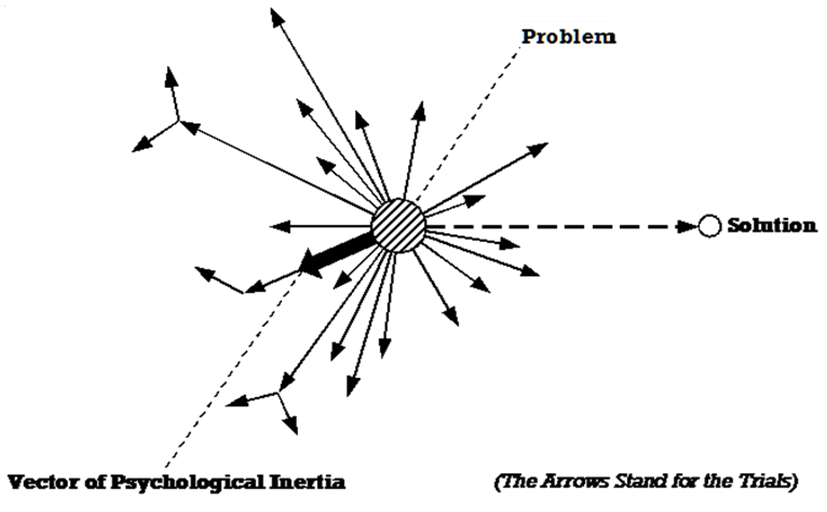
Figure 1: Trial and Error Method
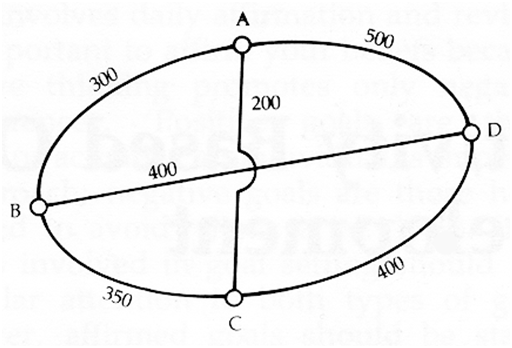
Figure 2
An example of a problem which has a low difficulty level is as follows:
“A man from city A wants to go to cities B, C and D for sightseeing (the order of these cities is not important) and then comes back to city A. Figure 2 is the plan of the roads connecting the cities and their lengths in kilometres. Help him to find the shortest route for sightseeing”.
Since the man departs from A and at last comes back to A so the possible routes are different only in the order of the other three cities: B, C and D. In other words, there are totally six possible variants:
ABCDA … … 300 + 350 + 400 + 450 = 1550
ABDCA … … 300 + 400 + 400 + 200 = 1300
ACBDA … … 200 + 350 + 400 + 500 = 1450
ACDBA … … 200 + 400 + 400 + 300 = 1300
ADBCA … … 500 + 400 + 350 + 200 = 1450
ADCBA … … 500 + 400 + 350 + 300 = 1550
and two possible solutions: ABDCA and ACDBA. In this case, the ratio of variants/solutions is 3. In contrast, Edison had been conducting more than 50,000 experiments to find the alkaline accumulator, not counting his own mental experiments.
For the problems which have only a finite number of possible variants, the trial and error method is quite appropriate. One just considers variant after variant in order to find out the solution.
TRIZ divides difficulty levels of problems (or the inventive creativity levels) into five levels. The first level has some possible variants. The second level has some dozens of possible variants. The third level has some hundreds of possible variants. The fourth level has some thousands to some dozens of thousands of possible variants and the fifth level has some hundreds of thousands, some millions even countless variants. There is a change not only in quantity but also quality here: the higher the level is, the wider the scientific and technological knowledge required to solve the problem.
As indicated, the trial and error method is quite suited to problems at the lowest levels of difficulty. However, for problems at higher levels this method shows many disadvantages, some of which are outlined below.
- The number of ideas achieved per unit of time is few, so the problem-solving process lasts for a long period of time.
- The existing vector of psychological inertia prevents the solver from the right solution because it drives the mind to what is previously known. \[i.e. the functional fixedness phenomenon, Ed.\]
- The trial and error method wastes much time, thinking energy, material means and even human lives, if time is critical in a life-threatening situation.
- The trial and error method has no mechanism for directing the solver’s thinking towards the solution: the solver is unable to define the direction in which the necessary solution might be found. This is the fundamental disadvantage of the trial and error method.
In contrast, imagine what happens if we have a directing mechanism (see Figure 3a).
Thanks to this mechanism the solver can eliminate a considerable number of barren trials not coinciding with the solution’s direction. In the ideal case, if the directing mechanism can be built very exactly the solver can use only one trial leading to the solution (see Figure 3b). Thus, the solver can transfer problems from the fifth level to the second or the first, where the usual principle of considering variants is suitable. In fact this is the heart of the whole problem: one must be able swiftly to reduce the field of enquiry and turn difficult problems into easy ones.
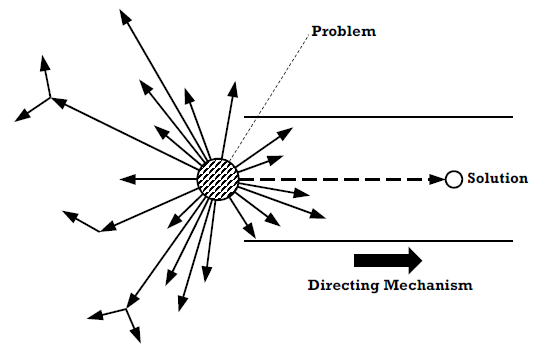
Figure 3a
There have been efforts to perfect the trial and error method such as brainstorming, morphological analysis, check-listing, synectics… and their modifications. Practically, methods make contributions to overcoming mainly the first three disadvantages of the trial and error method. TRIZ differs from them in finding the directing mechanism.
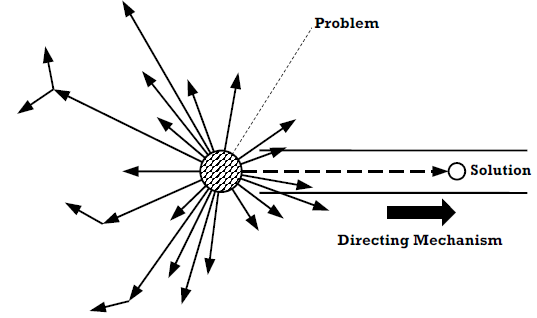
Figure 3b
TRIZ and the Systems Approach
Mankind has to study objects and solve problems that are getting more and more complex. The approach considering the whole as an arithmetical sum of components is not suitable any more. It is necessary to have an approach that permits study not only the components and the dependences, actions and influences between them, but also the qualitative change of the whole in relation to these components. Creativity in general and inventive creativity in particular are very complicated concepts. For that reason the systems approach is consistently used in TRIZ.
System is defined as follows: a system is an assembly composed of connected component elements so that the whole assembly has such properties which cannot be reduced to the properties of the separate component elements. These properties are called systemness (or wholeness) of the given system. The systemness is used to express specific functions of the system or to answer the question ‘for what is the system born (or constructed)?’
An element is understood as a component part of the system which will not be divided more under given consideration or in the concrete conditions of the given problem.
A connection is interaction, mutual dependence and influence between elements usually shown in three aspects: substance, energy (field) and information.
An airplane for example is a system. It consists of connected component elements such as its engine, fuel tank, body, wings, tail, electric circuits, control mechanisms… and the whole airplane can fly. This property cannot be reduced to the property of the engine, fuel tank, body… separately.
Figure 4 is a symbolic scheme of the system.
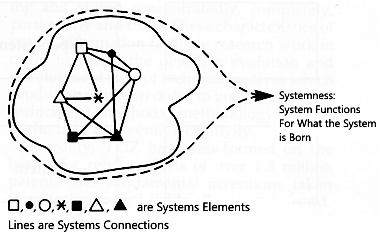
Figure 4
The writer does not intend to classify the elements, the connections and the systems in detail here. He would just like to emphasise a few points associated with the concept of system.
- The systemness depends on both the elements and the connections. For that reason, it is possible to increase the systemness by changing (modifying, adding, removing…) the elements, or the connections, or both.
- In general, the system’s development is shown in the tendency to increasing efficiency of the systemness or ideality of the system. This ideality is evaluated by the ratio: \[sum of the useful systems functions/sum of the expenditures on their realisation\]. To achieve this goal, every element and every connection should be built so that this ratio is constantly increased.
- Because of systems connections, any change happening somewhere in the system will not be located at that place but will spread throughout the system.
- In reality, nearly all systems are open systems. They exchange substance, energy and information with other systems and the environment.
- The definition of a system is relative in character. What may be called an element in some circumstances, under others can be called a sub-system. On the contrary, what may have been called a system may be an element of a bigger system. In this case, the latter system is named as supersystem. If an airplane is a system, then an engine will be a sub-system and an airport will be a supersystem. Thus, we can differentiate further: sub-subsystem, super-supersystem and so on, forming the systems hierarchy. Through changing systems level we can extract many specific problems from the initial problem situation. This is important, because in many cases the right solutions do not lie at the given systems level but at other levels.
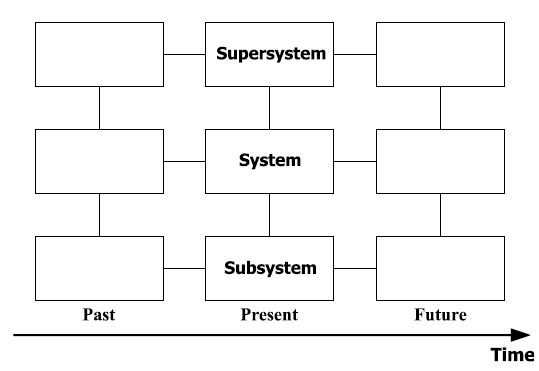
Figure 5: Nine-Systems Thinking Display
- Over time, systems are constantly in evolution and in a process of development. So we should differentiate them in time: the past system, the present system, the future system. However, time also possesses relative characteristics. For example, if we suppose wood is the present system, then the tree will be the past system. If a full-grown tree is the present, then a young tree will be the past and wood will be the future. This is also important because in many cases the right solutions do not arise at the present but in the past or in the future.
TRIZ aims at constructing systems thinking. There is always a particular system in each inventive problem. TRIZ not only requires but also creates devices that help a solver to ‘see’, think about and process, at least, nine systems ‘display’ (see Figure 5).
As reality has shown, the solution of the problem sometimes does not lie in the system or sub-system at the present but in the present supersystem or system, sub-system and supersystem in the past, so to solve problems at the present time is too late. The other three systems relate to the future. The faster the speed of change, the more important becomes the role of foreseeing future problems and development.
TRIZ uses a systems approach and goes on to discover the objective laws of evolution and development of technical systems. These represent themselves as the base for building the directing mechanism which helps us escape blind trial and error.
Subjective and Objective Sides of Creativity
Although there are many creativity definitions, researchers, in general, agree on two major points of creativity concept: novelty and utility. It is widely believed that creativity relates mainly to the subjective psychology of human beings. That is true but not enough. If accepting that where both novelty and utility exist at the same time, there exists creativity, then reality has shown that creativity can happen at the place where subjective psychology of human beings is absent. For example, the evolution and development of biological systems made the appearance of bio-individuals, species more adaptable to their environment… and possessing new and useful abilities for survival. This is also creativity but human psychology does not take part in this process. \[i.e. the creativity of evolution, Ed.\] In this case there is also a contribution of trial and error method: mutations play part of the trials, and the survival of the fittest are the solutions.
So it is possible to claim that there is an objective side of creativity, and that creativity can appear wherever evolution and development occur. It is only when human beings became creative subjects that psychology, and human subjectivity participated in the creative process.
TRIZ not only takes into account the subjective side of creativity but also supposes that it would be a fundamental drawback if insufficient attention were paid to the objective side of creativity. Moreover, TRIZ especially emphasises the objective side of creativity and concentrates its great efforts on finding out the objective laws of evolution and development in the field of inventive creativity. The essence of the issue is that only those people who grasp these objective laws and manage this psychology along them can achieve a high efficiency in creativity.
Human psychology has a concretely historical character and is not unchangeable. Though TRIZ takes into account present psychology, TRIZ also has the purpose of constructing a new psychology which will work in accordance with systems thinking, directed by objective evolution and development laws.
The Important Role of Patent Information
In order for a technical invention to get a patent it must satisfy the following requirements simultaneously:
- Being the solution of the problem: the author of the invention must indicate the way to implement the idea, not present the idea only.
- Novelty: the author of the invention must point out the new aspects of the invention in comparison with its prototype.
- Utility: the author must show his invention overcoming what disadvantages and/or creating what advantages in comparison with its prototype.
Although creativity appears in all areas of human activities, inventiveness is, maybe, the only field where the author of the creative product is compelled to describe the above points in his (or her) application form for patents. For example, in the literature field, a lot of writers describe family life but no one is compelled to show the novelty and utility of one’s own work in comparison with its prototype (previous work). The same situation can be found in other fields such as music, painting, military, management, politics…
Due to strict technical, economic and especially legal requirements, information on inventions (or patent information) which is different from the information reflecting other kinds of creativity, is structured in special patterns, classified for easily searching and stored concentratedly, completely, particularly and truly. These charactseristics of patent information facilitate research work in order to reveal the objective evolution and development laws of technical systems which produce patents, in order to build techniques (principles), methods, methodology, theory in the fIeld of inventive creativity.
In reality, TRIZ has been formed on the basis of careful analysis of over 1.5 million patents and fundamental inventions taken from technological fields all over the world. TRIZ is also a collection and reflection of creative experiences of many inventors’ generations all over the world.
Dialectics - The Philosophic Foundation of TRIZ
Dialectics, in our view, is the science of the most common laws of natural, social and mental development. Creativity is associated with a development, so TRIZ has selected dialectical laws as its philosophic foundation.
There are three laws of dialectics:
- The law of transition of quantitative changes to qualitative changes and vice versa.
- Laws on negation of negation.
- The law of unity and struggle of opposites.
Of them, the third law is the nucleus of dialectics and the first two laws may be considered as particular cases.
Development, from the viewpoint of dialectics, can be understood as follows:
Supposing at first the system was at some level of development where there was unity of opposites. This unity does not exist forever. Because of a struggle between the contrary sides, the initial unity is broken and a contradiction arises. The contradiction is resolved so that the system turns to a new level of development (new unity). In the long run, another contradiction will emerge and will be resolved again so that the system will turn to a newer level of development… and so on without ending. Western readers may be interested to learn that there is some similarity between dialectics and the Taoist philosophy of the Orient.
TRIZ identifies three kinds of contradiction:
- Administrative contradiction between knowing the objective to achieve but not knowing the way to achieve it (or not knowing the right way to achieve it among several known ways)
This contradiction shows that a given situation is a problem situation, or in short, the problem.
- Technical contradiction lies in the fact that improvement of one element of a system (or one of characteristics), through ways previously known, leads to a deterioration in other elements (or other characteristics).
This contradiction shows that the known approaches are not suitable and a new one is needed.
- Physical contradiction lies at the heart of technical contradiction and is a cause of it. Physical contradiction relates not to the whole system but to one part of it – or more precisely, to one fragment of that part. Physical contradiction is based on the fact that this fragment must have two mutually contradictory physical states, that previously cannot coexist in this given fragment. The physical contradiction is usually presented as follows: the fragment must have this state to meet this demand and another contradictory state to meet the other demand.
In fact, to solve a problem is to resolve physical contradiction, i.e. to make a unity from two mutually contradictory states, that previously eliminate each other.
The following is a simple example demonstrating the above three contradictions:
‘Imagine the stage when people used only straight wires to connect electric devices. There was the requirement: make up a kind of the cord appropriately connecting the telephone with the handset’.
In this case, an administrative contradiction occurs between knowing the goal to reach (the requirement to be satisfied) and not knowing what type of cord will be appropriate. In other words, the problem starts (see Figure 6a).
By using a known straight cord one can reveal technical contradiction which can be formulated in two ways:
If the cord is short we get the advantage of compactness but do not get convenience when using the telephone.
If the cord is long we get convenience when handling the telephone but lose compactness (the cord occupies much place on the table or gives reason for the telephone falling when someone stumbles over it) (see Figure 6b).
Thereby, the physical contradiction is: the cord must be short for compactness and must be long for convenience when using the telephone. In this problem two mutually contradictory physical states are ‘short’ and ‘long’.
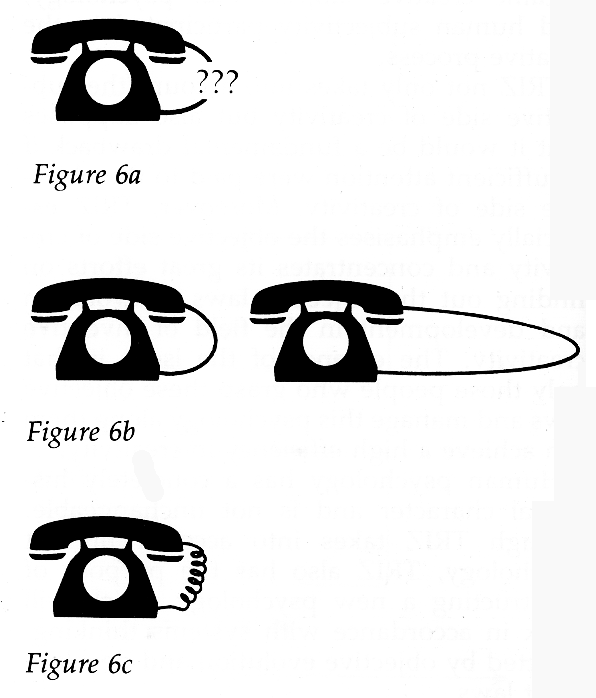
In other problems physical contradiction may be: the fragment ought to be hot and not to be hot, be moving and not to be moving, etc.
Eventually, the straight cord was replaced by a spiral cord which osvercame the given physical contradiction (see Figure 6c). In other words, spiral cord established the unity of two mutually contradictory states. It is also the creativity product in comparison with its prototype: straight cord. In general, in TRIZ there is the means that helps the solver to reveal and to eliminate revealed contradictions.
Figure 7 summarises the sources, on which TRIZ has been constructed.
TRIZ Structure
TRIZ structure is shown on Figure 8. The objective laws of evolution and development of technical systems serve as the base of TRIZ. At the present eight such laws have been found. In the future the number may increase. The names of these laws are:
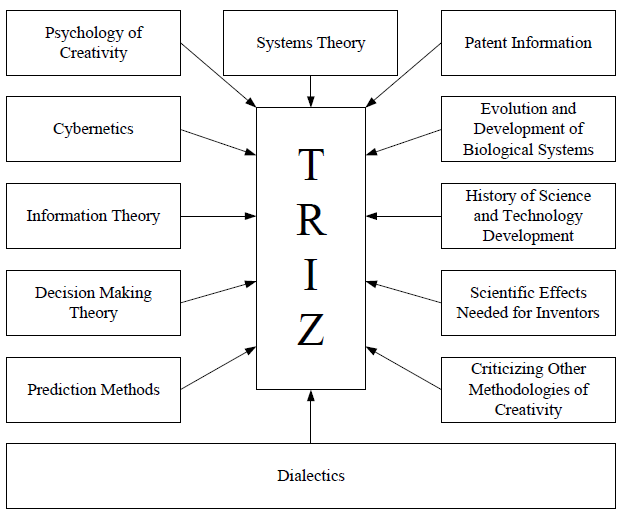
Figure 7: The Sources of TRIZ
- Law of completeness of component parts in technical systems
- Law of transference of energy in technical systems
- Law of co-ordination between component parts in technical systems
- Law of increasing ideality of technical systems
- Law of irregular development of component parts in technical systems
- Law of transition to development at supersystems level
- Law of transition from development at macrolevel to microlevel
- Law of increasingly controllable characteristics of technical systems.
In TRIZ there is a technique called substance-field analysis (vepol analysis in Russian) which helps the solver to differentiate familiar (standard) and unfamiliar (nonstandard) problems. The standard problem concept has the meaning only for one who learned TRIZ. Then, the solver can use standard rules from an information store for solving inventive standard problems. For the time being there is a system of 76 standard rules in TRIZ.
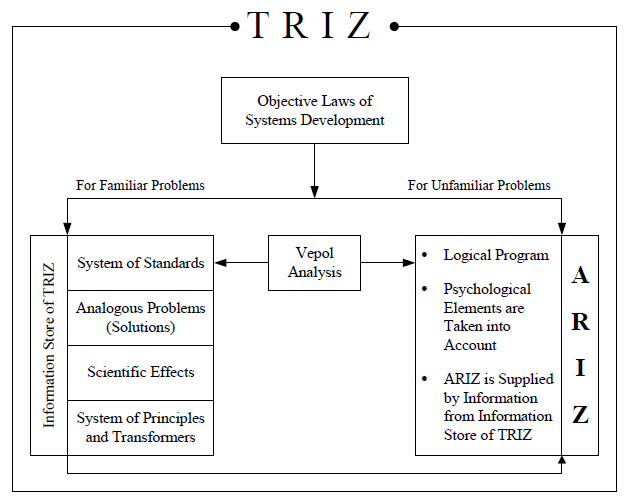
Figure 8: TRIZ Structure
In order to grasp TRIZ the participant in the studying process must solve hundreds of instructional problems, taken from patent information. The solutions to these problems factually become the participant’s ‘capital’ which can be used in reality when he (or she) meets analogous problems.
The information store of TRIZ includes a knowledge-base which collects strong scientific effects often found in the field of inventive creativity and for making inventions at higher creativity levels. Presently, TRIZ has selected 50 geometrical, over 100 chemical, over 300 physical and a few biological effects.
The information store of TRIZ also contains the system of techniques helping the solver to overcome technical and physical contradictions. The system involves 40 basic principles and 11 transformers.
If the given problem is not standard (unfamiliar), then the solver should use ARIZ (Algorithm of Inventive Problem Solving). ARIZ is a logical, directed and planned programme composed of many steps which aims at rationally organising the process of inventive problem solving. ARIZ is an algorithm for human beings so ARIZ’s steps were built not only on the basis of objective laws of evolution and development of technical systems, but also considering the elements of psychology and imagination. ARIZ is directly supported by the information store of TRIZ.
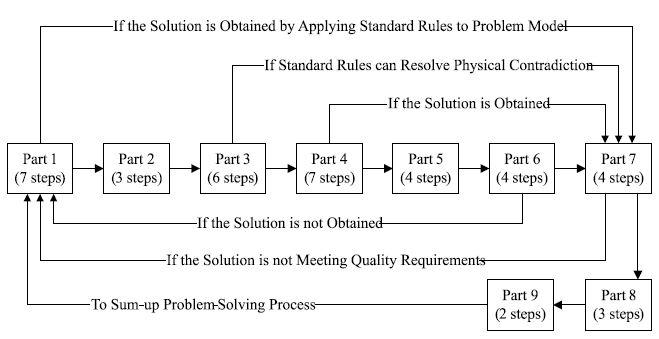
Figure 9: ARIZ Structure
Structure of ARIZ-85C
ARIZ came into being in 1956 and was called ARIZ-56, and since has had its modifications as ARIZ-59, -61, -64, -65, -68, -71, -75, -77, -82A, -82B, -82C, -82D. The latest ARIZ is ARIZ-85C, whose structure is shown in Figure 9.
ARIZ-85C has 40 steps, and is divided into 9 parts.
Part 1 – analysis of the problem. This part aims at extracting the simple and clear problem model from the initial complex problem situation. If standard rules applied to the problem model can give the solution, the solver can go to Part 7 immediately. If not, the solver should come to Part 2 – analysis of the problem model.
In Part 2, the solver needs to reveal and list intrinsic resources existing in the given system that can help to solve the problem. These resources used to be expressed in the form of space, time, substances, energies (fields) and information.
Part 3 is dedicated to determining the final (ideal result and physical contradiction. The final ideal result can be regarded as the ideal target to which the solver should steer his (or her) thinking. And the physical contradiction expresses the difficulty needed to be overcome on the way to the final ideal result. In Part 3 standard rules are used again to resolve physical contradiction. If the solution can be obtained the solver can go to Part 7 at once. If not, the solver goes to Part 4.
Part 4 requires the solver to mobilise and use intrinsic resources (including their modifications and combinations) to solve the problem. If the solution is found, the solver can go to Part 7. If not he (or she) comes to Part 5.
Part 5 requires the use of the information store of TRIZ to generate ideas for solving the problem. After that, the solver goes on with Part 6.
In Part 6 two possibilities may occur. The first one – the necessary idea is found. Then the solver must develop it into a technical solution and goes to Part 7. The other one – failure in getting the idea. It is essential to get back to Part 1 in order to formulate the changed problem or another problem. Sometimes, it may be the problem at supersystem or super-supersystem levels… and repeat the process to solve the new problem.
Part 7, analysing how to overcome physical contradiction, aims at evaluating the efficiency of the obtained solution. Here there are checking questions. If one of them is unsatisfactorily answered, the solver has to go back to the beginning. If everything is fine, it is necessary to check the formal novelty of the obtained solution in the comparison with the existing patents and to formulate sub-problems in order to put it into practice.
Part 8 has the task of widening the application ability of the obtained ideas on the supersystem and on related problems.
Part 9 aims at establishing the feedback between the solver and TRIZ. First, the solver should sum up his (or her) process of using TRIZ so that the solver can perfect his (or her) TRIZ’s qualification and skills. Second, the solver may discover new points when solving the given problem which at present are not available in TRIZ, thereby permitting refinements in TRIZ. In other words, TRIZ is a self-developing system. TRIZ becomes more and more powerful and more and more suitable to TRIZ’s uses.
TRIZ and Facts
Before 1970, TRIZ was mainly taught at seminar workshops. After that many centers, schools studying and teaching TRIZ with different programs were formed in many cities of the former Soviet Union. In particular, during the time from 1972 to 1981 about 7,000 people studied TRIZ at different levels and made 11,000 patent applications, half of which have been considered and 4,000 patents granted. According to Soviet researchers, investing one rouble in organising TRIZ’s classes can bring 16 roubles profit from applying the inventions obtained. Some materials of TRIZ have been translated and published in socialist countries and also in the USA, Japan, Switzerland, Finland… In July 1989 an International TRIZ Association was formed in the former Soviet Union with its President – Mr. G.S. Altshuller, and the Journal of TRIZ was issued in 1990.
At present hundreds of corporations in CIS, Israel and Finland are actively using TRIZ, and hundreds-of-thousands of innovations have been created.
TRIZ is continuing to develop and is being applied to other areas, such as engineering value analysis used for improvement of current products and their cost reduction, process improvement, management, economics, research, science, failure prediction, education (especially in educating children to think creatively). Inventing machine systems, created through combining TRIZ and personal computing won the golden medal at the world exhibition EXPO’90 organised by UNIDO. In recent years, there have been some new studies aiming at constructing greater theories based on TRIZ such as the theory of development of technical systems (Russian acronym TRTS); a general theory of strong thinking (OTSM) and a theory of development of creative personalities (TRTL).
Reflections From Personal Experience
The writer of this article has had many lucky opportunities concerning TRIZ. The first one is through being trained personally by the founder of TRIZ – Mr. G.S. Altshuller in the early 1970s. Since then I have received new materials on TRIZ regularly from Mr. Altshuller and colleagues. Secondly I have had many chances to visit Russia to study and work over a period of 22 years, so I have been able to observe closely the development of TRIZ, and exchange and discuss many related issues with Mr. Altshuller and colleagues. Thirdly, working as a physicist in the field of experimental solid state physics I have to solve problems concerning science and technology, therefore I have a good environment to use TRIZ. Additionally I have used TRIZ for solving other problems encountered relating to behaviour, communication, teaching, managing, organising. Fourthly, I have begun teaching creativity methdologies (mainly TRIZ) in Vietnam from 1977 and in 1991 I formed the Center for Scientific and Technical Creativity (CSTC) at HoChiMinh City University (for more details, see Introducing Creativity Methodologies into Vietnam, Creativity and Innovation Management, December 1994).
Below there are some of my thoughts about TRIZ and creative thinking.
- TRIZ in general and ARIZ in particular is very powerful creativity methodology for solving inventive problems at high levels.
- TRIZ is a helpful methodology to manage contemporary challenges such as fast change, increasing complexity, diversity and strong competition and to convert these challenge into opportunities.
- Like any tool, the user not only uses the tool but the tool also influences the user. TRIZ brings the user many advantages such as:
A system of various multiple perspective in accordance with the diversity of possibilities
Increasing creative curiosity and observation
Overcoming of psychological inertia
Developing the use of imagination
Identifying unity, similarity, analogy among objects, phenomena, processes…in differing domains.
Increasing sensibility in perceiving an processing information
Helping logically to evaluate available creative solutions
Having different approaches to solve problems
Knowing how to reveal, formulate and select the problem needing to be solved
Knowing how to discover contradictions and to generate ideas for resolving them
Predicting systems development, initiating and purposively carrying out this develolment
Predicting failures and finding ways to prevent them (because any creation can be double-edged sword)
Creativity methodologies are often used to improve and perfect external systems, but in fact they can also be used and need to be used to improve and perfect human being. In this aspect, TRIZ has a great potential.
- TRIZ structure is flexible and permits
- teaching and learning parts of TRIZ
- using parts of TRIZ according to the type and level of difficulty of the problem
One of the great difficulties in mastering the whole TRIZ is the time needed for learning and practising. In the ideal case the user needs to study many other supporting subjects (see Figure 7). One practical solution is combining TRIZ with personal computer through creating appropriate software.
Another way, I think more essential, is to teach TRIZ and creativity methodologies from kindergarten to high schools for some dozen hours each year so the program is completed when the user graduates from university. Furthermore, teachers of other disciplines need to study creativity methodologies to help students to discover knowledge of these disciplines methodically.
- Of the number of creativity methodologies that I have studied and used in work and daily life, I like TRIZ best. But I suppose that to cope with the variety of this world, creativity methodologies need to be varied and it is necessary to let users have the right to select.
- TRIZ has a great capacity for enlarging application to other non-engineering fields. This can be understood because TRIZ relies on different generalised sources (see Figure 7). In this connection, of course, concrete characteristics of each field should be taken into consideration.
- There are many definitions of human beings, one of them is that human beings are thinking creatures. But from possessing thinking ability to knowing how to think is a long distance. One of the missions of the science of creativity is bridging this distance. The science of creativity needs to educate and train people how to think and act creatively in order to govern development process to construct society which progressively becomes more humane and efficient. Many writers suppose that a great number of tragedies at personal, group, even national and global levels have deep causes through inadequate thinking skills. Writing on this point, I remember William Drummond’s observation: ‘He who will not reason is a bigot; he who cannot is a fool; he who dares not is a slave’ and I want to add ‘He (or she) who knows how to think is a free and happy man (or woman)’.
To conclude this article, I would like to quote some phrases that I love heartily:
‘Human history becomes more and more a race between education and catastrophe’ (H.G. Wells)
‘The object of the education of children lies not in communicating the values of the past, but in creating new values of the future’ (John Dewey)
‘There is one thing stronger than all the armies of the world and that is an idea whose time has come’ (Victor Hugo)
Maybe, the time for the idea of knowing how to think among all mankind will come very soon.
Further Reading
For detailed information on contemporary TRIZ, please consult the following Russian books and journals:
Books
Altshuller, G.S. (1969, 1973) Algorithm Izobretenia, Moskovski Rabotri, Moskva.
Seliuski, A.B., Slugin, G.I. (1977) Vdokhnovenie Po Zakazu, Karelia, Petrozavodsk.
Altshuller, G.S. (1979) Tvortrestvo Kak Totrnaia Nauka, Sovietskoe Radio, Moskva (If I do not make a mistake, this book was translated into English and published by Publishing House Gordon and Breach in the USA).
Altshuller, G.S., Seliuski, A.B. (1980) Krilia Dlia Ikara, Karelia, Petrozavodsk.
Jukov, R.F., Petrov, V.M. (1980) Sovremennie Metodi Nautrno - Tekhnitreskogo Tvortrestva, Leningrad.
Altshuller, G.S. (1984, 1987) I Tut Poiavilsia Izobretatel, Detskaia Literatura, Moskva.
Altshuller, G.S., Zlotin, B.L., Filatov, V.I. (1985) Professia - Poisk Novogo, Kartia Moldoveniaske, Kishiniov.
Altshuller, G.S. (1986, 1991) Naiti Ideii, Sibirskoe Otdelenie ‘Nauka’, Novosibirsk.
Petrovitr, N.T., Tsurikov, V.M. (1986) Putch K Izobreteniu, Molodaia Gvardia, Moskva.
Ivanov, G.I. (1987)… I Natrinaite Izobretatch, Vostotrnoe - Sibirskoe Knijnoe Izdatelstvo, Irkutsk.
Sbornik (Collection) (1987) Derzkie Formuli Tvortrestva, Karelia, Petrozavodsk.
Sbornik (Collection) (1988) Nitch V Labirinte, Karelia, Petrozavodsk.
Zlotin, B. L., Zusman, A. V. (1988) Mesiats Pod Zvezdami Fantazii, Lumina, Kishiniov.
Sbornik (Collection) (1989) Pravila Igri Bez Pravil, Karelia, Petrozavodsk.
Altshuller, G.S., Zlotin, B.L., Zusman, A.V., Filatov, V.I. (1989) Poisk Novikh Idei: Ot Ozarenia K Tekhnologii, Kartia Moldoveniaske, Kishiniov.
Salaamatov, lu.P. (1990) Kak Statch Izobretatelem, Prosveshenie, Moskva.
Zlotin, B.L., Zusman, A.V. (1990) Izobretatel Prishiol Na Urok, Lumina, Kishiniov.
Sbornik (Collection) (1991) Kak Statch Eretikom, Karelia, Petrozavodsk.
Sbornik (Collection) (1991) Shans Na Prikliutrenie, Karelia, Petrozavodsk.
Zlotin, B. L., Zusman, A. V. (1991) Reshenie Issledovatelskikh Zadatr, Kishiniov.
Vikentiev, I.L., Kaikov, I.K. (1992) Lestnitsa Idei, Novosibirsk.
Journals
Rubric ‘Tekhnologia I Psikhologia Tvortrestva’ in Journal ‘Tekhnika I Nauka’ from 1979 to 1984
Journal TRIZ from 1990.
Acknowledgements
With respectful acknowledgement to my teacher – the founder of TRIZ, G.S. Altshuller.
As one of TRIZ-disciples I would like to thank Dr. Tudor Rickards and Ms. Susan Moger for giving me a chance to write about the main ideas of TRIZ in the pages of Creativity and Innovation Management.
17.3.3 Systems Inertia In Creativity And Innovation12
Phan Dung
Abstract
Creativity and innovation are associated with systems state transition process. For successful state transition, systems inertia should be taken into account. In this paper, the concept of systems inertia is formulated, a few recommendations are outlined and a preliminary vision on the related issues is given.
Introduction
Creativity and innovation lead to positive changes in systems. There are many questions associated with this process of change. For example, how to manage changes deliberately and surely? How to decrease the cost of the changes? How to increase benefits from the changes? How to increase acceptability of changes in systems? And how to decrease the length of change process? To answer such questions adequately, systems inertia should be taken into consideration.
This paper will outline a few points on systems inertia, to which, in the writer’s opinion, everyone working in the field of creativity and innovation (especially, practitioners) should pay close attention.
Some working definitions
A system is an assembly composed of connected component elements so that the whole assembly has such properties which cannot be reduced to the properties of the separate component elements. These properties are called systemness of the given system. The systemness is used to express specific functions of the system or to answer the question “for what is the system born (or constructed)” (for more details, see Dung, 1995).
A systems state is defined by all possible specific parameters (in the widest meaning) describing the given system, so when at least one of them changes, we will consider it as state transition.
Creativity is an activity leading to any thing (in the widest meaning) having both novelty (or newness) and utility (or usefulness) simultaneously.
Innovation is a process making new, stable elements and connections happen and/or making existed elements and connections disappear in the given system, and thus, translating it into the second state where the given system operates in practice better than at the first state (i.e. both the newness and usefulness have become real in the given system).
Systems Inertia
For practical purposes, it is useful to begin with a very simple instance taken from daily life (see figure 1).
The truck moves at a constant velocity of V. At moment the driver puts on the brakes with the force of F. The truck has not stopped at once but moves further, slowing down for the time interval of because of the truck’s inertia. We will replace the specific terms by the generalized terms as indicated in figure 1. And now, we can formulate the definition of systems inertia.
Systems inertia is the attempts or efforts made by the given system, towards preserving the old states (i.e. the past state, especially, in the system having memory effect and the present state) and always resisting the transition to the new state if the new state does not coincide with the change tendency at the old states.
Systems inertia in itself may be positive or negative depending on specific situation in relation to a specific person. But in creativity and innovation, remarkably, at their high levels, systems inertia is usually negative. In this paper we will focus mainly on the negative side of systems inertia. What relates to the positive side of systems inertia will be the topic of another paper. Below, we will present a few thoughts about creativity and innovation in the context of systems inertia.
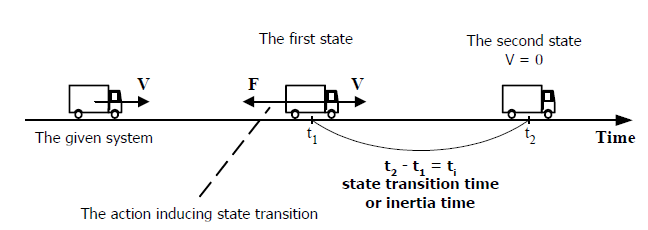
Figure 1
The Implications of Systems Inertia
According to the special theory of relativity, the maximum velocity of motion is equal to that of light in vacuum, i.e. there is not infinite velocity. For this reason, we can conclude that systems inertia is the attribute inherent in any system and is always greater than zero ( ti > 0). Creativity and innovation deal with a state of transition of systems, then systems inertia should be taken properly into account, although in many systems, systems inertia can be invisible.
In creativity and innovation, systems inertia should be taken into account in at least in three cases ( see figure 2).
- If we assume that people (in particular: one person) are creative subjects, then systems inertia can be expressed in the form of their psychological inertia, habits, styles, inflexibility of organizational structure… can prevent them from the right solution because systems inertia drives the mind (in the widest meaning) to what is previously known.
- People conducting creativity and innovation deal with a certain system to improve it. In this case, systems inertia may strongly counteract introduced changes and in such way the given creative solution can fail.
- Even when the given solution is successfully implemented, when people apply it in practice, because of systems inertia, the system ‘practice’ may not accept such a solution.
By the way, in our opinion, the problem can be considered as successfully solved only when its solution has been accepted fully by practice. More concretely, when all acceptors (or nearly all acceptors), potentially needing to use the given solution in reality already have used it as usual. In other words, what we need is not creativity (innovation) for the sake of creativity (innovation) but for the sake of the problem being solved successfully in practice.
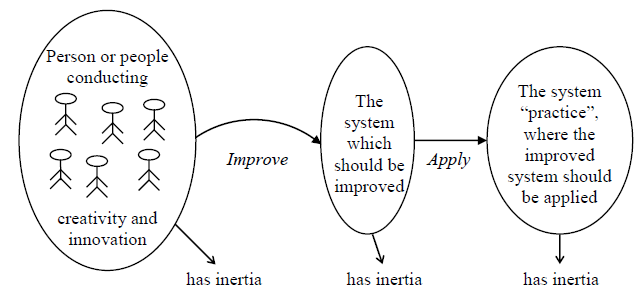
Figure 2
- Generally, the greater degree of change is in system, the more systems inertia there is, therefore, the more the resistance against state transition there is. This point may have a significant influence, at least, on two stages of problem solving process: problem finding and decision making.
- Problem finding stage: Differing from the type of instructional problem given in schools, the problem encountered in reality is not specific to a target and rightly stated problem. More exactly, in reality we have the initial problem situation, from which different specific problems can be derived, depending on how concretely a person looks at this situation. In relation to systems inertia we will use a degree of change in the given system as the criterion for differentiating these specific problems (see figure 3).
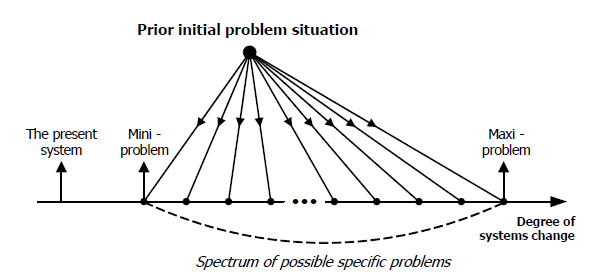
Figure 3
Among specific problems, constituting the spectrum there are two extreme problems (in the meaning of change degree): minimum problem (mini-problem) and maximum problem (maxi-problem). It is desirable, that the mini-problem should be tackled first because of the following advantages (see Altshuller, 1979):
Its solution, if it is found has high acceptability in practice.
Its solution cost is low
The period of time, for which its solution is implemented in practice is short.
Its solution benefits are high
Because of systems connections, any change happening somewhere in the system will not be located at that place but will spread throughout the system. In consequence, systemness of the system may get worse. So, minimum change helps to decrease this danger.
To solve the mini-problem, the solver must make maximum efforts in using intrinsic accessible resources present in the system, and in such way the solver would check the paradigms, on the basis of which the system was created and evaluate a position of the system on the S-curve (for information about S-curve, for example, see Altshuller, 1979; Foster, 1986).
These advantages contribute to an explanation of why, in many cases, continuous improvement has a significant potential to enhance competitiveness (see, for example, Bessant, 1992).
This recommendation does not mean: “Never (attempt to) solve the maxi-problem”. For research goals, the solver can take it up. Or if the solver discovers that the old paradigms have been exhausted, which usually occurs when the system is located at top part of the S-curve, they may wish to proceed with the maxi-problem.
- Decision making stage: If the mini-problem can be solved, the solver may have found a few equivalent solutions. In this case, again, preference would be given to the solution, that will change the system to the minimum extent because of above stated advantages.
To overcome systems inertia we need to have the action inducing state transition. But the appropriate attention should be paid to its type, magnitude, space, time, and ways of application… in which the action will develop in order to get high effectiveness in conducting creativity and innovation. For example, for many problems instead of the impulsive, discrete regime of action, the continuous regime is used.
In practice, concerning inertia time, there are several cases to be taken into consideration:
- There exists optimum inertia time t(i-op) in the meaning that t(i-op) is the shortest time, through which the system can pass to the new state successfully (without damage or destruction) for the given way of state transition.
- In practice, usually, if the new state is desirable, people tend to intensify the given inducing action, like a driver increasing braking force for shortening state transition time. But there is a limitation. If ti < t(i-op) the system can be damaged or even destroyed. Thus, rapid change (including rapid development) may lead to bad consequences (i.e. future shock).
- If in practice ti > t(i-op), then time will be wasted, therefore all means will be wasted.
- If ti >> t(i-op), excluding wasting time, there may be a danger of damaging or destroying the system, because the newly emerging need of change in the system is not satisfied in time.
- Generally, t(i-op) is objective (i.e. it cannot be changed) for the given way, in which state transition is performed in the system. But this time may be shortened if we can find a differing way, more appropriate for state transition. For example, in order to avoid getting a glass broken, pouring boiling water quickly into it, we can put a silver spoon into the glass in advance. In other words, here, again, creativity and innovation are required.
For simplicity in presenting the next issue, the imaginary systems state transition process is illustrated symbolically by figure 4.
State one is described by the elements: point, straight, plus sign and state two: point, circle and square. States 1A, 1B, 1C, 1D are some of intermediate states. The lines between elements are systems connections. In the figure we can watch how state one turns into state two: the point remains unchangeable during the state transition process; the straight, bending down step by step, turns into the circle; the plus sign reduces and has disappeared at last (plus sign is backward element); the square has appeared and grows up to the necessary scale; the multiplication sign has appeared and grows up to the necessary scale (states 1A, 1B, 1C) then reduces and has disappeared because this sign is not needed at the state two. In other words, the multiplication sign plays an active part only temporarily at some intermediate states.
So we will continue our thoughts on state transition, as follows:
The intermediate states do not play the same part during the state transition process. For example, at the initial intermediate state (state 1A) there are the changes in quality but at other intermediate states the changes are mainly quantitative. Because of the uneven qualitative change, special attention should be paid to the first initial intermediate state. That is, it is necessary to prepare the system fully and neatly, only then the state transition process may be started.
Now, except for some simple mechanical, electrical systems, where may be calculated theoretically, there is not the generalized formula for all systems. But in practice, we may make ti to be closer t(i-op) to if we can imagine the state transition clearly in detail and perform necessary changes continuously without idling. Here we should make the most of newly emerging quality and tendency as positive inertia. For example, once, straight has had bending tendency (states 1A, 1B), then bending process should be continued constantly up to circle and similarly for other elements and connections.
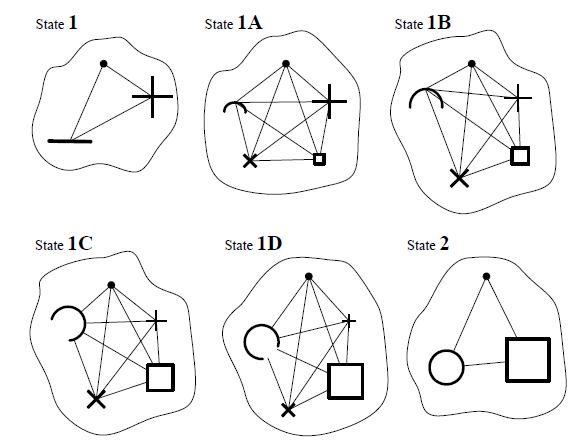
Figure 4
During state transition process, there may be elements or connections which play positive part only temporarily (e.g. the multiplication sign at the states 1B, 1C), warning means should be prepared. Because they also have inertia and their inertia may resist process reducing them (the multiplication sign at the state 1D).
For backward elements and connections like the plus sign, appropriate liquidation ways must be chosen or newly created because of their inertia, i.e. they do not disappear voluntarily. Please, remember about how difficult it is to liquidate rubbish, waste, especially radioactive waste.
It is necessary to distinguish two kinds of newly emerging elements and connections. The first is of new elements and connections obtained by reconstruction and reorganization inside the system (e.g. circle obtained from existed straight). And the second is of new elements and connections, introduced into the system from outside (e.g. square and multiplication sign are the new elements which did not exist at the state one). Here is a recommendation. If we have a problem in the given system, first thing we should do is to mobilize and use existing intrinsic resources (including their modifications and combinations) to solve the problem. If the solution has not been found, then think of elements and connections to be introduced into the given system from outside. These new elements and connections should be selected among positive candidates so that, being introduced into the given system, they help to solve the problem and, simultaneously, do not complicate the given system and cause negative consequences in it. That is, again, the changes in the given system should be minimum ( see also point 3).
In our life, many times, we play the role of the new elements or connections entering the system from outside (e.g. to be hired, to get married, to go abroad). According to point 11 we must not complicate the system, cause negative consequences in it and must help the system to solve its problems (i.e. we must contribute to increasing the systemness). Only then the system can accept us easily. There are useful sayings: “When in Rome, do as the Romans do” or “Do not pray to your religion in a church of strange religion”.
This recommendation is important, notably at our time when we would like to avoid many conflicts, due to a merger or acquisition of firms, international business, cultural exchange, workforce migration and so on.
- System consists of subsystems, so we have ti-sys for the whole system and a number of ti-sub for subsystems. In general, they may be significantly different. We should pay appropriate attention to this point in designing, constructing and managing systems state transition process so that these are coordinated and consistent between themselves. If not, the given system can be deformed, degenerated, even destroyed (see figure 5).
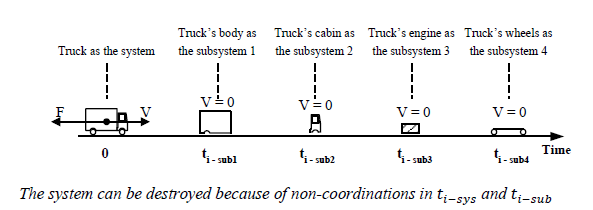
Figure 5
Conclusion and vision
Creativity and innovation are associated with systems state transition to a new state, where the system operates better. More than that, in practice, creativity and innovation are performed not for their sake but for the sake of successful problem solving. Therefore, systems inertia as an inherent attribute in any system should attract at the very least attention of everybody who work in the field of creativity and innovation.
The recommendations, outlined above, mainly, have emphasised the disadvantages of systems inertia. With increasing time, a number of recommendations (including those on its advantages) can be greater and they may serve as a check-list in designing, constructing and managing creativity and innovation.
In our opinion, the issues on systems inertia should be integrated in programs of training courses on creativity and innovation. Our experiences at the Center for Scientific and Technical Creativity, belonging HoChiMinh City University have shown that such issues are very useful for courses’ participants in overcoming their psychological inertia, problem finding and choosing, decision making, using existing positive inertia and creating new positive one.
In our opinion, qualitative and quantitative research on systems inertia should be enlarged and deepened. It is helpful, not only for creativity and innovation but also for traditional areas such as physics, chemistry, biology, society, economics, cybernetics… i.e. everywhere there a management of transition processes is needed. The results of such research will contribute to common cause of converting fast change challenges into opportunities.
References
Altshuller, G.S. (1979) Tvortrestvo Kak Totrnaia Nauka, Sovietskoe Radio, Moskva.
Bessant, J. (1992). ‘Big Bang or Continuous Evolution: Why Incremental Innovation is Gaining Attention in Successful Organisations’. Creativity and Innovation Management, Vol. 2, pp. 59-62.
Dung, P. (1995). ‘TRIZ: Inventive Creativity Based On The Laws Of Systems Development’. Creativity and Innovation Management, Vol. 1, pp. 19-30.
Foster, R. (1986). Innovation (The Attacker’s Advantage), Summit Books, New York.
17.3.4 Creatology: A Science For The Twenty-First Century13
Phan Dung
Abstract
This paper is associated with the emerging discipline: Creatology. The paper is structured in five parts. In the introduction part working definitions on creativity, creative thinking and innovation are given. The second part describes some main events concerning the history of creatology. A brief review on applied aspect of creatology i.e. creativity techniques, methods, methodologies is presented in the next part. The three parts mentioned above are written on the basis of available literature published in English and Russian in the field of creativity and innovation with comments of the current author. The fourth part outlines some results and experiences of introducing creativity methodologies into Vietnam. A few conclusions and a preliminary vision on the related issues are given in the last part of the paper. The current author having been working for nearly 25 years in the field of creativity and innovation believes that the new discipline will make a “revolutionary” contribution to solving the problems facing individuals, companies, organizations, countries and Planet Earth in the twenty-first century.
- Introduction
Creativity was connected with the process of humanization of our earliest ancestors. Creativity has been helping human kind achieve today’s civilization. And creativity will play growingly important part in the development process of all people in the future.
Although there are many different, even contradictory opinions on creativity in general and on definition of creativity in particular. Most researchers have agreed on two major points of creativity concept: novelty and utility. So the working definition of creativity being used in this paper is formulated as follows:
Creativity is an activity leading to any thing (in the widest meaning) having both novelty (or newness) and utility (or usefulness) simultaneously.
Below the working definitions of problem, creative thinking and innovation will be given in this manner:
Before we have creative products we use in daily life (for example: goods, tools, devices, machines…), initially, creative ideas of these products emerged in the heads of their creators. In other words, human being’s creativity is associated with creative thinking. Many studies have shown that our brains work actually actively when we have problems to solve and/or decisions to make.
Problem (or Problem Situation) is a situation where a solver (or solvers) knows aim or purpose or goal to reach but
- does not know any way to reach it or
- does not know the optimum way to reach it among several known ways to reach it (i.e. decision making process)
Problems are very diverse and can be personal, collective, national, global.
Creative thinking is the thought process leading the solver (or solvers) to
- knowing the way to reach his/her aim or purpose or goal or
- knowing the optimum way to reach his/her aim or purpose or goal among several known ways.
We called this process creative thinking because there are both newness: from “not knowing” to “knowing” and usefulness: at last the desired aim or purpose or goal is reached (at least for the given solver).
After getting the solution to the given problem, the next step is to realize it in places where this solution is needed.
Innovation is a process of implementation converting both the potential newness and usefulness which are located within the solution into real ones to be accepted solidly by the given system
By the way, in our opinion, the problem can be considered as successfully solved only when its solution has been accepted fully by practice. More concretely, when all acceptors (or nearly all acceptors), potentially needing to use the given solution in reality already have used it as usual. In other words what we need is not creativity (innovation) for the sake of creativity (innovation) but for the sake of the problem being solved successfully in practice. In such case we will have a genuine development in reality.
Because creativity and innovation can occur in every area of human activities and life, creatology (creativity science) is a transdisciplinary and integrative science.
Because of limited time for a presentation at our Symposium, allow me present only a few main facts associated with the development history of creatology (including the networking of an independent creativity community of scientists and practitioners) and a brief review on its applied aspect i.e. creativity techniques, methods, methodologies. Then, we will share with you some experiences of our activities introducing creativity methodologies into Vietnam during the past 20 years. Conclusions and a preliminary vision on the new discipline will be given in the last part of the paper.
- On the Road to Creatology
In Volume 7 of his “Mathematical Anthology” the Greek mathematician Pappos who lived around 300 A.D. first coined the term “heuristics”. And although Pappos cited Euclid, Appolonius of Pergamos and Aristos the Elder as his precursors, the origin of heuristics - the science of making discoveries and inventions - is associated with his name. From the first the terms “discovery” and “invention” were given the broadest interpretation in heuristics. Discoverers and inventors were taken to include artists, poets, politicians, military leaders, philosophers and others. Later many mathematicians including Descartes, Leinbniz and Poincare applied themselves to the problem of creating heuristics. Evidently, since it was denied the possibility of experimental development, mathematics felt the need for an instrument for solving creative problems earlier and more strongly than other sciences.
In the second half of the 19th century research studies on the psychology of scientific and technological creativity began to appear. The status of deliberate and explicit research on the topic of creativity within the United States was pointed frequently to the presidential address given to the American Psychological Association by J.P. Guilford in 1950.
In 1950s and 1960s the field of creativity received a stimulus for the new development stage thanks to created practical methods or methodologies which allowed really to improve personal and collective creative abilities and these methods or methodologies could be taught and learned. (For example, brainstorming was created by Alex F. Osborn in the USA, algorithm of invention - by G.S. Altshuller in the former Soviet Union, lateral thinking - by Edward de Bono in the UK).
In 1954, Osborn founded the Creative Education Foundation (CEF). A year later the first Creative Problem Solving Institute (CPSI) was held at the State University of New York at Buffalo. CPSI (pronounced sip-see) has been an annual event ever since.
Through the work of Osborn the Center for Studies in Creativity (CSC) was formed at the Buffalo State College. An undergraduate curriculum was approved in 1974 and the graduate program - in 1975, and in November of 1994 the 100th student earned a Masters of Science in Creativity and Innovation from Buffalo State College.
In the former Soviet Union (now the Community of the Independent States - CIS) Altshuller founded the Laboratory for Invention Methodology (LIM) in 1969, and collaborated with others to form the academic and research Institute of Inventive Creativity (IIC) which belonged to the All-Union Association of Soviet Inventors in 1971. Luckily, the current author was one of its first students.
In Cambridge, UK, Dr. de Bono founded the Cognitive Research Trust in 1969, and then the Center for the Study of Thinking.
Now it is very difficult to enumerate fully all centers or units working in the field of creativity and innovation in the world. But most of them are located in Europe and Northern America. This statement is also true for creativity and innovation networks, associations, national, international conferences, professional journals and teaching programs on creativity and innovation.
There has been tremendous growth in the number and nature of national, regional, continental and international forms of networking, for example: the American Association of Managers of Innovation, the American Creativity Association, the Canadian Creativity Network, the Danish Creativity Network, the Nordic Creativity Network, the PERISCOPE Group in Western Europe (from which the European Association for Creativity and Innovation was formally established by notarial act on 27th , October 1993), the PRISM Group in Northern America, TRIZ Association was formed in the former Soviet Union in July 1989, the International Creativity Network connecting individuals on an international level.
Not only has the level of networking expanded, but also the number and kind of international conferences. The trend to have more than one or two main conferences a year continues.
Another very promising trend is the increase in number and quality of resources available in the literature. From 1967 to today, the creativity field has grown from one to four dedicated journals: 1) The Journal of Creative Behavior was issued in 1967, 2) Creativity Research journal – 1988, 3) TRIZ Journal – 1989 and 4) Creativity and Innovation Management journal – 1992. Except for that, highly respected journals within a variety of disciplines are now publishing articles and research on creativity and innovation. Only the Creativity-Based Information Resources created by the Center for Studies in Creativity contains over 5,600 annotations of periodicals, journals, assessment instruments, books, edited collections, software, theses and dissertations.
The term “Creatology” was suggested for the first time by Hungarian Istvan Magyari – Beck at the Conference on Creativity Research hosted by the Center for Studies in Creativity in August 1990. He proposes that creativity could be studied within a new, independent, cross-disciplinary frame work called creatology which is able to synthesize many different approaches to creativity and innovation that are currently isolated from each other. These approaches include sociological, psychological, economic, scientometric, management science, theory of organization, computer science, theory and history of art, humanities, and sciences. And there is agreement among leading scholars about the possibility and necessity of this kind of discipline.
Like many other sciences, creatology also has its applied aspect aiming at creation of tools (in the broadest meaning) for increasing productivity and effectiveness in creative thinking. The next part of the paper will outline this very important aspect for all people.
- Creativity Techniques, Methods, Methodologies and Theories
Psychologists started to experiment with simple problems. It emerged that the experimenters solve problems by compiling a list of variants, that in this process much depends on their previous experience and that each variant considered transforms their view of the problems, etc. In other words, most people used to solve problems by the trial and error method. Such a method is quite suited to problems at the lowest levels of difficulty, where the number of possible variants is small. However, for problems at higher levels this method shows many disadvantages, some of which are as follows:
- The number of ideas achieved per unit of time is few
- The existing vector of psychological inertia prevents the solver from the right solution because it drives the mind to what is previously known.
- The trial and error method wastes much time, thinking energy, material means and even human lives.
- The trial and error method has no mechanism for directing the solver’s thinking towards the solution. This is the fundamental disadvantage of the trial and error method.
The problem solving process has several stages but, initially, many researchers had been focused their attention on the stage of how to generate the more the better creative ideas (divergent thinking). In the West there had been efforts to perfect the trial and error method such as brainstorming, check-listing, forced-relationships, morphological analysis, synectics using four analogies (personal, direct, symbolic and fantasy), lateral thinking’s techniques… and their modifications. Then, in order to enhance the effectiveness of creative thinking there have been created differing problem solving processes (programs) containing also convergent thinking for all stages of the problem solving process. Among these programs there are very known ones such as Creative Problem Solving developed by the Center for Studies in Creativity in Buffalo (CPSB) and the five stages of thinking (To-Lo-Po-So-Go Process) by Edward de Bono.
In our opinion, practically, the mentioned above techniques, methods, methodologies have made the great contributions to overcoming, mainly, only the first three disadvantages of the trial and error method.
Among numerous works on creativity and innovation in former socialist countries there is the distinguished Theory of Inventive Problem Solving (Russian acronym is TRIZ). TRIZ is created by Genrikh Saulovich Altshuller in the Soviet Union (now CIS), starting in 1946. TRIZ differs from “Western” methodologies mentioned above in finding the directing mechanism.
The TRIZ’s main ideas are as follows:
It is widely believed that creativity relates mainly to the subjective psychology of human beings. That is true but not enough. There is an objective side of creativity, and creativity can appear wherever evolution and development occur. If accepting that where both novelty and utility exist at the same time, there exists creativity, then reality has shown that creativity can happen at the place where subjective psychology of human beings is absent. For example, the evolution and development of biological systems made the appearance of bio-individuals, species more adaptable to their environment… and possessing new and useful abilities for survival and development. This is also creativity but human psychology does not take part in this process. It is only when human beings became creative subjects that psychology and human subjectivity participated in the creative process. The essence of the issue is that only those people who grasp the objective laws of evolution and development and manage this psychology (the subjective side of creativity) along them can achieve a high efficiency in creativity The objective side of creativity in TRIZ serves as a directing mechanism in problem solving and decision making. Thanks to this mechanism the solver can eliminate a considerable number of barren trials not coinciding with the solution’s direction. In the ideal case, if the directing mechanism can be built very exactly the solver can use only one trial leading to the solution. In fact this is the heart of the whole problem: one must be able swiftly to reduce the field of enquiry and turn difficult problems into easy ones. Human psychology has a concretely historical character and is not unchangeable. Though TRIZ takes into account present psychology, TRIZ also has the purpose of constructing a new psychology which will work in accordance with systems thinking, directed by objective evolution and development laws. At the present TRIZ contains eight such laws, Algorithm of Inventive Problem Solving (Russian acronym is ARIZ), 40 basic principles, 11 transformers, 76 standard rules, the Knowledge Base which collects strong scientific effects for making inventions at higher creativity levels. In recent years, there have been some new studies aiming at constructing greater theories based on TRIZ such as the Theory of Development of Technical Systems (Russian acronym is TRTS), the General Theory of Strong Thinking (OTSM) and the Theory of Development of Creative Personalities (TRTL).
TRIZ has a great capacity for enlarging application to other non-engineering fields. Such a research has begun and widely continues. This can be understood because TRIZ relies on different generalized sources (for example, philosophy, systems theory, information theory, cybernetics… In this connection, of course, concrete characteristics of each field should be taken into consideration.
- Introducing Creativity Methodologies into Vietnam
In 1977 the first course on creativity methodologies in the whole Vietnam was conducted by the current author for students from differing departments of HoChiMinh City University. In April 1991, after some courses on creativity methodologies for students and large public audiences had proved to be successful, the administration of HoChiMinh City University permitted me to establish the Center for Scientific and Technical Creativity (CSTC).
By August 1996, we worked with more than 3,500 participants (86 courses in all including the basic and intermediate levels), among them high school and university students, workers, dressmakers, sport trainers, artists, pharmacists, physicians, engineers, lawyers, managers, scientists and so forth from all economic and social sectors. Their ages range from 15 to 72, education level from year 9 to Ph.D, Professors.
Below I will outline some of our experiences derived from our activities.
- There are many financial and other difficulties in Vietnam; everywhere money is needed. It is not easy to hope for funding from the state to perform our activities. We must first rely mainly on our forces, energy and enthusiasm to bravely enter a market. In other words, our Center has been working from the very beginning up to now as a self-supporting enterprise. We think, now the market has accepted us and our creativity methodologies program. Thus, we have been able to balance all our expenses during the process of growth of the Center.
- The most important resource for every country is its human resource, and creativity is a human being’s fundamental resource, so our creativity methodologies program should serve a great number of people. So we have built our program not associated with any deeply specialized knowledge of sciences or technologies for the public at large.
- According to a Vietnamese cultural tradition everybody should learn not for money but first of all for becoming a human being, that is, education and training provide students with not only knowledge but also helping them to be good people for their families and society. So our creativity methodologies program is carried out not for the sake of creativity only but we also concentrate our attention on ethic side of a creative personality.
- Our creativity methodologies program has the purpose to help participants become using creativity tools in daily works and life. We have been convinced that only appropriate emotion can promote a human being to act in reality. So our program involves also examples, stories, exercises that may inspire such a emotion inside participants.
- Our program emphasizes active participation and self-discovery. The participants make full use of self-study materials, instructor presentation, individual and group exercises and case studies. Throughout the program the participants have the opportunity to apply their newly gained knowledge, tools and skills in problem solving and decision making process. Audio and video equipment are used during the program.
- Vietnam today has an income of 200 USD per capita. It is important for us to understand that if we want to spread creativity methodologies widely in our country, we should set a cheap fee for the course. Indeed, now the cost of the basic course lasting 60 hours and including textbooks is equivalent to 15 USD per participant. In spite of that we have a great satisfaction because we have such a strong desire to promote a development process in Vietnam.
- Participants are very busy and diverse, so we cannot teach them for a long time and in one constant place. So we organize our courses at different times of the day, including evening courses. The Center also offers on-site training courses in and out of HoChiMinh City on request. Practically, we conducted some courses in Hanoi and Cantho.
- Creativity methodologies is a new subject in Vietnam. Most people have not known about it, so we should foster its widest dissemination. In this connection, we provide introductory lectures, seminars, addresses on radio and on TV, schools, institutions, hospitals, companies, plants… (many times free of charge) to describe the advantages of creativity methodologies. In addition to that, more than a dozen newspaper articles, written by correspondents about our creativity methodologies program, our Center’s activities and successes of past participants helped very much in this aspect.
- Because of systems inertia in general and psychological inertia in particular a far new subject like creatology could be too difficultly accepted by people at the command of administration. In our case, creativity methodologies courses had been taught for the first period of time only to creativity lovers. After these courses have proved to be successful, they became compulsory for all students of the given institution. Thus, now, our courses have been integrated in the general program for all graduate students at several universities in HoChiMinh City.
- For the present our research is focused not only on improving teaching and training methods, perfecting our creativity methodologies program where we have combined “Western”, “Eastern” creativity methodologies and our culture but on elaborating on some topics to contribute to the development of this discipline in the world. By the way, I would like to say some words more about our program, although we teach at the same time the “Western” methodologies and TRIZ but we have devoted much time to TRIZ because of its very powerful advantages. Of the number of creativity methodologies that I have studied and used in work and daily life I like TRIZ best. But I suppose that to cope with the variety of this world, creativity methodologies need to be varied and it is necessary to let users have the right to select.
In spite of the obtained results, there are many points we would like to make better, for example:
- Our working facilities are poor.
- Because of financial reasons we are forced to take on the average from 40 to 50 participants for every course.
- Teaching and training works at our Center are often overloaded so we lack in the time for summing up achieved results, writing new books and doing research.
- Process preparing teachers, trainers and researchers working in the field of creativity and innovation at our Center occurs very slowly, again because of financial difficulties. This has delayed us in opening regularly the courses on creativity methodologies of intermediate and advanced levels and building the courses for children and school students.
- Conclusions and Vision
There are three areas: nature, society and thinking that should be understood and transformed by human kind during its history of evolution and development. Unfortunately, thinking had been receiving the least attention until recently. This disbalance between three mentioned above areas has served as a deep cause for a great number of tragedies at personal, group, even national and global levels. So, the emerging discipline – creatology – recognizing that creative thinking can be understood, nurtured, improved by the use of tools and controlled and making a lot of necessary efforts in these directions may be considered as the greatest but most overdue paradigm shift and revolution of the present century. Creatology will exert great impact on development in the 21st century at large.
The contemporary challenges faced by us such as fast change, increasing complexity, diversity and competition lead to an increasing amount of problems at all levels. If “necessity is the mother of the invention “ then there has been good stimulus for developing creatology. And in its turn, creatology with creative problem solving and decision making tools will convert these challenges into opportunities.
History books about the 19th or the 20th century economic development show that there were four ways to success. The first way was to have more natural resources than your neighbors; the second way was to be born rich and have more capital per person than your neighbors; the third way was to have better technology than your neighbors; and the fourth way was to be better skilled and educated than your neighbors. And if you had some combination of those four, you could be a successful individual, a successful business firm, or a successful country. “What is the key strategic variable that is left for you to deal with in the 21st century?”. Natural resources are going to move around the world, capital is going to move around the world, new process technology will move somewhat slower. What is left as the key strategic variable is the skills and education of the workforce. But what skills and what education we need for the future? There have been many studies on new skills of the future. Among enumerated skills in these studies we can read: creative thinking. American educator John Dewey wrote “The object of the education of children lies not in communicating the values of the past, but in creating new values of the future”. So the education we need is creative education which educates all people (not only children) in creativity – the utmost humanness. Such a creative education should arm all people at all systems hierarchical levels with productive and effective mental tools for successfully solving problems and properly making decision in time. What will occur in the future if mankind cannot solve its problems? Writing on this point, I remember H.G. Wells’s notice: “Human history becomes more and more a race between education and catastrophe”.
There are many definitions of human beings, one of them is that human beings are thinking creatures. But from possessing thinking ability to knowing how to think is a long distance. One of the main missions of creatology is bridging this distance. Creatology needs to educate and train people how to think and act creatively in order to govern development process to construct society which progressively become more humane and efficient. By the way, I remember William Drummond’s observation: “He who will not reason is a bigot; he who cannot is a fool; he who dares not is a slave” and I want to add “He (or she) who knows how to think is a free and happy man (or woman)”. Creativity methodologies are often used to improve and perfect external systems, but in fact they can also be used and need to be used by human being to improve and perfect his (her) internal world. Thus, the quality of life for people is also enhanced.
We are only at the first stages of the information age but here many questions have arisen, for example, how to find relevant information in the information ocean, how to handle (process) information streams effectively, how to use information to produce new outlooks, concepts, ideas and knowledge needed for the scientific and technological revolution. Without creatology we cannot answer such questions.
Creativity is the fundamental human resource. Like other resources, in order to exploit it much we should invent appropriate, productive and effective tools. “Tools” in creatology are creativity techniques, methods, methodologies… that in their turn will have enormous influence on the whole user’s awareness, attitude and responsibility. We can be optimistic with creatology because differing from other resources as ore, coal, oil and so on, creativity increases with utilization – it is endless resource.
We may dream of the time when will be a movement to eradicate “the illiteracy in mastering and using creativity tools” for every person, then, everyone, indeed, will be the REAL OWNER of his (her) LIFE and INNOVATOR making an active contribution to the common social progress.
To conclude this paper, I would like to quote some phrases that I love heartily:
“To give a fair chance to potential creativity is a matter of life and death for any society” (A. Toynbee).
“The biggest problem in the world could have been solved when it was small” Lao Tzu).
17.3.5 The Renewal In Creative Thinking Process For Problem Solving And Decision Making14
Phan Dung
Abstract
There are three areas: nature, society and thinking that should be understood and transformed by human kind during its history of evolution and development. Unfortunately, up to now, thinking has been receiving the least attention. This insufficient attention has served as a deep cause for a great number of tragedies at personal, group, even national and global levels.
This paper gives a brief review on a renewal history in thinking methods for problem solving and decision making: from natural trial and error method based on a solver’s experiences which has many disadvantages, not meeting the contemporary demands; through methods of activating creative thinking which increase thinking productivity in many cases, significantly; to the directing thinking method based on the objective laws of systems development – TRIZ which makes an emphasis on increasing the effectiveness and efficiency of problem solver’s thinking process. A vision on related issues and a few fresh illustrations for the renewal in thinking processes of creativity methodologies course’s participants who attended it in the Institut Aminuddin Baki (National Institute of Educational Management) from the 2nd to 7th December 1996 are given in the last part of the paper.
The current author having been working for nearly 25 years in the field of creativity and innovation (creatology) believes that the creativity methodologies will make a “revolutionary” contribution to the renewal in every person’s creative thinking processes.
Contents
I. Introduction
Definitions of CREATIVITY; PROBLEM; CREATIVE THINKING; INNOVATION and COMPLETE INNOVATION
Trial and error method and its disadvantages.
Methods of activating creative thinking
V. TRIZ: Creative thinking based on the objective laws of systems development (its main ideas)
- Vision and illustrations
- Introduction
- There are many definitions of human beings, one of them is that human beings are thinking creatures.
- Many studies have shown that our brains work really actively when we have problems to solve or/and decisions to make.
- But from possessing thinking ability to knowing how to think to solve problems and make decisions is a long distance.
- One of the missions of the creativity science - creatology - is bridging this distance.
- This paper will give a brief review on the renewal history of thinking methods having been used in problem solving and decision making processes.
- A vision on related issues and illustrations derived from fresh comments of the participants which have attended the 30-hour course “Creativity and TRIZ Problem Solving Method” at IAB, from the 2nd to 7th December 1996 will be given in the last part of the paper.
- Definitions of “Creativity”, “Problem”, “Creative Thinking”, “Innovation” and “Complete Innovation”
- CREATIVITY: is an activity leading to any thing (in the broadest meaning) having both newness and usefulness simultaneously.
1.1 The thing having both newness and usefulness simultaneously is called the “improved object”
1.2 Newness is any thing different from any previously known object of called a “prototype”
1.3 Any newness brings about usefulness only inside its certain “region of application”. So the given newness being applied outside its region of application can bring about harm. In this meaning, any creation can be a double-edged sword.
1.4. Creativity is associated with change, diversity, complexity, competition, evolution and development.
- A PROBLEM: is a situation where a solver knows aim (in the widest meaning) but
does not know any way to reach it, or
does not know the optimum way to reach it among several known ways to reach it (i.e. decision making process).
2.1 Problems can be personal, collective, national and global.
2.2 Problems can occur anywhere, at any time with anybody.
2.3 Problems can be seen by everyone or hidden.
2.4. Human being’s life is a chain of problems to solve and decisions to make.
- CREATIVE THINKING is the thought process leading the solver from not knowing to
knowing the way to reach his / her aim, or
knowing the optimum way to reach his / her aim among several known ways.
3.1 We called this process creative thinking because there are both “newness” : from “not knowing” to “knowing” and “usefulness” : at last the desired aim is reached (at least for the given solver).
3.2 Creative thinking is the thinking process for solving problems and making decisions.
INNOVATION is a process of implementation and inculcation converting both the potential newness and usefulness which reside in the solution into real ones to be accepted stably, sustainably and fully by the given system.
COMPLETE INNOVATION: in our opinion, the problem can be considered as successfully solved only when its solution has been accepted fully by the system “practice” (COMPLETE INNOVATION), i.e. when all acceptors (or nearly all ones), potentially needing to use the given solution in reality have used it as usual. In other words, what we need is not creativity for the sake of creativity but for the sake of the problem being solved successfully in practice, that is, for the sake of “complete innovation”. Only in such case we will have a genuine development in reality (“The end of fishing is not angling but catching”). See fig.1.
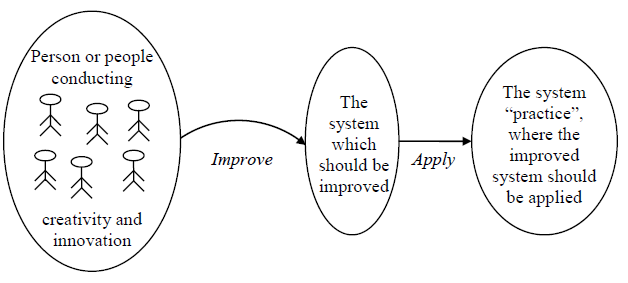
Fig. 1
- Trial And Error Method
Many studies have shown that the most popular method for problem solving is the trial and error method. That is, problems have been solved by reviewing widely differing variants and most of them failed. See fig.2.
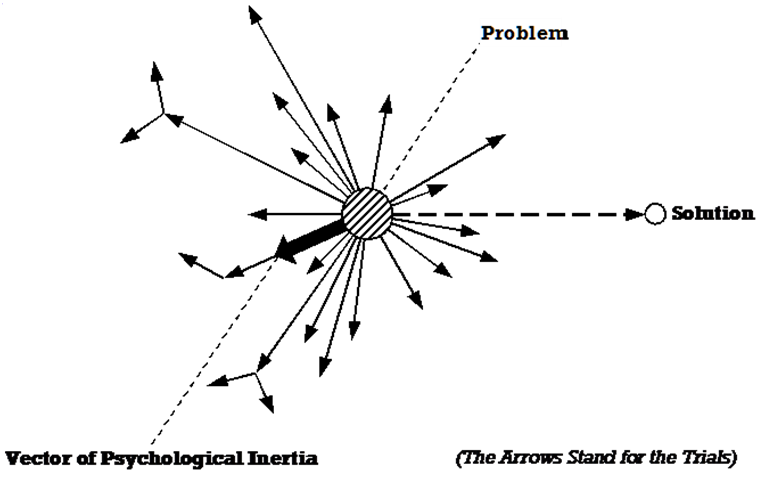
Fig. 2
There are many sayings about making trials after trials:
Try all the keys in the bunch
If at fisrt you don’t succeed try and try again
An oak is not felled at one stroke
Do you undo, the day is long enough
At the end of the 19th century Edison was using the trial and error method. His workshop employed up to a thousand men, and this made it possible to break down one problem into several subproblems, and for each to simultaneously test many variants. When Edison was intent upon creating incandescent light, he went through more than 9,000 experiments in an attempt to produce a bulb. His often phrase: “I’ll try anything. I’ll even try Limburger cheese”.
Disadvantages of the trial and error method:
- The trial and error method wastes much time, thinking energy, material means and even human lives.
- The number of ideas achieved per unit of time is few, so the problem solving process lasts for a long period of time. In other words, productivity of generating ideas is low.
- The existing vector of psychological inertia prevents the solver from the right solution because it drives the mind to what is previously known.
- There is not a mechanism to reveal all possible variants, as a result, the right solution can reside beyond the trial variants.
- Criteria for “right” or “wrong” variants are subjective so a solver can miss appropriate solutions.
- The trial and error method has no mechanism for directing the solver’s thinking towards the solution: the solver is unable to define the direction in which the necessary solution might be found. This is the fundamental disadvantage of the trial and error method.
- Methods of Activating Creative Thinking
- The methods of activating creative thinking include forced-relationship; morphological analysis; check-listing; brainstorming; synectics; lateral thinking; mind-mapping… and their modifications and combinations.
- These methods have a common postulate like the following opinion said by Linus Pauling: “The best way to have a good idea is to have lots of ideas”.
- Depending on a specific object to be improved some of these methods can permit to get billions ideas within several dozens minutes. In other words, the methods of activating creative thinking increase a productivity of idea generation.
- The main merit of these methods is their simplicity and accessibility. They can be easy taught, learned, digested, mastered and used.
- These methods are very appropriate for the kind of problems having a great number of possible trials and at the same time a great number of diverse solutions such as problems concerning the diversifying of items, goods, models etc. See fig.3.
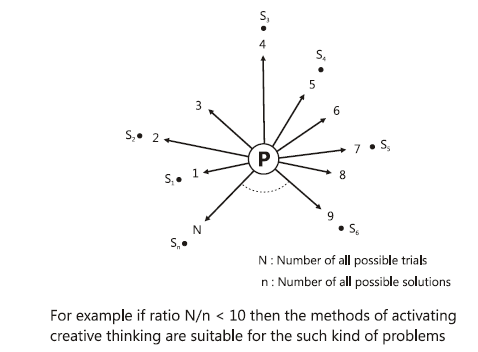
Fig. 3
- Because of their old tactics of selecting trials these methods are not suitable for the kind of problems having a great number of possible trials but at the same time only one or several solutions. That is, the methods of activating creative thinking lose their strength in solving problems of higher difficulty levels. See fig.4.
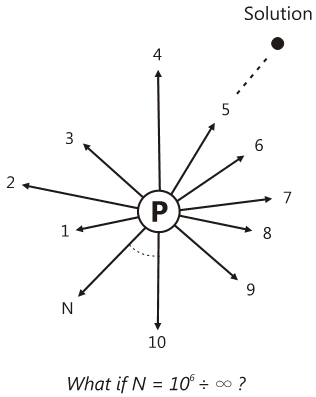
Fig.4
- TRIZ: Creative Thinking Based On The Objective Laws of Systems Development
- TRIZ is the Russian acronym for Theory of Inventive Problem Solving (TIPS in English). TRIZ was created by Genrikh Saulovich Altshuller in the former Soviet Union (now CIS), starting in 1946. Now the term TRIZ has become an international term for professionals working in the field of creativity and innovation. More and more americans, western europeans are interested in TRIZ.
- As we have known from part three of this paper, the sixth disadvantage of the trial and error method is fundamental one, i.e. the lacking of a directing mechanism in problem solving thinking processes.
- Imagine what happens if we have a such directing mechanism. Thanks to it the solver can eliminate a considerable number of barren trials, not coinciding with the solution’s direction. See fig.5.
- In the ideal case, if the directing mechanism can be built very exactly, the solver can use only one trial leading to the neccessary solution. See fig.6.
Thus the solver can transfer problems having a great number of possible variants to problems having several variants, where the usual principle of considering variants is suitable. In fact, this is the heart of the whole problem: one must be able to swiftly reduce the field of inquiry and turn difficult problems into easy ones.
TRIZ mainly differs from the methods of activating creative thinking mentioned above in finding this directing mechanism.
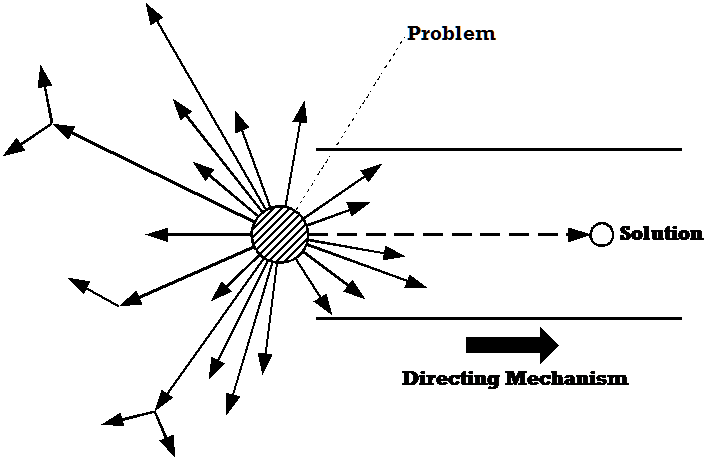
Fig.5
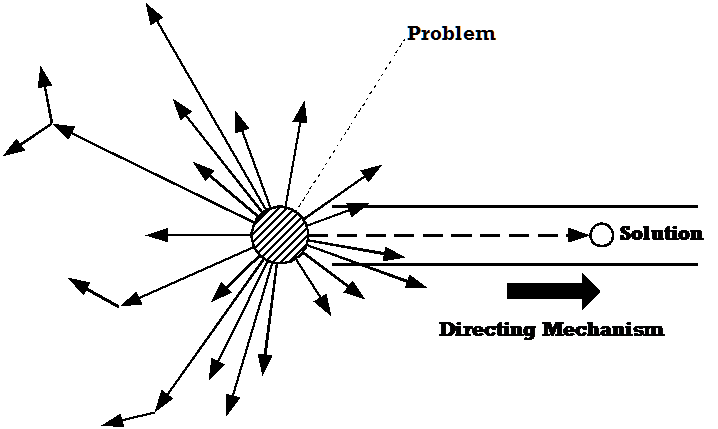
Fig.6
- The analogous example
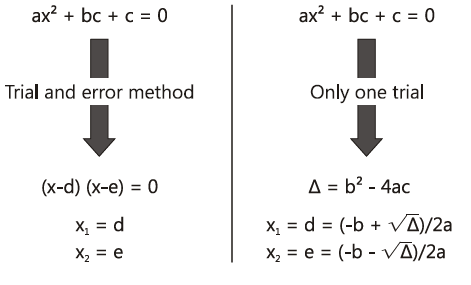
- What is the directing mechanism?
6.1 It is widely believed that creativity has roots in a subjective human psychology. That is true but not enough. Fig.7.
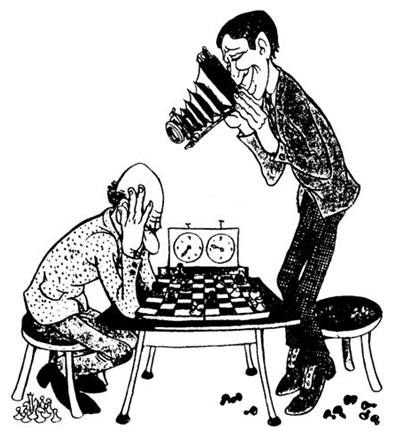
Fig.7
6.2 The analogous example: the fable about creativity.
Mentioning to creative thinking, we usually and immediately think of the psychological process happening inside the solver’s brain and reason that looking for the laws of creative thinking means looking for the laws of subjective psychology. In fact, What is the matter? Imagine the following situation (see fig.8):
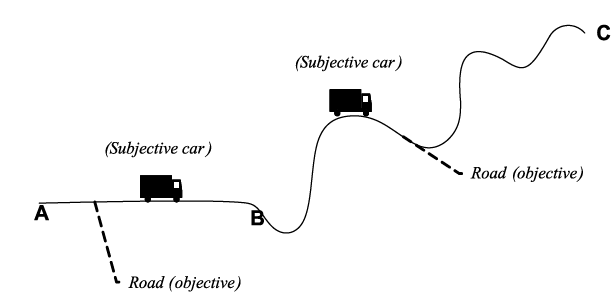
Fig.8
A car was on a winding, up and down road. There were a driver and a researcher in the car. The researcher’s duty was observing, and describing the driver’s psychological behaviours and drawing necessary conclusions. The following is the researcher’s report after the trip.
“I sat by the driver during the trip from B to C, never failed keeping my eyes on him. Thus, what I saw was absolutely enough. Obviously, this driver was more active than those drivers I had met, at least more than the one driving me from A to B, because he frequently makes the steering wheel left and right. Moreover, he usually changed the gear and speed. The sun was shining his left and then right face. The speed ventilating the car was changed as well. This allowed me to suppose that he was keen not only on activity but also sunbathing his face. The change of wind velocity into the car is the reflection of the driver’s inspiration. In one word, through the study of several drivers on lots of journeys, I could see a great variety of them. However, there were some considerable same points: they loved sunbathing and had their own tastes of enjoying ventilation. No doubt, that conclusion is an affirmation with clear demonstration. From that we can reason that: in order to let him work well we have to make up the conditions that meet their own tastes.”
The imagined situation above is more and less a fable and has a close relationship to creative thinking. Let’s “anatomize” that situation. The driver who wanted to drive safely had to watch out the road clearly and get his car into the right line. Therefore, on a winding, up and down road, he could not help turning the steering wheel left and right, and changing gear many times. The researcher paid no attention to that objective matter, but focused his mind on the driver (never failed keeping his eyes on the driver), and considered the driver’s behaviours and psychological reactions something very decisive to drive from B to C. Generalizingly, we can regard the road as the objective law (you have to follow me or you get accident). So the roots of the problem are the objective laws themselves, primarily those concerning evolution and development of matters.
In that imagined situation above, it is fortunate to have the road ready, in other words, the development law has been known at a very specific level. In reality, the matter is far more complicated. The road might not be found yet. However, in any case, on the aspect of methodology and cognition, we have to make the efforts to look for objective development laws in priority and creative thinking has to rely on those laws. Thinking by subjective experiences will have to pay a dear price as a good experience in this case will become the worst in another case. As Hegel’s speaking: “Weak point is the lengthening of strong point.”
However, that does not mean psychological laws are thrown away. On the contrary, it is necessary to perceive them thoroughly to develop their good points and limit their weak points.
6.3 It is possible to claim that except for a subjective side (human psychology) there is an objective side of creativity.
6.4 TRIZ especially emphasizes the objective side of creativity and concentrates its great efforts on finding out the objective laws of creativity, namely, the laws of systems development. These laws in TRIZ have served the foundation of the directing mechanism in problem solving and decision making
6.5 The message sent by TRIZ is simple: “Only those people who grasp these objective laws and manage their psychology along them can achieve a high efficiency in creativity”.
- The sources of TRIZ. See fig.9.
- TRIZ is a large theory with a great number of “tools”: 8 objective laws on systems development; 40 principles; 11 transformers; 76 standard rules based on substance-field (energy) - information - analysis (Vepol Analysis in Russian); the full program for problem solving (ARIZ in Russian) consisting of 40 steps; a knowledge-base containing many strong scientific effects (in the meaning of usefulness for creativity at higher levels)
- It requires 200 to 300 teaching hours including a lot of diverse exercises to master TRIZ. To become a TRIZ-specialist, someone should study for several years. But TRIZ structure is flexible and permits:
teaching and learning parts of TRIZ
using parts of TRIZ according to the type and level of difficulty of the problem.
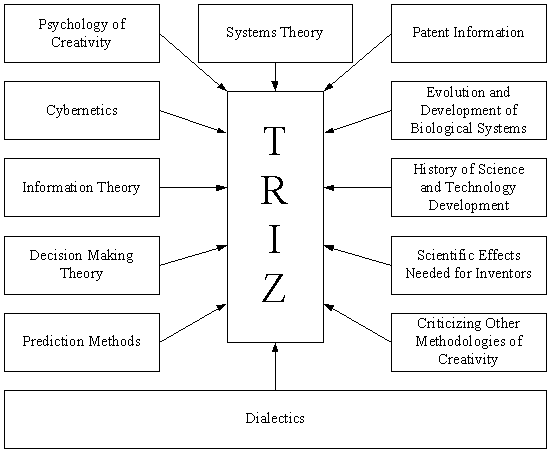
Fig.9
- In July 1989 an International TRIZ Association was formed in the former Soviet Union with its president - Mr. G.S.Altshuller, and the Journal of TRIZ had been issued since 1990.
- In recent years, there have been some new studies aiming at constructing greater theories based on TRIZ such as the theory of development of technological systems (Russian acronym TRTS); a general theory of strong thinking (OTSM) and a theory of development of creative personalities (TRTL).
- Vision and Illustration
Vision:
- The contemporary challenges faced by us such as fast change, increasing diversity, complexity and competition leading to an increasing amount and quality of problems at all levels. The period of time for which a problem should be solved, a decision should be made decreases significantly.
- The way left to success in economic development in the 21st century is creativity skills of the workforce. (See fig.10).
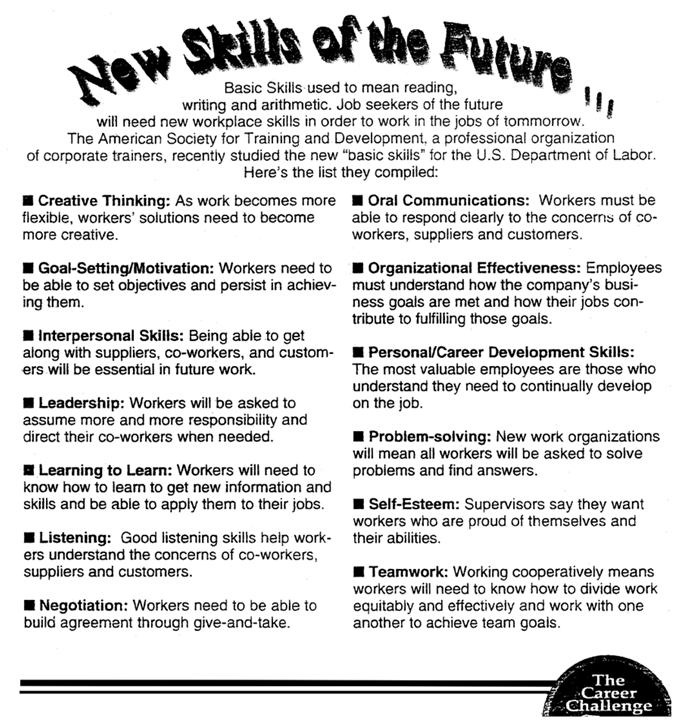
Fig.10
- Differing from other resources like ore, coal, oil and so on which will be dried up, creativity – the fundamental human resource increases with utilization, it is the endless resource.
- We are only at the first stages of the information age but here many problems have arisen, for example, how to find relevant information in the information ocean?; how to handle (process) information streams effectively? and how to use information to produce new outlooks, concepts, ideas and knowledge needed for the scientific and technological revolution? We cannot solve mentioned above problems successfully without creativity methodologies.
- If “necessity is the mother of the invention” then there has been good stimulus for developing creativity science (creatology). And in its turn, creatology with creative problem solving and decision making tools will convert mentioned above challenges into opportunities.
- Now, there are more and more people predicting the fourth wave of development of our civilization - the creativity wave. For example, see fig.11.
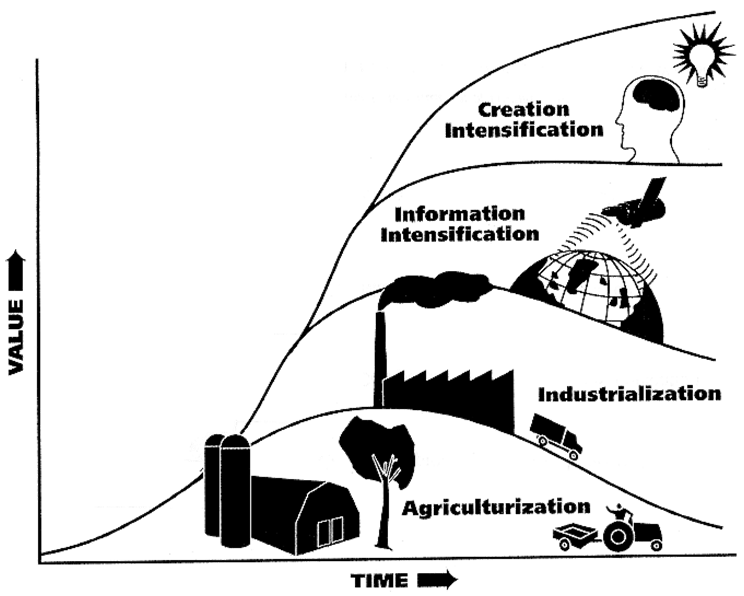
Fig.11
- We can represent the human development history from human being’s legs to human being’s brain as follows, see fig.12.
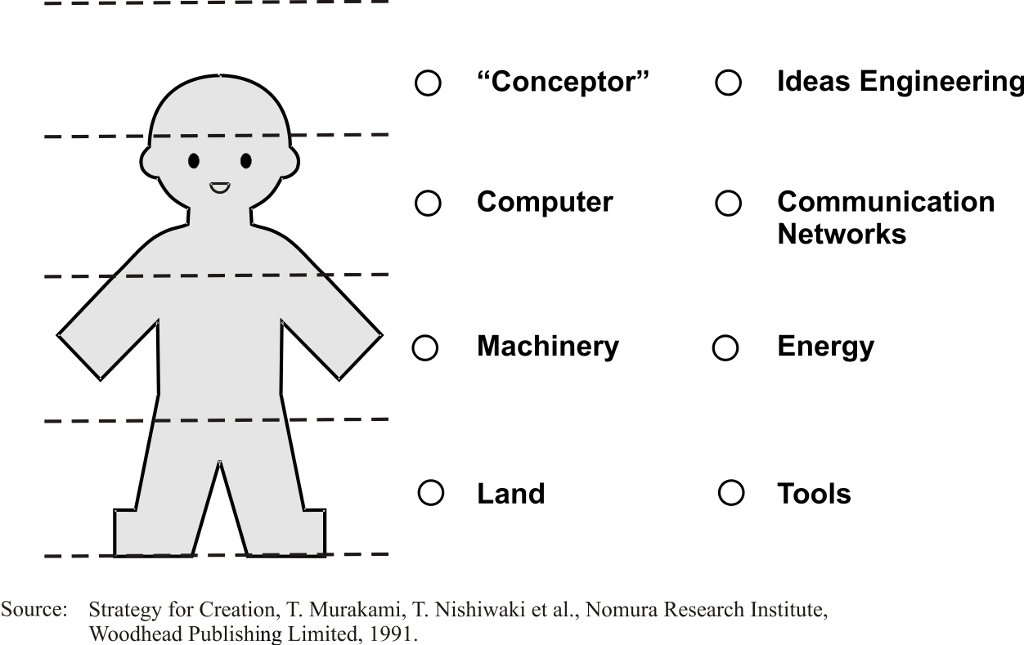
Fig.12: Evolution of Industrial Societies and Externalization of Human Functions
- There are many definitions of human being’s life, one of them is that human life is a chain of problems to be solved and decisions to be made. If problems are not solved well and decisions are not made properly, human life will be “a sea of torments”. On the contrary, human life will be happier, more humane and efficient.
- We may dream of the time when there will be a movement to eradicate “the illiteracy in mastering and using creativity tools (methodologies)” for problem solving and decision making thinking processes, then everyone, indeed, will make an active contribution to the common economic, social and cultural progress. See fig.13.
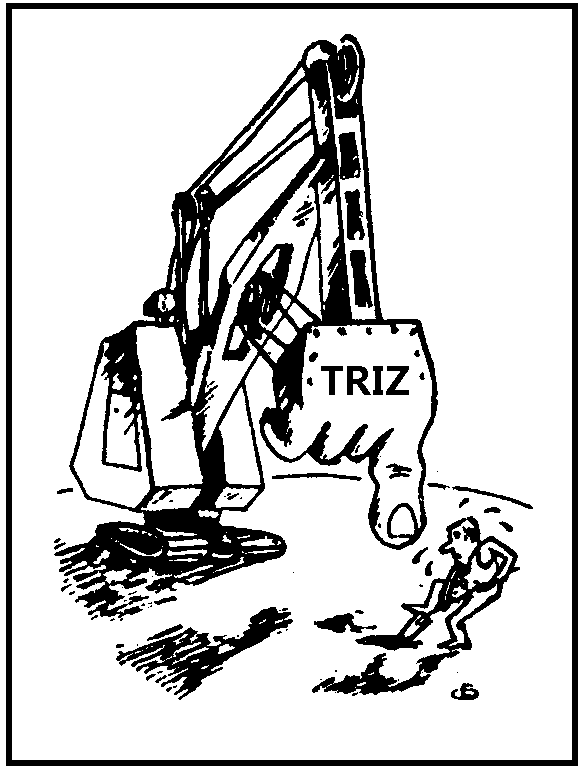
Fig.13
THE FOLLOWING ILLUSTRATIONS ON THE RENEWAL IN THINKING PROCESSES FOR PROBLEM SOLVING AND DECISION MAKING are the fresh comments of the participants attending the course “Creativity and TRIZ Problem Solving Method” at Institut Aminuddin Baki (National Institute of Educational Management), Genting Highlands, Malaysia last week, from the 2nd to the 7th December 1996:
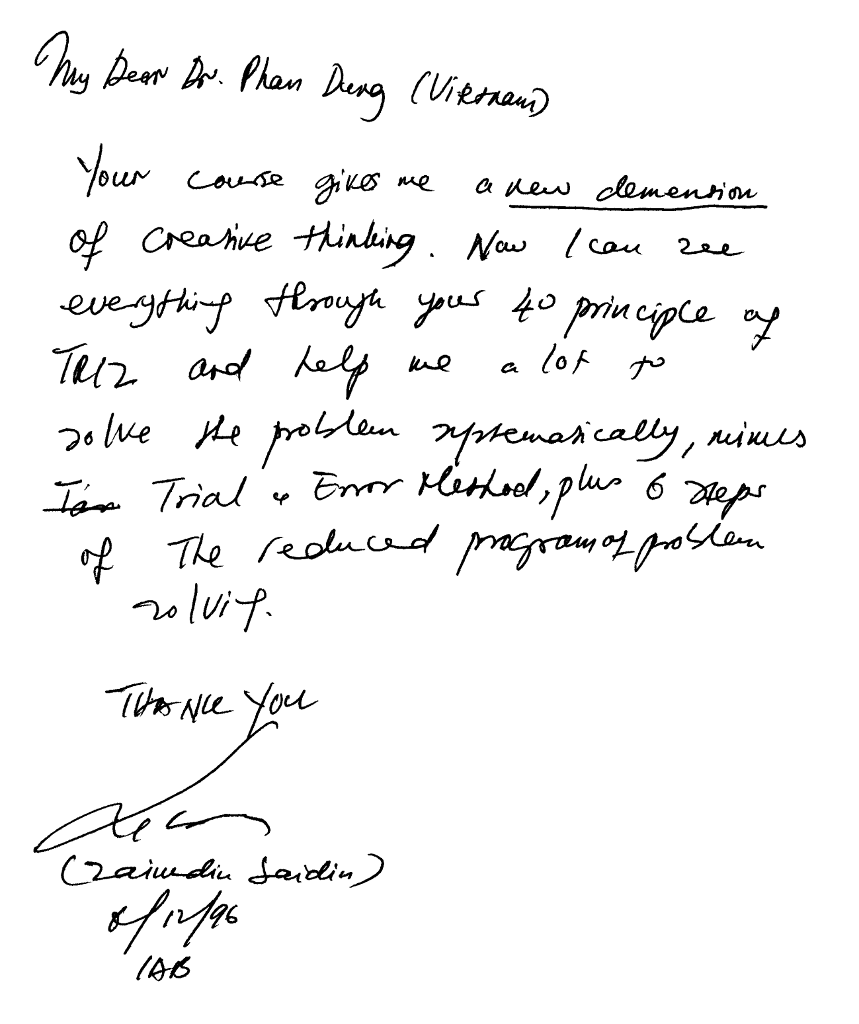
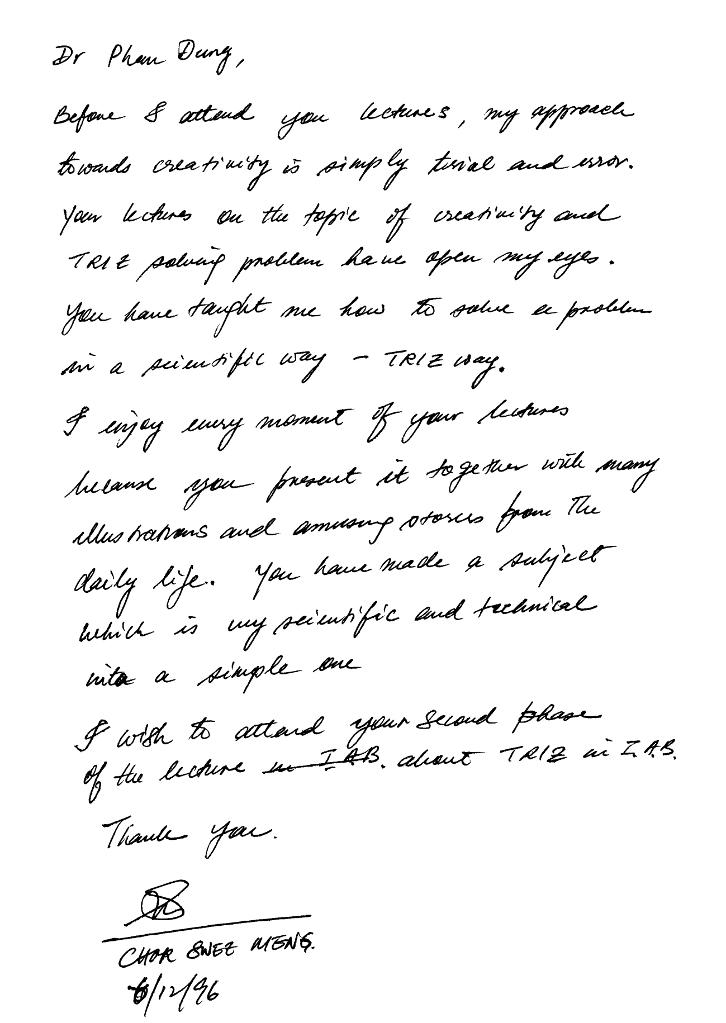
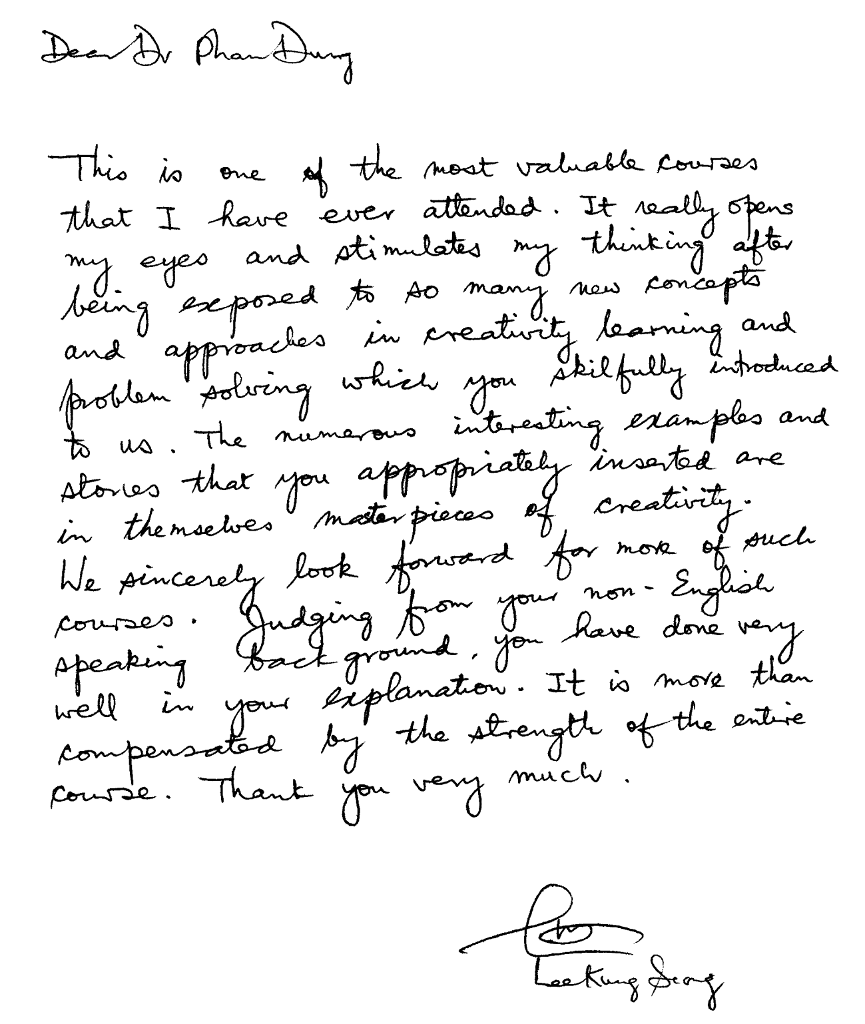
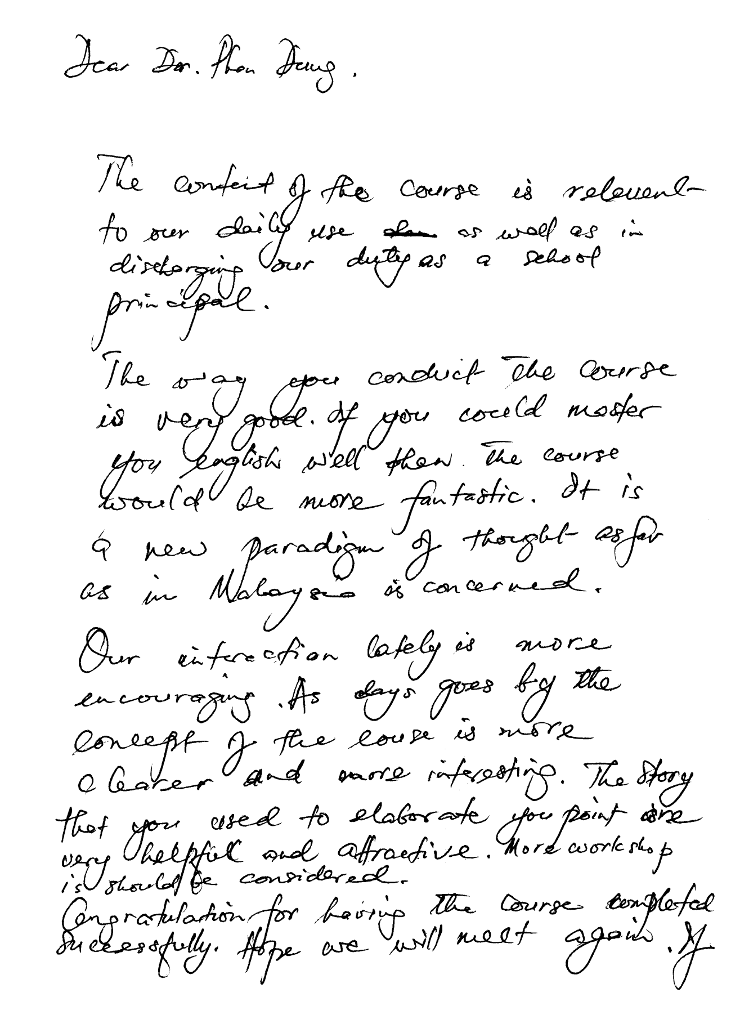
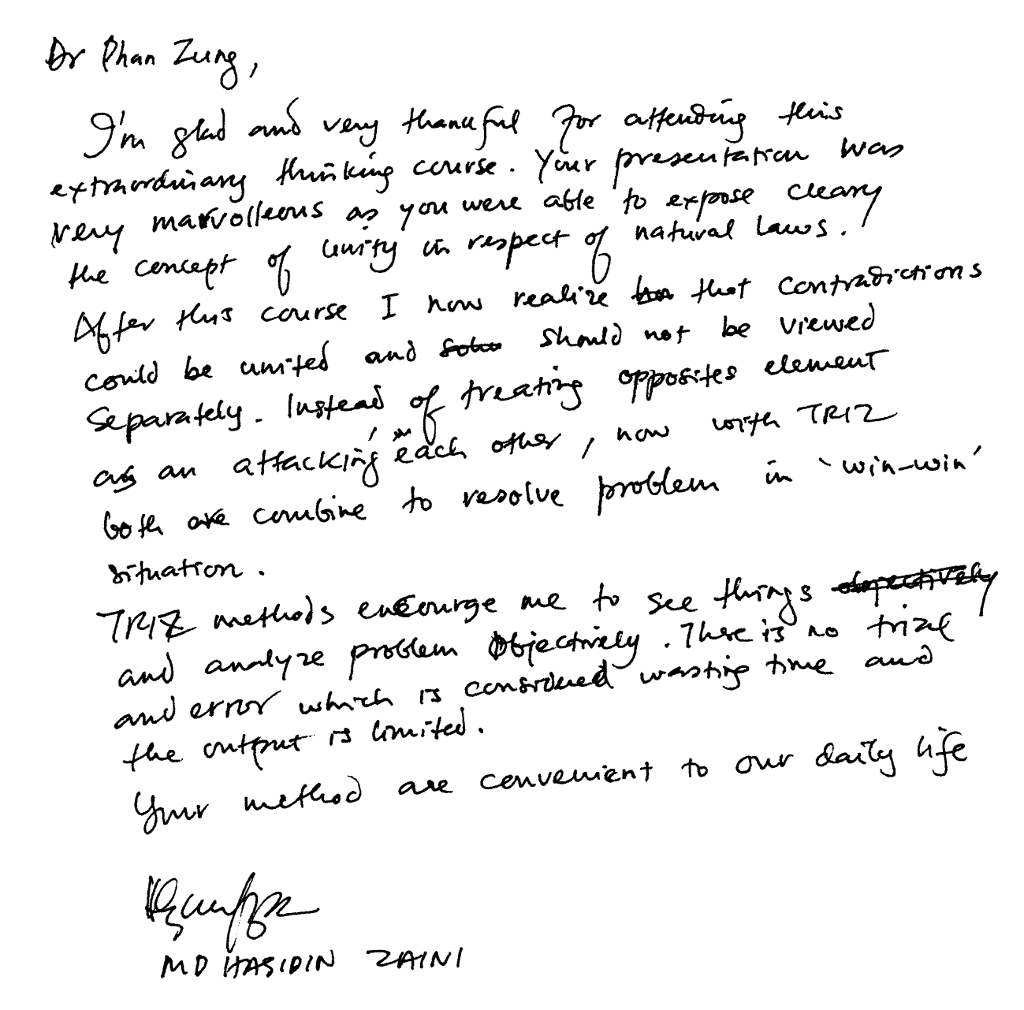
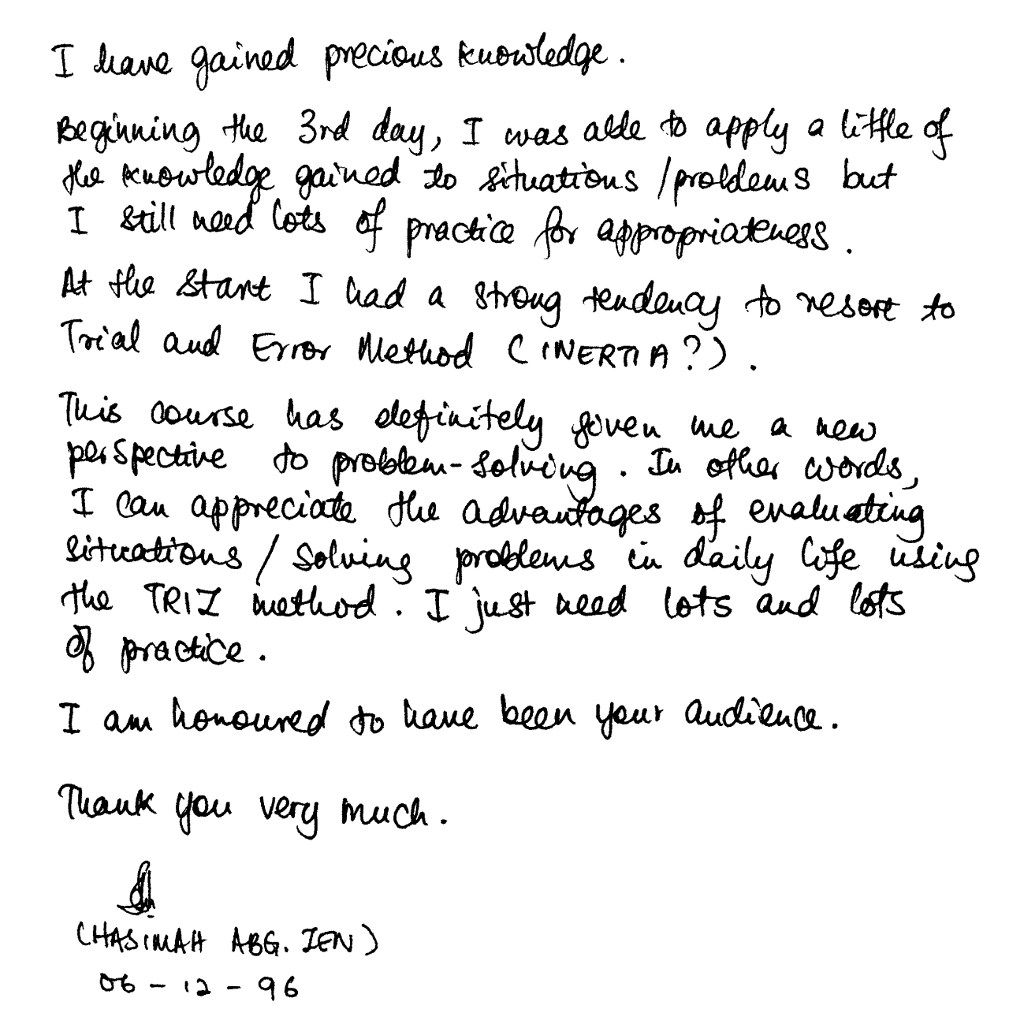
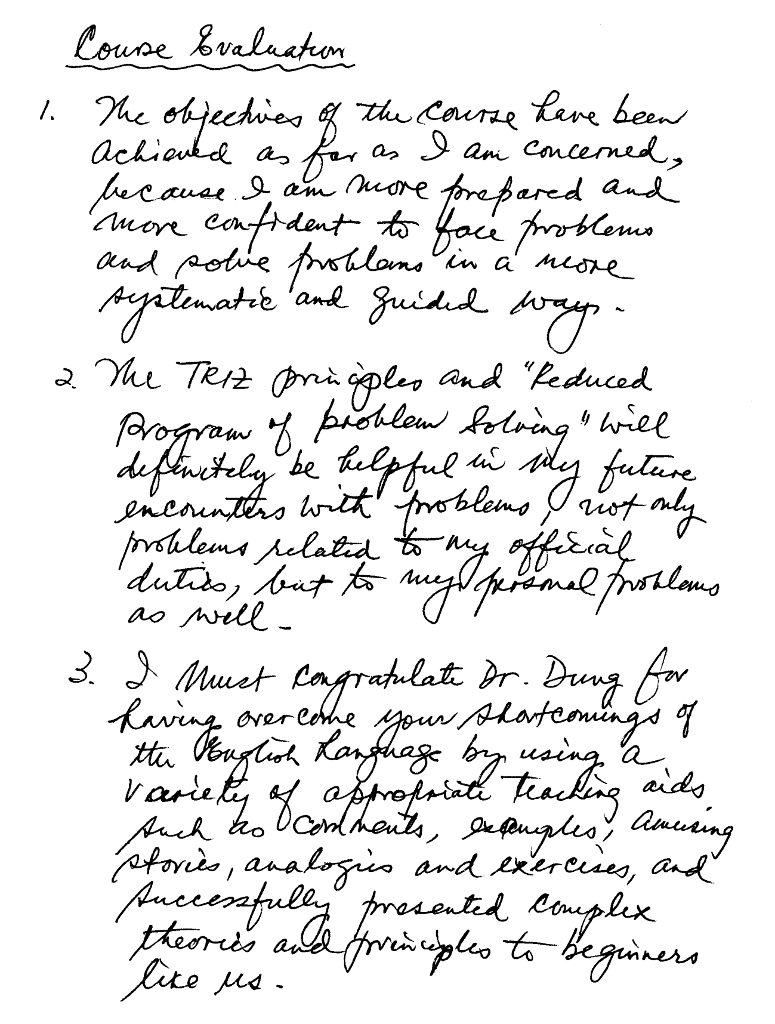
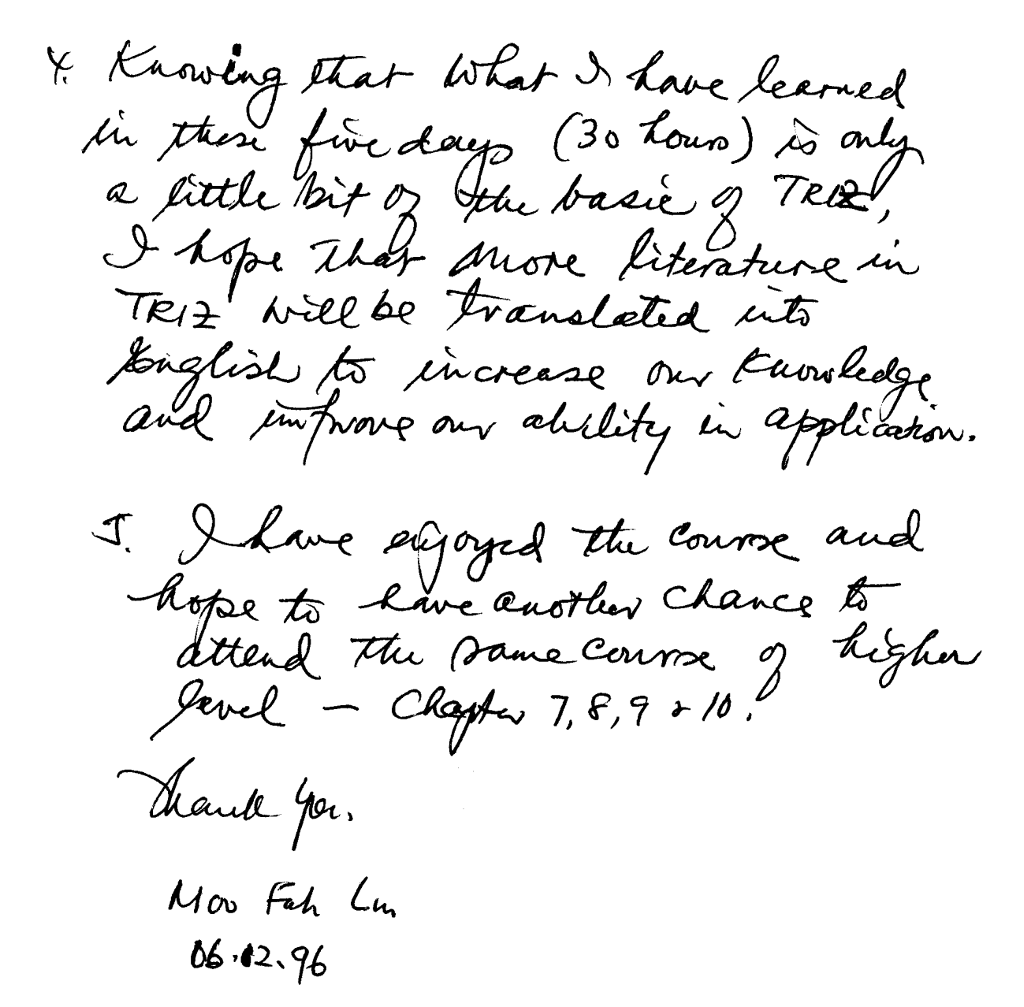
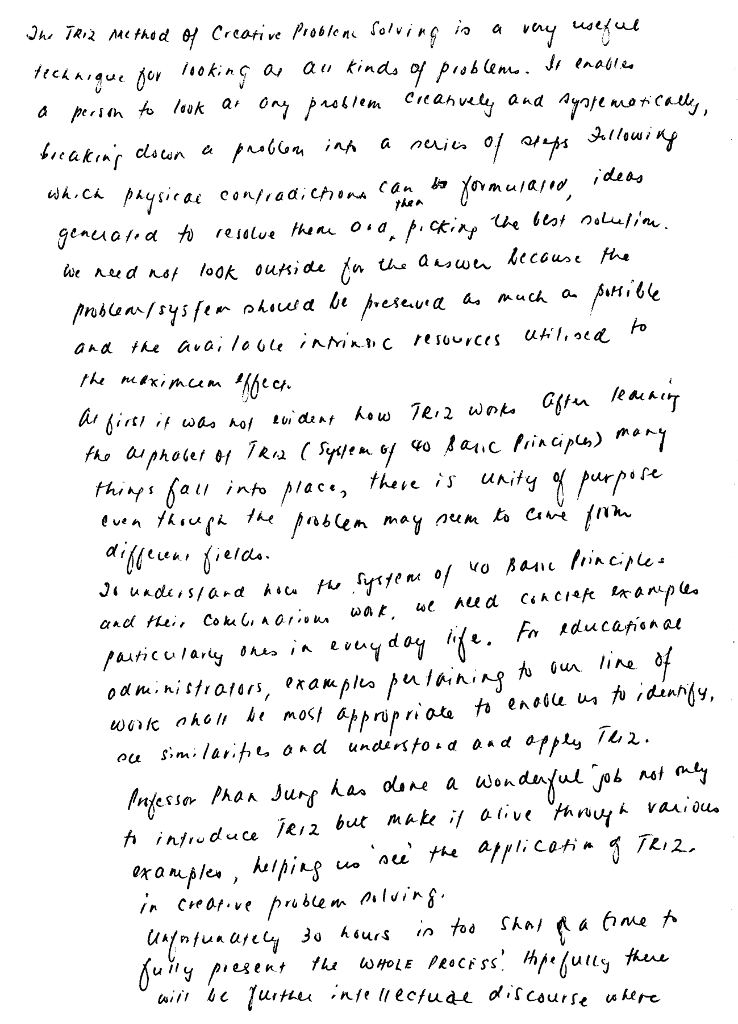
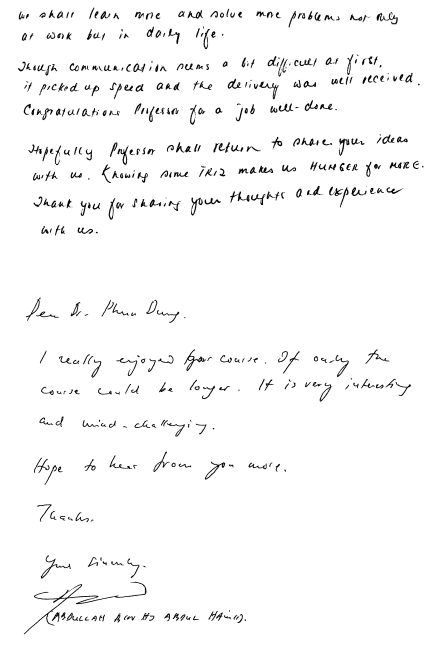
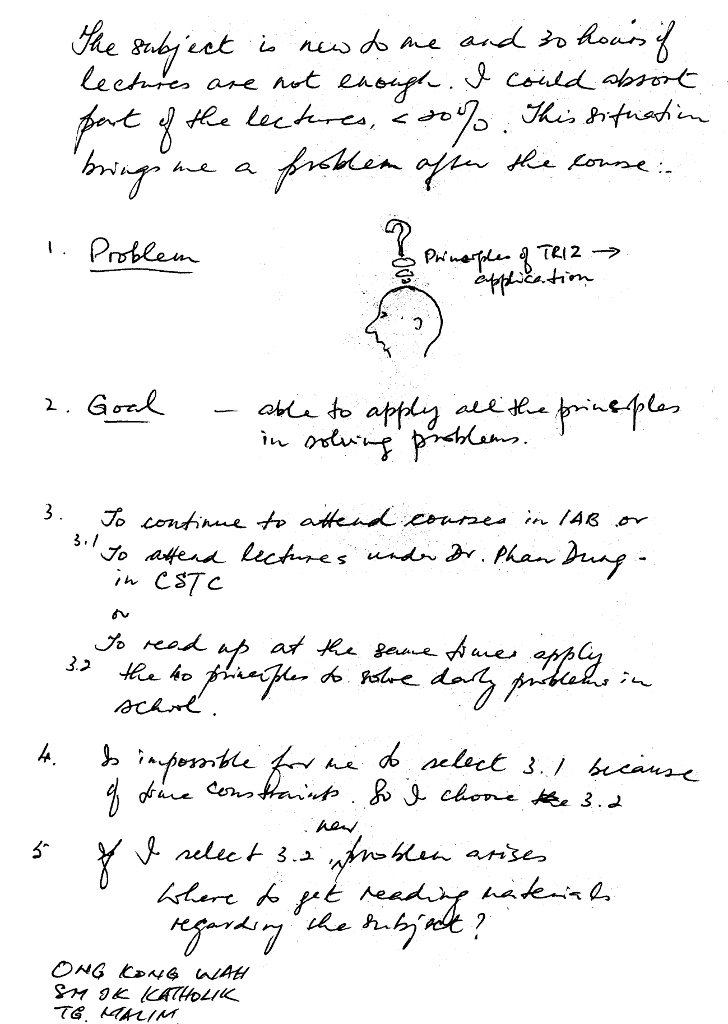
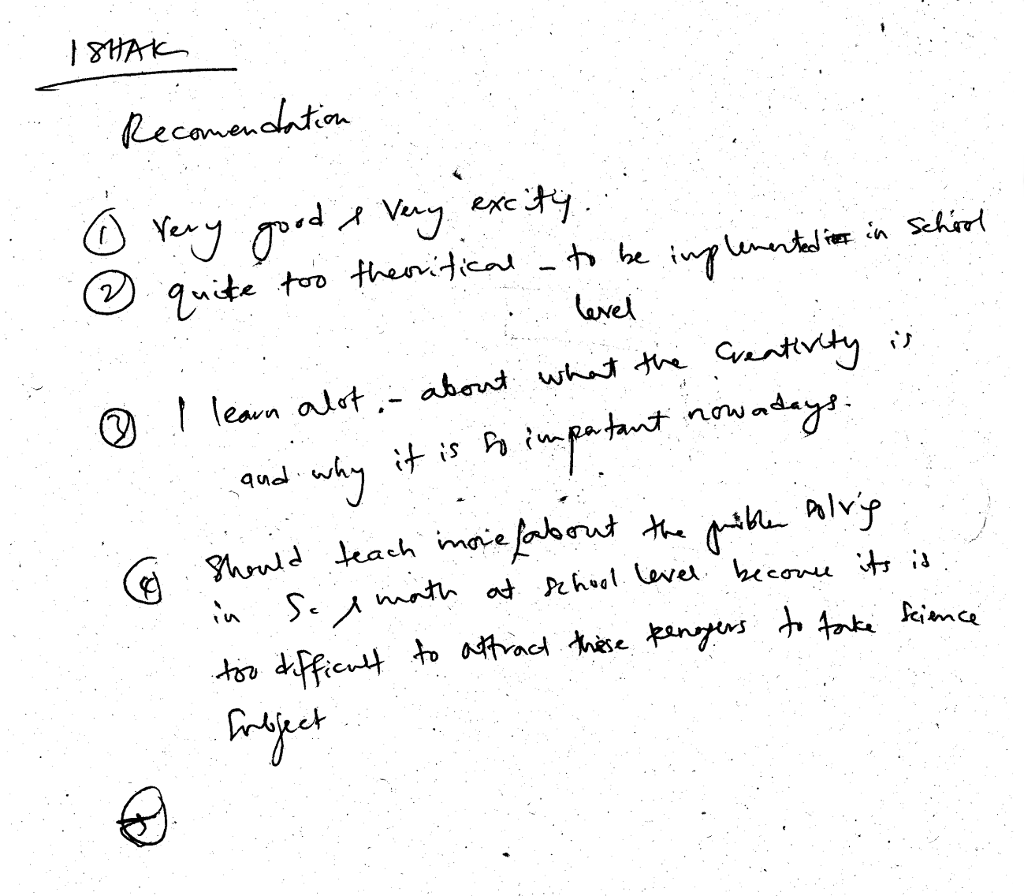
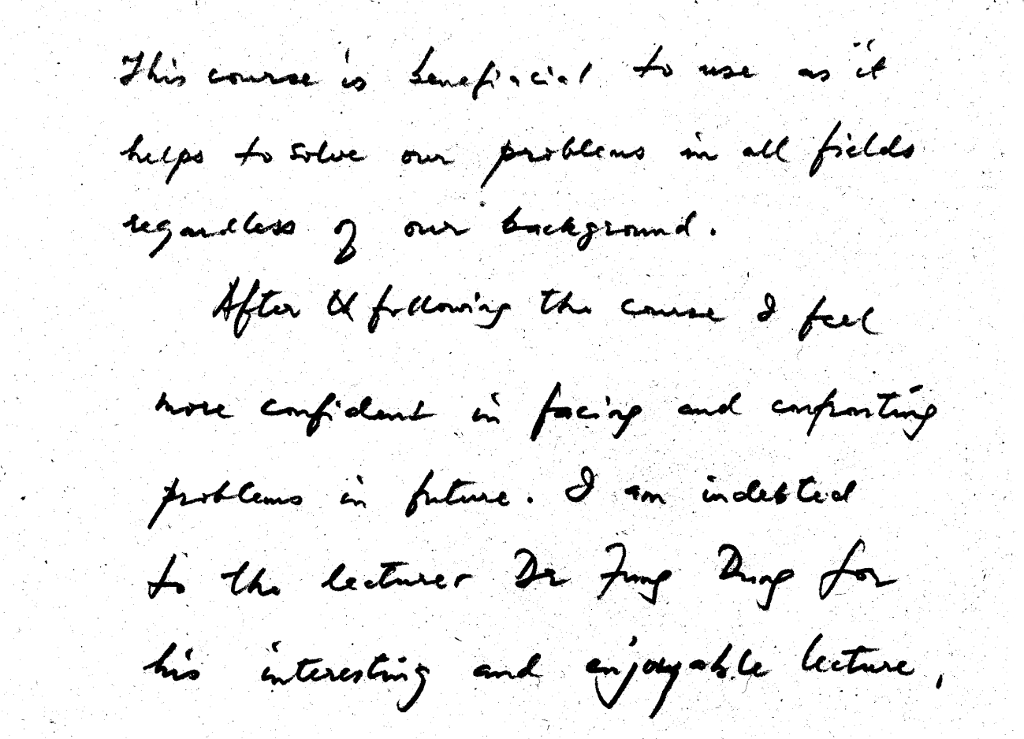
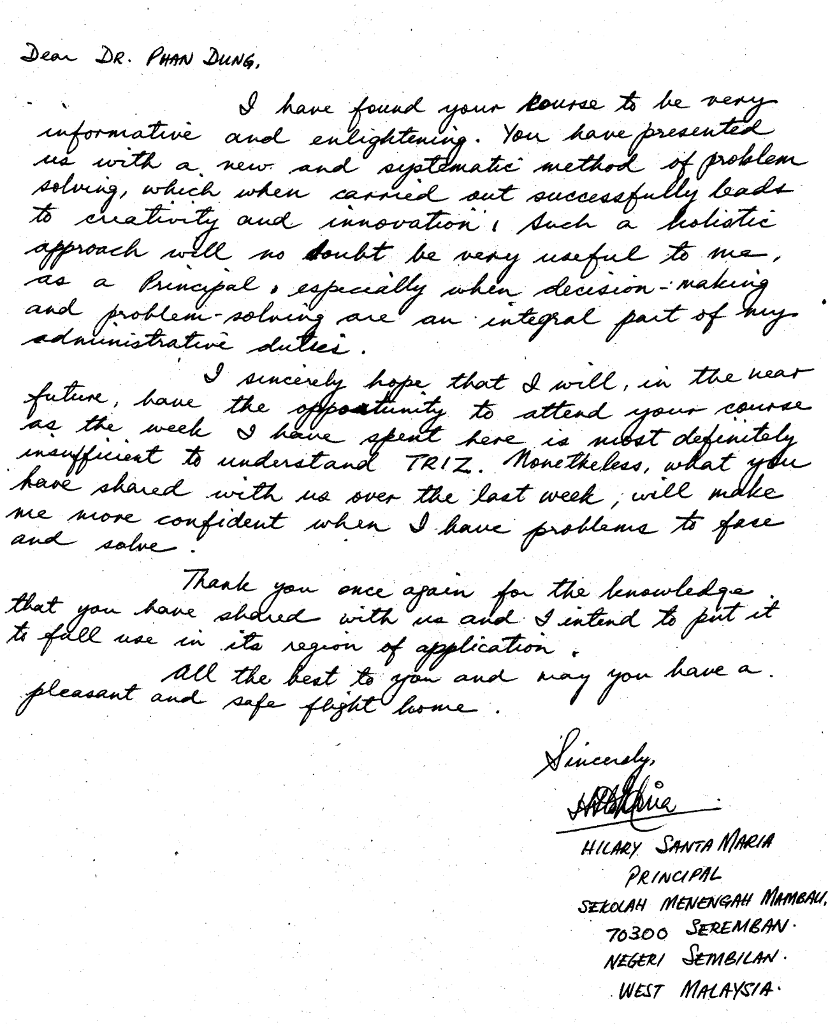
Literature
Alvin Toffler (1985). The Third Wave. New York: Bantam Books.
de Bono, E. (1977). Lateral Thinking. Harmondsworth: Penguin.
Gordon, W.J.J (1961). Synectics: The Development of Creative Capacity. New York: Harper and Row.
Osborn, A.F. (1979). Applied Imagination (3rd ed.). New York: Charles Scribner’s Sons.
Phan Dung (1995). TRIZ: Inventive Creativity Based on The Laws of Systems Development. Innovation Management Journal, Vol. 4, No. 1, pp. 19-30.
Teruyasu Murakami (1994). Creativity and The Next Generation of Japanese-Style Management. Creativity and Innovation Management Journal, Vol. 3, No. 4, pp. 211-220.
Zwicky F. (1969). Discovery, Invention, Research, Thought: The Morphological Approach. New York.
Further Reading
For detailed information on contemporary TRIZ, please consult the following Russian books and journals:
Books
Altshuller, G.S. (1969, 1973) Algorithm Izobretenia, Moskovski Rabotri, Moskva.
Seliuski, A.B., Slugin, G.I. (1977) Vdokhnovenie Po Zakazu, Karelia, Petrozavodsk.
Altshuller, G.S. (1979) Tvortrestvo Kak Totrnaia Nauka, Sovietskoe Radio, Moskva (If I do not make a mistake, this book was translated into English and published by Publishing House Gordon and Breach in the USA).
Altshuller, G.S., Seliuski, A.B. (1980) Krilia Dlia Ikara, Karelia, Petrozavodsk.
Jukov, R.F., Petrov, V.M. (1980) Sovremennie Metodi Nautrno - Tekhnitreskogo Tvortrestva, Leningrad.
Altshuller, G.S. (1984, 1987) I Tut Poiavilsia Izobretatel, Detskaia Literatura, Moskva.
Altshuller, G.S., Zlotin, B.L., Filatov, V.I. (1985) Professia - Poisk Novogo, Kartia Moldoveniaske, Kishiniov.
Altshuller, G.S. (1986, 1991) Naiti Ideii, Sibirskoe Otdelenie ‘Nauka’, Novosibirsk.
Petrovitr, N.T., Tsurikov, V.M. (1986) Putch K Izobreteniu, Molodaia Gvardia, Moskva.
Ivanov, G.I. (1987)… I Natrinaite Izobretatch, Vostotrnoe - Sibirskoe Knijnoe Izdatelstvo, Irkutsk.
Sbornik (Collection) (1987) Derzkie Formuli Tvortrestva, Karelia, Petrozavodsk.
Sbornik (Collection) (1988) Nitch V Labirinte, Karelia, Petrozavodsk.
Zlotin, B. L., Zusman, A. V. (1988) Mesiats Pod Zvezdami Fantazii, Lumina, Kishiniov.
Sbornik (Collection) (1989) Pravila Igri Bez Pravil, Karelia, Petrozavodsk.
Altshuller, G.S., Zlotin, B.L., Zusman, A.V., Filatov, V.I. (1989) Poisk Novikh Idei: Ot Ozarenia K Tekhnologii, Kartia Moldoveniaske, Kishiniov.
Salaamatov, lu.P. (1990) Kak Statch Izobretatelem, Prosveshenie, Moskva.
Zlotin, B.L., Zusman, A.V. (1990) Izobretatel Prishiol Na Urok, Lumina, Kishiniov.
Sbornik (Collection) (1991) Kak Statch Eretikom, Karelia, Petrozavodsk.
Sbornik (Collection) (1991) Shans Na Prikliutrenie, Karelia, Petrozavodsk.
Zlotin, B. L., Zusman, A. V. (1991) Reshenie Issledovatelskikh Zadatr, Kishiniov.
Vikentiev, I.L., Kaikov, I.K. (1992) Lestnitsa Idei, Novosibirsk.
Journals
Rubric ‘Tekhnologia I Psikhologia Tvortrestva’ in Journal ‘Tekhnika I Nauka’ from 1979 to 1984
Journal TRIZ from 1990.
17.3.6 Dialectical Systems Thinking for Problem Solving and Decision Making15
Phan Dung
Abstract: Problems can occur to any person at any time and in any place. Unfortunately, our present educational and training system mainly prepares specialists. As a result of that, these specialists having such narrow thinking may successfully solve their specialized problems but may not know how to solve other problems. Life will be happy if all problems in general can be solved well. In the opposite case life will be “the sea of torments”.
The author of this paper argues that the kind of thinking we need for problem solving and decision making in any case should rely on the most generalized knowledge, isomorphic, similar or analogical properties and conclusions that are applicable to all or almost all areas of practice. In other words, this paper presents the kind of thinking based on dialectical laws, the results of systems research and some important concepts derived from different sciences such as informatics, cybernetics… This kind of thinking has been realized in TRIZ and has recently extended its applications to other non-engineering fields. In this paper, the author shares some of his experience in teaching this kind of thinking at the Center for Scientific and Technical Creativity (CSTC) belonging to Vietnam National University – HoChiMinh City.
Introduction
There are three areas: nature, society and thinking that should be understood and transformed by mankind in order to meet its needs during its history of evolution and development. Unfortunately, among them, thinking had received the least attention until recently. This situation has caused a great number of tragedies at personal, group, national, and even global levels.
Our present educational and training system mainly prepares specialists. As a result of that, these specialists having such a narrow thinking may successfully solve their specialized problems but may not know how to think to solve other problems. Life will be happy if problems in general can be solved well. Using a problem approach, this paper will consider some points associated with how to improve thinking for everyone.
A brief personal view of thinking and related issues will be presented in the second part of this paper. The third part will outline main ideas of TRIZ (Russian acronym for Theory of Inventive Problem Solving - TIPS) which can be named as inventive creativity based on the laws of dialectics and systems development. The author will share some of his experience in teaching creativity methodologies in Vietnam for last 22 years as well as the results achieved so far. A few conclusions and visions will be given in the last part of the paper.
A Personal View of Thinking and Related Issues
- Usually, human activities originate from his (her) needs. Besides individual needs, there also exist the needs of a whole group or community or society.
- In search of ways how to meet their needs, people encounter problems. A problem is a situation where a solver knows the aim (in the widest meaning) but a) does not know any way to reach it, or b) does not know the optimum way to reach it among several known ways to reach it (i.e. decision making process).
Problems can occur anywhere, at any time and to anybody. They can be classified very differently depending on chosen criteria.
- Many studies have shown that our brains work really actively when we have problems to solve or/and decisions to make. The thought process leading the solver from not knowing to a) knowing the way to reach his/her aim or b) knowing the optimum way to reach his/her aim among several known ways we call creative thinking. Because there are both newness: from “not knowing” to “knowing” and usefulness: at last the desired aim is reached (at least, creative for the given solver).
- In our opinion, a problem can be considered as successfully solved only when its solution has been accepted stably, fully and sustainably by the system “practice” (complete innovation), i.e. when all acceptors (or nearly all ones), potentially needing to use the given solution in reality have used it as usual. In other words, what we need is not creativity for the sake of creativity but for the sake of the problem being solved successfully in practice, that is, for the sake of “complete innovation”. Only in such case we can have a genuine development in reality.
- Many studies have shown that the most popular method for problem solving is the trial and error method, that is, problems have been solved by reviewing widely differing variants and most of them failed. See Fig. 1.
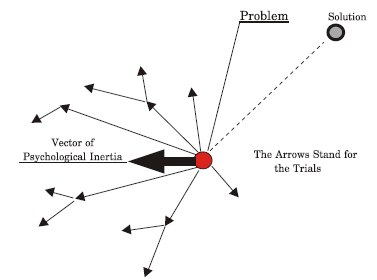
Fig. 1: The Trial and Error Method
The trial and error method is quite suited to problems having a small number of possible trials. However, for problems having a great number of possible trials but at the same time among them only one or several are solutions, this method shows many disadvantages.
- There are two kinds of problems faced by mankind during its history of evolution and development: to cognize and to transform the reality (in the widest meaning). Because of its complication people could not cognize and transform the whole reality at once, only one time they had to divide the reality into different specialized fields based on common properties or/and functions inherent in each field in order to solve problems easier. Another reason for specialization is socio-economic one. Society needs such solvers which should be prepared rapidly and economically in order to get benefits as soon as possible. Thus, the process of specialization began and became stronger and deeper, and it has contributed to explanation why our educational and training system mainly prepares specialists, see Fig. 2.
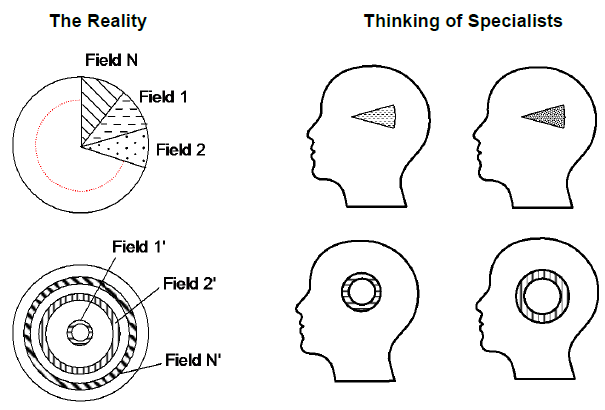
Fig. 2: The Dividing of the Reality and Thinking of Specialists
- Specialization and preparing specialists had many advantages if the following assumptions would be valid for ever:
The reality can be divided into different fields objectively.
Divided fields do not change with a time.
Connections and interactions between divided fields can be neglected.
The whole can be considered as an arithmetical sum of components. Then, a specialist can easily and confidently work in the given field all his/her life.
- The contemporary challenges faced by us such as fast change, increasing complexity, diversity and competition, on the one hand, have shown that the above assumptions have losed their force. On the other hand, these challenges have leaded to an increasing amount of problems (including totally new kinds of problems).
In order to meet partly these challenges, the educational and training system began preparing generalists having some knowledge of several fields who may coordinate with specialists and thus, compensate for specialization’s disadvantages in solving cross-disciplinary problems, see Fig. 3.
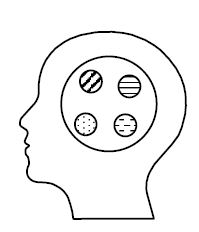
Fig. 3: Thinking of Generalists
- According to the American philosopher R.B. Perry, a specialist can be defined as a person who knows more and more with a time about lesser and lesser and at last he/she will become knowing almost all things about nothing. On the contrary, a generalist is defined as a person who knows less and less with a time about greater and greater and at last he/she will become knowing nothing about all things, see Fig. 4.
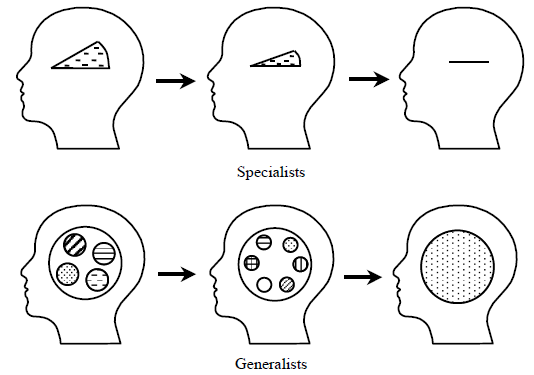
Fig. 4: Generalists and Specialists
So, in our opinion if the educational and training system continues preparing specialists and generalists in traditional way, like before and now, then we cannot cope with future problems because of the old set of paradigms.
- In fact, the reality is in unity and interactions between its components and changes quantitatively and qualitatively with a time. First of all, thinking, on the one hand, should obey the inherent universal attributes and development laws of the reality. On the other hand, thinking should put forward ideas for further cognizing and transforming the reality which are based on these universal attributes and laws, taking into account specific points of concrete problems, see Fig. 5.
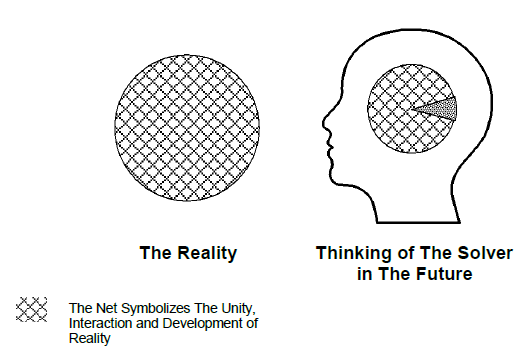
Fig. 5: The Reality and Thinking of the Solver in the Future
- If accepting that where both newness and usefulness exist at the same time, there exists creativity, then creativity and innovation are associated with development and vice versa. Creativity and innovation can happen at the place where subjective psychology of human being is absent. For example, the evolution and development of biological systems had been creativity and innovation but human psychology did not take part in this process then.
- Luckily, in comparison with our ancestors, now we have a very great amount of information about many kinds of evolution and development in biology, society, cosmology, scientific and technological knowledge and so forth. If before, this information to great extent has been processed fragmentarily in accordance with specialized fields, then now, we should reprocess the whole information about the reality from angles of development. In a such way, because of unity of the reality we can reveal the most generalized laws of development or at least, isomorphic, similar or analogical laws of development which can serve as an directing mechanism in creative thinking (thinking for problem solving and decision making). Thanks to this mechanism the solver can eliminate a considerable number of barren trials not coinciding with the laws of development, see Fig. 6.
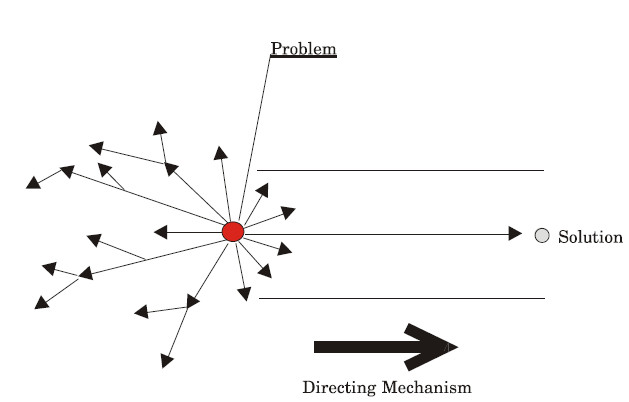
Fig. 6: Directing Mechanism
In the ideal case, if directing mechanism can be built very exactly the solver can use only one trial leading to the solution, see Fig. 7. The essence of the issue is that only those people who grasp these objective laws of development and manage the psychology along them can achieve a high efficiency in creativity and innovation.
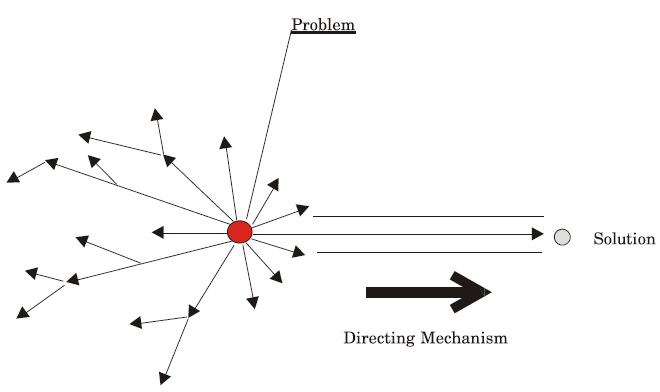
Fig. 7: Directing Mechanism and Solution
Below we will present briefly main ideas of TRIZ ((Russian acronym for Theory of Inventive Problem Solving - TIPS) which has been built on the basis of dialectics as philosophy of development and laws of systems development.
TRIZ (TIPS)
TRIZ was created by Genrikh Saulovich Altshuller in the Soviet Union (now CIS), starting in 1946. The following figure illustrates the sources, on which TRIZ has been constructed.
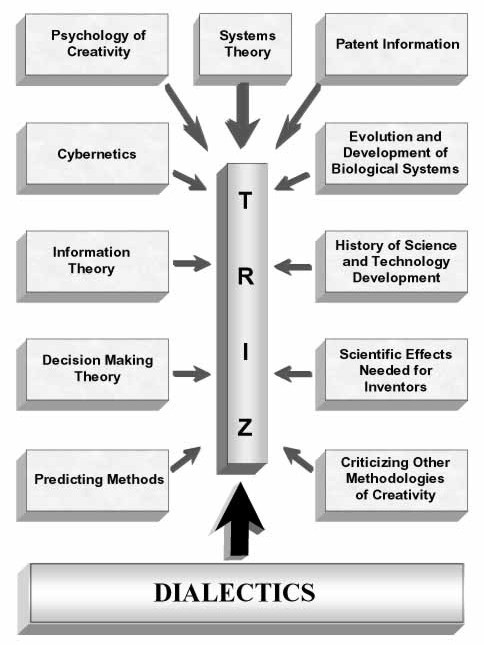
Fig. 8: TRIZ
Dialectics, in our view, is the science of the most common laws of natural, social and mental development. Creativity is associated with a development, so TRIZ has selected dialectical laws as its philosophic foundation. Development from the viewpoint of dialectics, can be understood as follows: Supposing at first the system was at some level of development where there was unity of opposites. This unity does not exist for ever. Because of a struggle (interaction) between the contrary sides, the initial unity is broken and a contradiction arises. The contradiction is resolved so that the system turns to a new level of development (new unity). In the long run, another contradiction will emerge and will be resolved again so that the system will turn to a newer level of development… and so on without ending. Western readers may be interested to learn that there is some similarity between dialectics and the Taoist philosophy of the Orient.
TRIZ identifies three kinds of contradiction in problem solving process: 1) Administrative, 2) Technical and 3) Physical contradiction. In fact, to solve a problem is to reveal and to resolve these contradictions.
Mankind has to study objects and solve problems that are getting more and more complex. It is necessary to have an approach that permits study not only the components and the dependences, actions and influences between them, but also the qualitative change of the whole in relation to these components. Creativity in general and inventive creativity in particular are very complicated concepts. For that reason the systems approach is consistently used in TRIZ. Another advantage of systems research is to help researchers in revealing isomorphic, analogical properties, conclusions, even laws between systems belonging differing fields.
Although creativity appears in all fields of human activities, inventiveness may be, the only field where patent information (information on inventions) containing creativity information is structured in special patterns, classified for easily searching and stored concentratedly, completely, particularly and truly. These characteristics of patent information facilitate research work in order to reveal the objective development laws of technical systems which produce inventions, in order to build techniques (principles), methods, methodology, theory in inventive creativity.
In reality, TRIZ has been formed on the basis of careful analysis of over 1.5 million patents and fundamental inventions taken from technological fields all over the world, taking the similarities on development between these fields and other fields, (for example biology, scientific and technological knowledge) into account.
TRIZ takes into account present psychology, but from its viewpoint human psychology has concretely historical character and is not unchangeable. Thus, TRIZ also has the purpose of reconstructing the old psychology and creating a new psychology which will work in accordance with systems thinking, directed by objective development laws. TRIZ structure is shown on Fig. 9.
The objective laws of development of technical systems serve as the base of TRIZ. At the present eight such laws have been found. In the future the number may increase.
In TRIZ there is a technique called substance-field analysis (vepol analysis in Russian) which helps the solver to differentiate familiar (standard) and unfamiliar (non standard) problems. The standard problem concept has the meaning only for one who learned TRIZ. Then, the solver can use standard rules from information store for solving inventive standard problems. For the time being there is a system of 76 standard rules in TRIZ.
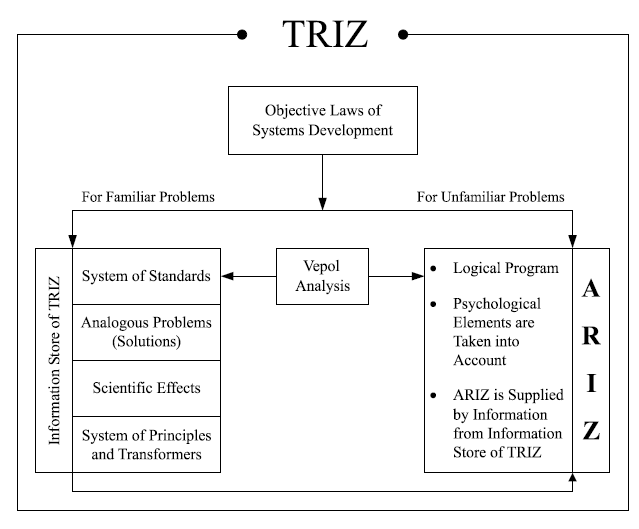
Fig. 9: TRIZ Structure
In order to grasp TRIZ the participant in the studying process must solve hundreds of instructional problems, taken from patent information. The solutions to these problems factually become the participantỈs ơcapitalư which can be used in reality when he (or she) meets analogous problems.
The information store of TRIZ includes a knowledge-base which collects strong scientific effects often found in the field of inventive creativity and for making inventions at higher creativity levels. Presently, TRIZ has selected 50 geometrical, over 100 chemical, over 300 physical and a few biological effects.
The information store of TRIZ also contains the system of techniques helping the solver to overcome technical and physical contradictions. The system involves 40 basic principles and 11 transformers.
If the given problem is not standard (unfamiliar), then the solver should use ARIZ (Algorithm of Inventive Problem Solving). ARIZ is a logical, directed and planned programme composed of many steps which aims at rationally organizing the process of inventive problem solving. ARIZ is an algorithm for human being so ARIZ’s steps were built not only on the basis of objective laws of evolution and development of technical systems, but also considering the elements of psychology and imagination. ARIZ is directly supported by the information store of TRIZ.
In July 1989 an International TRIZ Association was formed in the former Soviet Union with its President - Mr. G.S. Altshuller, and the Journal of TRIZ was issued in 1990.
At present hundreds of corporations in CIS, former socialist countries, USA, Israel, Finland, United Kingdom, Germany, the Netherlands, Spain, Sweden, Japanà are actively using TRIZ, and hundreds of thousands of innovations have been created.
TRIZ is continuing to develop and is being applied to other areas, such as engineering value analysis used for improvement of current products and their cost reduction, process improvement, management, economics, research, science, failure prediction, education (especially in educating children to think creatively). Inventing machine systems, created through combining TRIZ and personal computing won the golden medal at the world exhibition EXPO’90 organised by UNIDO. In recent years, there have been some new studies aiming at constructing greater theories based on TRIZ such as the Theory of Development of Technical Systems (Russian acronym TRTS); a General Theory of Strong Thinking (OTSM) and a Theory of Development of Creative Personalities (TRTL).
Introducing Creativity Methodologies into Vietnam
After I graduated from the Soviet academic and research Institute of Inventive Creativity in 1973, with encouragement of Mr. G.S.Altshuller and the experiences based on my use of creativity methodologies, I had an intention to introduce and disseminate them in Vietnam.
In 1977 the first course on creativity methodologies in the whole Vietnam was conducted by the current author for students from differing departments of HoChiMinh City University. In April 1991, after some courses on creativity methodologies for students and large public audiences had proved to be successful, the administration of HoChiMinh City University permitted me to establish the Center for Scientific and Technical Creativity (CSTC).
By September 1999, we worked with more than 7000 participants (147 courses in all, including the basic and intermediate levels), among them high school and university students, workers, dressmakers, sport trainers, artists, pharmacists, physicians, engineers, lawyers, managers, scientists and so forth from all economic and social sectors. Their ages range from 15 to 72, education level from year 9 to Ph.D., Professors.
Below I will outline some of our experiences derived from our activities.
- There are many financial and other difficulties in Vietnam; everywhere money is needed. It is not easy to hope for funding from the state to perform our activities. We must first rely mainly on our forces, energy and enthusiasm to bravely enter a market. In other words, our Center has been working from the very beginning up to now as a self-supporting enterprise. We think, now the market has accepted us and our creativity methodologies program. Thus, we have been able to balance all our expenses during the process of growth of the Center.
- The most important resource for every country is its human resource, and creativity is a human beingỈs fundamental resource, so our creativity methodologies program should serve a great number of people. So we have built our program not associated with any deeply specialized knowledge of sciences or technologies for the public at large.
- According to a Vietnamese cultural tradition everybody should learn not for money but first of all for becoming a human being, that is, education and training provide students with not only knowledge but also helping them to be good people for their families and society. So our creativity methodologies program is carried out not for the sake of creativity only but we also concentrate our attention on ethic side of a creative personality.
- Our creativity methodologies program has the purpose to help participants become using creativity tools in daily works and life. We have been convinced that only appropriate emotion can promote a human being to act in reality. So our program involves also examples, stories, exercises that may inspire such a emotion inside participants.
- Our program emphasizes active participation and self-discovery. The participants make full use of self-study materials, instructor presentation, individual and group exercises and case studies. Throughout the program the participants have the opportunity to apply their newly gained knowledge, tools and skills in problem solving and decision making process. Audio and video equipment are used during the program.
- Vietnam today has an income of 250 USD per capita. It is important for us to understand that if we want to spread creativity methodologies widely in our country, we should set a cheap fee for the course. Indeed, now the cost of the basic course lasting 60 hours and including textbooks is equivalent to 20 USD per participant. In spite of that we have a great satisfaction because we have such a strong desire to promote a development process in Vietnam.
- Participants are very busy and diverse, so we cannot teach them for a long time and in one constant place. So we organize our courses at different times of the day, including evening courses. The Center also offers on-site training courses in and out of HoChiMinh City on request. Practically, we conducted some courses in Hanoi, Cantho, Dongthap and Tiengiang.
- Creativity methodologies is a new subject in Vietnam. Most people have not known about it, so we should foster its widest dissemination. In this connection, we provide introductory lectures, seminars, addresses on radio and on TV, schools, institutions, hospitals, companies, plants… (many times free of charge) to describe the advantages of creativity methodologies. In addition to that, dozens newspaper articles, written by correspondents about our creativity methodologies program, our CenterỈs activities and successes of past participants helped very much in this aspect.
- Because of systems inertia in general and psychological inertia in particular a far new subject like creatology could be too difficultly accepted by people at the command of administration. In our case, creativity methodologies courses had been taught for the first period of time only to creativity lovers. After these courses have proved to be successful, they became compulsory for all students of the given institution. Thus, now, our courses have been integrated in the general program for all graduate students at several colleges of Vietnam National University - HoChiMinh City.
- For the present our research is focused not only on improving teaching and training methods, perfecting our creativity methodologies program where we have combined “Western”, “Eastern” creativity methodologies and our culture but on elaborating on some topics to contribute to the development of this discipline in the world. By the way, I would like to say some words more about our program, although we teach at the same time the ơWesternư methodologies and TRIZ but we have devoted much time to TRIZ because of its very powerful advantages.
- At the end of the courses, the general agreement of the participants was that the new discipline is very useful and necessary to all kinds of people. They also proposed that the course should be integrated in the general program of education for the whole country in order to develop the creative potentials of all people. Below there are some of my and their thoughts about TRIZ.
- TRIZ in general and ARIZ in particular is a very powerful creativity methodology for solving inventive problems at high levels.
- TRIZ is a helpful methodology to manage contemporary challenges such as fast change, increasing complexity, diversity and strong competition and to convert these challenges into opportunities.
- Like any tool, the user not only uses the tool but the tool also influences the user. TRIZ brings the user many advantages such as:
A system of various multiple perspectives in accordance with the diversity of possibilities.
Increasing creative curiosity and observation.
Overcoming of psychological inertia.
Developing the use of imagination.
Identifying unity, similarity, analogy among objects, phenomena, processes… in differing domains.
Increasing sensibility in perceiving and processing information.
Helping logically to evaluate available creative solutions.
Having differing approaches to solve problems.
Knowing how to reveal, formulate and select the problem needing to be solved. Knowing how to discover contradictions and to generate ideas for resolving them.
Predicting systems development, initiating and purposively carrying out this development.
Predicting failures and finding ways to prevent them (because any creation can be a double-edged sword).
- Creativity methodologies are often used to improve and perfect external system, but in fact they can also be used and need to be used to improve and perfect human beings. In this aspect, TRIZ has a great potential.
Conclusions and Visions
- If before, thinking was considered as the human beingỈs natural instrument for problem solving, then now, there are growing needs and orders which require us to cognize and transform it in order to create more effective problem solving methodologies than the trial and error method and its modifications. The emerging discipline – creatology – recognizing that creative thinking can be understood, nurtured, improved and controlled by the use of tools and making a lot of necessary efforts in these directions may be accepted as the greatest but most overdue paradigm shift and revolution of the present century. Creatology will exert great impact on development in the 21st century at large.
- We are only at the first stages of the information age but here many questions have arisen, for example, how to find relevant information in the information ocean, how to handle (process) information streams effectively, how to use information to produce new outlooks, concepts, ideas and knowledge needed for scientific and technological revolution. Without craetology we cannot answer such questions.
- The contemporary challenges faced by us such as fast change, increasing complexity, diiversity and competition lead to an increasing amount of problems at all levels. If “necessity is the mother of the invention” then there has been good stimulus for developing creatology. And in its turn, creatology with creative problem solving and decision making tools will convert these chalenges into opportunities.
- Creativity is the fundamental human resource, like other resources, in order to exploit it much we should invent appropriate, productive and effective tools. “Tools” in creatology are creativity techniques (principles), methods, methodologies… that in their turn will have enormous influence on the whole user’s awareness, attitude and responsibility. We can be optimistic with creatology because differing from other resources as ore, coal, oil and so on, creativity increases with utilization - it is endless resource.
- There have been many studies on new skills for the future workforce which is the key strategic variable of economic development. Among enumerated skills in these studies we can read: creative thinking. So the education in the broadest meaning we need is creative education which educates all people in creativity - the utmost humaneness. But such creative education in the future, difffering from the old education should arm all people with productive and effective mental tools for successfully solving problems in general, not only in specialized fields, because human beings are not workers only. In other words, such creative education will prepare solvers who can solve successfully any problem they encounter in their lives to satisfy their just needs and thus to satisfy social needs of development. In this connection, from my point of view, TRIZ is one of the best potential candidates for that.
- We may dream of the time when will be a movement to eradicate “the illiteracy in mastering and using creativity tools for problem solving” for every person, then, everyone, indeed, will be the real owner of his/her life and innovator making an active contribution to the common social progress. By the way, I remember William Drummond’s observation: “He who will not reason is a bigot; he who cannot is a fool; he who dares not is a slave” and I want to add “He/she who knows how to think (to solve problem and to make decision) is a free and happy man/woman”. Creativity methodologies are often used to improve and perfect external systems, but in fact they can also be used and need to be used by human being to improve and perfect his/her internal world. Thus, the quality of life for people is also enhanced.
Further Reading
For detailed information on the points presented in this paper, please consult the following articles, books and journals:
In English
Phan Dung (1994) Introducing Creativity Methodologies into Vietnam. Creativity and Innovation Management, 4, 240-242.
Phan Dung (1995) TRIZ: Inventive Creativity Based on The Laws of Systems Development. Creativity and Innovation Management, 1, 19-30.
Phan Dung (1996) Systems Inertia In Creativity and Innovation. Lecture presented at the fifth European Conference on Creativity and Innovation, Vaals, the Netherlands, April 28-May 2, 1996
Phan Dung (1996) Creatology: A Science for the 21st Century. Keynote paper presented at the International Symposium and Seminar: “Education: The Foundation for Human Resource and Quality of Life Development”, Chiang Mai, Thailand, August 26-30, 1996.
Phan Dung (1996) The Renewal in Creative Thinking Process for Problem Solving and Decision Making. Keynote paper presented at the sixth National Seminar on Educational Management and Leadership, Genting Highlands, Malaysia December 9-12, 1996.
Phan Dung (1996) Creativity Methodologies (the summary of the course) for English speaking participants.
Phan Dung (1997) Dialectical Systems Thinking For Problem Solving and Decision Making. The 7th International Conference on Thinking, Singapore, June 1-6, 1997.
Phan Dung (1998) Dialectical Systems Thinking For Problem Solving and Decision Making, in Morris I. Stein (ed.), Creativity’s Global Correspondents 1998. Florida, Winslow Press, USA, 143-161.
In Russian
Books
Altshuller, G.S. (1969, 1973) Algorithm Izobretenia, Moskovski Rabotri, Moskva.
Seliuski, A.B., Slugin, G.I. (1977) Vdokhnovenie Po Zakazu, Karelia, Petrozavodsk.
Altshuller, G.S. (1979) Tvortrestvo Kak Totrnaia Nauka, Sovietskoe Radio, Moskva (If I do not make a mistake, this book was translated into English and published by Publishing House Gordon and Breach in the USA).
Altshuller, G.S., Seliuski, A.B. (1980) Krilia Dlia Ikara, Karelia, Petrozavodsk.
Jukov, R.F., Petrov, V.M. (1980) Sovremennie Metodi Nautrno - Tekhnitreskogo Tvortrestva, Leningrad.
Altshuller, G.S. (1984, 1987) I Tut Poiavilsia Izobretatel, Detskaia Literatura, Moskva.
Altshuller, G.S., Zlotin, B.L., Filatov, V.I. (1985) Professia - Poisk Novogo, Kartia Moldoveniaske, Kishiniov.
Altshuller, G.S. (1986, 1991) Naiti Ideii, Sibirskoe Otdelenie ‘Nauka’, Novosibirsk.
Petrovitr, N.T., Tsurikov, V.M. (1986) Putch K Izobreteniu, Molodaia Gvardia, Moskva.
Ivanov, G.I. (1987)… I Natrinaite Izobretatch, Vostotrnoe - Sibirskoe Knijnoe Izdatelstvo, Irkutsk.
Sbornik (Collection) (1987) Derzkie Formuli Tvortrestva, Karelia, Petrozavodsk.
Sbornik (Collection) (1988) Nitch V Labirinte, Karelia, Petrozavodsk.
Zlotin, B. L., Zusman, A. V. (1988) Mesiats Pod Zvezdami Fantazii, Lumina, Kishiniov.
Sbornik (Collection) (1989) Pravila Igri Bez Pravil, Karelia, Petrozavodsk.
Altshuller, G.S., Zlotin, B.L., Zusman, A.V., Filatov, V.I. (1989) Poisk Novikh Idei: Ot Ozarenia K Tekhnologii, Kartia Moldoveniaske, Kishiniov.
Salaamatov, lu.P. (1990) Kak Statch Izobretatelem, Prosveshenie, Moskva.
Zlotin, B.L., Zusman, A.V. (1990) Izobretatel Prishiol Na Urok, Lumina, Kishiniov.
Sbornik (Collection) (1991) Kak Statch Eretikom, Karelia, Petrozavodsk.
Sbornik (Collection) (1991) Shans Na Prikliutrenie, Karelia, Petrozavodsk.
Zlotin, B. L., Zusman, A. V. (1991) Reshenie Issledovatelskikh Zadatr, Kishiniov.
Vikentiev, I.L., Kaikov, I.K. (1992) Lestnitsa Idei, Novosibirsk.
Altshuller, G.S., Viortkin, I.M. (1994) Kak Statch Geniem, Belarus, Minsk.
Journals
Rubric ‘Tekhnologia I Psikhologia Tvortrestva’ in Journal ‘Tekhnika I Nauka’ from 1979 to 1984
Journal TRIZ from 1990.
17.3.7 On the Basic Program “Creativity Methodologies for Problem Solving and Decision Making” Being Taught by the CSTC (Center For Scientific and Technical Creativity) in Vietnam16
Phan Dung
From the Introduction written by the editor:
“Our last report for the year is with the most significant contribution from Phan Dung of Vietnam. He tells about the valuable work he has been doing in his program “Creativity Methodologies” that he teaches at the Center for Scientific and Technical Creativity (CSTC) in Vietnam and other places throughout the world since 1977—and we have lots to learn from him.”
Morris I. Stein, Ph.D.
Professor Emeritus, Psychology
New York University
New York, N.Y.
April, 1999
I. INTRODUCTION
There are many programs designed for teaching creativity methodologies in the world. These programs differ in many ways, for example, in their theoretical rationale, in their creativity tools (in the widest meaning) to be taught, in the type of participants for whom they are intended.
On purpose to share ideas and work with the colleagues working in the field, in this paper I will report about the basic program “Creativity Methodologies for Problem Solving and Decision Making” (it will be called “the basic CM program” for short) that has been taught by me and the Center for Scientific and Technical Creativity (CSTC) in Vietnam and abroad since 1977. Our other programs will be presented in the future papers when opportunities allow.
- SOME MAIN TRAITS OF THE BASIC CM PROGRAM
- The basic CM program was designed for preparing users of creativity methodologies, not creativity teachers or researchers.
- Among the potential users, up to now we have concentrated our efforts on high school graduates or more highly trained people in the workforce.
- To maximize benefits which participants in particular and society in general can get, we teach creativity not for the sake of creativity but for the sake of problem to be fully solved. Because “the end of fishing is not angling but catching” and I want to add “and the caught fish should be consumed by the appropriate subjects and the environment is not polluted afterwards.”
- High school graduates or more highly trained people, I would like to make an emphasis on the following point: irrespective of age, career and position can be entitled to enroll in our basic CM program. The reason for this is as follows:
Our present educational and training system mainly prepares specialists. As a result of that, these specialists having such a narrow thinking may successfully solve their specialized problems but may not know how to think to solve other problems. Human being’s life is an assembly of problems to be solved and decisions to be made. His/her life will be happy when problems in general (not only specialized ones) can be solved well. This point, also brings about benefits to companies, organizations and society. Please, imagine how workers can work well in the workplace when their heads are occupied with other problems (for example, family problems) they do not know how to solve. Besides such a narrow thinking cannot respond to the contemporary challenges faced by us, for example, fast change, increasing complexity, diversity and competition.
Therefore, our program should be composed of knowledge, methods and thinking skills that are applicable to all or almost all areas of reality. In this connection, we think, TRIZ (the Russian acronym for Theory of Inventive Problem Solving) and its sources relying on the most generalized scientific and technical knowledge can fully deserve attention. So we took TRIZ and its sources as the core of the basic CM program.
- But we also suppose that to cope with a variety of problem situations that may occur in daily life and work of participants, creativity methodologies included in our program need to be varied. Except for TRIZ, we also teach other creativity methods. These methods had been selected with the following criteria: a) there is scientific rationale that underlies them; b) they have a wide area of application; c) they have, indeed, a strong effect on problem solving thinking process.
The selected methods had been integrated in our program logically, that is, they did not become a separate patch.
- We strive to structure our program so that it takes participants through simple issues to more complicated ones and every part of the program is a logical successor of previous ones.
- Our program has the purpose to prepare creativity methodology users on a daily basis. We believe that participants will actually apply creativity methodologies in all aspects of their lives only when the program can induce inside participants the needed emotions promoting them to do that. So our program involved many examples, stories, cases, graphic depictions, cartoons and exercises that may inspire such emotions.
- Our program also took Vietnam’s cultural traditions and present socio-economic features into account for Vietnamese participants, facilitating their understanding and use of creativity methodologies.
- I began to take an interest in creative thinking in the early 1960s and had myself validate my thinking and gave feedback on my problem solutions and decisions everywhere I could in my life. In 1973 I graduated from the first Soviet Institute of Inventive Creativity as one of its first students. After that I have to solve many problems concerning science, technology, organising, managing, teaching, communication and behaviour. Thus, the basic CM program also includes my own experiences, ideas and scientific research on the subject.
- Our program has been revised from time to time in light of the participants’ comments and suggestions.
Below, I will outline the current version of the 60-hour basic CM program.
- THE PROGRAM’S CONTENT
Our basic CM program consists of seven chapters.
In Chapter 1 “Introduction” we provide participants with definitions and explain implications of the basic concepts, such as creativity, area of application, problem, creative thinking, innovation, full innovation, relationship between creativity and development, discovery, invention (in wide and legal meanings), patent information in order to create preparatorily the needed common language and framework of the course. Then we outline the program’s subject, objectives and benefits. We also provide a brief review of the historical development of creatology in general and creativity methodologies in particular.
Chapter 2 “The Natural Method of Problem Solving” presents the content of the trial and error method, its advantages and disadvantages. The emphasis is on its fundamental disadvantage: the trial and error method has no mechanism for directing the solver’s thinking towards the solution and it cannot respond to contemporary challenges. We also show that there are two sides of creativity: subjective one (psychology of the human being) and objective one (developmental laws of reality). Those people who manage this subjective side along the objective side can achieve a high efficiency and effectiveness in problem solving and decision making process. That is, the objective developmental laws can serve the directing mechanism.
Chapter 3 “Some Basic Knowledge” preparing participants for understanding and using creativity methodologies is organized into three parts.
The first part is designed to help participants understand and, to some extent cope with the psychological elements inherent in their thinking process: needs, emotions, memory, language, symbols, visual thinking, association, intuition, imagination, psychological inertia and so on.
The second part of Chapter 3 centers on systems thinking and related issues. Concepts such as system, systemness, systems change spreading effect, systems intrinsic resources, systems space, systems non-linear cause and effect relations, systems inertia are stressed. The systems approach is consistently used in all other our programs.
The last part of Chapter 3 focuses on dialectics—the philosophic foundation of all our programs. Dialectics, in our view, is the science of the most common laws of natural, social and mental development. Dialectical logic reflects the logic of development, therefore the logic of creativity. In fact, to solve a problem is to resolve contradictions on win-win basis to turn the given system into a new unity of two eliminating each other’s contrary sides, (that is, into a new level of development). Please, see also APPENDIX.
In short, our programs aim at constructing such a kind of creative thinking which is systems thinking in form and dialectical in content.
Some other basic knowledge derived from cybernetics, information theory and other generalized sources are introduced to participants later in the following chapters where needs for that appear.
Our program can be decoded as “Scientific - Technical - Knowledge - Based Creativity Methodologies for Problem Solving and Decision Making.”
Chapters 4, 5, 6 contain creativity methodologies which are structured in an order such as that found in chemistry: chemical elements, chemical compounds (results of various combinations of chemical elements) and chemical theory (where chemistry is organized into the whole logical system of knowledge).
Concretely, Chapter 4 “Forty Basic Creativity Principles” presents the elementary techniques and how to use them with help from the Matrix of Principles and the Reduced Process of Problem Solving. When these principles are organized into appropriate combinations they will create creativity methods which are very useful for definite classes of problems. In TRIZ there are many methods such as these, for example, 76 Standard Rules, 11 Transformers.
Chapter 5 “Methods of Activating Creative Thinking” provides participants with a broad overview of familiar ways to western readers methods such as Brainstorming, Morphological Analysis, Synectics. In our view, for example, Morphological Analysis is the combination of some of 40 principles that are structured in the following sequence: Fragmentation - Local Quality - Local Quality again - Joining - Removal.
Chapter 6 deals with TRIZ as the theory and ARIZ (the Russian acronym for Algorithm of Inventive Problem Solving) as the Full Process of Problem Solving. We introduce the conceptualization of TRIZ by exploring creativity levels, eight laws of systems development, the lifeline of systems… All of them serve as the immediate basis of TRIZ. We also demonstrate how to use ARIZ.
ARIZ built on the base of TRIZ is a logical, directed and planned program composed of many steps which aim at rationally organizing the process of problem solving and decision making. ARIZ is an algorithm for human beings so ARIZ’s steps were constructed not only on the basis of objective laws of systems development, but psychological elements were also taken into account. TRIZ is a large theory with a great number of creativity tools so we have been forced to put other TRIZ’s components into the intermediate and advanced CM programs.
The last chapter—Chapter 7 “Summary and Visions” provides a review of the whole program to help participants avoid “not to see the wood for the trees” and gives visions on related issues in the field.
Appendix
There are several types of contradictions in the problem solving process. Among them, physical contradiction (please, do not associate “physical” only with physics, it is simply the name) lies at the heart of the problem. The physical contradiction is usually presented as follows: one of the elements in the given system must have this side (in the widest meaning) to meet this demand and another contradictory side to meet the other demand, while these sides eliminate each other.
In fact, to solve a problem is to resolve physical contradiction, i.e. to make a unity of two mutually contradictory sides.
The following is some examples illustrating the above saying.
Example 1 (derived from engineering): Imagine the stage when people used only straight wires to connect electric devices. There was the requirement: make up a kind of cord appropriately connecting the telephone with the handset.
If the cord is short we get the advantage of compactness but do not get convenience when using the telephone. If the cord is long we get convenience when handling the telephone but lose compactness.
The physical contradiction is: the cord must be short for compactness and long for convenience. In this problems two eliminating each other sides are “short” and “long.” Eventually, the straight cord was replaced by spiral cord which overcame the given physical contradiction. In the other words, spiral cord established the unity of two mutually contradictory sides “short” and “long.” It is the short-long -win-win solution, not a compromise one. The spiral cord in comparison with the straight cord has simultaneously both newness and usefulness so we have also creativity here.
At this point, I would like to turn your attention to the everyday language people used to use in thinking: instead of calling it the cord which creates the unity of the contradictory sides “short” and “long” they call it the spiral cord that disguises the unity. In addition, the usual either-or logic (either “short” or “long”) does not help much in resolving contradictions.
In general, in TRIZ there is the means that help the solver to reveal and to eliminate revealed contradictions. In the above mentioned example, the principles Dynamism and Spheroidality were used.
Example 2 (derived from business): There was a man who loved animals very much. Whenever he got some money, he brought home to raise birds, cats, dogs, bears, elephants and so on. One day, he wanted to become a professional businessman in trade of animals but he did not want to leave his animals those he himself fed and trained.
Thereby, the physical contradiction is: these animals have to be sold to get profit and not to be sold to enjoy their owner.
The answer was to let these animals for rent. That means selling them for a while and then getting them back, and over and over again. In his case, the renting established the unity of two contradictory sides: “selling” and “not selling.” The principles used in this example were Uninterrupted Useful Effect and Periodic Action.
Example 3 (derived from manufacture): Candy company X set up the aim of changing no candy price to keep customers’ belief, though the material’s prices were increasing in the market. The physical contradiction came out of this: a candy should be small (decreasing in weight) to compensate for the increase in the material’s prices and big (the same size and form like before) to keep customers. The candy company X solved the problem by manufacturing the kind of candies with many slits on their surfaces. The deeper slits are, the lighter candies are while they are still in the same size and form. The principles to resolve the physical contradiction “small” - “big” were Dynamism and Moving To A New Dimension.
In this example, I do not want to discuss the ethical implications that may arise. I will touch on the relationship between creativity and ethic in a separate paper.
Now, for you my dear colleagues, there is Example 4 (derived from handling people). Please, analyse the following situation taken from the book “How to win friends and influence people” by Dale Carnegie, p. 205, in the edition published 1991 by Cedar to find the physical contradiction. I can say in advance that the used principles are Beforehand Cushioning, Preliminary Counteraction, Counterweight and Self-Service.
“CHARLES SCHWAB was passing through one of his steel mills one day at noon when he came across some of his employees smoking. Immediately above their head was a sign that said “No Smoking.” Did Schwab point to the sign and say, “Can’t you read?.” Oh, no not Schwab. He walked over to the men, handed each one a cigar, and said, “I appreciate it, boys, if you will smoke these on the outside.” They knew that he knew that they had broken a rule—and they admired him because he said nothing about it and gave them a little present and made them feel important. Couldn’t keep from loving a man like that, could you?.”
For Further Reading
For detailed information on some of the points presented in this paper, please consult the following articles, books and journals in English and Russian. Concerning the other materials in Vietnamese, please contact the CSTC.
In English
Phan Dung (1994) Introducing Creativity Methodologies into Vietnam. Creativity and Innovation Management, 4, 240–242.
Phan Dung (1995) TRIZ: Inventive Creativity Based on The Laws of Systems Development. Creativity and Innovation Management, 1, 19–30.
Phan Dung (1996) Systems Inertia In Creativity and Innovation. Lecture presented at the fifth European Conference on Creativity and Innovation, Vaals, the Netherlands, April 28–May 2, 1996
Phan Dung (1996) Creatology: A Science for the 21st Century. Keynote paper presented at the International Symposium and Seminar: “Education: The Foundation for Human Resource and Quality of Life Development,” Chiang Mai, Thailand, August 26–30 1996
Phan Dung (1996) The Renewal in Creative Thinking Process for Problem Solving and Decision Making. Keynote paper presented at the sixth National Seminar on Educational Management and Leadership, Genting Highlands, Malaysia December 9–12, 1996.
Phan Dung (1996) Creativity Methodologies (the summary of the course) for English speaking participants.
Phan Dung (1997) Dialectical Systems Thinking For Problem Solving and Decision Making. The 7th International Conference on Thinking, Singapore, June 1–6, 1997.
Phan Dung (1998) Dialectical Systems Thinking For Problem Solving and Decision Making, in Morris I. Stein (ed.), Creativity’s Global Correspondents 1998. Florida, Winslow Press, USA, 143–161.
In Russian
Books
Altshuller, G.S. (1969, 1973) Algorithm Izobretenia, Moskovski Rabotri, Moskva.
Seliuski, A.B., Slugin, G.I. (1977) Vdokhnovenie Po Zakazu, Karelia, Petrozavodsk.
Altshuller, G.S. (1979) Tvortrestvo Kak Totrnaia Nauka, Sovietskoe Radio, Moskva (If I am not mistaken, this book was translated into English and published by Publishing House Gordon and Breach in the USA)
Altshuller, G.S., Seliuski, A.B. (1980) Krilia Dlia Ikara, Karelia, Petrozavodsk.
Jukov, R.F., Petrov, V.M (1980). Sovremennie Metodi Nautrno - Tekhnitreskogo Tvortrestva, Leningrad.
Alshuller, G.S. (1984, 1987) I Tut Poiavilsia Izobretatel, Detskaia Literatura, Moskva
Altshuller, G.S. Zlotin, B.L., Filatov, V.I. (1985) Professia -Poisk Novogo, Kartia Moldoveniaske, Kishiniov.
Altshuller, G.S. (1986, 1991) Naiti Ideii, Sibirskoe Otdelenie ‘Nauka,’ Novosibirsk.
Petrovitr, N.T., Tsurikov, V.M. (1986) Putch K. Izobreteniu, Molodaia Gvardia, Moskva.
Ivanov, G.I. (1987)…I Narinaite Izobretatch, Vostotrnoe - Sibirskoe Knijnoe Izdatelstvo, Irkutsk
Sbornik (collection) (1987) Derzkie Formuli Tvortrestva, Karelia, Petrozavodsk.
Sbornik (collection) 1988) Nitch V Labirinte, Karelia, Petrozavodsk.
Zlotin, B.L., Zusman, A.V. (1988) Mesiats Pod Zvezdami Fantazii, Lumina, Kishiniov.
Sbornik (collection) 1989) Pravila Igri Bez Pravil, Karelia, Petrozavodsk.
Altshuller, G.S., Zlotin, B.L., Zusman, A.V., Filatov, V.I. (1989) Poisk Novikh Idei: Ot Ozarenia K Tekhnologii, Kartia Moldoveniaske, Kishiniov.
Salaamatov, Iu.P. (1990) Izobretatel Prishiol Na Urok, Lamina, Kishiniov.
Sbornik (collection) (1991) Kak Statch Eretikom, Karelia, Petrozavodsk.
Sbornik (collection) (1991) Shans Na Prikliutrenie, Karelia, Petrozavodsk
Zlotin, B.L., Zusman, A.V. (1990) Reshenie Issledovatelskikh Zadatr, Kishiniov.
Vikeniev, I.L., Kaikov, I.K. (1992) Lestnistsa Idei, Novosibirsk.
Journals
Rubric “Technologia I Psikhologia Tvortrestva” in Journal ‘Tekhnika I Nauka’ from 1979 to 1984
Journal TRIZ from 1990 on.
17.3.8 Enlarging TRIZ and Teaching Enlarged TRIZ for The Large Public17
Phan Dung
Abstract
Genrikh Saulovich Altshuller in his speeches, articles and books repeatedly stressed the possibility and necessity of enlarging TRIZ into non-technical areas.
This paper gives a brief review on some ideas and results associated with a process of enlarging TRIZ and teaching enlarged TRIZ for the large public at our Center for Scientific and Technical Creativity (CSTC) belonging to Vietnam National University - HoChiMinh City College of Natural Sciences.
Requirements, rules and resources which, in our view, should be taken into consideration in this process are put forward in the first part of the paper. The second part presents some results derived from the process mentioned above. A few illustrations are given in the third part. Conclusions and visions on related issues are outlined in the last part.
On the basis of our own experiences in using TRIZ for solving different kinds of problems and teaching TRIZ for the large public irrespective of age, profession and position for many years, we believe that TRIZ itself, in all senses, can be the core of the general theory of creative problem solving. Such a kind of theory needs to educate and train all people how to think and act creatively in a scientific way in order to govern the development process to construct a society which progressively becomes more humane and efficient.
Introduction
In 1973, after I graduated from the Public Institute of Inventive Creativity (PIIC or its Russian acronym is AzOIIT) I had such a strong desire to share my TRIZ (the Russian acronym for Theory of Inventive Problem Solving) knowledge with my compatriots, because what I had learned from Mr. Altshuller had been so useful in my life.
In 1977, with encouragement from Mr. Altshuller – the founder of TRIZ, my experiences with him and the experiences based on my use of TRIZ in my work and daily life I created the adapted program entitled “Creativity Methodologies” and conducted it as an extra-curricular course for students from differing departments of HoChiMinh City University. I wrote the “adapted program” because in order to introduce into and disseminate TRIZ widely in Vietnam, in the first place, I should take into account Vietnam’s cultural, social, economic, scientific and technological conditions. This adaptation, shortly after that, was turned into a process of enlarging TRIZ to be taught not only for engineers but for the large public. In this regard, it is necessary to say a little about the reason for such a change.
H. G. Wells remarked, “Human history becomes more and more a race between education and catastrophe”. As a teacher in education I am keenly aware of this challenge and, of course, I would like to contribute as much as possible to the victory of education. But what does education do to beat catastrophe?
There are many definitions of human beings, one of them is that human beings are thinking creatures. But from possessing thinking ability to knowing how to think well is a long distance. Many writers suppose that a great number of tragedies at personal, group, even national and global levels have deep causes through inadequate thinking skills for solving related problems.
A long time ago, Charles Darwin suggested, “The highest possible stage in moral culture is when we recognize that we ought to control our thoughts”. But in practice, as Mr. Altshuller indicated in his famous book Creativity as an Exact Science, “Any idea of controlling something that is not yet controlled today is received calmly. We will find means of controlling it, we shall control it. Yet only the idea of controlling the process of creativity as a rule encounters hefty resistance”. In spite of that , he has created TRIZ, “The new technology of creativity, in which the process of thinking is not chaotic but organized and plainly subject to control”.
Today, many educators including myself have shared the thought of Jim Killian, the former president of Massachusetts Institute of Technology, “The basic aim of education is not to accumulate knowledge, but rather to learn to think creatively, teach oneself and seek answers to questions as yet unexplored”. In my turn, I would like to add, “And put creative ideas into action”.
Initially, TRIZ was aimed first of all at engineers. Later on, Mr. Altshuller in his speeches, articles and books time and again stressed the possibility and necessity for enlarging TRIZ to other non-engineering fields, that is, for creating the general theory of creative problem solving in any area of human activity.
On the basis of our own experiences in using TRIZ for solving different kinds of problems and teaching TRIZ for the large public irrespective of age, profession and position for more than 25 years we believe that TRIZ itself, in all senses can be the core of such a theory. In our vision, TRIZ-based general theory of creative problem solving will help education to beat catastrophe. Writing on this point, I remember William Drummond’s observation. “He who will not reason is a bigot; he who cannot is a fool; he who dares not is a slave” and want to add in TRIZ spirit “He/she who knows how to think and act for solving the problems encountered during his/her life in a scientific way is a free and happy man/woman”.
This paper gives a brief review on some ideas and results associated with enlarging TRIZ and teaching enlarged TRIZ for the large public at our Center for Scientific and Technical Creativity (CSTC) belonging to Vietnam National University - HoChiMinh City College of Natural Sciences.
I. Enlarging TRIZ and Teaching Enlarged TRIZ for the Large Public: Requirements, Rules and Resources.
In our view, the efforts for enlarging TRIZ and teaching enlarged TRIZ for the large public should be made according to the following requirements, rules and resources:
- To fulfil Mr. Altshuller’s humane ideal as he wrote, “People have equal right to happiness and this right includes, first of all, the right to creativity, the right to the development of related abilities for creativity… Everyone must be literate in creativity”.
- For this aim, TRIZ must be enlarged toward eradicating “the illiteracy in creativity” in general, so that enlarged TRIZ can help the general populous to solve problems in all aspects of their daily lives in the scientific way like TRIZ solving problems in technological fields.
- For a long time, research work should aim at managing creative thinking in the process of problem solving and create a full set of appropriate tools (in the largest meaning) to cope with the variety of people’s lives and the world. To that end, enlarged TRIZ should be a further development of constructing the kind of creative thinking which is dialectical systems thinking and directed by the objective laws of systems development in accordance with the inherent features of TRIZ.
- TRIZ has its own great intrinsic resources that can be used for self-enlargement. For example, in TRIZ there are many points whose meanings may be explained or interpreted much more largely so that TRIZ philosophy and/or spirit might be used in any sphere of human activity, not only in technological fields. Moreover, from the view of systems hierarchy, Mr. Altshuller considers forty basic creativity principles analogous to chemical elements and creativity methods analogous to chemical compounds (results of various combinations of chemical elements). The real world, which is infinitely diverse at an atomic level of the systems hierarchy consists of more than a hundred chemical elements. If we take into account not only forty principles but subprinciples with their implications, I am sure that the obtained quantity is much more than a hundred. Imagine what a diverse world of creativity tools we can create. In this connection, I believe that the other (non-TRIZ) creativity methods are only special cases of TRIZ.
- TRIZ has been constructed relying on a lot of sources (see Figure 1). Among them there are sciences having a high degree of generalization (e.g. dialectics, systems theory, cybernetics, information theory). This means that these sciences have a very large area of application. So, their current knowledge and new findings in the future can facilitate effectively the process of enlarging TRIZ on the path to creation of the general theory of creative problem solving.
- There are two sides of human creativity: subjective (psychological) and objective. According to TRIZ, the essence of the issue is that only the person who grasps the objective laws of systems development and manages his/ her psychology along them can achieve a high efficiency in creativity.
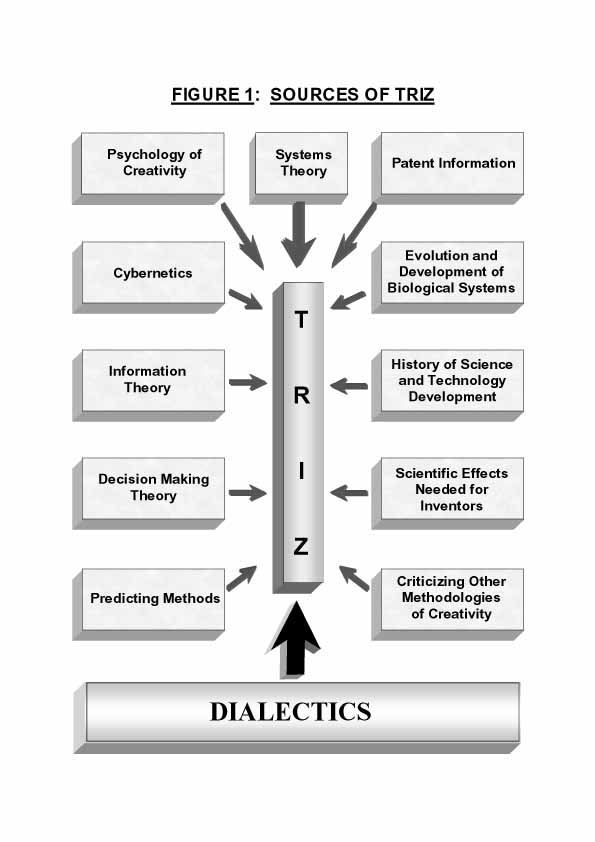
It is obvious that this management will be better if the person knows how his/ her psychological factors work. So, teaching of enlarged TRIZ needs to be supplemented by more knowledge of cognitive psychology.
- Patent information which on its merits is information about inventive creativity (or development of inventions) has helped research work in order to reveal the objective development laws of technological systems. But one drop of sea water may reflect the taste of the whole sea. Then, on the one hand there are possibilities to transpose application of the objective laws of systems development, ideas, the way we reason and tools in TRIZ to other non-technological areas, and on the other hand you may present enlarged TRIZ with countless illustrations taken from non-technological areas. It is possible because development of all kinds of systems obey the similar, analogical or isomorphic laws.
- According to Mr. Altshuller, especially when tackling inventive problems of the highest levels, a solver has to have a knowledge of the whole of technology, the whole of physics, the whole of chemistry. To meet this demand, the booklets “Guiding the Usage of Physical/ Chemical/ Geometrical Effects in Inventing” were born. In our view existing “Guidings” are inadequate, primitive and not convenient to use. Given this, I think, there will be very large room for future research work in that direction.
- In enlarging TRIZ, Mr. Altshuller’s working style should be strictly followed, that is, every enlargement in TRIZ should be verified, corrected and perfected through a feedback established with the development information in general and patent information in particular, and the results of use of learners during and after the teaching process.
Luckily, in comparison with our ancestors, now we have a very great amount of information about many kinds of evolution and development in biology, society, cosmology, scientific and technological knowledge and so forth. If before, this information to great extent has been processed fragmentarily in accordance with specialized fields, then now, we should reprocess all information about reality from the angle of development. In such a way, because of unity of reality we can reveal the most generalized laws of development or at least, isomorphic, similar or analogical laws of development which can serve as a directing mechanism in creative thinking (thinking for problem solving and decision making).
- In principle, the large public must be understood as all people without any exception. In practice, up to now we have concentrated our efforts on people with high and higher education irrespective of age, profession and position.
In our view, enlarged TRIZ is able to be fully adapted for people with lower education.
- Like other sciences, during its evolution and development TRIZ can be enlarged toward specialization on stages of a process of conducting creativity and innovation, and on theoretical and applied issues.
- Enlarging TRIZ and Teaching Enlarged TRIZ for the Large Public: Some Results.
Our program “Creativity Methodologies” based on TRIZ has the aim of providing the large public (not only engineers) with knowledge and tools which help them solve creatively and innovatively in a scientific way problems (not only technological ones whose solutions must be patentable) they may encounter during their lives. The following are some results derived from the process of accomplishing this aim.
II.1. Introducing Clarity into and Enlarging Concepts Used in TRIZ
It is known that every discipline has its basic concepts and their definitions help people to have a common language which is useful in thinking, communication and action. With time, the term that is a form of expression of the given concept can remain the same but its content may be changed and enriched with many new meanings (implications). It is one of the ways to enlarge an application of concepts. Thus, we have made a real attempt to do that for basic concepts used in TRIZ. The following are definitions with explanations involved in some of these concepts.
Creativity is an activity leading to anything (in the largest meaning) having both newness and usefulness simultaneously.
There are many implications relating to how to understand this definition. For example:
The human activity is only one of possible activities in the universe.
In the given field, newness is any sign of difference from any previously known object (called a prototype object or shortly, prototype). To reveal newness we should first choose a prototype, then compare the object after improvement with the chosen prototype.
In the above definition of creativity the emphasis is made on “simultaneously” because any newness brings about usefulness only inside its specific region of application. So the given newness being applied outside its region of application can bring about harm. In this meaning, any creation can be a double-edged sword.
Creativity creates development and in every development there is creativity. So, searching for creativity laws in creativity science is searching for development laws. In this connection, the patent information is only one of possible information sources about development.
Our activities originate from and meet our needs. In search of ways to meet our needs, we may encounter or set problems to solve.
A problem is a situation where a solver knows the aim (in the largest meaning) but
does not know any way to reach it or
does not know the optimum way to reach it among known ways to reach it (i.e. decision making process).
Problems differ in difficulty levels. For example, TRIZ divided the difficulty of technological problems (or the inventive creativity) into five levels. If we take also all other problems into consideration, it is apparent that human life is a succession of problems to be solved and decisions to be made. Life will be happy if all problems in general (not only technological problems) can be solved well. In the opposite case, life will be “the sea of torments”. TRIZ needs to be enlarged toward helping ordinary people to solve well all the problems which they may face in their work and life. If TRIZ could do so, their lives would be “ the sea of happiness”. In our view, TRIZ has a great capacity for that.
Basically, a human being has to think really and actively when he/she has a problem to solve.
Creative thinking is the thought process leading the solver from not knowing to
knowing the way to reach his/ her aim or
knowing the optimum way to reach his/ her aim among known ways.
We call this thought process creative thinking of the solver because there are both newness: from “not knowing” to “knowing” and usefulness: at last the desired aim is reached and both ends are found by the solver’s own thinking efforts. In fact, creative thinking is the thinking process of solving problems and making decisions.
After getting the solution in the form of an idea to the given problem, the next step for the solver is to realize it in places where this idea is needed. In other words, in addition to thinking, actions need to be performed to ensure that the solution becomes real and accepted.
Innovation is a process of thinking up creative ideas and implementing them so that all changes as results of this process are fully, stably and sustainably accepted by the related systems which after that function better than before.
A crude innovative process can be represented by Figure 2.
In our opinion, the problem can be considered as successfully solved only when its solution has been accepted fully, stably and sustainably, at last, by the system of potential users in practice (full or complete innovation). Then, newness becomes oldness and usefulness becomes real, and only in such a case we will have a genuine development in reality. In other words, what we need is not creativity for the sake of creativity but for the sake of the problem being solved successfully in reality, that is, for the sake of full (complete) innovation. Because “the end of fishing is not angling but catching” and I want to add “and the caught fish should be eaten by the appropriate consumers and the environment is not polluted afterwards”. In this regard, we have set a task before us, ’To teach creativity methodologies which must motivate learners to put their gained knowledge and tools into action”. Innovative process represents a process of systems state transition, that is, it transforms related systems from a prototype state to an improved state. Namely, here systems inertia should be taken into consideration. Systems inertia is the attempt or effort made by the given system toward preserving the old state and always resisting the transition to the new state if the new state does not coincide with the change tendency at the prototype state.
According to the special theory of relativity, the maximum velocity of motion is equal to that of light in vacuum, i.e., there is not infinite velocity. For this reason, we can conclude that systems inertia is the attribute inherent in any system and state transition time (inertia time) is always greater than zero. Human psychology is only one kind of system, thus, psychological inertia may be considered as a special case though a very important case of systems inertia.
II.2. TRIZ: Dialectical Systems Thinking for Problem Solving and Decision Making.
For preparing TRIZ users a teaching program may be designed to present only TRIZ content accompanied by illustrations and exercises. Doing so is useful because, in the sense of advantages, TRIZ in comparison with the trial and error method is like an excavator in comparison with a shovel. But practice shows that the excavator’s user works better when he/she understands the basic knowledge and working mechanism underlying this excavator. In other words, TRIZ learners need to know and understand TRIZ knowledge sources and logic. For this reason, in our basic course “Creativity Methodologies”, one special chapter is devoted to presenting these related issues including psychology of creativity, systems theory, dialectics and patent information to the extent of preparing learners for understanding and using TRIZ competently later on. Some other applied knowledge derived from cybernetics, information theory and other generalized sources are introduced to learners later during the teaching when needs for that appear.
In this paper we confine ourselves to making emphasis on some points concerning dialectics and systems thinking.
Dialectics is the science of most common laws of nature, social and mental development. Creativity is associated with a development, so TRIZ has selected dialectical laws as its philosophical foundation.
There are three basic laws of dialectics:
- The law of the negation of negation, which conveys the direction of development.
- The law of the mutual transformation of quantitative and qualitative changes , which demonstrates the mechanism of development.
- The law of unity and struggle of opposites, which demonstrates the source of development.
Of them, the third law is the nucleus of dialectics and the first two laws may be considered as particular cases.
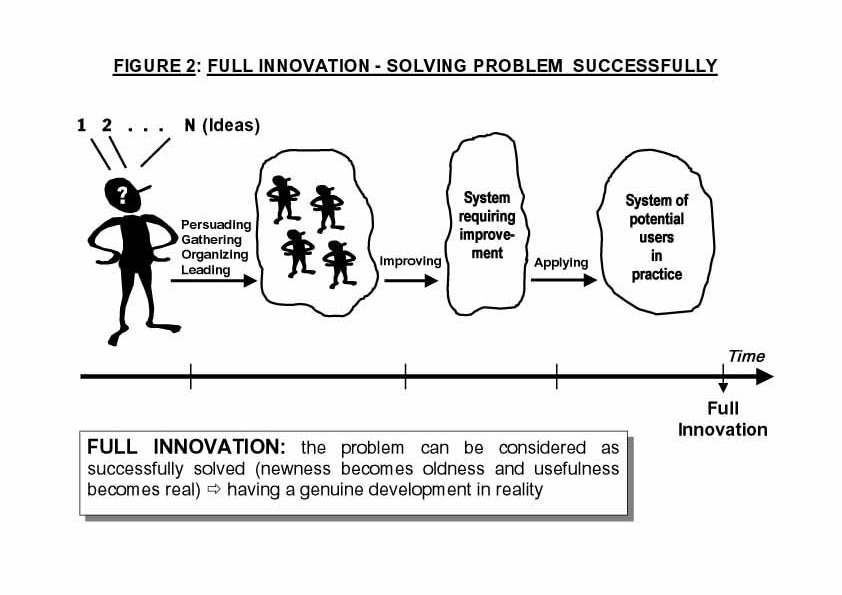
In addition to the three basic laws of dialectics there exist also non-basic laws. Non-basic laws of dialectics are those universal laws which reflect relationships of phenomena in the universe. Since these relationships are very diverse, they are expressed in a large number of laws. In particular, these non-basic laws include essential, stable, recurrent and intrinsic relationships between:
- The individual, the particular and the universal
- Phenomenon and essence
- Form and content
- Cause and effect
- Necessity and chance
- Possibility and reality, etc.
Development, from the viewpoint of dialectics, can be understood as follows:
Supposing at first the system was at some level of development where there was unity of opposites. This unity does not exist forever. Because of changes and a struggle (mutual interaction) between the contrary sides, the initial unity is broken and a contradiction arises. The contradiction is resolved so that the system turns to a new level of development (new unity). In the long run, another contradiction will emerge and will be resolved again so that the system will turn to a newer level of development… and so on without ending. Figure 3 shows crudely development, creativity, innovation and problem solving process in dialectical meaning.
Unity 2 (object after improvement) in comparison with Unity 1 (prototype object) has both newness and usefulness simultaneously so Unity 2 is also the creativity product. In terms of dialectics we can say Unity 2 negates (replaces) Unity 1. Dialectical logic reflects the logic of development, therefore the logic of creativity. According to TRIZ, to solve a problem is to resolve contradictions on a win-win basis to turn the given system into a new unity of two contrary sides where previously those sides eliminated each other, that is, into a new level of development. In TRIZ there is the means that helps the solver to reveal and to resolve revealed contradictions.
In fact, the human problem solving process represents the process of discovering contradictions and resolving them. Therefore, three kinds of contradictions put forward in TRIZ (administrative, technical and physical ones) are general, i.e. they exist in all kinds of problems. In other words, these concepts of contradictions and ways of resolving them can be fully enlarged to non-technological areas including daily life activity.
Example (derived from business):
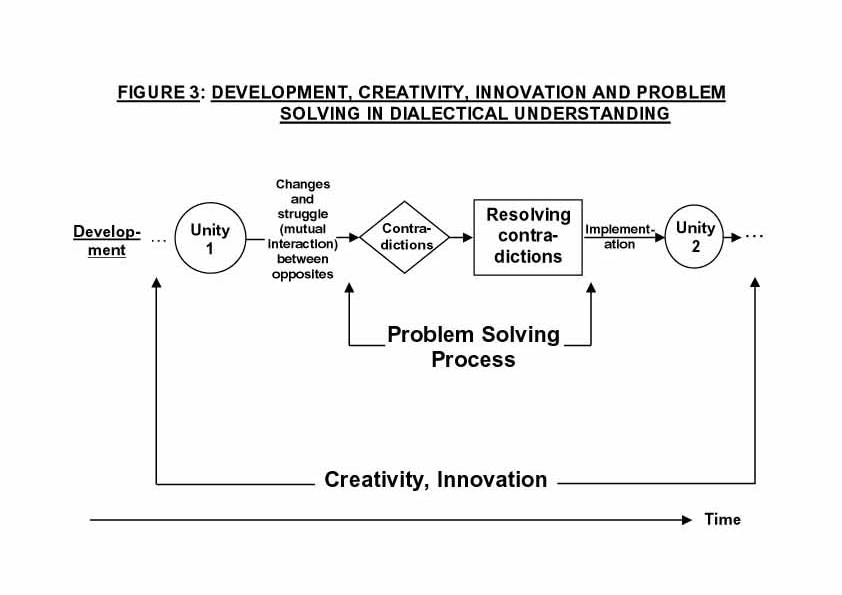
There was a man who loved animals very much. Whenever he got some money, he brought home to raise birds, cats, dogs, bears, elephants and so on. One day, he wanted to become a professional businessman in trade of animals but he did not want to leave his animals - those he himself fed and trained.
Thereby, the physical contradiction is: these animals have to be sold to get profit and not be sold to be enjoyed by their owner.
The answer was to let these animals for rent. That means selling them for a while and then getting them back, and over and over again. In his case, the renting established the unity of two contradictory sides: “selling” and “not selling.” The principles used in this example were Continuity of Useful Action and Periodic Action.
Mankind has to study objects and solve problems that are getting more and more complex. The approach considering the whole as an arithmetical sum of components is not suitable any more. It is necessary to have an approach that permits us to study not only the components and the dependences, actions and influences between them, but also the qualitative change of the whole in relation to these components. System is defined as follows: a system is an assembly composed of connected component elements so that the whole assembly has such properties which cannot be reduced to the properties of the separate component elements or connections. These properties are called systemness (or wholeness) of the given system. The systemness is used to express the specific function of the system or to answer the question “For what is the system born (or constructed)?”
Because of systems connections, any change happening somewhere in the system or in the surrounding environment will not be located at that place but will spread throughout the system and beyond it. This systems change spreading effect may cause contradictions inside and/ or outside the given system.
The systemness depends on both the elements and the connections. For this reason, it is possible to develop the systemness by changing (in the largest meaning, for instance, modifying, adding, removing, nesting) the elements, or the connections, or both. In this sense, TRIZ tools (for example, 40 principles) work as systems transformers.
Development in general and creativity in particular become with time more and more complicated. For that reason, the knowledge of systems research is consistently used in TRIZ, see Figure 4.
There is always a particular system in each problem. TRIZ not only requires but also creates devices (for example, System Operator) that help a solver to “see”, think about and process, at least, “nine-systems thinking display”. It is needed because, information resides in any of its systems which may have influence on or serve as prompts to a solution to the given problem.
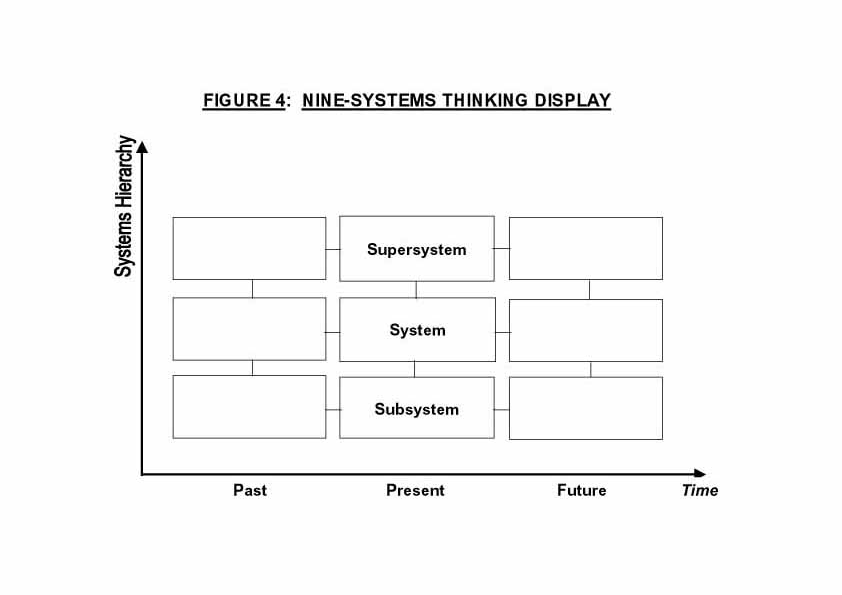
TRIZ is a concrete expression of applying dialectics and systems research to the creative thinking process, that is, such a kind of creative thinking directed by objective systems development laws. This directing mechanism helps the solver to eliminate a considerable number of barren trials not coinciding with the solution’s direction.
II.3. Concepts of Systems Space and Ideal Criterion for Good Solution/ Decision
In reality, we may deal with multifunctional systems. In these cases, for the n-functional system we can consider it on each-function basis separately and for each-function consideration we also have two axes existing in TRIZ Systems Operator: axes of time and systems hierarchy. Certainly, these n ways of consideration are interrelated.
In addition to that, though TRIZ also takes into account the subjective (psychological) side of creativity (e. g. psychological inertia, imagination) for human beings’ happiness it is not enough. The point is that different people have different urgent needs, interests, preferences, perspectives… And all of these things may be correct, need to be respected and taken into consideration by the problem solver, even from the viewpoint of the whole of a community or the whole of mankind.
In response to all said above the third axis called axis (or dimension) of consideration has been introduced into TRIZ Systems Operator (see Figure 5). Then, the axis (or dimension) of consideration and together with it, the axis of systems hierarchy will revolve on the axis of time as many times as there are ways of consideration by interested people. Axes which are ones of time, systems hierarchy and dimension of consideration form the Systems Space. In particular, for only one dimension of consideration we have the Systems Plane.
With introducing the dimension of consideration, there may arise a new kind of contradiction: contradiction between different systems belonging to different dimensions of consideration. According to TRIZ win-win solution the solver must find the solution which is good for all these systems simultaneously.
Generalizing all presented above we have put forward the Ideal Criterion for Good Solution/ Decision as follows:
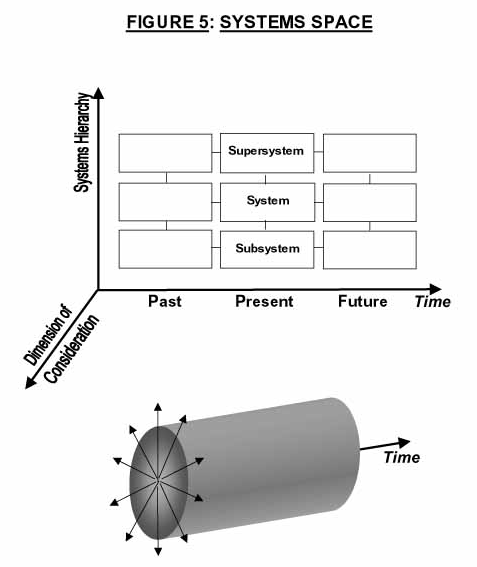
The solution/ decision which is being considered the good one should be good not only for the system residing in the given problem but for all systems and environment in systems space. Of course, to meet this criterion is very difficult. For practical use, we have reduced it as follows:
The solution/ decision which is being considered the good one should be good not only for the system residing in the given problem but, at least, for all systems and environment residing in the nine-systems display if there is only one dimension of consideration, or for all 9n systems and environment if there are n dimensions of consideration.
In our view, the concept of Ideal Criterion for Good Solution (ICGS) is very important for many reasons. Some of them are as follows:
- The contemporary challenges faced by us such as fast change, increasing complexity, diversity and competition lead to an increasing amount of problems at all levels. Because of that, no system can solve all problems for the rest of systems. All systems are interrelated, so if ICGS is not maintained a solution of one system may cause problems for other ones. And further, the system which made the given decision in the past can encounter new problems in the future as negative consequences. As a result of this, we do not have the needed sustainable development.
- On the other hand, if the given solver (or decision maker) should take the consequences in the form of punishment from society or within his/her conscience then his/her life would not be happy. So ICGS may serve as a motivating factor for human beings’ actions.
- Educating all people, especially from early ages, to keep ICGS during the problem solving process, in our view, may help to lift cultural and ethical levels that now do not correspond to economic, scientific and technological progress.
II.4. Enlarging an Understanding of TRIZ.
Though TRIZ, first and foremost has been built for solving technical problems but only in semantical aspect, TRIZ has a lot of potentials for a larger interpretation, therefore, a larger understanding and use of TRIZ.
In TRIZ, there are many words, phrases, sentences and even paragraphs which can be (and in our view, should be) understood in the largest meaning, see Figure 6. In addition to that, those people who have learned also the sources of TRIZ can understand TRIZ to a larger extent in light of these sources.
In general, when teaching TRIZ we always encourage our learners to understand meanings of TRIZ statements largely and in dialectical, systems and imaginative ways.
II.5. Diversifying Kinds of Application of TRIZ
When teaching TRIZ to our learners we also always make an emphasis on the diversity of application of TRIZ tools and statements on a daily basis. This is important because in daily life and work there are many different problems whose solutions require an application of only one or two of TRIZ points. Moreover, usefulness of these solutions is realized immediately and explicitly and this joy itself of daily life helps people to become happier.
To accomplish that purpose, we illustrate it by examples taken from different areas and give our learners exercises helping them to understand and use TRIZ diverse advantages separately or in combination such as:
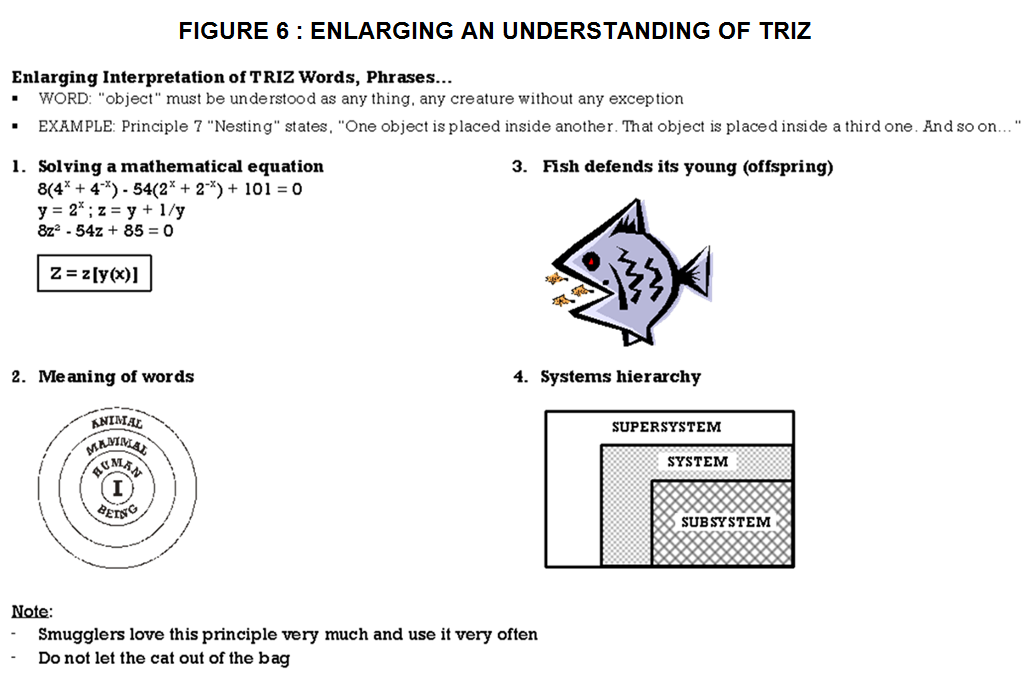
Providing a system of various multiple perspectives (dimensions of consideration) in accordance with diversity of possibilities (resources).
Increasing creative curiosity and observation.
Overcoming psychological inertia.
Developing creative imagination.
Identifying unity, similarity, analogy among objects, phenomena, processes… in different areas.
Increasing sensibility in perceiving and processing information
Helping logically to explain and evaluate available creative solutions.
Having different approaches to solve problems
Knowing how to discover contradictions and to generate ideas for resolving them.
Predicting systems development, initiating and purposefully carrying out this development.
Predicting failures and finding ways to prevent them (because any creation can be a double-edged sword).
Improving and perfecting human beings in general and problem solvers in particular.
II.6. Deepening TRIZ Logic
As you and we have seen, TRIZ itself is a large theory with a great number of creativity tools. Though we strive to structure our program so that it takes learners through simple issues to more complicated ones and every part of the program is a logical successor of previous ones, in fact, even those people who have learned the whole of TRIZ may not “see the wood for the trees”.
To avoid this, at the end of each course we always provide learners with a review of the whole program.
Mr. Altshuller wrote about the relationship between principle, method and theory as follows: “Crudely expressed, principle, method and theory form a chain of the type ‘brick – house – city’ or ‘cell – organ – organism’”. In other words, if we take TRIZ as a system then the method will be a subsystem and the principle – subsubsystem. According to a systems logic, a systemness of a system defines systemness of component subsystems and in turn, the given subsystem defines systemness of component subsubsystems and so on. To follow this logic in the thinking process for solving problems is very important, especially for problems in daily life and work where learners do not use (or cannot use ARIZ) but used to use only some principles or methods. We always require our learners to pay their attention to this logic by emphasizing that they should use principles or methods not for the sake of these principles or methods but for the sake of transformation of the given system residing in the problem in accordance with TRIZ objective laws of systems development.
There are nine laws of systems development in TRIZ:
- The law of conpleteness of component parts of the system.
- The law of passability of transference of the system.
- The law of concordance between component parts of the system.
- The law of increasing the degree of idealness of the system.
- The law of non-uniform development of component parts of the system.
- The law of the transition to development at level of the supersystem.
- The law of the transition from development at macrolevel to microlevel.
- The law of increasing the degree of controllability of the system.
- The law of the transition from one S-curve to another.
The following are some examples of an understanding and application of TRIZ, see Figures 7, 8, 9, and 10.
Among them, Figure 9 shows how to explain the process of development of the given system (i.e. the pointer) logically in terms of TRIZ principles, methods and laws. Eight principles found in the pen-pointer which are arranged in a certain order of their application can serve as one of possible TRIZ methods. This method can be applied to other similar objects in order to develop them (e.g. to the feather duster, see Figure 10).
Additionally, in Figure 9, reflections of TRIZ laws also can be seen:
the law of concordance between component parts of the system (e.g. concordance between the pointer’s user and the environment where he/she should carry it with himself/herself - Cushion in Advance and Dynamicity);
the law of transition to development at level of the supersystem (e.g. the pen-pointer is a supersystem in relation to the separate pointer and pen - Consolidation);
the law of non-uniform development of component parts of the system (e.g. in the system pen-pointer the mechanical pointer is developed into the laser beam, meanwhile, the pen remains the same);
the law of the transition from development at macrolevel to microlevel (e.g. from mechanical rod to photons - Replacement of Mechanical System);
the law of increasing the degree of idealness of the system (e.g. Continuity of Useful Action and Universality);
the law of the transition from one S-curve to another (e.g. from paradigms of mechanics to ones of optics).
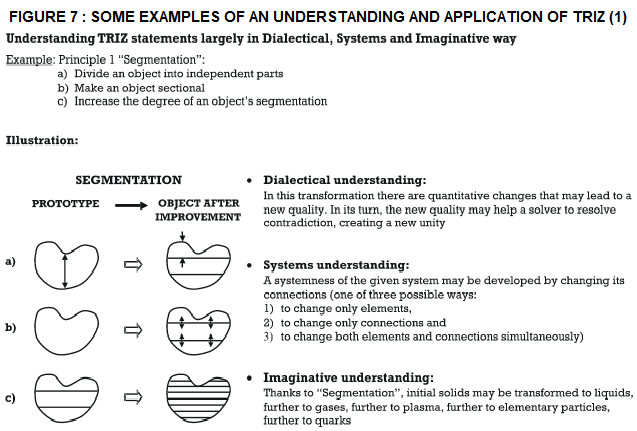
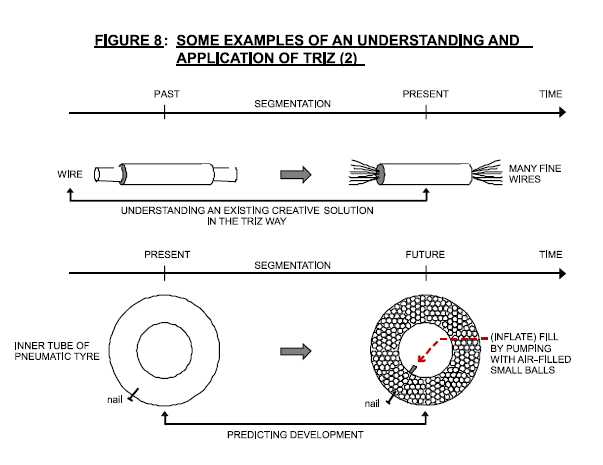
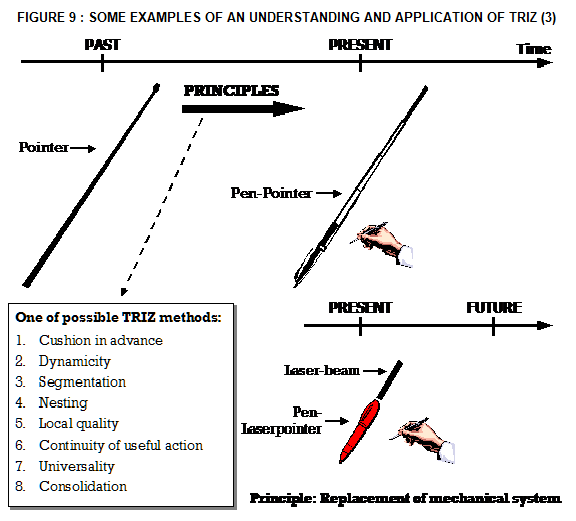
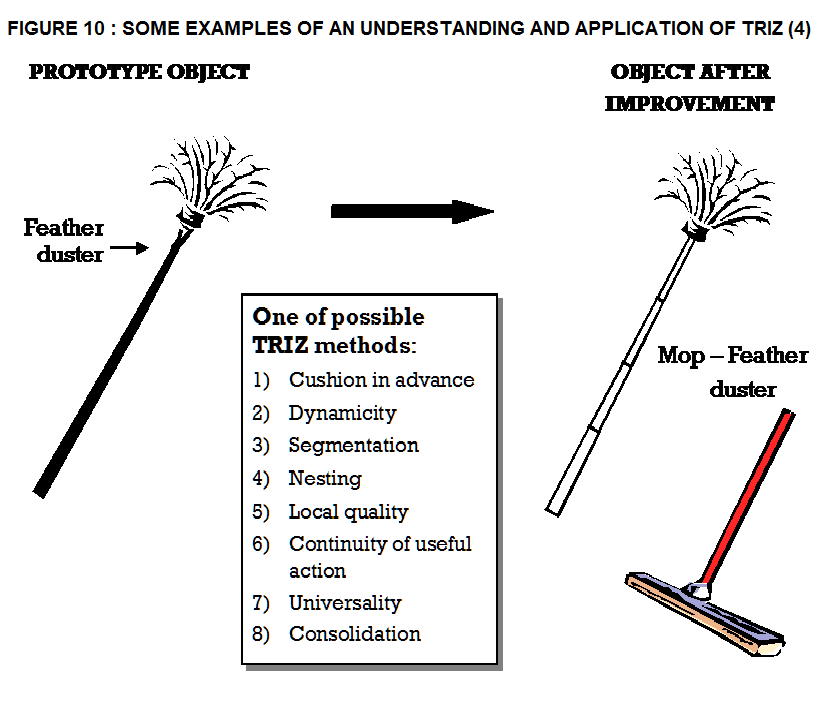
The following is another example but this time, it is an interpersonal problem.
Story written by Vu Huu Su and published in the issue 28 July, 1997 of the newspaper “Kien Thuc Gia Dinh” (Family’s Knowledge):
One of the people I often visit is a writer who is always busy writing novels and short stories. His wife is a literary critic. His two children are gifted students.
There has been a cold war between my friend and his wife for two weeks. It was just because of a proverb.
His daughter, who majors in literature, asked him,
“Daddy, could you please explain the meaning of the proverb ‘The daughter-in-law abstains from eating September Rau-muong (a popular kind of water spinach in Vietnam), saving it for her mother-in-law’?”
“It’s not so difficult to understand the saying, dear”, replied the father, “Rau-muong is rare in September, as that’s not the season for growing it. The proverb is for praising dutiful daughters-in-law who always save rare, good things for their mother-in-law. Understand?”
“Yes, I do”, said the daughter.
“What an explanation!”, his wife interfered. “September is not the season for growing Rau-muong. That’s true. Yet this means September Rau-muong is not as good as usual, but very tough, tart and fibrous. Though it’s hard to find it, it’s not precious at all. The proverb is not for praising but for mocking foxy daughters-in-law, who are ‘wolves in sheep’s clothing’. Get it?”
He replied: “This proverb came from ordinary people who are honest and simple, not as fault-finding as you critics. For you, to read is just to seek for the work’s content, and theme, and idea and the like without any understanding of literature and artistry at all”
“How can we find the artistic merits in such works as yours? Right, so I know nothing about literature and artistry. Then why did you insist on me writing recommendations for your works so many times?”
“The poor and stupid want to be intellectual, likewise, short-sighted people always peer around”.
“How right you are! I’m such a peasant! I’m so short-sighted! But why were you so crazy about this girl? Can you remember how many tears you have cried over me?”
The argument continued that way, on and on. And these are its last words.
“OK. We’ll get divorced then!”
“Thanks a million! Go ahead! Write an application for it! I’ll sign it immediately!”
Neither of them has written the application. Yet they haven’t said a word to each other since then and just communicated through their children. Also, they have slept separately at night…
I would not have given this incident a second thought if I had not visited a friend who deals with divorce cases. He said with grief, “The humorous yet sad fact is that up to 80% of divorces are caused by such trivial conflicts. It is just because neither the husband nor the wife wants to give himself/herself up. If only each of them could make concessions to the other.”
Yes. If only they could make concessions.
Note the husband’s interpretation is wrong. The wife’s interpretation is correct in accordance with the meaning given in the Dictionary of Vietnam’s Proverbs.
**
Comments:
- Suppose that the husband and wife are famous writers. This means that they have a high level of creativity. But in this story they are not happy because they cannot solve the family’s problem well. In this connection, I suddenly remember the phrase said by one hero in a novel whose title I forget, “To be happy is more difficult than to be famous”.
- The author’s advice in this story, “If only each of them could make concessions to the other” is common. Following this advice repeatedly, however, may lead to stress and/or depression. Then, stress and depression will be a greater problem than the original. Problems should be solved well, they need not be hidden.
- “Up to 80% of divorces are caused by such trivial conflicts”. Why? We can see that the married couple cannot control themselves. Inversely, they are controlled by a harmful positive feedback which amplifies the tension between them and can destroy their family. Imagine what heavy consequences would happen to them and their children if they had divorced and what a society would be like which had many such divorced families. And in this case life will be, in fact, a sea of torments.
- From our viewpoint, the behaviour of the people in this story is the common behaviour of non-TRIZ users or not in TRIZ logic.
The point is that, the family should be considered as the system with its systemness. The system should be developed in accordance with the TRIZ laws of systems development. In this story, at least, violation of the law of concordance between component parts (the family’s members) of the system (i.e. the family) arrests our attention immediately.
Violation of the TRIZ laws is a strategical mistake in the meaning that, further using TRIZ methods and principles cannot solve the conflict because they are used outside the context of the TRIZ laws. For example, in this story, the married couple actually do not want to get divorced but they stand before the new problem, how to communicate with each other. To solve this problem, they use the principle Mediator (i.e. communicated through their children). The use of the principle Mediator here creates not progress but regress in comparison with the family’s state before the quarrel, thus violates the law of passability of (in this case, of information) transference of the system. And the family’s cold war remains and is not resolved.
5. Now, imagine that the daughter is a TRIZ user and needs to solve the problem of the meaning of the proverb. According to TRIZ logic she should not immediately think about a new system (i.e. her father) to solve her problem but should first try to solve the problem by herself. This means that she should comply with the TRIZ law of increasing the degree of idealness of the system and use the accessible intrinsic resources (i.e. principle of Self-service) to arrive at a solution. The accessible intrinsic resources can be revealed here as follows:
- Suppose the proverb in the text was written in quotation marks. These marks are an obvious intrinsic resource as they act as a clue towards the author’s intent: anything written inside such punctuation can be seen as ironic - thus the meaning is not to praise but to chastise the daughter-in-law. If the daughter could recognize this she could arrive at the correct interpretation.
- Another accessible intrinsic resource is the context in which the proverb is used. The daughter should use the context to draw meaning from the proverb rather than utilize another system (her father) to solve her problem.
- Perhaps, as they are such a literary family, there is a well-stocked family library, maybe, even containing a Dictionary of Proverbs, from which the daughter could gather the meaning of the proverb. This, again, is an intrinsic resource and would negate the need to introduce another system.
6. Now if her father were a TRIZ user, he would consider the relation between him and his daughter as the relation between instrument (father) and product (his daughter). According to the law of increasing the degree of idealness of the system he would act towards becoming the ideal instrument in the meaning that without him, his daughter (product) could solve her problem on her own. In other words, he should invest the TRIZ way of solving problems in his daughter, which would help her to solve not only the given problem, but, at least, her analogical problems in the future. Writing in this point, I remember similar trends of investment: student-centered teaching in education, employee-focused management, customer-oriented business and the saying “the next process is our customer” in Total Quality Management (TQM).
In this story, after supposing that the father is a TRIZ user there may be two possibilities.
- The father does not know the meaning of the proverb. So it is for him a problem.
- The father knows the meaning of the proverb.
In the first case, he should find the right meaning by himself using the accessible intrinsic resources, teach his daughter the way of solving the problem and finally, recognize that he did not know the meaning of the proverb before. This helps him to convince his daughter of the power of the scientific methodology of TRIZ.
In the second case, he simply teaches his daughter how to solve her problem, but never gives the meaning of the proverb in a ready form.
However, in reality, the father is not a TRIZ user. Instead, he merely guesses at the meaning of the proverb and offers this as the right explanation. Why does he do this? One reason is probably psychological - his need for respect in front of his wife and daughter. If he admits he does not know he loses respect.
7. Now suppose the wife had been a TRIZ user. Her duty then would be to criticize the husband because he is wrong and his wrong answer is in turn influencing the daughter’s learning. However a technical contradiction is present in this situation: if the wife corrects her husband the daughter will understand the right meaning of the proverb, but the husband will lose the respect of the daughter. If the wife does not correct her husband he will retain his respect, but the daughter will wrongly understand the proverb. The situation may well become worse when the daughter offers her incorrect interpretation in class. Further, the wife stands before a physical contradiction, that is, the wife should correct her husband so the daughter understands the proverb and not correct him in order to satisfy his need for respect.
The solution to the wife’s problem is as follows: the wife should wait until she and her husband are alone and then show him the Dictionary of Proverbs with the true meaning in it. She should suggest that the husband corrects the daughter when they are on their own. There is a good chance then that the daughter’s respect for her father would actually increase in regard to his ability to audit his mistakes. This solution can be seen as utilizing the transformer Separation of Opposite Requirements (i.e. criticizing and not criticizing) in Time.
In the future, if everyone in the world is a TRIZ user, in our view, a great number of problems like the ones in this story which need not arise will disappear and all unnecessary tragedies will be avoided. Then, the sea of torments becomes step by step the sea of happiness.
II.7. Other Non-TRIZ Creativity Methods as Special Cases of Possible TRIZ Methods
As well as TRIZ, we also teach other creativity methods, because we suppose that to cope with a variety of problem situations that may occur in the daily life and work of learners, creativity methodologies included in our program need to be varied. These methods have been selected with the following criteria:
- there is scientific rationale that underlies them;
- they have a wide area of application;
- they have, indeed, a strong effect on problem solving thinking process.
The selected methods are very familiar to western people such as Forced Relationships, Brainstorming, Morphological Analysis, Synectics. They have been integrated in our program logically, that is, they did not destroy the harmony of the program because, in our view, they are special cases of possible TRIZ methods.
As noted earlier in the part I.4 of the current paper, according to Mr. Altshuller, creativity method is a system (combination) of creativity principles providing for a certain order of their application. To illustrate this point, let’s take the method Morphological Analysis as an example.
Problem:
Use Morphological Analysis Method to design different forms of dolls
Solution:
Step 1: Determining functional parts of the object: a doll
A: head ; B: body; C: hands; D: legs.
Step 2: Determining possible morphological types of each functional part enumerated in the step 1
A (head): head 1; head 2; head 3; head 4.
B (body): body 1; body 2; body 3; body 4.
C (hands): hands 1; hands 2; hands 3; hands 4.
D (legs): legs 1; legs 2; legs 3; legs 4.
And building morphological matrix (table), see Figure 11
Step 3: Compiling morphological formulas which have a general form:
Aa – Bb – Cc – Dd , where a, b, c, d = 1, 2, 3, 4.
In this case, we have 256 specific formulas (dolls)
Some dolls are as follows, see also Figure 11.
Step 4: Analyzing, evaluating and selecting best formulas (dolls)
Comments:
In our view, Step 1 is a combination of two principles: Segmentation and Local Quality. Step 2 is a principle: Local Quality again. Step 3 is a principle: Consolidation. And Step 4 is a principle: Extraction.
Summing up, at last we have:
Morphological Analysis Method = Segmentation + Local Quality (1) + Local Quality (2) + Consolidation + Extraction.
Such an analysis can also be used for other non-TRIZ creativity methods.
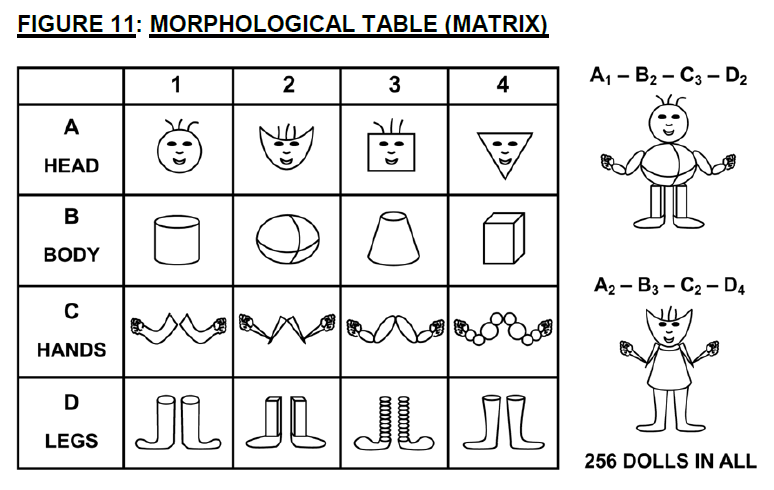
- Teaching Enlarged TRIZ for the Large Public: Some Illustrations
We can illustrate the advantages of teaching enlarged TRIZ for the large public by numerous testimonials attesting to its value from our former learners of the program “Creativity Methodologies” (CM). Our Center for Scientific and Technical Creativity (CSTC) has had thousands of such reports. In this section of the current paper we have taken some fragments from them:
… As I am a high school student I cannot take full advantage of this subject. However it helps me to study more effectively. The benefits from the course are quite significant.
… After the course in Creativity Methodologies, I stopped thinking unsystematically. Instead, I began to use Creativity Methodologies, and have a more comprehensive view of any problem. I plan optimal steps for solving math problems, anticipate potential problems.
(T.T.M. – Eleventh grader from Le Hong Phong high school)
… Obviously, the more I learned the more interested I became. I was surprised to find that my thinking had improved greatly.
… In study, I was able to deal with difficult problems thanks to my ability to ask questions and look at all aspects of those problems.
… The subject has made me more confident and decisive when coping with daily work. I hope I will achieve greater success if I apply what I have learned in my future job.
(D.B.C – Student from Preparatory Course of University)
… Creativity Methodologies are beneficial to me not only in dealing with problems. When I was still at school, I used to be punished for fighting with my classmates. If I had learned this subject then and been able to reason, using the nine-systems thinking display, I would not have resorted to violence. Not long ago, while I was enjoying some coffee with a few friends of mine, I was confronted by a group of local youths. I immediately thought of the nine-systems thinking display: if I had had a fight with them, I would have either been bitten by the youths or arrested by the police for causing public nuisance. At the same time I remembered the principles of Convert Harm into Benefit and Transition into a New Dimension. I took the initiative to shake hands with them and offer them some coffee. As a result, the conflict was solved positively. This method turned out to be better than violence. In my view, my response to this situation can be regarded as an example of creative thinking for myself.
(N.C.H – University student)
I have known for many years that I didn’t have an effective method in thinking. Faced with a problem, I found myself very slow in working out a solution, as compared to other people. I always had to grope about step by step, feeling completely at a loss, not knowing what to do to solve the problem. I could not concentrate on anything, and often left things halfdone.
Now that the course is coming to an end, I find myself completely changed from what I was before. The lack of self-confidence and the inertia in my nature have given way to optimism, observation, and inquisitiveness. My mind has been sharpened and become more alert, enabling me to find the solution to a problem more quickly, effectively and economically. What I like most in the course is that for every point presented in a lesson, the instructor always gave us illustrations taken from daily life, besides mentioning the inventions in which the method was used. I also like his humanistic approach to teaching.
I regret not having been able to attend this course earlier, which made me waste a lot of my time. The subject is necessary for everybody, and should be included in the curriculum for high schools.
(N.T.T.T. - University student)
I have benefited a lot from the CM course at the CSTC:
The subject has provided me with the right methods and skills to improve my way of thinking to make more efficient decisions in problem solving.
I have been trying to overcome psychological and systems inertia in perceiving information and solving problems. This is essential to dealing with problems not only in scientific, technical and economic fields but also in social and family life. The subject really helps build up a creative personality including unselfishness and generosity.
(H.K.H. - University student)
I find this CM course interesting, extremely interesting. Each lesson at the CSTC is like a festival for me. I wish I had taken the course when I was a freshman, not just now being a third year student.
(N.T.T.T. - University student)
… I began solving problems in a new way and find it easier to cope with them. The subject enables to come up with original ideas I had never had before.
… As I was very busy with my study, I had little time for my family. I had tried hard to cope with both my study and family, but things always went wrong. After the course, I began applying some of the 40 principles to dealing with my problems, and these efforts have been successful … Sometimes I can’t help praising myself.
(H.T.T. – Student from the Open University)
… After a short course in Creativity Methodologies, I have gained a lot of advantages for myself making me become more confident in thinking. I now have a more appropriate and comprehensive approach to dealing with problems and can easily discover a great number of interesting things around me.
… I seem to have “grown” considerably after the course. The subject has provided me with new approaches to thinking, looking at and solving problems. Since I finished the course I have studied more efficently.
(N.T.T.N – Student from the College of Social Sciences and Humanities)
… I have become a new man since I finished the course in Creativity Methodologies. I have been equipped not only with a great amount of comprehensive knowledge, but also with scientific, and most convincing approaches to thinking, which I have been making use of in my daily life and work.
(N.C.T – Student of the College of Natural Sciences)
…What surprises me most is that Creativity Methodologies can be applied not only in the technological fields, but also in such fields, as society, business, study. Creativity Methodologies teach us how to think systematically to solve problems we encounter.
(H.T.T – Student from the University of Technology)
…It came to my mind all beyond my expectations that this subject is one of the basic sciences that lays a foundation for other sciences. This should be the first course for anyone to take. I used to base my thinking on my own feelings, and use the trial and error method to deal with problems. Now thanks to what I have learned, I am now well equipped with a variety of multidimensional and more logical thinking methodologies.
(V.D.Q – Student from the College of Natural Sciences)
… This subject should have been taught to us before any other subjects as it provides the best approaches to other subjects.
(N.M.T – Student of the University of Medicine and Pharmacy)
… From the beginning to the end of the course, most of what I learned was new, interesting, and useful for me.
The lesson on inertia, which helps me to better understand myself and human beings, was very heplful in perfecting my character and behaviour.
The lesson on 40 principles, which help me develop my systematic working habits and reasoning thinking, in particular Segmentation, Prior Counteraction, Prior Action, Cushion in Advance, Convert Harm into Benefit, Dynamicity, Periodic Action, Rushing Through, Changing the Color.
… As a high school math teacher, I will apply what I have learned in teaching and counseling my students.
(D.T.T.H – High school math teacher)
Upon completion of the CM course, by means of 40 principles I have a thorough and sound understanding of improvements, inventions and innovations in new products offered on sale in the market. I can also identify the defects of a particular new product, the improvements to be made, and anticipate its solutions regarding this product.
I am planning to incorporate the spirit and knowledge of this subject into my teaching in order to increase efficiency of my training, enabling my students to learn more systematically and take initiative on their own.
(N.H.H. - Teacher in physics, Mac Dinh Chi high school)
… I have been wondering why so many people have used the trial and error method without ever being able to find the right approach, but what is meant by the right approach? Why is this subject not introduced in high school to save time and energy?
… I teach literature, so developing students’ imagination is essential and the best approach is not to discourage new ideas resulting from cognitive needs. Consequently, students will learn the lessons more easily, and what they have discovered by themselves they will bear in mind.
(D.T.M.H – High school literature teacher)
… Creativity Methodologies enable us to overcome weaknesses of working by rote, and restore the intrinsic quality of creativeness of humans.
…I teach dialectics to students. I think if we combine all the laws and principles of dialectical materialism with techniques of Creativity Methodologies, my lectures will be more interesting. Students will be more interested in philosophy, which will therefore be more practical. I would like this subject to be included in the curriculum of Hanoi University.
(T.N.T – Philosophy lecturer, University of Hanoi)
…Before the course I had never been able to think independently and systematically. If I can apply what I have learned I will be successful in both work and life.
… In an interview at the end of the course, both the interviewers and the interviewees concentrated on the youth. I am totally in favour of that. However, it would be unfair not to include the old generation as course learners. This was agreed on by a senior high school teacher at the meeting. If only leaders of the Ministry of Education and Training would spend some time attending the course.
(T.T.D.T – High school teacher)
Your course gives me a new dimension of creative thinking. Now I can see everything through your 40 principles of TRIZ which help me a lot to solve the problem systematically, minus Trial and Error Method, plus 6 steps of the Reduced Program of Problem Solving.
(Z.S. - Educational administrator, Ministry of Education, Malaysia)
This is one of the most valuable courses that I have ever attended. It really opens my eyes and stimulates my thinking after being exposed to so many new concepts and approaches in creativity learning and problem solving which you skilfully introduced to us. The numerous interesting examples and stories that you appropriately inserted are in themselves masterpieces of creativity. We sincerely look forward for more of such courses.
(L.K.S. - Educational administrator, Ministry of Education, Malaysia)
I am glad and very thankful for attending this extraordinary thinking course. After this course I now realize that contradictions could be united and should not be viewed separatedly. Instead of treating opposite elements as attacking each other, now with TRIZ both are combined to resolve problem in “win-win” situation.
TRIZ methods encourage me to see things and analyze problems objectively. There is no trial and error which is considered wasting time giving limited output. Your methods are convenient to our daily life.
(M.H.Z. - Educational administrator, Ministry of Education, Malaysia)
My present job doesn’t sound to be one that has anything to do with science and technology. With the tools that I have learned, I have made various designs of new blouses, some of which I find really good. Though I have no plan to become a fashion-designer in the future, this ability to design new models of clothes can help me become an owner of a well-known dress-making shop. Also, thinking methodically will help me work more efficiently with a program carefully envisaged from A to Z, with no redundant operations that waste my time. If I had attended the CM course right after I finished high school, my career prospects at that time must have been different.
(N.T.M.D. - Dress-maker)
In my production work, by using brainstorming and the table of creativity principles in solving technical contradictions, I have taken the initiative in improving a lifting machine using a manual pump, which was highly appreciated by the people in my factory.
(T.B.H. - Worker)
To illustrate, below I will describe one of my successful efforts since I finished the CM course at the CSTC:
Company Fujitsu sent over 210 Vietnamese to Japan for training. After they had been in Japan for a while, once a week the company arranged for some of them to talk with their families via television bridge. Once there was a technical problem: the participants could only see one another’s faces without any sound. Our manager had decided to postpone the meeting. This meant that the families should return home and come back in a week. Among them there were many from very far provinces. Remembering the point “Using the intrinsic resources inherent in the given system” (principle Self-service) in the CM course, I came up with an idea: participants talk on the international telephone of Fujitsu’s net while seeing one another on the television screen. All trainees and their families were happy. Because of this, I also felt happy.
(T.T.T.C. - Employee, Company Fujitsu)
…I graduated in Law, and became involved in management … I was interested in the lessons from which I learned a wide range of thinking techniques (40 principles and methods) that I can apply in solving socio-economic problems. I have found that these techniques are essential to daily activities. Creativity Methodologies help me to identify my shortcomings, in particular, psychological inertia, performing jobs by rote, lack of initiatives. I have been trying to get rid of these weaknesses and practising Creativity Methodologies.
(V.K.C. - Scientific research officer, Vietnam National Center for Sciences and Technologies)
Now things have become different after the CM course. I don’t mean that it is a sort of miracle. But undoubtedly, if I learn how to think in a more creative way, then I can save more time for more work. Now whatever work I take charge of, big or small, I view it as a problem. I use the new methods to solve it and I can do it faster. Good-bye to my old-fashioned way (the trial and error method). In my hospital, I have reorganized the rooms and medical devices, giving each of them more functions (the principle of Universality) without ill affecting the treatment and order. I now realize fully that: Without methods, great persons can get lost; with good methods, ordinary persons can do great things.
(N.T.Q.L. - Doctor)
I used to feel proud of my ability to create, as compared to other people in the small community where I work. But July 3rd, 1991 was a turning point in the development in my thinking since it was the day I began attending the CM course. Looking back, I realized now that what I had before were small and mediocre ideas. What I can be sure about is that if I had attended this course nine or ten years earlier, I could have done things much more effectively.
(H.T.K. - Engineer in Computer Science)
It is the course I took from the CSTC that helped me to cope with my research problems to which I was unable to find appropriate solutions.
I had never thought that after only ten days of learning I could become so much more scientific in both my work and life.
(N.N.D. - Researcher, Research Institute for Policies of Scientific and Technological Strategies)
After learning the CM course with you, I have put it into practice to solve a variety of challenging problems that I meet in real life. I would like to inform you of that so you can share my happiness.
Further, he presented in detail how to solve his three specialized problems applying what he learned from CM course and drew the following conclusion:
I have found that the reason why I could find the solutions to my problems is that I have mastered ARIZ. This helped me quickly identify the problem, with its technical and physical contradictions. I determinedly pushed the contradictions to extremes to resolve them by TRIZ tools. Using ARIZ, I find that my ability to solve problems has augmented ten times. And in my daily life CM have made me feel more confident and comfortable.
(L.V.K. - Mechanical engineer)
During the course, I have used 40 creativity principles and had four inventions in improving wood processing technically.
(T.K.T. - Graduate from Trade School of Chemistry)
Happily, after applying what I have learned to my job, I have made three little inventions and some improvements.
(N.T.T. - Dentist)
Half way through the course, I began applying what I had learned in my research work, in particular, by using such principles as “Local quality”, “Prior Counteraction” and “Segmentation”. I was able to control the growing of the mushrooms. This has brought about mechanization of mushroom raising, the problem to which I had been looking for a solution. And now I have been able to find the answer. In addition, the size of a mushroom can be controlled to meet market demand. I have recently been conducting a number of experiments for which the results are satisfactory.
(N.H.D. - Agro-engineer)
After the CM course, one of my successful efforts was making improvements in the design and packaging of our product by creativity tools. As well as that, in organizing the production process I made a change to a piece of equipment: a container full of products with a weight of 100 kg made it difficult for workers to load it onto a cart, and then carry it to a steam-heated furnace. In fact the workers were able to handle a load of 70 kg (because 100 kg is too heavy for them), short of 30 kg. I applied the following principles: “Continuity of Useful Action”, “Dynamicity”, “Segmentation” and “Consolidation”. The container was divided into two separate parts, with 50 kg product for each. But once inside the furnace, the two halves were joined with special hooks, and turned into one container to be fitted to the furnace’s power. Thus, the container always holds the content of 100 kg without any waste.
(L.C. - Deputy director, Beverages Company)
I feel ashamed of myself for being unaware of this subject, a useful tool for management work, although I have been working for many years at the National Center for Scientific and Technological Information (NCSTI).
(T.T.L. - Department head, NCSTI)
I have to blame myself for taking the CM course so late although it has been in existence in Vietnam for over 22 years. Unlike other courses, this subject impressed me right from the very first lessons with the first concepts.
I am happy to learn that this subject, which is a new science in the world, has been introduced in Vietnam. Everyone can do worse than take up this subject.
(T.M.D. - Deputy General Inspector, Ministry of Science, Technology and Environment)
I am a researcher with 18 years of experience in scientific research and 10 years in business management. The subject astonishes me and I have a feeling that I have been making unnecessary efforts to clear the weed to make a path for me to go while there is a wide asphalted road not far from where I am. I wish I had learned this subject earlier.
(B.B.Q – Ph.D. Depury General Director of the company EMECO)
Before taking the CM course I had never thought of such an excellent course being available in Vietnam.
As a training manager I had participated in many courses and seminar-workshops held by different international schools in Vietnam and abroad. I think the CM course is the most interesting course I have attended up to now.
(T.H.H. - Head of Training Department, Company UNILEVER-VIETNAM)
This subject has helped us to realize how harmful it is to think without orientation, to do things from habits and by trial-and-error. In our case, it is even worse because we are teachers, whose duty is to train students to be creative (as we had been asked by our teachers) without ever asking ourselves how to do it. It’s silly to ask people to do things we don’t know ourselves! TRIZ and the methods activating thinking can help anyone who has mastered them in his/her work. And I think there should be a movement to eradicate “the illiteracy in Creativity Methodologies” for every working person so that he/she can rearrange his/her work in a more creative way.
(L.T.A. - University lecturer)
- Conclusions and Visions
Conclusions:
- As TRIZ disciples we must enlarge TRIZ into non-technological areas and make real attempts on the path toward creation of the general theory of creative problem solving like Mr. Altshuller wanted us to.
- The efforts for enlarging TRIZ and teaching enlarged TRIZ for the large public should be made on the basis of definite requirements, rules and resources to avoid distorting TRIZ philosophy/spirit.
- On the basis of our own experiences in using TRIZ for solving different kinds of problems (not only technological), teaching enlarged TRIZ for the large public for more than 20 years and experiences of our former learners, we believe that our activities are on the right road to implement Mr. Altshuller’s humane ideal.
- Teaching enlarged TRIZ has the purpose to prepare creativity methodologies users on a daily basis. We believe that learners will actually apply creativity methodologies in all aspects of their lives only when the program can induce inside learners the needed emotions promoting them to do that. So our program involves many examples, stories, cases taken from different areas of human activity, graphic depictions, cartoons and exercises that may inspire such emotions.
- In spite of the achieved results, there are many points we would like to make better, for example, teaching and training works at our Center are often overloaded so we lack the time for processing all obtained results, doing research and writing new textbooks.
- Judging by
- the composition of our classes which are mixed in ages, levels of education, professions and positions. By March 2001, we had worked with nearly 8,000 people from all economic and social sectors (more than 180 courses in all and each course consists of 60 hours),
- the financially self-supporting work of our Center from the very beginning,
we believe that, with appropriate ways, enlarged TRIZ can be introduced into any system (organization, society…) and accepted by its people.
Visions:
In the full program of teaching TRIZ there is one important part: Development of Creative Imagination. Additionally, in Nine-Systems Thinking Display there are three systems in the future: supersystem, system and subsystem. According to TRIZ tradition, this paper would be insufficient if we did not give some thoughts about the future which can be influenced by TRIZ.
1. Mankind’s history has shown that civilization has been created not because of enhancing (amplifying) human psychological and/or physiological abilities. Instead, civilization has been created mainly by people working with more and more perfect tools (in the largest meaning) which have been built on the basis of discovered objective laws and are appropriate for the great masses.
Among three areas: nature, society and thinking which should be understood and transformed by humankind, thinking had been receiving the least attention until recently. This imbalance between these three areas has served as a deep cause for a great number of tragedies at personal, group, even national and global levels.
In the thinking process for solving problems and making decisions, the trial and error method is a natural tool which has a great amount of disadvantages. In contrast, TRIZ with its system of artificial thinking tools is created on the basis of discovered objective laws of systems development. In this relation, the TRIZ approach is significantly stronger than an approach based only on human psychology and has much larger prospects.
Imagine how great humankind’s civilization will be when ordinary people work with the perfect tools in thinking as they do in the other two areas: nature and society? To realize this point, TRIZ needs to be developed towards becoming tools for the great masses, not for engineers only.
2. Human life is a succession of problems. Because of many contemporary challenges, with time, the amount of problems increases at all difficulty levels. To convert the challenges into opportunities, everyone should be a good solver in the meaning that he/she is able to solve all problems he/she is faced with in a scientific way without errors during all of his/her life. In this regard, we believe that beside traditional professions which are different for different people there is a common profession for all: the profession of solving problems and making decisions. In other words, a need for inventing the general theory of creative problem solving has emerged.
TRIZ with its great advantages and potentials is one of the best candidates for that.
3. The education (in the largest meaning) we need is creative and innovative education which educates all people in creativity and innovation - the utmost humanity. Such an education will prepare solvers who can solve successfully any problem they encounter in their life and work to satisfy their just needs and thus to satisfy social needs of sustainable development.
TRIZ philosophy in general, TRIZ win-win logic and its science-based tools in particular will contribute to constructing the creative and innovative education in order to beat catastrophe.
4. Preparing good solvers will help to kill several birds with one stone.
- to solve problems such as how to find relevant information in the information ocean, how to handle (process) information streams effectively, how to transform information into knowledge (see Figure 12).
- to prepare the creative and innovative workforce (in the largest meaning) which is so needed for the knowledge economy, because, essentially, the knowledge economy is the economy based on creativity and innovation.
- to raise moral and cultural levels in societies, because the tools’ user not only uses the tools but the tools also influence the user. In the case of thinking tools, they can improve greatly the user’s attitude, behaviour, life skills, emotions and actions in relation to other people and nature.
- to enable us to establish concordance at all levels from group to global easier and faster than before, because all people have the common thinking language and methodology.
- to prepare people who will become the masters of their lives and make an active improvement of the quality of their lives not waiting passively for assistance from outside.
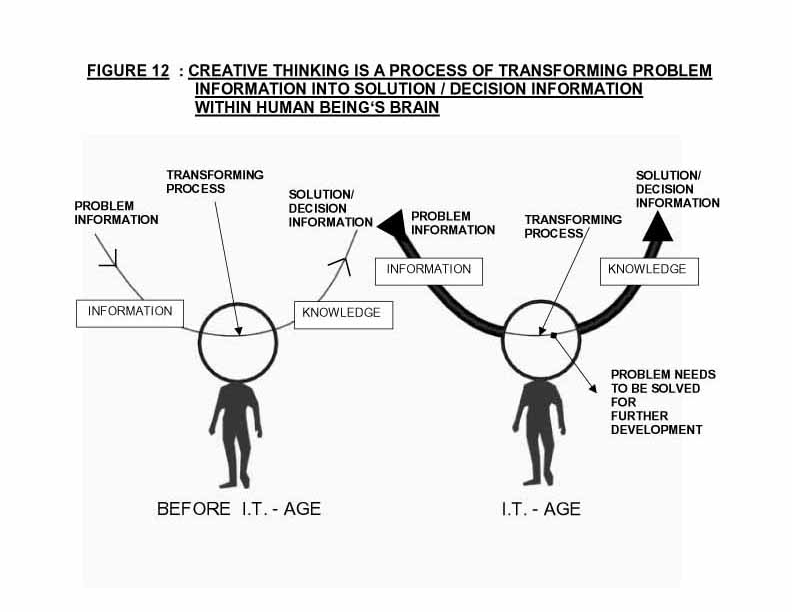
5. TRIZ is a large theory. To master TRIZ requires a lot of time to learn, exercise and practise let alone to master the General Theory of Creative Problem Solving (GTCPS) in the future. One practical solution is combining TRIZ with personal computers through creating appropriate software.
What is more essential, we think, is to teach enlarged TRIZ (or GTCPS when it has been created) from kindergarten to higher schools (of course, with programs corresponding to related learners) for some dozen hours each year so the full program is completed when the user graduates from university, see Figure 13 and 14. Furthermore, teachers of other disciplines need to study TRIZ (or GTCPS) and also to teach their disciplines in its light and help their students to themselves discover/invent knowledge of these disciplines in a scientific way.
6. TRIZ has been built relying on a lot of sources, see Figure 1. Developing TRIZ further, we believe that, in its turn, developed TRIZ will help these source-sciences to solve their problems more creatively and innovatively.
∗ ∗ ∗
At last, please enjoy looking at Figures 15 and 16.
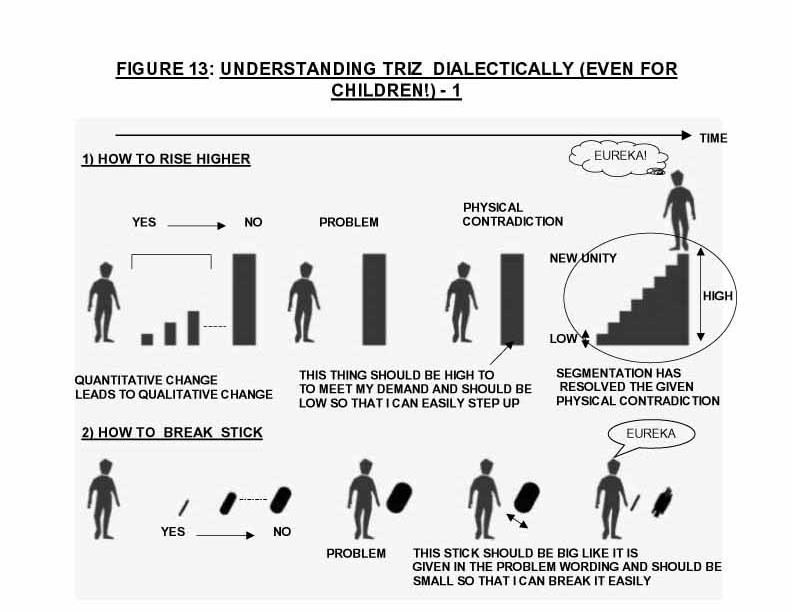
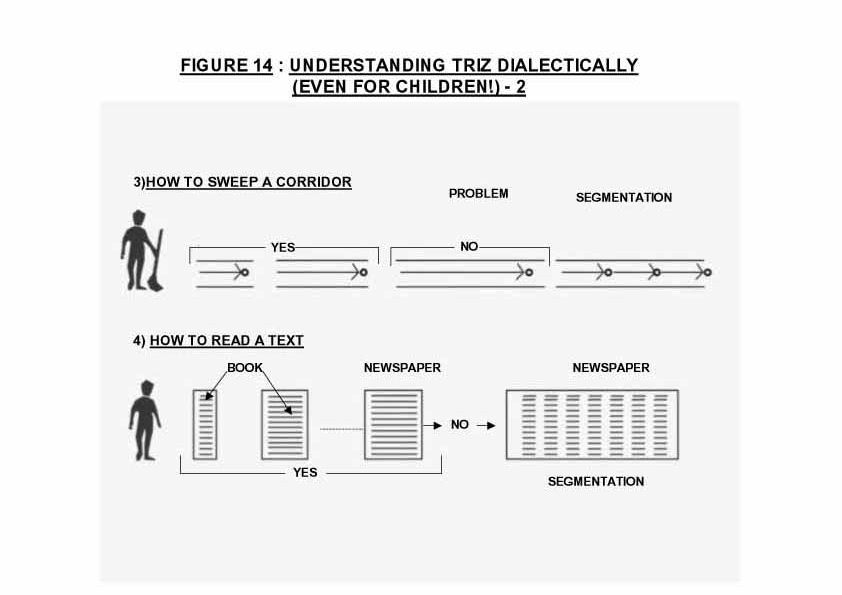
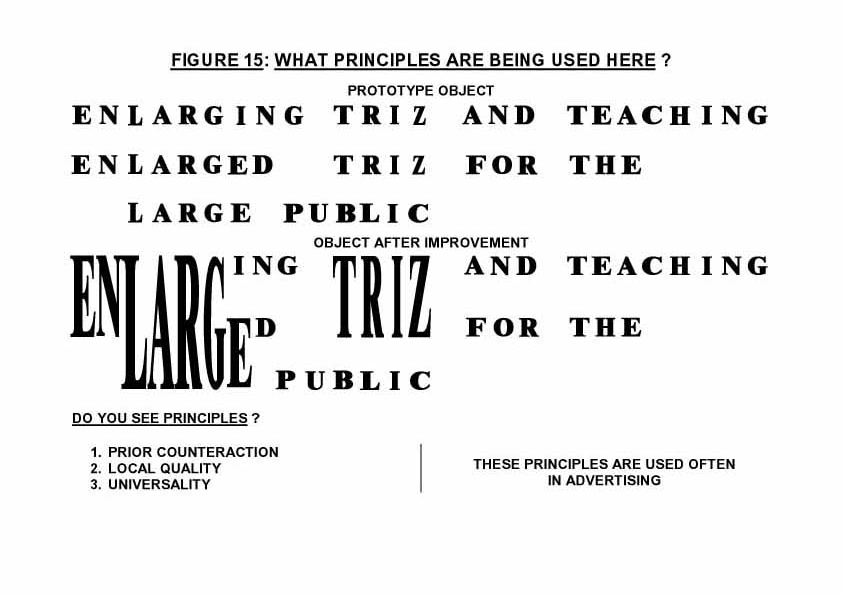
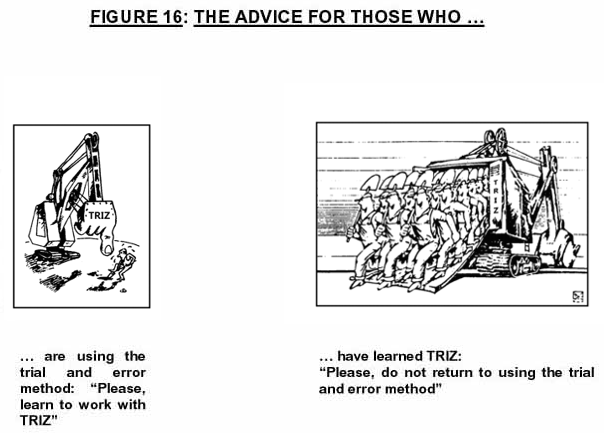
Further reading:
For detailed information on some of the points presented in this paper, please consult the following articles, books and journals in Vietnamese and English
In Vietnamese:
- Phan Dung, Nguyen Chan, Duong Xuan Bao (1983) Algorithm for Invention. The Scientific and Technical Publishing House, Hanoi.
- Phan Dung (from 1986 to 1990) Columns: “Improvement of Creative Ability” in “Creativity” magazine. Scientific and Technical Committee, Hochiminh City.
- Phan Dung (1990) How to Create? Or Science on Creativity, Self-Introduction. Scientific and Technical Committee, Hochiminh City.
- Phan Dung (1991) Creativity Methodologies Based on The Scientific and Technical Knowledge. Scientific and Technical Committee, Hochiminh City.
- Phan Dung (1992) Handbook for Creativity: The Basic Creativity Principles. Scientific and Technical Committee, Hochiminh City.
- Phan Dung (1993) Report on Creativity and Innovation Issues in Vietnam (unpublished). Scientific and Technical Committee, Hochiminh City.
- Phan Dung (1993) System of Standards for Solving Inventive Problems. The CSTC, Hochiminh City.
- Phan Dung (1994) Report on a Dependence of Economic Effects on Creativity and Innovation Levels (unpublished). Ministry of Science, Technology and Environment, Hanoi.
- Phan Dung (1995) On System, Systems Thinking and Systems Inertia. The CSTC, Hochiminh City.
- Phan Dung (1998) Creativity Methodologies: Summing Up and Vision. The CSTC, Hochiminh City.
In English:
- Phan Dung (1994) Introducing Creativity Methodologies into Vietnam (invited article). Creativity and Innovation Management, 4, 240-242, UK.
- Phan Dung (1995) TRIZ: Inventive Creativity Based on The Laws of Systems Development (invited article). Creativity and Innovation Management, 1, 19-30, UK.
- Phan Dung (1996) Systems Inertia In Creativity and Innovation. Lecture presented at the fifth European Conference on Creativity and Innovation, Vaals, the Netherlands, April 28 - May 2, 1996. In the Conference Proceedings: “Creativity and Innovation: Impact”, 143-150, 1997.
- Phan Dung (1996) Creatology: A Science for the 21st Century. Keynote paper presented at the International Symposium and Seminar: “Education: The Foundation for Human Resource and Quality of Life Development”, Chiang Mai, Thailand, August 26-30, 1996.
- Phan Dung (1996) The Renewal in Creative Thinking Process for Problem Solving and Decision Making. Keynote paper presented at the sixth National Seminar on Educational Management and Leadership “Personal Renewal Towards Leadership Maturity in Educational Management”, Genting Highlands, Malaysia, December 9-12, 1996.
- Phan Dung (1996) Creativity Methodologies (the summary of the basic course for English speaking participants). The CSTC, Hochiminh City.
- Phan Dung (1997) Dialectical Systems Thinking for Problem Solving and Decision Making. The 7th International Conference on Thinking, Singapore, June 1-6, 1997. Also in Morris I. Stein (ed.) Creativity’s Global Correspondents - 1998, Florida, Winslow Press, USA, 143-161. And in The Korean Journal of Thinking & Problem Solving, 2000.4, 49-67.
- Phan Dung (1999) On the Basic Program “Creativity Methodologies for Problem Solving and Decision Making” Being Taught by the CSTC in Vietnam (invited article). In Morris I. Stein (ed.) Creativity’s Global Correspondents - 1999, Florida, Winslow Press, USA, 250-256.
- Phan Dung (2000) Some Results Derived from Teaching the Course “Creativity Methodologies” (invited article). In Morris I. Stein (ed.) Creativity Global Correspondents – 2000, Florida, Winslow Press, USA.
17.3.9 My Experiences with My Teacher Genrikh Saulovich Altshuller18
Phan Dung
From the Introduction written by the editor:
“Phan Dung, Ph.D., D.Sc., of Vietnam, who has been one of the earliest and consistent contributors to our volumes on “Creativity’s Global Correspondents,” now provides us with a fascinating paper on “My Experiences With My Teacher Genrikh Saulovich Altshuller.” (Dr. Phan Dung, it should be noted, is going to present a paper in California at the Altshuller Institute meeting on TRIZCON 2001.)
Dr. Dung starts his paper with a most exciting statement. “Throughout my life,” he says, “I have never stopped thinking that I am very lucky to know TRIZ (the Russian acronym for Theory of Inventive Problem Solving) and to have learned it directly and happily by chance from the teacher: Genrikh Saulovich Altshuller, the father of TRIZ. I am sure that if I had not discovered TRIZ in 1971, I would certainly have known it later and would have followed it for the rest of my life.”
Like many great occurences, so Dr. Dung’s acquaintance with Mr. Altshuller began by chance. An instructor was late for a class, so Dr. Dung had the opportunity to chat with other students about creative thinking. It is they who introduced him to Mr. Altshuller. Of this occurrence, Dr. Dung tells us, “We arrived early, met the teacher Mr. Altshuller, and after some of Andrei’s (the acquaintance who brought him to class) introductory sentences, I said immediately what I had prepared because I had some reasons to worry: the class had begun quite some time before I arrived, it might already be full. I worried that I would not be permitted to enter the Institute. The teacher Mr. Altshuller listened attentively to me, did not interrupt, and then briefly gave his agreement which dispersed my prepared arguments in the case of his having questions. He said: ‘If you love creative thinking, you can enter the class. I think whatever you study in this Institute will be useful to you and your heroic country. I will help you if you have any difficulties.’ I was as happy as if I were floating on air. And from that moment, I had a new life.”
Dr. Dung then devoted the remainder of the paper to a discussion of this “new life.” There is so much we would want to quote. We shall, however, limit ourselves and hope that readers will read Dr. Dung’s paper in its entirely for the fascinating material it contains.
We cannot resist, for introductory purposes, citing Dr. Dung’s initial description of Mr. Altshuller. He says, “I thought that the teacher who taught creativity would be older (in order to have creative experiences to share with others) so I was surprised. He looked like a young sportsman, because of his well-proportioned body, his lively gait, and his simple clothing (I have hardly ever seen him wearing a neck-tie, even when I see his pictures in newspapers, books or magazines) and his easy-going and modest manner. He had a kind-hearted face, intelligent, warm eyes and thick, curly, brownish hair. He was quite handsome according to the traditional model. As I came to know later, at that time, he was 45 and he had his first patent when he was only 14.”
Dr. Dung spends the rest of the paper talking about his relationship with Mr. Altshuller – their warm relationship, the books he gave him, etc. And then came the day when Dr. Dung received the distressing news of Mr. Altshuller’s death, on September 24, 1998, “after a long sickness.”
“Remembering what I knew about him (directly or from TRIZ colleagues and other’s memoirs), the idea sometimes springs up in my mind that he was real and not real at the same time.”
To learn both the “real” and the “not real” of this great man, Genrikh Saulovich Altshuller, who provided us with TRIZ and a whole variety of insights into the creative process, reading of the paper by Dr. Dung is a must.”
Morris I. Stein, Ph.D.
Professor Emeritus, Psychology
New York University
New York, N.Y.
March, 2001
Throughout my life, I have never stopped thinking that I am very lucky to know TRIZ (the Russian acronym for Theory of Inventive Problem Solving) and to have learned it directly and happily by chance from the teacher: Genrikh Saulovich Altshuller, the father of TRIZ. I am sure that if I had not discovered TRIZ in 1971, I would certainly have known it later and would have followed it for the rest of my life.
In my childhood, whenever I did something wrong (in spite of good aim or so I thought) I was often scolded “It’s foolish! You should think carefully before doing anything”. Saying nothing, I thought to myself “Not until I make mistakes and am criticized, does anyone teach me how to think!” and I tried to learn the way of thinking.
In high-school, like my friends, I did admire scientists, inventors, writers and poets. I also wished that I could do something new to contribute to my country and mankind as well. I asked myself “How can they think up such wonderful things?”. In correcting exercises, some of my friends volunteered to solve the problems for the whole class on the spot. At that time I wondered “How can they think so quickly?”
Such questions arose in my mind many times a day. Although I discussed them with my friends and asked my elders, I felt dissatisfied. Sometimes, new questions arose from the answers.
When learning laws in physics, chemistry, and biology, I thought “Are there any laws in thinking? Why haven’t they been taught in high-school? Why don’t I find my own way of thinking?”
In learning, I first chose mathematics to observe my thinking process when solving problems. After coming to a solution, I recalled my way of thinking many times, then tried to explain it logically, even the problems which were solved by chance. Not all solving processes could be explained logically, but I felt very excited whenever successful. By self-evaluating, I saw my thinking was better. After that, I became more self-confident and liked doing exercises more, not only in the mathematical discipline.
In 1967, I was sent to the Soviet Union (now CIS) to study experimental solid state physics. After a pre-university year learning Russian, I went into the State University of Azerbaigian in Baku city. It was the Russian language, bookstores and libraries that helped me find the answers to some of the questions that had haunted me for such a long time. Whenever I had free time, I went to the bookstores, or the libraries to search for documents related to creative thinking. My understanding improved considerably. I applied my reading to my thinking and achieved some interesting results. However, I wanted to understand more concretely and more practically.
I think it is inevitable that my habit of reading about creative thinking, sooner or later, would have lead me to TRIZ. And in this inevitability there happened a lucky event.
One day, in 1971, when I was a senior, my lecturer of “solid state theory” was late, so I chatted to some Soviet students beside me. Fifteen minutes passed but the lecturer had not arrived yet. I asked them my questions associated with creative thinking. Andrei told me that the All-Union Association of Soviet Inventors and Rationalizators had just founded the Public Institute of Inventive Creativity which taught the creative thinking methods. He, himself, had been studying here and was finding it interesting. Like a thirsty man who sees the water, I asked Andrei to guide me to enter the Institute after class.
We arrived early, met the teacher Mr. Altshuller, and after some of Andrei’s introductory sentences, I said immediately what I had prepared because I had some reasons to worry: the class had begun quite some time before I arrived, it might already be full. I worried whether foreigners would be accepted to the Institute… In general, I worried that I would not be permitted to enter the Institute. The teacher Mr. Altshuller listened attentively to me, did not interrupt, and then briefly gave his agreement which dispersed my prepared arguments in the case of his having questions. He said: “If you love creative thinking, you can enter the class. I think whatever you study in this Institute will be useful to you and your heroic country. I will help you if you have any difficulties”. I was as happy as if I were floating on air. And from that moment, I had a new life.
This was the first time I saw the teacher Mr. Genrikh Saulovich Altshuller. I thought that the teacher who taught creativity would be older (in order to have creative experience to share with others), so I was surprised. He looked like a young sportsman, maybe because of his well-proportioned body, his lively gait, and his simple clothing (I have hardly ever seen him wearing a neck-tie, even when I see his pictures in newspapers, books or magazines) and his easy-going and modest manner. He had a kind-hearted face, intelligent, warm eyes and thick, curly, brownish hair. He was quite handsome according to the traditional model. As I came to know later, at that time, he was 45 and he had his first patent when he was only 14.
Coming to study with me later in my first class (1971 – 1973), were also Mr. Nguyen van Chan, Mr. Nguyen van Thong; and in the second one (1973 –1975) Mr. Duong Xuan Bao, Mr. Thai Ba Can and Mr. Nguyen Quang Tho, all of whom were also Vietnamese students at that time.
The Public Institute of Inventive Creativity (PIIC or its Russian acronym is AzOIIT) was founded by the teacher Mr. Altshuller’s initiative, and he was also the designer of curricula and syllabus. Its objective was to prepare the professional inventors, the researchers and lecturers of the creativity methodologies and the organizers of the creative and inventive activities. This Institute was also a place where the new research results of TRIZ were tested and where the feedback received from the teaching and application by learners was used in order to perfect TRIZ. The progam lasted 2 years. The main subjects were:
- Creativity Methodologies ( TRIZ was the principal course but the methods of other schools in the field, including Western ones were also studied)
- Development of Creative Imagination.
- Psychology of Creativity.
- Systems Theory.
- Information Theory.
- Cybernetics.
- Decision Making Theory.
- Patentology.
- Forecasting Methods.
- History of the Development of Science and Technology.
As Philosophy had already been studied in the university program, it was not taught at the PIIC.
Some subjects had to be finished by passing a test, the others required a marked examination. In the end, learners had to write and defend a thesis before the Institute Scientific Council. There were two kinds of thesis theme.
- Solving a practical problem at a successful enough level to have a patent (including application documents of invention written by the author himself)
- Research work to continually develop a certain part of the creativity methodologies. The teacher Mr. Altshuller mainly taught two subjects (No 1&2) which took the largest amount of time for classroom activities and homework. The more I study, the more I understand the teacher Mr. Altshuller’s advice: “For a long time, solving problems will be more important than studying the theory” and “studying the creative thinking is the same as learning to play sport. So you have to focus much on practising in order to achieve the skills and manners needed for your work and life”.
As I said above, it was an irreplaceable opportunity to learn directly from the teacher Mr. Altshuller. As time went by, the more I knew him, the more I appreciated this opportunity.
First and foremost, it was the chance to learn the work (TRIZ) from the author himself. Therefore, the learners were not afraid of misunderstanding after some misrepresentation of TRIZ’s methodology. Nowadays, when exploring the Internet, and watching the activities about TRIZ over the world, I find that the problem of incorrect understanding and teaching of TRIZ is not in very small number. When learning from the author himself, learners could ask about anything involved with the work and they could have reliable answers to their questions, even concerning the experiences with which his work was written. If you learn only from those who have read or learned before you, you will not have this chance.
However, it is unascertainable whether the author is always able to deliver effectively his knowledge to learners. Knowledge is information. There are various factors such as: the accuracy and the form of generating, processing and encoding information from the transmitter, the environment, and the cognitive level of the receiver that can influence the effectiveness of communicating this information. In this aspect, I had another chance too: the teacher Mr. Altshuller was an excellent pedagogue. As a learner, I found that his language was clear and accurate, neither complicated nor wordy. So listeners could understand exactly what he meant. Always using pictures, and illustrations, he made his lectures well-arranged and highly convincible with valuable details. Let’s make a comparison - you are invited to taste a special dish by two people; the first one says “It is very delicious, go ahead!”, the second does not use the words “delicious” or “go ahead” but goes into details so strongly desirous that you serve yourself before his speeches have finished. Evidently, you are persuaded more easily by the second one, who motivates you to do the act. The teacher Mr. Altshuller applied a flexible approach in giving lectures and answering questions, depending on the kind and/or the level of listeners. He mastered a rich source of expressions, examples and stories from various domains, so he easily made a good connection with learners. Furthermore, he had a lot of funny, humorous tales and anecdotes related to creativity, which set a relaxed atmosphere in his classroom. Listening to him, I felt that he did not present TRIZ as the theory only but that I had listened to the story of his research and theory building process. Writing on this point, I remember Tolstoi’s observation: “It is worth not only knowing that the Earth is round but more importantly knowing how to come to this conclusion”. I must say the teacher Mr. Altshuller had managed to capture the heads and hearts of the learners. He was not only a teacher but also an artist. He, himself, was a symbol of beauty in conveying the best and the most human quality; that is, the creativity, to the learners. Probably for this reason, he is also well appreciated in the Soviet Union as a science fiction writer.
Through his answers to my questions in the classroom, at break-time, or during my visits to his apartment, especially in the time of writing my thesis, I felt my knowledge became more profound. He not only satisfied my queries but also provoked me to develop my thoughts further in a way that I could not imagine before. Simultaneously, I became more strict with myself because in answering carefully certain questions, he added “My answers all follow from what we have already learned”. His eyes seemed to say “with your ability you can answer your own questions, you should solve these yourself first. Be self-confident, my young man”. Since then, I have usually applied my own knowledge to answer the questions by myself and only asked the teacher or others once I cannot. This effort improved my self-confidence and my independence in learning and researching later.
In writing our theses, the teacher Mr. Altshuller encouraged us to choose our own subjects appropriate to our specific fields. Knowing that my major was physics, he suggested I should choose the theme “Guiding the Usage of Physical Effects in Inventing” while my heartfelt, long-nurtured topic was “The Psychological Inertia in Solving Creative Problems”.
As I said above, in my high school, I usually validated my own thinking process in solving problems, but there were some problems I could not solve. After seeing the result, I realized that it was not because I did not have enough necessary knowledge and capacity but because there seemed to be a certain force hampering me to apply my knowledge, and I hated that force. Afterwards, I found its name: the Psychological Inertia. Minding the psychological inertia, failing many times because of it, and really have strong negative feelings about it, I wanted to choose it as my topic instead of complying with his advice. I did not know how to tell him (in Vietnam I was taught to obey the teacher). Finally I decided to tell him frankly because I was also taught to have “frankness and courage”. That made me feel peaceful.
I intended to accept his suggestion once he did not agree with me. When I told him, I thought that he would persuade me to follow his idea, but, unexpectedly, he agreed at once: “If you love the psychological inertia, begin now please”. Simultaneously, he showed me the difficulties that I had to figure out in advance when I, as a physicist, moved to study psychology.
I gave him whatever I had partially finished writing. If he had time, we would discuss it at once, if not, he would read it at home and make an appointment with me. He commented on every part of the thesis and asked me many questions such as: “How have people taken steps to implement this idea? Which document was it published in? Have you really read the original text? Have you found all of the related documents? Is your data convincible? Is there any data more convincible? Is it too early for you to draw this conclusion? Is there any other explanation? Any other kind of approach and consideration? Are you able to create tools or at least offer some advice to help others overcome their psychological inertia? In which directions may this theme be continually developed?” … As a matter of fact, “I shed the sweat” while working with him and I understood that he was very strict in research work. His training and teaching style gave me important advantages when I worked on my dissertations for doctor’s degrees: Doctor of Philosophy and Doctor of Science19 in physics about the optical processes in semimagnetic semiconductors in 1980s in Leningrad (now Saint Petersburg). And especially “The Psychological Inertia”, which then I continued to develop into “The Systems Inertia”, was reported at the European Conference on Creativity and Innovation and published in the Netherlands.
When I gave the teacher Mr. Altshuller my manuscript for his last review before it was typewritten, I wrote on the first page, the Scientific Supervisor: Genrikh Saulovich Altshuller. He saw it and crossed it out. To my surprise he just smiled and said: “You chose and completed the thesis yourself, not me, you have to be responsible for your work”. There were some implications in his speech. Maybe he judged that my thesis was not good enough for him to put his name to and even made him lose his prestige; maybe, he was sincere, and thought that his role was only as an opponent or an adviser, not as a scientific supervisor. Furthermore, he wanted to raise the responsibility of learners who should make their own authority in science research without relying on other’s reputations. Here, I suddenly remember a humorous story “Rabbit Defends his Thesis”. It was said that, in his thesis, the rabbit concluded that he could eat fox, wolf even bear. Finally, the thesis was also passed because of a simple reason - his scientific supervisor was a lion.
By the way, I would like to say a little more. I came three times to study and to work in the setting of university education and science research in the Soviet Union - in total about 12 years. I found, in general, that lecturers and scientists did not impose their research idea on their learners. They were willing to discuss with learners who sometimes had their own idea. Even in the case that learners did not agree with their lecturers or scientific supervisors, they did not use their authority to hamper learners from implementing their research idea. In my experimental physics field, I met such problems about ten times. After discussion, these professors generally said: “Here are samples and equipment, try to conduct your experiments as you like and see what will happen, you never know”. However, they would not compromise their high requirements of the process and the method of implementing the idea, the verification of the obtained data, the interpretation of results gained and the prediction of possible consequences.
During the time of the teacher Mr. Altshuller’s reviewing my thesis for the last time, I was really in an indescribable state: happiness and worry. They were mixed up. I was happy because I had just finished what I was interested in. Also, I was worried because I had to type my paper according to the rules of submitting research. Typing was my financial problem because my monthly scholarship was only 60 roubles. So, I planned to cut down some of my expenses.
On returning my thesis in a large envelope, he said, “You have to finish some missing figures. Congratulations on your successful work!”. He shook my hand and quickly walked away. On the way to my student hostel, I could not understand what he had meant, for in the thesis I had already drawn all the figures. So why had he asked me to do that again? Entering my room, leaving the door open, hurriedly I opened the envelope. My thesis had been typed with some blanks for the “unfinished” figures. In the next meeting, I said thanks to him. He said to me, “I did it because the Institute’s typist was typing some new documents. So I took the opportunity to ask her for help”. He said: “I took the opportunity” then changed his subject. He advised me to bind the thesis in volume by myself, not to waste my money on having it done in a workshop, because there were only 40 pages. I realized that he went out of his way to help me in many cases. The point was that, when we Vietnamese students talked to him during the break time or when we visited his apartment, answering his and his wife’s (Mrs.Valentina Nhikolaevna Zhuravliova) questions about our life, study, scholarship, and accommodation… they remembered everything and they always took the opportunity to help us. In their words, manner and actions we clearly felt their parental warm concern for us. They cared for us in many ways, giving us advice on things such as how to keep warm in the freezing temperatures, what to eat a lot of for our health, where to go sightseeing… They used to invite us to come to their apartment to enjoy a family atmosphere, and always asked us to have dinner with them before leaving. Their and other teachers’ hospitality comforted us a lot for the long time of six years of study there in Baku, because we had no money to travel back home for holidays, even once.
After successfully defending my two theses: one on physics at the University and other on creativity at the PIIC I went to the teacher Mr. Altshuller’s appartment to say goodbye to his family because I had to get back to Vietnam after my graduation. I gave him my address in Vietnam and promised to write to him as soon as I got there. He took a lot of typed pieces of papers out and gave them to me and said: “Here is the draft of my book. Take it with you. After its publication, I will post the printed copy to you. But in case it gets lost, you already have this draft copy. Send our best regards to all your family members. I am sure that your country will be completely re-unified without fail”. I told him that, maybe in a short time I would come back here to be a doctoral student in physics because I was recommended by the State University of Azerbaigian. But according to our rules, I had to return to my country first. At that time, it was the beginning of the summer of the year l973, the Paris Agreement on Peace in Vietnam had been signed several months ago. He kept his promise and to ensure that they reached me, he asked the students who returned to Vietnam after me to bring me the necessary materials.
Until the end of the year l982, I was prevented from going to the Soviet Union for my work on Ph. D. dissertation because of many unreasonable bureaucratic reasons on four occasions. Finally, after I had passed a tiring exam with many requirements, I flew to the Soviet Union. This time, I studied at the State University of Leningrad (now Saint Petersburg) some thousands of kilometers away from Baku. On January 2nd, l983, the teacher Mr. Altshutller replied: “Pleased to get your letter from Leningrad, not somewhere else. It is wonderful, because there are schools of TRIZ with many instructors and researchers. They will give you a lot of information about TRIZ as well as its accomplishments. I am writing immediately here some addresses of those who are in Leningrad”.
Further, he gave me a list of three with their full names, addresses, and telephone numbers: V.M. Petrov20, E. S. Zlotina21, V.V. Mitrofanov22 and wrote: “You tell them that I introduced you to them, and today I will write to Zlotina about this”. He added: “Today I will also send you the following books: ‘Creativity As An Exact Science’, and ‘The Wings for Icharus’ and a new document ‘ARIZ-82B’. I’m going to write to the Trizniks23 in Leningrad and they will provide you with other materials. How about the Journal ‘Technology and Science’24. Have you subscribed to the one for the year 1983? And how about the old ones? You must read the issues from 1 to 9 from the year 1981, and from 3 to 5 and 8 from the year 1982”. He reminded me of his ten-year old suggestion, taking my interest in psychology inertia into his account:“I really expect you to do something on ‘Guiding of the Usage of Physical Effects in Inventing’, while you are living in the Union these days. If necessary, the above mentioned Journal will publish your research, or also your research on psychology… Happy New Year with many best wishes for your health and prosperity in the days living in Leningrad”. After receiving the teacher Mr. Altshuller’s letter I contacted Volodia Petrov and Fira Zlotina. And we became friends.
At the beginning of October, 1983, I went to Baku to visit my old places, my old teachers and classmates, especially the teacher Mr. Altshuller’s family. Never has the trip faded from my mind. It was an extremely emotional, unforgetable one. Maybe you can guess why. I myself, during the last ten years, had worked, was now married with a child, had faced the severe reality of daily life and work. As a result, I looked much more experienced than before. So this time, meeting Mr. and Mrs. Altshuller I could discuss with them many subjects in a deeper and more thoughtful way, even some “delicate” topics in comparison with the standards of that time. I knew much more about his personal life with its many ups and downs as well as his intentions about TRIZ. I told him about what I had done in Vietnam (I had taught the first course on TRIZ in Vietnam in 1977) and my opinions about TRIZ. He gave me positive encouragement about my work, gave me his own ideas and his own experiences. They were so precious to me. If he had some points to disagree with me, he just suggested, “You may be right in such a case”. Then, he presented me with many materials on TRIZ and others including magazines, books, and typewritten research papers.
He saw me off at the bus station. He went with his back just beginning to be bent over and a slightly slow walk which I had not seen before. I felt moved and loved him so much. From the bottom of my heart, I prayed for his health. I wished that he would live a long, long time.
Quite different from my arrival with a light traveling bag, I flew back to Leningrad with my overweight baggage. Although I did not have to pay tax for 20 kilos according to the rules, additionally, I had to pay the same amount as an excess baggage charge for the presents from my old teachers and classmates. The teacher Mr. Atlshuller’s gift alone weighed over 10 kilos.
Thanks to him and TRIZ colleagues, especially, my new friends: Volodia and Fira, I always kept up with the development of and new studies on TRIZ (including the manuscript materials that would be published later in the form of articles or books). Leafing back through his letters, I encountered the things he used to write to me, such as “Let me know about this material… that one, have you got them yet? If not, I will send them to you”. Or ,“In the package I am sending to you today there are the following materials…”
I remember one episode. It was the third time I was living in the Soviet Union (again in Leningrad), doing my research on my Doctor of Science’s degree, and I discovered two books in the package he had sent me. These books were written by his former students about TRIZ and about how to teach it with acknowledgements and dedications to him from the authors in ink on the first page. At once, I phoned him to confirm: “Genrikh Saulovich, you must be mistaken in sending me the books whose authors had presented them to you”. He just laughed, “No , I am not mistaken. You need them more than I do”. Hearing nothing from me on the end of the line, he thought that I must be so embarrassed. So, he added, “Don’t worry. I will tell them that I presented the books to you from me. Now let’s change the subject…”.
Here is his last letter of February 2nd, 1997: “I’ve got your letter of January 6th, 1997 with your report on your teaching trip in Malaysia and your photos. Thank you so much”.
“I am enclosing here with this letter for you the “Information” about the TRIZ Association. I would like you to know all about its activities”.
“TRIZ has begun its long steps towards the West. Many TRIZ related institutes and schools have been established, the translation of TRIZ is in progress. The book ‘And Suddenly the Inventor Appeared’ that was translated into English (in America) has just been printed. As soon as I receive it, I will send it to you. Write to me more often. Good luck!”
“PS: Did you get the two books ‘How to Become a Genius’ and ‘The Corner of Attack?’.
After that, I did not get any letters from him any more although I had written to him several times. I thought that, maybe, he had moved to a new address like before, when his family went to Petrozavodsk from Baku to live, but… maybe… sometimes I shuddered with fear when my mind was lead to that terrible thing… In the end of the year l998, our Center for Scientific and Technical Creativity (CSTC) was connected with the Internet, on American TRIZ websites I got the distressing news that he had passed away on September 24th, l998 after a long sickness.
Getting the bad news, I quickly sent the teacher Mr. Altshuller’s family a fax of condolence to share the great loss all Trizniks had suffered. Then I phoned Mrs. Valentina Nhikolaevna Zhuravliova, his wife, to talk more about him and remember with her my sweet memories of him. During the conversation, she repeated several times, “You Vietnamese students were very lucky to have a long time to study with him. Many Trizniks did not get an opportunity like that”.
In my mind, I often think I had a very good opportunity to improve myself immensely when I was his student, working and corresponding with him. It is said that one of the most effective ways of learning is imitating, willingly following other’s examples. This impulse naturally comes from the learner’s need and internal aspiration. Considering the typical example of a child’s learning to speak at home, we can see that he lives, plays, and communicates naturally without realizing he is learning and accepting the effect of nurture from his teachers. But he can learn how to speak from the family members very rapidly with everyday improvement. If you are lucky enough to have regular contact with those who get your admiration, your love, and who are better than you in many aspects, you will learn a lot from them almost as if you had been infected by them, although they do not have the intention of teaching you at all, and you yourself do not have the intention of learning, either. This is such a natural, effective way of learning that what you have learned will be digested and transformed into your own flesh and blood. It is not a borrowing process.
Remembering what I knew about him (directly or from TRIZ colleagues and other’s memoirs), the idea sometimes springs up in my mind that he was real and not real at the same time. He was real in his worldly body as my teacher. And he was not real like a legendary hero stepping out of the pages on which great names are written, for I had read much about them. Many of them encountered obstacles, they were even crushed by the evil powers, but with all their efforts, endurance, strong will and, of course, their talents, they contributed their great achievements to mankind’s prosperity. I knew all this, but before meeting the teacher Mr. Altshuller, I had no chance to contact let alone to learn from them, or to work with such people.
The teacher Mr. Altshuller’s life, indeed, had been unlucky even when he was in his mother’s womb. His father married his mother when they were working together for the Azerbaigian News Agency (Azerbaigian was one of 15 Republics of the Soviet Union) in Baku. His father had already been married once previously to marrying his mother. So his grandmother on his mother’s side objected to the new mariage so violently that his parents had to move to Tashkent city, the capital of the Republic Uzbekistan, where he was born on October 15, 1926. In 1928, his family returned to Baku amid the cool attitudes of his mother’s relatives.
His parents worked for the Press. So his home, of course, was packed with books that interested him from a very young age. He went to schools where there were many professional and devoted teachers. This enabled him to look for new things, arouse his curiosity about inventions. He got his first patent when he was still at high school.
The Soviet Union was attacked by Fascism in 1941, at the time he was 15. After high school, he joined the army and was assigned to an infantry regiment. Then, he was recommended to train in an air force school. No sooner had he finished the training, than the war ended. He applied for a position as a navy patent examiner at the Patent Office of Caspian Fleet, located in Baku. Right here, his interest in invention from a young age was combined with the needs of his job: he studied the patent information, examined invention documents, gave his advice to inventors. In 1946, he began the first steps on the path to constructing TRIZ. His desire to help the general populous to invent methodologically in a scientific way became stronger than his original purpose: how to get many patents for himself.
In 1949, he and his associate Mr. R. Shapiro directly wrote Stalin a thirty-page letter which took them 6 months. Beside the presentation of their invention, they proposed many measures to improve the Soviet patent system and creative, inventive activities in the Soviet Union. In the end, he and his friend were mistakenly accused of terrorism, arrested in 1950 and sentenced to twenty - five year’s penal servitude. He was exiled to Vorkuta, a hostile area with ice and snow, to work as a coal miner. During the time he was in his labor camps his father died. His mother applied many times for his amnesty, but failed. She was so disappointed that she committed suicide in 1953. Stalin died in the same year. So many sentences were again judged. In 1954, he and his friend, Mr. Shapiro were released. Back in Baku, he had to change his workplace several times, for a former prisoner was not welcome when he applied for a job. Finally, he decided to be his own employer. He worked as a freelance. He turned to writing for newspapers, then writing science fiction under the pen name Genrikh Altov. With the little money he earned he had time to develop his ideas originating from 1946. Sometimes, his life was not secure in this way. He had to sell his books, which he had collected over years and which he appreciated like his own children, to second - hand book-stores.
The first results of his and Mr. Shapiro’s research, which laid the basic foundation for TRIZ, were published in the Journal “Psychological Issues”( No. 6, 1956, pages 37 - 49). Later, Mr. Shapiro migrated to Israel. So, only the teacher Mr. Alshuller kept on his study of TRIZ. From 1958, he began to spread TRIZ through seminars, first in Baku, then in other cities such as Moscow, Donhetsk, Tambov, Ryazan… As the results of the success of the seminars, over 9 years from 1959 to 1967, he continuously wrote to the Central Council of the All Union Association of Inventors and Rationalizators (Russian acronym is VOIR) with many proposals, but did not receive any positive responses although the proposals were within Regulations and met the criteria of VOIR. Until, in 1968, the Central Council’s president, Ivanov was seriously sick. So, the secretary of the Council, V. N. Tiurin took his place temporarily. At that time, the situation seemed to get out of its darkness. The Public Research Laboratory of Inventing Methods (OLMI) was opened in 1969 and the Public Institute of Inventive Creativity (AzOIIT) was formed in Baku in 1971. In 1972, Sofanov, the newly - elected president of the Central Council of VOIR returned to the old policies, causing many problems for Mr. Altshuller’s activities. The highest tension point was reached in 1974. On one occasion Mr. Altshuller admitted some cadres from the School of Perfection of Management Qualification belonging to the Polish Council of Ministers to study at the AzOIIT, without an official permit from the VOIR’s Central Council. So Sofanov closed OLMI. To give his protest to the decision, Mr. Altshuller withdrew from AzOIIT.
Since then, the research and spreading of TRIZ has completely relied on the interest and willingness of volunteers, who expected no financial returns, under Mr. Altshuller’s leadership, without any legal financial support from the government, or from other societies. Many times he and his followers gave TRIZ classes in a “nomadical way” from city to city. Then they created TRIZ groups, centers, schools operating in clubs or cultural houses… Until the 1980s, hundreds of cities in the Soviet Union with such activities came into being. At first, he was the only one who taught TRIZ in the 1950s, 3 more began teaching TRIZ in 1968, and there were over 200 teachers by 1979. After that, conferences on the special subjects of TRIZ were held in 1980, 1982, 1985, 1987, and 1988 with more and more participants. The TRIZ Association was established in 1989 and the Journal of TRIZ came into being in 1990. The flourishment of TRIZ led the State Committee of Invention (GOSKOMIZOBRETENIE) and VOIR to make their decision to support the teaching system of the methods of invention and creativity (in Mr. Altshuller’s opinion, this decision should have been made 20 years before).
As soon as the cold war ended, the Soviet Union’s economy changed into the market one. So TRIZ development faced other new advantages as well as disadvantages. Due to the information exchange between the East and the West being better than before, some developed countries discovered TRIZ and quickly welcomed it to their countries. Now TRIZ became an international movement and the term TRIZ became an international term.
Unluckily, at the triumphant time of TRIZ, Mr. Altshuller left us forever with much love and respect from those who knew him and knew of him. At least, I think, one thing could console him and all Trizniks, that is he had witnessed how his loved child TRIZ had been internationally recognized.
There is one Vietnamese saying: “You can make a cake only if you have flour. It is a true genius who builds his whole cause with empty hands”. In fact, Mr. Altshuller created his brand new cause from nothing in hard conditions. He worked without any financial support from the government or other organizations. You can imagine that at that time the Soviet Union did not follow the market economy. Its economy consisted of only two components: the national and collective. They were strictly and directly controlled under the government. Therefore, all scientific and technical research was concentrated in institutes and universities that were managed by the state. At that time, he did not belong to the staff of any organization. Because of that, he could not get his passport to go abroad to report on TRIZ at international conferences. During “perestroika” the passport procedure changed but his health would not allow him to travel abroad. In other words, he had no chance to go out of his country even to the neighbouring socialist countries right up to the day he died. He also did not have a Kandidat Nauk degree (Ph. D.) yet he dared to invent a different way from that accepted by the state scientists in the field of creativity and innovation. Under the eyes of almost all scientists working for the above state institutes or universities, he was a “heretic”, incompetent to give his ideas on professional issues. In addition, there were other discriminations including a delicate one - he was a Jew.
Thinking about the teacher Mr. Altshuller and his cause I believe that the following reasons may explain why he persistently followed the ideal he had discovered and won deep love and respect from his disciples and students.
- Victor Hugo wrote: “There is one thing stronger than all the armies of the world. And that is an idea whose time has come”.
Apparently, Mr. Altshuller had managed to catch the idea and foresaw the “time of idea”; therefore, he became stronger than any obstacle he met on his way. And he got more and more supporters, and followers, in his own country as well as all over the world. Since the 1990s, more and more researchers have predicted that the age of creativity and innovation will come after the age of information.
- Not stopping at the creation of TRIZ, he also put his theory and tools into action as a great innovator. He knew how mobilize the “intrinsic creative resources” inside people to maximum effect, resolved many “physical contradictions” in his life and work and always kept the direction towards “the ideal system” and “the top ideal final result” in a flexible way.
- What he did was motivated by his great love of mankind which included every ordinary person. He used to say things such as, “The inventing process may and must be scientific. Creativity science, which will be an exact science, can be taught as well as learned in order that everyone (even a housewife) can invent in a scientific and methodological way”.
Those who knew him all admired his ability to work. Some people believed that he worked as much as a whole research institute. His huge amount of published books and articles on creativity and innovation and science fiction stories were merely the tip of the iceberg. To illustrate his working ability I want to tell you about his minor deed: his writing and reading letters. Between 1974 and 1986 he cooperated with the newspapers “The Truth for Children” writing the special column “Invention? So Simple - So Complex” to introduce TRIZ to the youth. After some publications, he received some hundreds of reponses. Later, there were 6 - 8 thousand letters to him per issue. The amount of letters only relating to this work which he read was about 22,000. To lead the TRIZ movement, he had to reply to at least 20 letters a day to his students living in other cities. His great love helped him overcome any barries, any obstacles… to calmly control his own suffering: his father had died; his mother had killed herself while he was at his penal servitude. In 1985, his only son, Evghenhi (pet name was Gienhia, about 10 years younger than I) whose unjust death was due to a mistaken appendicitis operation at a hospital left him and his family a granddaughter who just born - Yuna.
Despite the difficulties of his life, Mr. Altshuller was lucky in many aspects. He had a faithful wife, Mrs. Valentina Nhikolaevna, a real friend who could share everything with him, and he also had his friends, disciples, followers and students. These may seem ordinary and natural but in reality they are elusive for many.
One Vietnamese saying states: “You cannot succeed without the help of your teachers”.
We all have our own teachers and thank them for their nurture. As a matter of fact, I have many ones like those. However, the teacher Mr. Altshuller, truthfully speaking, has given me the deepest impression. I was very lucky to be his student.
You may question, “What did you manage to learn from him as his student?”. My answer is: “I have just learned a little from the teacher Mr. Altshuller. However, this small amount seems great to me because it changed my life in every way in comparison with the time before”.
17.3.10 Are Methodologies of Creativity Really Useful for You As a Teacher of Creativity?25
Phan Dung
From the Introduction written by the editor:
“Phan Dung, D.Ph and D.Sci., writes a most interesting paper from Vietnam which is titled “Are Methodologies of Creativity Really Useful for You as a Teacher of Creativity.” In this paper he presents some interesting questions that his students have asked during his lectures or breaks, or when they come to visit him. These questions are: “Do you really apply what you have taught when you work on a problem and have to make decision? What problems have you asked?” The answers vary with available time. In limited time the answer is a brief “Yes”. If time is not so limited the response is “from a comparative perspective, that is, the answer will clarify the differences between a present situation and its past counterpart, so that the questioner can figure for himself the problem to be solved to achieve present results.” It is most important to read this valuable paper for it points out questions that are exceedingly valuable to all concerned.”
Morris I. Stein, Ph.D.
Professor Emeritus, Psychology
New York University
New York, N.Y.
April, 2002
I have a strong desire to know the questions that students usually put to my colleagues, who are teaching courses related to creativity and innovation all over the world. As far as I am concerned, my students, during my lectures or breaks, or when they come to visit me, often ask this question: “Do you really apply what you have taught when you work on a problem and have to make decisions? What problems have you solved?”
If the time is limited,– during a lecture, for example– I will offer a brief answer: “Yes, I do. I have actually applied what I teach to the solution of the problems I encounter or create during my life.” If the time is not too limited, I offer the answer from a comparative perspective, that is, the answer will clarify the differences between a present situation and its past counterpart, so that the questioner can figure out for himself the problems to be solved to achieve present results. If I am given more time, I will analyze in detail the process by which my own problems have been solved to illustrate the methodology of creativity. Depending on the field of expertise the questioner is working in, I try to select the most relevant examples to illustrate my presentation. Those examples are usually taken from the areas of science, technology, entrepreneurship, leadership, management, public relations and communication skills, for they are the problems I have usually coped with in my own work and life.
In the year of 2001 we commemorated the tenth birthday of the Center for Scientific and Technical Creativity (CSTC). This year, 2002, sees the twenty-fifth year (1977-2002) of the course “Creativity Methodologies Based on Scientific Technical Knowledge for Problem Solving and Decision Making” (hereafter abbreviated as CM) offered in Vietnam. On this occasion, I write this brief paper to present a few results achieved by the application of CM to the solution of problems that arose from the introduction, propagation, and development of CM in Vietnam.
The year was 1977. Two years before, the war in Vietnam had ended with three million Vietnamese casualties, of which more than 300,000 bodies have not been found, and several millions of people with war-related disabilities. Many rural and mountainous areas, as well as forests, have been severely affected by bombs, mines, and Agent Orange. Vietnam, however, did not enjoy complete peace yet. The southwestern border war, and then the northern border conflict, broke out. The embargo against Vietnam was still effective, and Vietnam was one of the poorest countries on earth. As a university lecturer then, I was paid about 10 dollars per month. To solve the problem of food scarcity, many times I took my students to the countryside for cultivation work. The availability of office stationeries was also a big problem. My writing of the course book was often hampered by a lack of paper, pens or electricity, and also by pangs of hunger.
In other words, the whole country and every single individual was faced with a host of problems. Such a situation urged me to engage in the materialization of a dream cherished since I enrolled in the course offered by Mr. G.S. Altshuller, the founder of TRIZ (the Russian acronym for Theory of Inventive Problem Solving) at former Soviet Union’s Baku Public Institute of Inventive Creativity (BPIIC): popularization of creativity methodologies. I was committed to the belief that a poverty-stricken country must know how to apply creativity methods to the solution of its problems, because the traditional trial-and-error method, which requires a lot of time and money, would be a luxury item that it can’t afford to try.
Since then I have made a list of problems to be solved. First of all, a program of teaching creativity must be designed, lecture summaries compiled for students, who are merely required to have a high school educational level, regardless of age, occupation, expertise, position, or social status. Teaching programs had to be tailored to the needs of Vietnamese students, because what I learned at the Soviet Union BPIIC could not be applied fully to Vietnam’s particular cultural, socio-economic, and scientifio-technological conditions. This work came from the concept of “innovation,” expressed as follows: Innovation is a process of thinking up creative ideas and implementing them so that all changes as results of this process are fully, stably and sustainably accepted by related systems which after that function better than before.
The next thing to do was to persuade the university administrators to give a greenlight to the establishment of course programs on campus. How to attract students to the program was also an important concern. During this initial stage, I did not receive any overtime pay and my course was offered free of charge to anyone willing to study. The mechanism of central planning, bureaucratic structures, and the subsidy system then, usually, did not support anything that seemed to veer off from the prescribed plan. Another reason for university administrators’ unwillingness to endorse my teaching program was that most of them did not correctly understand the objective, purpose, meaning, and benefits of CM. They based their interpretation of CM on their mistaken understanding of the terms “creativity” and “methodology.” Some said methodology is part of philosophy and creativity is a high-level feat that can be performed by scientific geniuses like Einstein or Edison, that is, it cannot be taught or studied. Problem-solving and decision-making are the top-level leader’s or manager’s jobs alone, so the rest are just employees. For those reasons some were skeptical of the value of CM. Some even raised objections, saying that CM was abstract and impractical while there were urgent problems that deserved more attention. Apart from some backbiting remarks, some of my colleagues expressed their skepticism in a more direct way. “Have you,” said they to my face,” just landed from Mars?” or “Only crackheads take your course.”
Later, when everything was in order, some of my ex-students confessed: “When I was taking your course, I did not tell anybody, afraid of being made a public laughingstock. I just said I was taking a course in language.” In short, it is a form of psychological and systems inertia that I always encounter on my way.
After the problem of obtaining permission to teach creativity courses and students for them had been solved, I went on studying how to improve the quality of the program of CM and teaching methods so that all class participants, regardless of their socio-economic statuses, could understand my lectures more easily and apply what they learned to the solution of their own problems, which arose from their daily jobs and life. The core of the program was TRIZ. TRIZ, as I was taught, started from the area of technical invention and was designed primarily for technical inventors. Although Mr. Altshuller had more often than not emphasized the possibility of expanding TRIZ to other non-technical areas, no significant attempt was made in that direction then. This lack encouraged me to engage in the attempt to enlarge TRIZ and teach enlarged TRIZ to everybody so that enlarged TRIZ could be learned and applied by anyone to the solution of his/her practical problems. The potential of TRIZ proves the possibility of its expansion and I have obtained some promising results. Additionally, the already obtained results, in my opinion, can open up possibilities to construct a general theory of creative problem solving of which current methods of problem solving are only particular applications. This is our long-term research orientation.
In 1986 Vietnam started the process of renovation (doi moi), transformed itself into a mixed form of state-controlled and market-oriented economy, and implemented the Open-Door policy of integration into international communities. In 1991 I decided to set up a professional center guided by an overall aim: teaching and doing researches on CM, which must be operated in accord with market mechanism. In other words, the center would attain financial self-sufficiency by collecting tuition fees from students, so that it could cover expenses related to the propagation and development of CM in Vietnam. I did that against my will, because formerly I had had many times applied for financial aid from different offices, government institutions, including some international cultural and educational organizations, but what I received was a flat refusal. Apart from a certified permit issued by University of Ho Chi Minh City, our Center for Scientific and Technical Creativity (CSTC) had nothing else. No space allowed, no office facilities, no start-up capital, and many other “No’s.” In terms of staff, the Center had two persons: a university teacher and myself. That colleague took my course in CM in 1986. My salary was about 20 dollars per month and I had almost no experience of business markets. Still, I was optimistic and figured out, rather clearly, the ways to make something out of nothing and to create more from less. The fact that the market has accepted our products, as exemplified in the increasing number of students, is a shot that aims at more than a bird: 1- realizing my own dream of introducing, propagating and developing CM in Vietnam; 2- achieving financial self-sufficiency for our Center, which, as a university unit, should have been funded by the university; 3- enjoying the pleasure of commitment to one’s favorite work; 4- creating additional legitimate sources of income for the Center’s staff, who cannot just rely on their official pay to make both ends meet.
In fact, all the self-appointed tasks have been successfully done. Up to February 2002 we have taught more than 8,000 participants who enrolled in 188 basic and 12 intermediate courses (60 periods per course). In addition, there have been thousands of other people participating in talks, seminars, workshops, or short-term custom courses of approximately from 4 to 20 periods. The Center has a website in Vietnamese and English and a quarterly newsletter. The association of CM alumni elects a representative board and entrusts it to the maintenance of contact among alumni. The first Sunday after the Teacher’s Day (November 20) has been chosen to be the CM Traditional Reunion Day and celebrated with several meaningful and interesting activities at Ben Nghe Hotel (the director of which was also an alumnus). Participating in that meeting, talking with alumni, listening to their Song of Creativity, and seeing how excited they were when they related the successful applications of CM, I was filled with happiness. I was happy because the attempts made by teachers and students have borne fruits, which gives me a great dose of encouragement, a source of energy to keep the ball rolling and enhance my confidence in the ability of CM to solve future problems.
Somebody said, “Teaching is learning for a second time.” I want to add, “Applying what has been learned is learning again and again.” First, practical experiences are more telling than theoretical formulations. Second, application enables you to digest what you want to teach to others. Finally, application will give an edge to your lectures because you will present your ideas in a more inspiring way, stimulating your students better into the act of creation.
I have the good luck to study CM early, when I was a university student (actually, I should have started earlier), and have applied CM since then. I believe that CM will enable people to find solutions for their problems and make correct decisions so that a sustained development can keep growing, that is, all the parties will win and the rise of problems, which would not have arisen, will be nipped in the bud. By the same token, CM will enable every single individual and the whole humanity to enjoy more happiness in their life.
FURTHER READING:
For detailed information on some of the points presented in this paper, please consult the following articles, books and journals in Vietnamese and English
In Vietnamese:
- Phan Dung, Nguyen Chan, Duong Xuan Bao (1983) Algorithm for Invention. The Scientific and Technical Publishing House, Hanoi.
- Phan Dung (from 1986 to 1990) Columns: “Improvement of Creative Ability” in “Creativity” magazine. Scientific and Technical Committee, Hochiminh City.
- Phan Dung (1990) How to Create? Or Science on Creativity, Self-Introduction. Scientific and Technical Committee, Hochiminh City.
- Phan Dung (1991) Creativity Methodologies Based on The Scientific and Technical Knowledge. Scientific and Technical Committee, Hochiminh City.
- Phan Dung (1992) Handbook for Creativity: The Basic Creativity Principles. Scientific and Technical Committee, Hochiminh City.
- Phan Dung (1993) Report on Creativity and Innovation Issues in Vietnam (unpublished). Scientific and Technical Committee, Hochiminh City.
- Phan Dung (1993) System of Standards for Solving Inventive Problems. The CSTC, Hochiminh City.
- Phan Dung (1994) Report on a Dependence of Economic Effects on Creativity and Innovation Levels (unpublished). Ministry of Science, Technology and Environment, Hanoi.
- Phan Dung (1995) On System, Systems Thinking and Systems Inertia. The CSTC, Hochiminh City.
- Phan Dung (1998) Creativity Methodologies: Summing Up and Vision. The CSTC, Hochiminh City.
In English:
- Phan Dung (1994) Introducing Creativity Methodologies into Vietnam (invited article). Creativity and Innovation Management, 4, 240-242, UK.
- Phan Dung (1995) TRIZ: Inventive Creativity Based on The Laws of Systems Development (invited article). Creativity and Innovation Management, 1, 19-30, UK.
- Phan Dung (1996) Systems Inertia In Creativity and Innovation. Lecture presented at the fifth European Conference on Creativity and Innovation, Vaals, the Netherlands, April 28 - May 2, 1996. In the Conference Proceedings: “Creativity and Innovation: Impact”, 143-150, 1997.
- Phan Dung (1996) Creatology: A Science for the 21st Century. Keynote paper presented at the International Symposium and Seminar: “Education: The Foundation for Human Resource and Quality of Life Development”, Chiang Mai, Thailand, August 26-30, 1996.
- Phan Dung (1996) The Renewal in Creative Thinking Process for Problem Solving and Decision Making. Keynote paper presented at the sixth National Seminar on Educational Management and Leadership “Personal Renewal Towards Leadership Maturity in Educational Management”, Genting Highlands, Malaysia, December 9-12, 1996.
- Phan Dung (1996) Creativity Methodologies (the summary of the basic course for English speaking participants). The CSTC, Hochiminh City.
- Phan Dung (1997) Dialectical Systems Thinking for Problem Solving and Decision Making. The 7th International Conference on Thinking, Singapore, June 1-6, 1997. Also in Morris I. Stein (ed.) Creativity’s Global Correspondents - 1998, Florida, Winslow Press, USA, 143-161. And in The Korean Journal of Thinking & Problem Solving, 2000.4, 49-67.
- Phan Dung (1999) On the Basic Program “Creativity Methodologies for Problem Solving and Decision Making” Being Taught by the CSTC in Vietnam (invited article). In Morris I. Stein (ed.) Creativity’s Global Correspondents - 1999, Florida, Winslow Press, USA, 250-256.
- Phan Dung (2000) Some Results Derived from Teaching the Course “Creativity Methodologies” (invited article). In Morris I. Stein (ed.) Creativity’s Global Correspondents – 2000, Florida, Winslow Press, USA, 205 – 212.
- Phan Dung (2001) My Experiences with My Teacher Genrikh Saulovich Altshuller (invited article). In Morris I. Stein (ed.) Creativity’s Global Correspondents – 2001, Florida, Winslow Press. USA, 255 – 270.
- Phan Dung (2001) Enlarging TRIZ and Teaching Enlarged TRIZ for the Large Public. Keynote paper presented at the International Conference “TRIZCON2001”, Woodland Hills, California, USA, March 25-27, 2001.
Also in “The TRIZ Journal”, Issues June and July 2001 on the website http://www.triz-journal.com/index.html
ARIS là cách phiên âm khác của ARIZ – Algôrit giải các bài toán sáng chế (tiếng Nga viết là АРИЗ)↩︎
Ông Najib Razak lúc đó là bộ trưởng Bộ giáo dục, hiện nay là Thủ tướng Malaysia↩︎
Giám đốc trung tâm Sáng tạo khoa học – kỹ thuật (TSK) thuộc Trường đại học khoa học tự nhiên, Đại học quốc gia TP.HCM.↩︎
Phan Dung. Introducing Creativity Methodologies into Vietnam (invited article). Creativity and Innovation Management, V. 3, No 4, 240-242, UK. 1994↩︎
Phan Dung. TRIZ: Inventive Creativity Based on The Laws of Systems Development (invited article). Creativity and Innovation Management, V. 4, No. 1, 19-30, UK. 1995↩︎
Phan Dung. Systems Inertia in Creativity and Innovation. Lecture presented at the Fifth European Conference on Creativity and Innovation, Vaals, the Netherlands, April 28 - May 2, 1996. In the Conference Proceedings: ‘Creativity and Innovation: Impact’, 143-150, 1997↩︎
Phan Dung. Creatology: A Science for the 21st Century. Keynote paper presented at the International Symposium and Seminar: ‘Education: The Foundation for Human Resource and Quality of Life Development’, Chiang Mai, Thailand, August 26-30, 1996↩︎
Phan Dung. The Renewal in Creative Thinking Process for Problem Solving and Decision Making. Keynote paper presented at the Sixth National Seminar on Educational Management and Leadership “Personal Renewal Towards Leadership Maturity in Educational Management”, Genting Highlands, Malaysia, December 9-12, 1996↩︎
Phan Dung, Dialectical Systems Thinking for Problem Solving and Decision Making. The 7th International Conference on Thinking, Singapore, June 1-6, 1997. Also in Morris I. Stein (ed.) Creativity’s Global Correspondents - 1998, Florida, Winslow Press, USA, 143-161. And in The Korean Journal of Thinking & Problem Solving, 2000.4, 49-67↩︎
Phan Dung, On the Basic Program ‘Creativity Methodologies for Problem Solving and Decision Making’ Being Taught by the CSTC in Vietnam (invited article). In Morris I. Stein (ed.) Creativity’s Global Correspondents - 1999, Florida, Winslow Press, USA, 250-256↩︎
Phan Dung, Enlarging TRIZ and Teaching Enlarged TRIZ for the Large Public. Keynote paper presented at the International Conference “TRIZCON2001”, Woodland Hills, California, USA, March 25-27, 2001 Also in “The TRIZ Journal”, Issues June and July 2001 on the website http://www.triz-journal.com/index.html.↩︎
Phan Dung, My Experiences with My Teacher Genrikh Saulovich Altshuller (invited article). In Morris I. Stein (ed.) Creativity’s Global Correspondents – 2001, Florida, Winslow Press. USA, 255 – 270↩︎
There are two doctor’s degrees in the Soviet Union. The first one called ‘Kandidat Nauk’ is roughly equivalent to the degree of Doctor of Philosophy (D. Ph. or Ph. D.). The second one called ‘Doktor Nauk’ is the highest degree. It is translated into English as Doctor of Science (D. Sc. or Sc. D.). The degree ‘Doktor Nauk’ is awarded for a dissertation where its author having the first degree has opened a new research direction or solved a highly generalized problem in the given field.↩︎
V. M. Petrov, at the beginning of the l990s migrated to Israel. Now, he is the president of Israel - TRIZ Association.↩︎
E. S. Zlotina, at the beginning of the l990s migrated to Israel. She passed away because of cancer on December 8th, 1998.↩︎
V.V. Mitrofanov, at that time, was the principal of the People University of Scientific and Technical Creativity in Leningrad and now he is the president of the International TRIZ Association located in Saint Petersburg.↩︎
Trizniks are people who work in the field of TRIZ.↩︎
The Journal ‘Technology and Science’ (“Tekhnhika i Nauka”) came into being l894, published monthly in Moscow with its special subjects on science, technology, and manufacture. In the Soviet time, the Journal was directly mannaged by the All Union Council of Science and Technology Associations.↩︎
Phan Dung. Are Methodologies of Creativity Really Useful for You as a Teacher of Creativity (invited article). In Morris I. Stein (ed.) Creativity’s Global Correspondents – 2002, New York, USA, 211 – 218↩︎